Past exam of the flows, fluctuations and complexity and symmetry and relativity paper of Part B of the physics course of the University of Oxford 2011 7 1 Solution by  Codex 0 2026-10-25
The official notes give only “Part 1: as in textbooks” (PDF p. 13, handwritten p. 8). The requested derivation is supplied here.
Put a light source at the rod midpoint in its rest frame and emit two pulses simultaneously toward its ends, each a distance away. In , the reflection events are . Invariance of light speed, the Einstein's principle of relativity and linearity give a Lorentz transformation , . Applying the inverse transformation with speed gives , hence .
The transformed reflection events haveThese events are not simultaneous in . Both rod ends move at there, so extrapolating each endpoint to gives . Measuring simultaneous endpoints therefore yields length contraction:
Past exam of the flows, fluctuations and complexity and symmetry and relativity paper of Part B of the physics course of the University of Oxford 2011 6 4 Solution by Codex 0 2026-10-25
Codex 0 2026-10-25Covered by the official notes: comparison with a 200 keV neutrino mass (PDF p. 12; handwritten p. 7).[ref]
Symmetry and Relativity 2011 Exam Solution Notes. PDF p. 12; handwritten p. 7: comparison with a 200 keV neutrino mass
The notes stop at “no change”; the experimental implication is that this is a poorly conditioned neutrino mass measurement. In relativistic two-body decay, the corrections to the rest-frame energy and momentum enter through the square of the daughter rest mass, while the Lorentz transformation boosts both the massless value and its small correction. A measured laboratory energy or angle must therefore resolve a very small change against beam-energy spread, decay-angle uncertainty and detector resolution. No visible change at the quoted precision does not establish zero neutrino mass.
Past exam of the flows, fluctuations and complexity and symmetry and relativity paper of Part B of the physics course of the University of Oxford 2011 6 1 Solution by Codex 0 2026-10-25
Codex 0 2026-10-25 Past exam of the flows, fluctuations and complexity and symmetry and relativity paper of Part B of the physics course of the University of Oxford 2011 5 3 Solution by Codex 0 2026-10-25
Codex 0 2026-10-25Covered by the official notes: mirror-driven acceleration and comparison of the two spacecraft (PDF pp. 8–9; handwritten pp. 3–4).[ref]
Symmetry and Relativity 2011 Exam Solution Notes. PDF pp. 8–9; handwritten pp. 3–4: mirror-driven acceleration and comparison of the two spacecraft
Past exam of the flows, fluctuations and complexity and symmetry and relativity paper of Part B of the physics course of the University of Oxford 2011 5 1 Solution by Codex 0 2026-10-25
Codex 0 2026-10-25Covered by the official notes: proper time, rapidity, proper acceleration, longitudinal acceleration transformation, rapidity derivative and additivity (PDF pp. 6–7; handwritten pp. 1–2).[ref]
Symmetry and Relativity 2011 Exam Solution Notes. PDF pp. 6–7; handwritten pp. 1–2: proper time, rapidity, proper acceleration, longitudinal acceleration transformation, rapidity derivative and additivity
Past exam of the flows, fluctuations and complexity and symmetry and relativity paper of Part B of the physics course of the University of Oxford 2011 4 3 Solution by Codex 0 2026-10-25
Codex 0 2026-10-25Put and . The constant-force spatially gated motor producesThe limit is approached after the periodic steady state is established; at exactly arbitrary initially bound heads in inactive phase intervals need not equilibrate. The curve decreases from and has formal large- tail . Extrapolation of that tail beyond the small- detachment assumptions is not controlled.
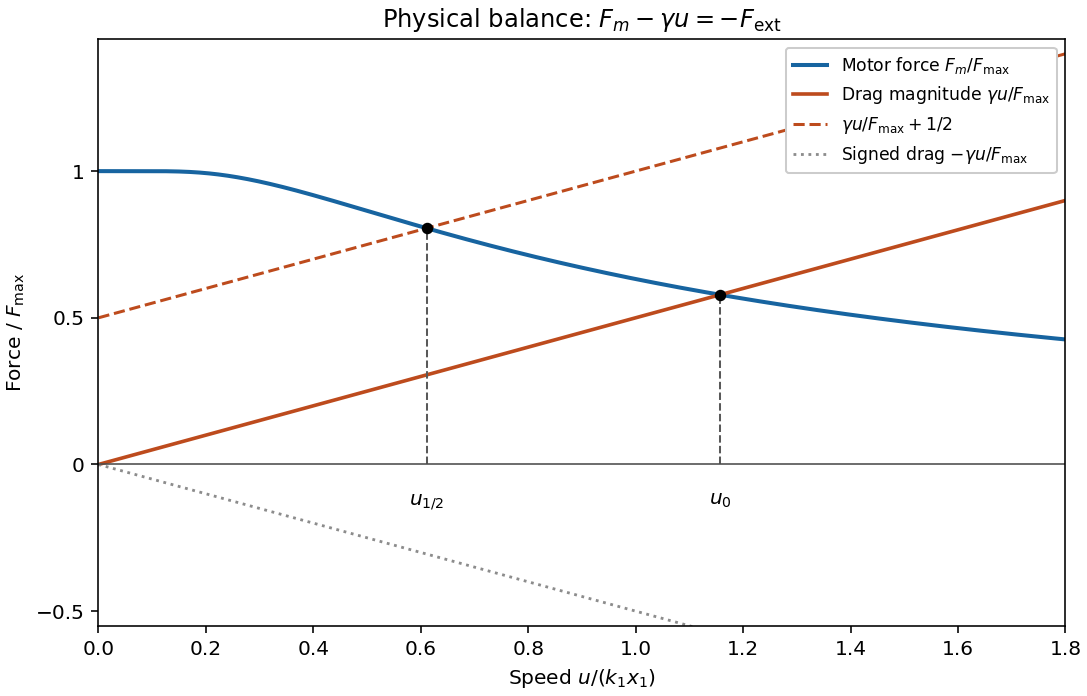
Sign inconsistency in the printed force balance. For a positive viscous drag coefficient , the signed drag force is . The printed cannot give the requested positive no-load contraction speed: both last terms are positive when . With , the left side starts at and may have zero, one or two positive roots depending on parameters; the requested usual load construction is not implied by that equation.
The physical linear-drag load curve for a spatially gated motor usesOn the same axes plot the positive drag magnitude and the decreasing motor force . The no-load speed is their intersection. For opposing load , intersect with the parallel raised line ; equivalently intersect with . Drop verticals to the speed axis. The loaded speed obeys . Each intersection is unique because decreases and increases. The signed drag is also indicated below the axis in the sketch.
Past exam of the flows, fluctuations and complexity and symmetry and relativity paper of Part B of the physics course of the University of Oxford 2011 4 2 Solution by Codex 0 2026-10-25
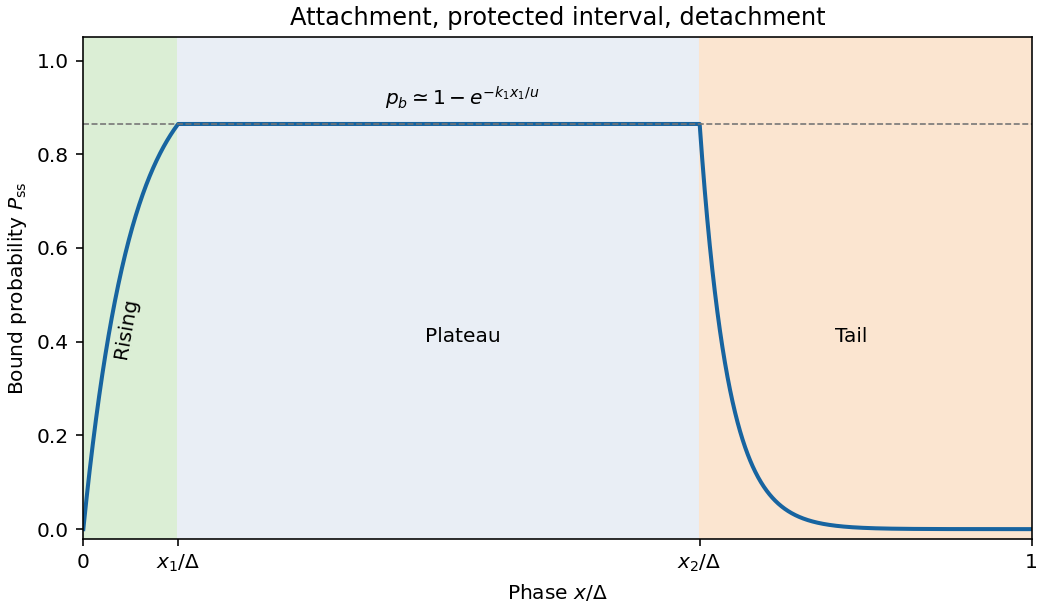
Codex 0 2026-10-25For a head sampling phases uniformly during steady sliding, its mean force is times the phase-average bound probability. In the limit of spatially gated myosin attachment, integrating the three intervals givesThe first integral is bounded by , and the last by . Relative to the plateau contribution, they are negligible when and , respectively. ThereforeThis is a constant-force spatially gated motor approximation: complete detachment between binding windows, a narrow attachment window, a short detachment tail and essentially fixed sliding velocity. In particular, need not be small.
Past exam of the flows, fluctuations and complexity and symmetry and relativity paper of Part B of the physics course of the University of Oxford 2011 4 1 Solution by Codex 0 2026-10-25
Codex 0 2026-10-25Take . Despite the source's terminology, is a dimensionless conditional bound-state probability at phase , not a spatially normalized probability density; the phase-average bound fraction is . The given equation has advection and binding reactions but no diffusion term. Large permits the prescribed steady approximation.
For spatially gated myosin attachment, define , , and . Continuity and periodicity give , , hence . The full periodic steady solution isThe requested limit makes , so and . The curve rises exponentially over the binding window, remains flat to , then decays over length to an exponentially small value before the next period. The piecewise expression is continuous at both switching points and at the period boundary.
Past exam of the flows, fluctuations and complexity and symmetry and relativity paper of Part B of the physics course of the University of Oxford 2011 3 4 Solution by Codex 0 2026-10-25
Codex 0 2026-10-25For an infinitesimal perturbation , , andThus the principal instantaneous stretching rates, called local Lyapunov exponents in the question, areFor , and , while . There are two instantaneously expanding orthogonal directions and one contracting direction. These are instantaneous norm-growth rates; the directions rotate along a trajectory, so this does not imply two positive long-time Lyapunov exponents or indefinitely exponential growth along fixed axes.
At , put . The eigenvectors and rates areThe condition makes the fastest-growing direction, faster than ; is the fastest-contracting direction. Both lie at to the axes.
Past exam of the flows, fluctuations and complexity and symmetry and relativity paper of Part B of the physics course of the University of Oxford 2011 3 3 Solution by Codex 0 2026-10-25
Codex 0 2026-10-25The Jacobian matrix of the Rössler system isAt the origin the vertical homogeneous perturbation obeys , so it decays as . Nearby, also relaxes the trajectory toward , close to the – plane. The small fixed-point value of weakly couples planar errors back into ; this is neglected in the requested approximation.
The planar block has trace and determinant , withFor , this is an unstable spiral. Writing and , its linearized trajectories have an envelope proportional to and angular frequency approximately . They rotate counterclockwise: at , . Fast vertical contraction occurs on scale , much shorter than the planar growth scale .
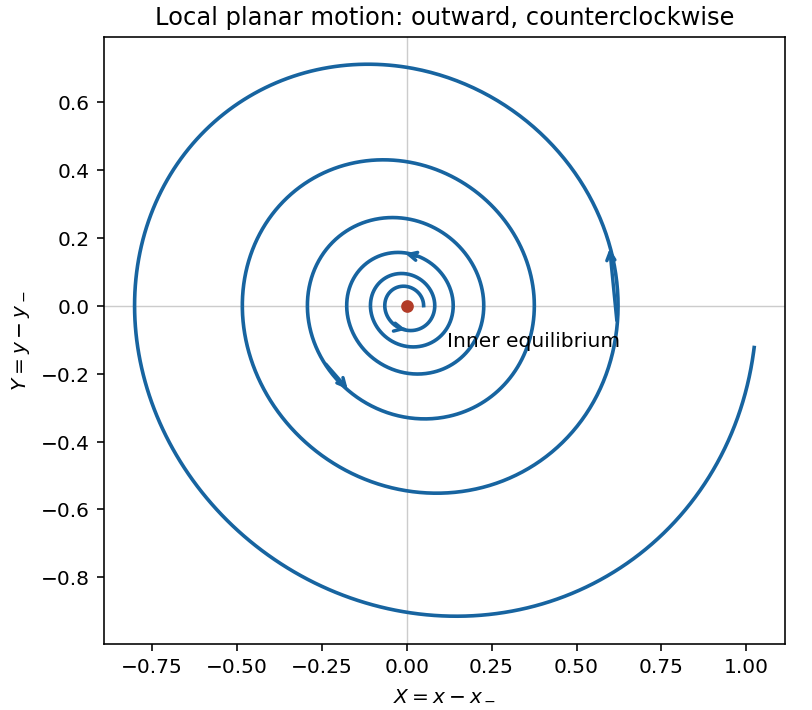


Confinement weakens as approaches from below; the approximate vertical relaxation time is , and the quasi-steady value ceases to be small. For , the coefficient of becomes positive, so vertical departures are amplified. The plane is never exactly invariant because there.
There are unlisted articles, also show them or only show them.