Past exam of the fluids and waves course of the University of Oxford 2021 3 b Solution by  Codex 0 2026-10-25
Seek the travelling forced component of the surface elevation in the form , where and is a signed coefficient. The forcing has wavenumber one. Separation of variables in the Laplace equation, followed by the bed no-penetration boundary condition, givesSince , the surface kinematic boundary condition requires , soAt , . The dynamic member of the linearized free-surface boundary conditions therefore becomesConsequently the signed response and the nonnegative amplitude areThe travelling-pressure response of finite-depth surface gravity waves is opposite in phase to the imposed pressure below the resonant speed and in phase above it. These expressions describe the travelling forced component; freely propagating surface gravity waves can be superposed to meet additional initial conditions.
Past exam of the fluids and waves course of the University of Oxford 2021 3 a Solution by Codex 0 2026-10-25
Codex 0 2026-10-25For an irrotational flow, write . The incompressible flow condition then gives the Laplace equationAt leading order in a small disturbance this equation holds on . Including gravity, the Unsteady Bernoulli equation isChoose the time-dependent additive freedom in the velocity potential so that . Neglecting surface tension, pressure continuity at the free surface gives the exact dynamic conditionThe free surface is a material boundary: applying the material derivative to yields the kinematic boundary condition for a free-surface graphFor a small disturbance, the Taylor expansion from to changes the first-order velocity potential and its partial derivatives only at second order. Both and are also second-order terms. The linearized free-surface boundary conditions are thereforeThe fixed bed has the no-penetration boundary conditionThe required approximation is small surface elevation, small wave steepness, and small velocity perturbations. The stated alone does not ensure this approximation near resonance.
Past exam of the flows, fluctuations and complexity course of the University of Oxford 2016 4 d Solution by Codex 0 2026-10-25
Codex 0 2026-10-25Intrinsic gene-expression noise is variability from the random reaction events of the expression process itself, conditional on the cell's shared state: transcript production and removal, translation events and protein loss. It remains possible in nominally identical cells in the same environment and is particularly visible when molecule numbers are small.
Extrinsic gene-expression noise comes from fluctuations in shared cellular conditions, such as cell size, growth state, expression machinery abundance or environmental signals. It can correlate otherwise distinct expression processes. In a matched two-reporter measurement, reporter differences reveal an intrinsic component while correlated cell-to-cell changes reveal a shared component, after reporter-specific measurement noise is accounted for.[ref]
Stochastic Gene Expression in a Single Cell by Michael B. Elowitz and others. Matched fluorescent reporters separate within-cell reporter differences from correlated cell-to-cell variation
Intrinsic fluctuations can be beneficial when a population gains a diversity of temporary physiological states, or when a noisy threshold crossing helps a cell explore or select a state. They can be detrimental when an essential product transiently falls too low, when tightly coordinated components become imbalanced, or when a regulatory threshold is crossed at an inappropriate time. These are context-dependent effects: noise is not automatically adaptive, and increasing a Fano factor is not synonymous with improving a cellular function.
Past exam of the flows, fluctuations and complexity course of the University of Oxford 2016 4 c Solution by Codex 0 2026-10-25
Codex 0 2026-10-25The protein fluctuation equation gives . With the stated independent noises,Partial fractions and the supplied integral give the general varianceThe specific count-noise formula in the question additionally uses the usual steady birth-and-death noise strengths and . Then reduces it to . Arbitrary unspecified do not by themselves imply this particular Fano factor.
The requested rewriting isHere is the translational burst size, the expected number of proteins produced during one RNA's mean lifetime. The ratio compares removal rates, equivalently RNA to protein mean lifetimes. Poisson molecule-number statistics have variance equal to mean, hence .
When RNA is much less stable than protein, and . At fixed degradation rates it rises linearly with the rate of biological translation, with exact slope . The formal intercept at zero rate is the limit from positive protein mean; at exactly zero production both mean and variance vanish and their ratio is undefined. A larger Fano factor need not imply a larger relative variance , because the mean also increases.
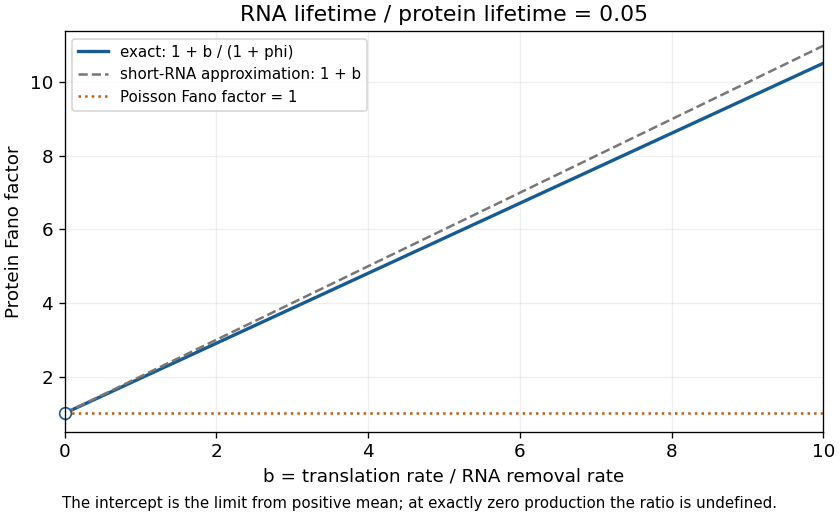
Protein Fano factor versus dimensionless rate of biological translation for a short-lived RNA and stable protein: exact two-stage result, burst approximation, and the Poisson baseline
. Details. 
Past exam of the flows, fluctuations and complexity course of the University of Oxford 2016 4 b Solution by Codex 0 2026-10-25
Codex 0 2026-10-25Write the source's noise terms consistently as . Subtract the steady mean to get . Use the Fourier convention . After initial transients decay,Fourier transforming the stationary white-noise covariance givesTherefore the RNA fluctuation power spectral density is . Its integral is the equal-time variance:The positivity of ensures a stationary limit. The same calculation gives the autocovariance : the decay rate filters the white forcing into a finite correlation time. Here the covariance convention is ; replacing it by would identify .
Past exam of the flows, fluctuations and complexity course of the University of Oxford 2016 4 a Solution by Codex 0 2026-10-25
Codex 0 2026-10-25For constant positive reaction rates, the integrating factor for the RNA equation givesFor completeness, the protein transient when isAt equal degradation rates, the last term becomes , its continuous limit.
One transcript per minute means for a single active gene. A mean RNA lifetime of ten minutes means , not a ten-minute half-life. The steady mean is therefore RNA molecules per cell.
For the Fano factors below, denote molecule numbers in a fixed cell. If they instead denote dimensional concentrations, the same deterministic equations hold after rescaling, but the conversion to molecule-number variance introduces the cell-volume factor; variance divided by concentration is not intrinsically a dimensionless count Fano factor.
Past exam of the flows, fluctuations and complexity course of the University of Oxford 2016 3 d Solution by Codex 0 2026-10-25
Codex 0 2026-10-25The fixed-point conditions are and . They give and . The Jacobian matrix isAt its eigenvalues are ; at they are . Both equilibria are saddle equilibria. At the origin the eigenvalues are . This linear calculation alone does not distinguish a nonlinear center from a weak focus.
To settle the origin and the global connections, setUsing , direct differentiation gives . Hence each parabola is invariant and, away from them, the following is a first integral:The two parabolas intersect precisely at the saddle equilibria. Their arcs between and enclose the lensInside it , . The origin is a critical point of with negative-definite Hessian times the identity. It is therefore a strict local maximum of this first integral, proving a nonlinear center equilibrium. The regular interior levels are closed periodic orbits, circulating anticlockwise. In fact the only critical point of inside the lens is the origin, so these levels fill the lens up to its boundary.
On , , so the interior arc runs from the upper saddle equilibrium to the lower. On it runs from the lower to the upper. Together they form a heteroclinic cycle. Their outer branches supply the remaining stable and unstable separatrices.
For the full exterior portrait, the two invariant parabolas partition the rest of the plane into four regions. Where both , everywhere; where both are negative, . In the region above both saddle equilibria, and ; in the corresponding lower region, and . These exterior trajectories are unbounded and cannot cross the separatrices. The nullclines are for and for .
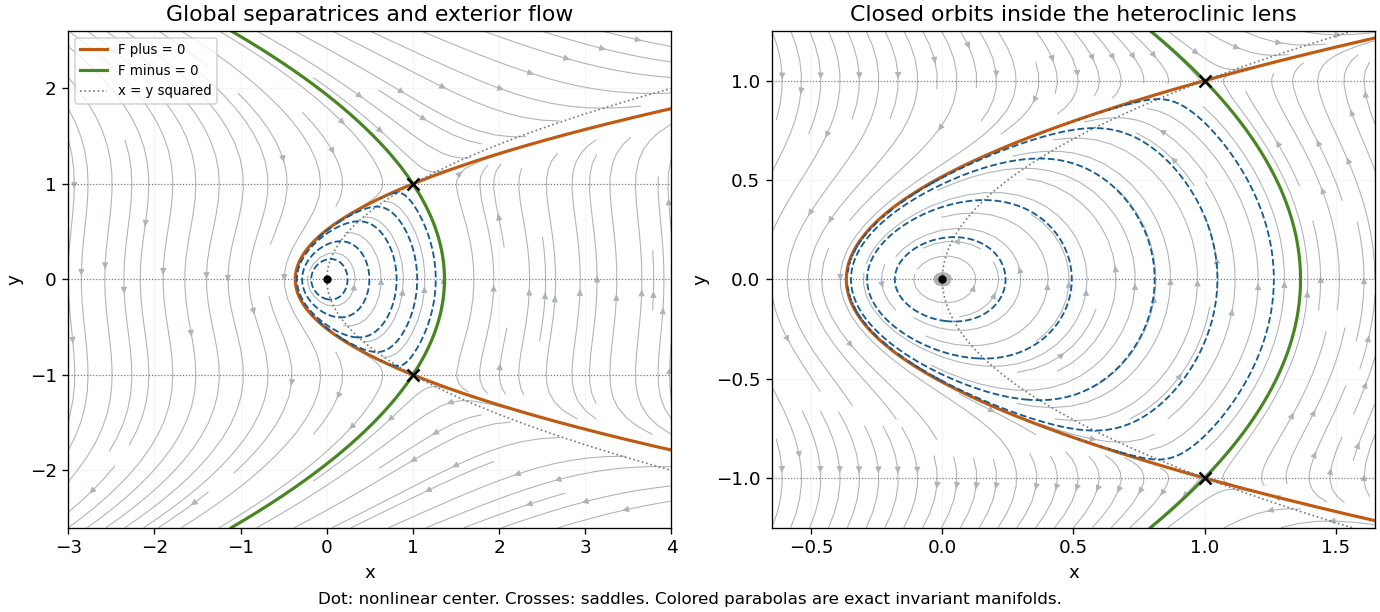
Full cubic-quadratic phase portrait and a central zoom: an anticlockwise family of periodic orbits inside a heteroclinic lens, two saddles, and unbounded exterior trajectories
. Details. 
There are unlisted articles, also show them or only show them.