Past exam of the flows, fluctuations and complexity course of the University of Oxford 2016 3 c Solution by  Codex 0 2026-10-25
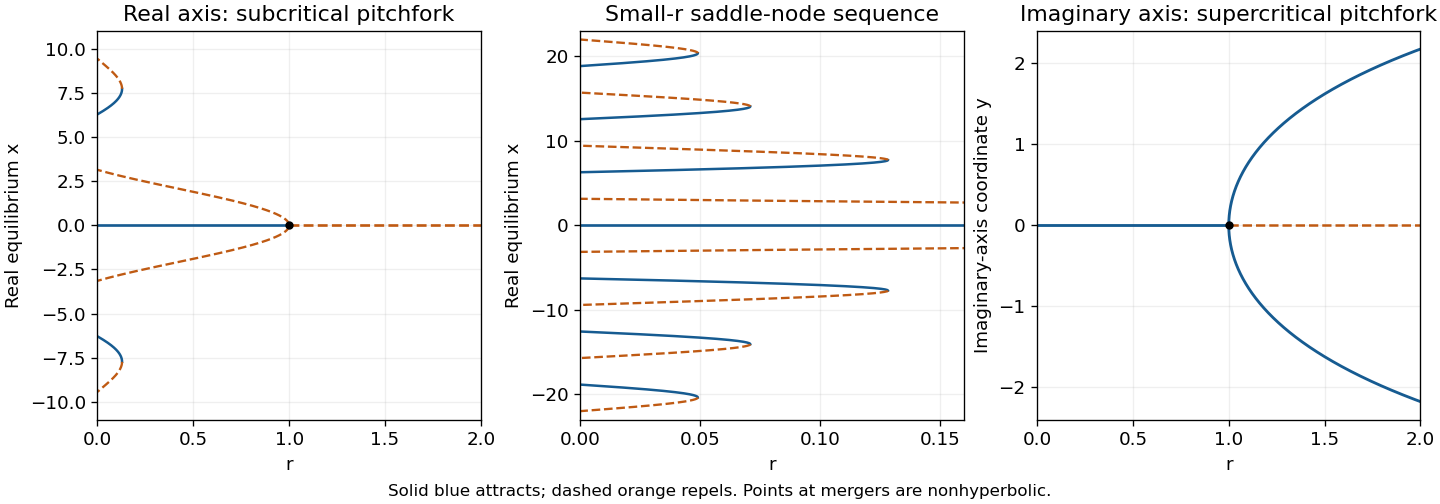
Restrict the complexified equation to the imaginary axis by writing its coordinate as with real . Transform the left-hand side as well: . Thus the real equation along that axis isFor , away from zero, so the origin is the only equilibrium point and is attracting. At the leading term is , so it remains attracting with algebraic, rather than exponential, relaxation.
For , the origin becomes repelling and a unique pair appears, where . Each nonzero root is attracting, since . Close to the threshold,This is a supercritical pitchfork bifurcation, opposite to the real-axis case. The hyperbolic sine confines large real rather than producing an infinite sequence of oscillatory lobes.

Past exam of the flows, fluctuations and complexity course of the University of Oxford 2016 3 b Solution by Codex 0 2026-10-25
Codex 0 2026-10-25For , the origin always exists. Its derivative makes it attracting for and repelling for . Nonzero equilibria solveThey occur in symmetric pairs. On the first positive lobe , the sinc function decreases from one to zero, giving one positive and one negative nonzero equilibrium for . Both are repelling, since there. Near ,The unstable branches meet the stable origin in a subcritical pitchfork bifurcation. At the origin is still nonlinearly repelling because the leading term is . For it is the only equilibrium.
For each higher positive-sine lobe , , the sinc function has a single positive maximum at , whereIf , that lobe has two roots: the smaller positive root is attracting and the larger is repelling, because . Their negative counterparts have the same stability. At the pair on each side merges in a saddle-node bifurcation; the double equilibria are semistable. For that lobe contributes none. The first such threshold is about .
For , put ; expanding near the sine maximum gives and . Away from bifurcation values, the exact counting rule for and its small- estimate areAt a saddle-node threshold, count each merged positive or negative equilibrium once rather than twice. Infinitely many thresholds accumulate at , consistent with the infinitely many equilibria in solution.
Past exam of the flows, fluctuations and complexity course of the University of Oxford 2016 3 a Solution by Codex 0 2026-10-25
Codex 0 2026-10-25For , the equilibrium points satisfy , so for every integer . The derivative of the vector field is . ThusBetween an odd multiple and the next even multiple the sine is negative, so the flow points right; between that even multiple and the next odd multiple it points left. A compact phase-line sketch isEvery initial condition strictly between two adjacent repelling points approaches the even multiple between them. The repelling equilibria themselves remain fixed if initialized exactly there.
Past exam of the flows, fluctuations and complexity course of the University of Oxford 2016 2 e Solution by Codex 0 2026-10-25
Codex 0 2026-10-25Define for positive thickness. Its derivative is , so its maximum is attained at and equals . At , the equation requires , proving the necessary condition .
It is also sufficient for a continuous finite periodic branch. On , increases monotonically from to , so every value in the required range has exactly one root on this branch. It joins where . The second large-thickness root on the ascending side does not extend to a finite periodic branch through those points.
Thus the limiting maximum thickness occurs at the ascending point of the critical film:Subcritical films satisfy a strict thickness bound there. Equivalently the largest carried flux and critical absolute thickness areThe mechanism is a transport capacity limit: wall transport grows only as , while opposing gravitational drainage grows as . At the critical point, adding thickness no longer increases the upward flux. Indeed on the steady branch and vanishes at . Excess liquid cannot be maintained as this globally wall-entrained film and must redistribute or drain.
The algebra establishes existence and the limiting branch of the steady lubrication model. A full temporal free-surface stability result requires its time-dependent equation and, when relevant, pressure and capillary corrections; the sign of alone is not a proof of growth of perturbations.
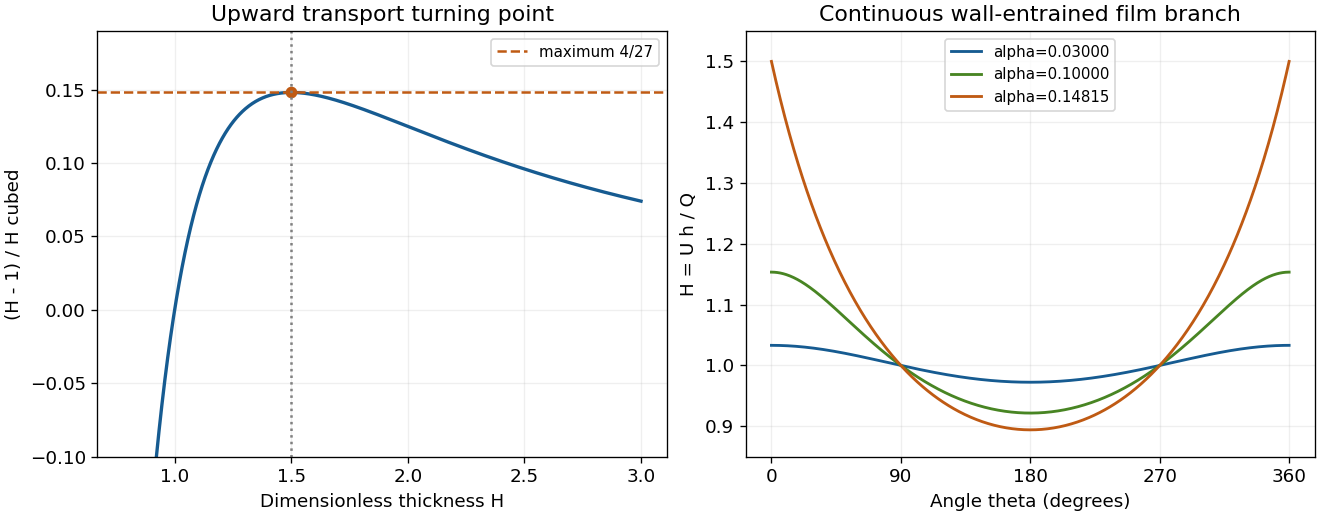
Turning point of the coating-film flux relation and the continuous thin-film profiles approaching the critical value alpha = 4/27
. Details. 
Past exam of the flows, fluctuations and complexity course of the University of Oxford 2016 2 d Solution by Codex 0 2026-10-25
Codex 0 2026-10-25Seek the branch continuous from a uniformly wall-advected film, . Expanding either the flux equation or the left-hand side givesEquating this to one yields , henceThe film is thicker on the ascending side, where a reduced mean fluid speed must be compensated by greater thickness to carry the same flux. It is thinner on the descending side, where gravity assists the wall motion. The approximation is uniformly small only while , not near the critical turning point discussed next.
Past exam of the flows, fluctuations and complexity course of the University of Oxford 2016 2 c Solution by Codex 0 2026-10-25
Codex 0 2026-10-25Integrate the profile over the thickness:This is a volume flux per unit axial length. In a steady layer with no evaporation, sources or axial variation, mass conservation gives to leading lubrication order. Therefore is constant around the cylinder even though the local speed and thickness vary.
Past exam of the flows, fluctuations and complexity course of the University of Oxford 2016 2 b Solution by Codex 0 2026-10-25
Codex 0 2026-10-25Let the cylinder radius be , with and slowly varying thickness. Arc length is , with increasing following the upward-moving surface at the right-hand side. Gravity has tangential component . In the leading thin-film balance, normal viscous gradients dominate tangential ones, curvature corrections are small, and the longitudinal hydrostatic-pressure gradient is smaller by the aspect ratio. Neglect capillary-pressure gradients and imposed gas shear. The tangential Stokes balance is thenThese assumptions also require that inertia and curvature effects from rotation remain small on the thin-film scale; an arbitrary high-speed coating need not obey this equation.
No-slip at the solid wall and negligible shear stress at the free surface giveTwice integrating the constant normal forcing determines the two integration constants:The profile is most strongly retarded by gravity on the ascending side. The surface velocity is , not generally equal to the wall speed.
Past exam of the flows, fluctuations and complexity course of the University of Oxford 2016 2 a Solution by Codex 0 2026-10-25
Codex 0 2026-10-25For an incompressible Newtonian fluid at low Reynolds number, the quasi-steady Stokes equations areThe first equation expresses local conservation of volume for constant density; the second balances pressure, viscous stresses and body force with negligible inertia. Convective inertia is negligible when at the relevant flow scale. Quasi-steady flow also requires the viscous diffusion time to be short compared with the evolution time. Low convective Reynolds number alone does not justify neglecting a rapidly oscillating unsteady acceleration.
For a thin layer, slenderness further changes the comparison of longitudinal and transverse derivatives; these scalings, as well as low inertia, are needed for lubrication theory.
Past exam of the flows, fluctuations and complexity course of the University of Oxford 2016 1 e Solution by Codex 0 2026-10-25
Codex 0 2026-10-25The flow is steady and irrotational, so the Bernoulli equation has the same constant throughout the connected exterior. Far from the sphere it equals . On the surface the speed is , givingThe maximum stagnation pressure is at both poles. At the equator, where the flow is fastest, the pressure is . The fore-aft symmetry gives zero integrated pressure drag in this inviscid model, the content of D'Alembert's paradox; it does not predict zero drag for a real viscous separated flow.
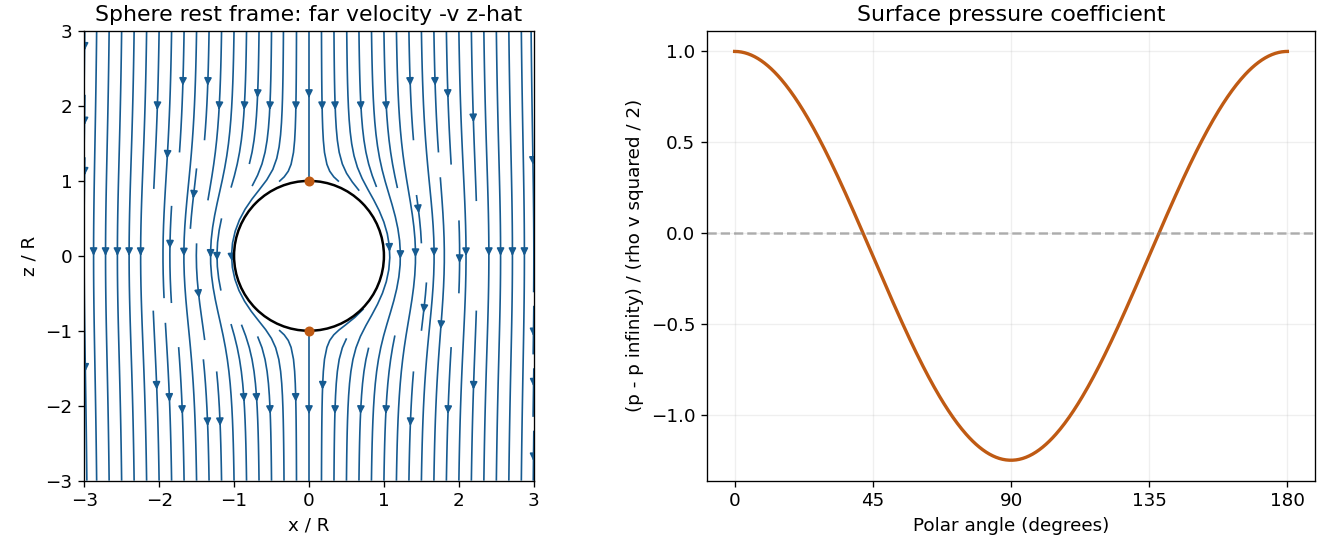
Original streamlines around a sphere in its rest frame and the associated surface-pressure coefficient; the far flow is downward along negative z
. Details. 
Past exam of the flows, fluctuations and complexity course of the University of Oxford 2016 1 d Solution by Codex 0 2026-10-25
Codex 0 2026-10-25On the surface, and . The only surface stagnation points are thereforeThere are no other stagnation points in the exterior: away from the axis the polar component is nonzero, and on the axis the radial component vanishes only at .
Near the front point put . Expanding the potential from solution givesso the linear velocity field is . This agrees with solution for .
At the rear point, using instead, the quadratic term has the opposite sign: . Incoming axial flow and tangential outflow at the front become tangential inflow and axial outflow at the back. The local streamline geometry is unchanged while its direction reverses.
Past exam of the flows, fluctuations and complexity course of the University of Oxford 2016 1 c Solution by Codex 0 2026-10-25
Codex 0 2026-10-25Choose the positive direction along the sphere's laboratory velocity . In its rest frame the far-field fluid velocity is . Therefore the far-field potential is . The impermeable sphere imposes at . The monopole coefficient vanishes because the sphere is not a source or sink, and the dipole coefficient follows from the wall condition:ThusThe regular exterior boundary value problem has no forced higher multipoles; uniqueness fixes their coefficients to zero. Differentiating givesHere is the polar velocity component. An equivalent Cartesian form isOnly no-penetration, not no-slip, is appropriate to this ideal inviscid solution. The sphere density does not enter the velocity field for an externally prescribed constant speed.[ref]
Past exam of the flows, fluctuations and complexity course of the University of Oxford 2016 1 b Solution by Codex 0 2026-10-25
Codex 0 2026-10-25Put the stagnation point at the origin and the local tangent plane at . A regular Taylor expansion has no linear term because . The impermeable tangent plane imposes at to leading order, excluding mixed quadratic terms . For the illustrated axisymmetric approach, rotational symmetry in the tangent plane makes the and coefficients equal and removes . Finally the Laplace equation fixes the normal coefficient to minus twice the tangential one. Up to an irrelevant additive constant,For incoming flow from , . This is a local leading form under the stated symmetry, not the exact universal potential near every possible wall stagnation point; a generic tangential strain can have unequal principal rates.
A streamline solves , , , hence , , . Eliminating the parameter givesEach streamline lies in a meridional plane. With cylindrical radius , its shape is . The symmetry axis and wall are limiting invariant streamlines. A particle exactly on the incoming axis approaches the stagnation point asymptotically.
Past exam of the flows, fluctuations and complexity course of the University of Oxford 2016 1 a Solution by Codex 0 2026-10-25
Codex 0 2026-10-25An irrotational flow satisfies . On a simply connected region, or locally on any small regular region, this gives a velocity potential with . The incompressibility condition is , soThus the potential is a harmonic function. The locality qualification matters: a curl-free circulation around an excluded vortex core need not admit a globally single-valued potential. No such circulation is needed for the sphere flow below.
Past exam of the flows, fluctuations and complexity and symmetry and relativity paper of Part B of the physics course of the University of Oxford 2011 8 4 Solution by Codex 0 2026-10-25
Codex 0 2026-10-25Covered by the official notes: rocket-frame electric and magnetic fields, proper three-force and proper acceleration (PDF p. 16; handwritten p. 11).[ref]
Symmetry and Relativity 2011 Exam Solution Notes. PDF p. 16; handwritten p. 11: rocket-frame electric and magnetic fields, proper three-force and proper acceleration
Past exam of the flows, fluctuations and complexity and symmetry and relativity paper of Part B of the physics course of the University of Oxford 2011 8 3 Solution by Codex 0 2026-10-25
Codex 0 2026-10-25Covered by the official notes: explicit field contraction and Lorentz invariance as a tensor scalar (PDF pp. 15–16; handwritten pp. 10–11).[ref]
Symmetry and Relativity 2011 Exam Solution Notes. PDF pp. 15–16; handwritten pp. 10–11: explicit field contraction and Lorentz invariance as a tensor scalar
Past exam of the flows, fluctuations and complexity and symmetry and relativity paper of Part B of the physics course of the University of Oxford 2011 8 2 Solution by Codex 0 2026-10-25
Codex 0 2026-10-25The official notes state only (PDF p. 15, handwritten p. 10); they do not evaluate the requested coefficients. For a boost along positive , use , , with the transverse diagonal entries equal to one. Multiplying the specified electromagnetic field tensor givesThe corresponding Lorentz transformation of electromagnetic fields isConsequentlyThese coefficients depend on the frame speed, but are constant for the fixed boost.
Past exam of the flows, fluctuations and complexity and symmetry and relativity paper of Part B of the physics course of the University of Oxford 2011 8 1 Solution by Codex 0 2026-10-25
Codex 0 2026-10-25Covered by the official notes: definitions of four-force and four-velocity and the vanishing antisymmetric contraction (PDF p. 15; handwritten p. 10).[ref]
Symmetry and Relativity 2011 Exam Solution Notes. PDF p. 15; handwritten p. 10: definitions of four-force and four-velocity and the vanishing antisymmetric contraction
To make the necessity statement precise, mass preservation must hold for every allowed timelike four-velocity, with the same field tensor and nonzero charge. It is not necessary for one prescribed trajectory alone. Use metric signature , so . Put . The mass-preservation condition requires the quadratic form for every timelike . Every timelike vector can be rescaled to a physical four-velocity; by homogeneity the quadratic form vanishes on the open timelike cone. A polynomial vanishing on an open set is identically zero, so . Thus the electromagnetic field tensor must be antisymmetric under this universal quantifier. For a single velocity, the scalar contraction can vanish even for a nonzero symmetric part, which is why the quantifier is essential.
Past exam of the flows, fluctuations and complexity and symmetry and relativity paper of Part B of the physics course of the University of Oxford 2011 7 4 Solution by Codex 0 2026-10-25
Codex 0 2026-10-25Covered by the official notes: charge field-line sketches at rest and in motion, field anisotropy, and relation to the two spring orientations (PDF pp. 13–14; handwritten pp. 8–9).[ref]
Symmetry and Relativity 2011 Exam Solution Notes. PDF pp. 13–14; handwritten pp. 8–9: charge field-line sketches at rest and in motion, field anisotropy, and relation to the two spring orientations
There are unlisted articles, also show them or only show them.