Past exam of the mathematical methods I course of the University of Oxford 2016 10 Solution by  Codex 0 2026-10-25
Expanding and equating coefficients gives , . ThusThe two-argument arctangent fixes the quadrant; if , the phase is arbitrary.
For the coupled ordinary differential equations, set . The first equation becomes , and the initial values give . The second then reduces to . Its initial value problem has solutionWhere , reconstruct . The scalar function is smooth for every real , but the original coupled system cannot have a finite at its first zero, about . The requested sketch up to can display the analytic continuation of , with that distinction marked. Initially , and ; it first rises, reaches a maximum, then decreases through zero and becomes negative within the plotted interval.
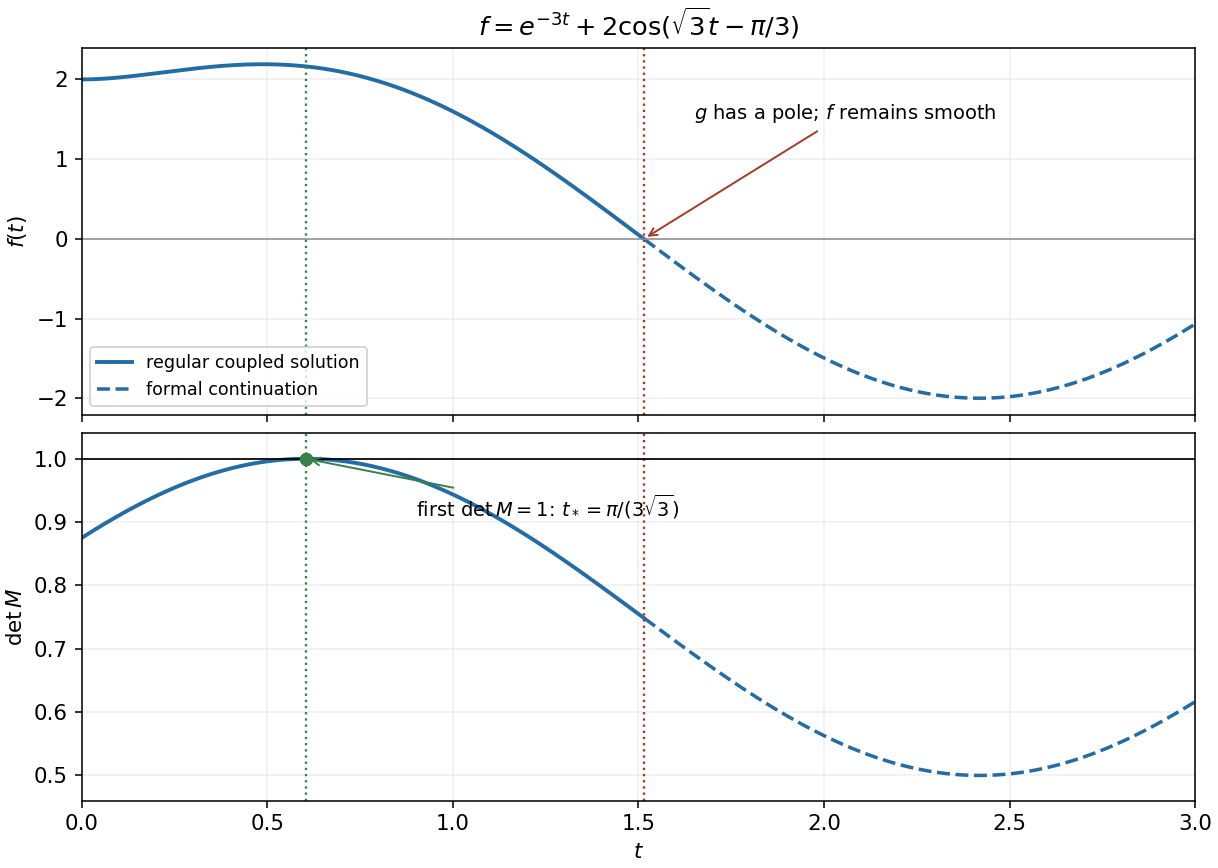
The scalar solution and matrix determinant, with the first regular rotation time and the later pole in the reconstructed variable
. Details. 
For the determinant of , separate its upper-left block from the constant last diagonal entry. Using givesThus precisely when . The smallest positive solution isIt occurs before the zero of , so and are finite there. Put . At this time the upper block isFor a rotation matrix, each column must have unit norm, giving . Both signs are allowed by the stated assumption that is a constant:Both have determinant and preserve lengths. If a positive is intended, only the first row remains; positivity is not stated in the question.
Past exam of the mathematical methods I course of the University of Oxford 2016 resit 7 Solution by Codex 0 2026-10-25
Codex 0 2026-10-25For a diagonal matrix, each diagonal entry separately obeys . Hence all four possibilities areFor the second form, givesBecause are linearly independent and , the coefficient forces ; the coefficient then gives . ThusBoth constants are nonzero, as required.
Past exam of the mathematical methods I course of the University of Oxford 2016 resit 6 Solution by Codex 0 2026-10-25
Codex 0 2026-10-25A plane through the three points also contains the origin exactly when their position vectors are linearly dependent. The scalar triple product isThus . The resulting plane is , which contains all three points and the origin. The points are not collinear: the differences and cannot be proportional, since their last two components would require . Therefore the plane used in the argument is well defined.
Past exam of the mathematical methods I course of the University of Oxford 2016 resit 5 Solution by Codex 0 2026-10-25
Codex 0 2026-10-25Rearrange as and put . The resulting linear differential equation is , soThe initial condition gives . Its graph is a Gaussian function above the horizontal asymptote , symmetric about , with its maximum there. It rises for and falls for , since .
Past exam of the mathematical methods I course of the University of Oxford 2016 resit 4 Solution by Codex 0 2026-10-25
Codex 0 2026-10-25Choose the cylinder centre's initial position as the coordinate origin, with downhill motion to the right and . For rolling without slipping, the clockwise angular speed is . A point initially vertically above the axis therefore hasA different origin adds constant coordinates without changing the following velocity test. Setting gives and .
For strictly upward motion, and . The first condition fixes ; choose the negative sine branch to maximize . Positivity then requiresAt the relevant point is momentarily stationary, not moving upward. Thus a material point inside or on an ordinary cylinder cannot move exactly vertically upward in this motion. The mathematical extension describes the looping trochoid of a point beyond the rolling radius, illustrated in the figure.
Past exam of the mathematical methods I course of the University of Oxford 2016 resit 3 Solution by Codex 0 2026-10-25
Codex 0 2026-10-25Let , and . For distinct centres, the two spherical surfaces intersect exactly whenStrict inequalities give a nondegenerate circle; equality gives a single tangency point. If , equal radii give coincident spheres and unequal radii give no intersection, so the circle-centre formula below does not apply.
Subtracting the squared sphere equations gives the radical planeThe centre of the circle of intersection of two spheres is the projection of either sphere centre onto this plane. Write ; substitution gives and henceThe circle radius squared is , providing another check of the intersection conditions.
Past exam of the mathematical methods I course of the University of Oxford 2016 resit 2 Solution by Codex 0 2026-10-25
Codex 0 2026-10-25Expanding the determinant along its first row givesThe required factorization isEach factor is a symmetric polynomial. The second is , making its permutation symmetry especially transparent. This factorization holds over both real and complex coefficients.
There are unlisted articles, also show them or only show them.