
For a simplex in a simplicial complex , its link consists of the simplexes disjoint from whose union with is a simplex of :This is a simplicial subcomplex, because taking a nonempty face preserves both conditions. At a vertex of a closed combinatorial surface its link is a cycle graph; at a boundary vertex in a triangulated surface with boundary it is a graph path. Geometrically, the incident triangles form a cyclic fan or a fan with two ends. Deleting one incident triangular face from a cyclic fan changes the vertex link into a path.
The performance difference between spatially incompatible and compatible trials in a Simon task. A group difference in overall reaction time is distinct from a group difference in this conflict cost.
A rule or boundary converting internal evidence into a response, such as reporting a signal when . Changing the criterion can change hits and false alarms without changing the separation of the underlying evidence distributions. A measured response threshold is therefore not automatically a pure measure of sensory sensitivity.
Under an equal-variance Gaussian evidence model, is separation of signal and noise means in units of their common standard deviation. A yes/no task gives , where and are hit and false-alarm probabilities. This formula assumes the model; it does not define every possible sensory-discrimination measure.
The ability to discriminate stimulus classes, conceptually distinct from the decision criterion determining which response is selected. A higher frequency of fear judgments can reflect a criterion shift without better discrimination.
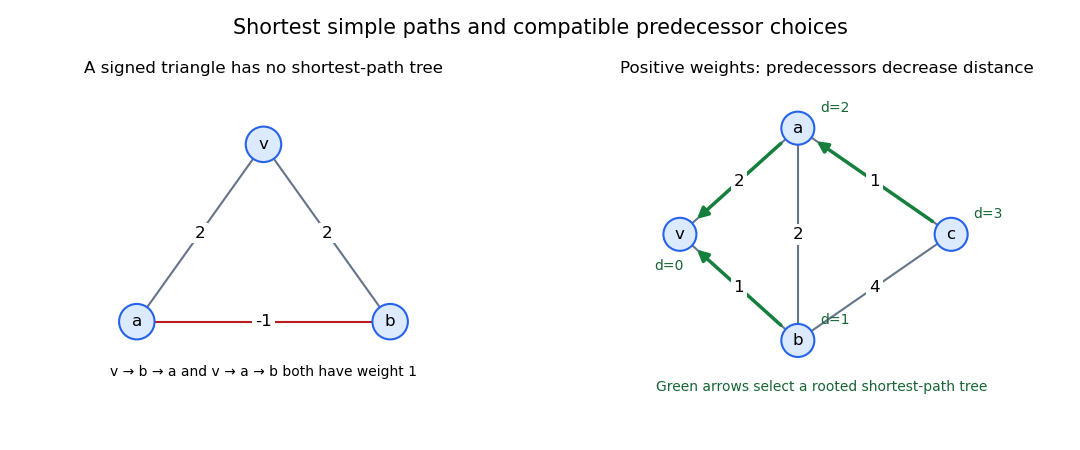
A shortest-path tree rooted at a source vertex is a spanning tree whose unique tree route from the source to every vertex solves the shortest path problem in the original weighted graph. Dijkstra's algorithm constructs one for a finite connected graph with nonnegative edge lengths, recording a predecessor whenever a distance improves. It need not be a minimum spanning tree: one minimizes each source-route length, the other the total weight of the tree's edges.

Unlike the sum in the usual shortest path problem, the bottleneck cost of a nonempty graph path is its largest edge weight. The optimum is the smallest threshold at which the endpoints become connected by edges of weight at most that threshold. For a finite undirected graph, sorting edges and increasing the threshold, with a disjoint-set data structure maintaining components, finds this value. In the same undirected setting, the minimax path property of a minimum spanning tree provides a single tree representing such optimal routes for every pair of vertices.
Suppose two pieces occupy a common connected component of a graph in an unweighted undirected graph. For integers , in each round an evader moves at most edges, then a pursuer moves up to edges along a shortest path to the new evader position, stopping upon capture. Let be their finite graph distance at a surviving round boundary.
The triangle inequality bounds the separation after the evader moves by . If that separation is at most , the pursuer captures it. Otherwise the pursuer reduces it by exactly , givingHence every surviving history has at most rounds. With a finite branching factor, the surviving search tree is finite and depth-first tree search becomes a complete search algorithm. This does not make its first goal optimal for arbitrary rewards. Initial reachability is essential: an infinite graph distance supplies no decreasing finite bound.
For a graph on vertices with all edge weights in , every minimum-weight shortest path has the smallest possible number of edges. Indeed, positivity permits a simple optimum, and a simple -edge path weighs at most for , while any path with more edges weighs at least . A breadth-first search followed by weighted dynamic programming along increasing-hop edges therefore solves the single-source problem in time. Choosing an arbitrary breadth-first tree alone is insufficient: equal-hop routes may still have different weights.
In a finite graph with positive integral edge weights, replacing by makes every transformed shortest path minimise original weight first and edge count second. Positive weights imply that an optimal route is simple, with at most edges. Original integral path weights that differ have a gap of at least one; multiplication by outweighs every possible difference in simple-path edge counts. Among equal-weight paths, only the added edge count differs. Thus a single ordinary shortest path computation solves lexicographic weight-and-hop minimisation.
Let be the minimum weight of a route from a fixed source to using at most edges; repeated vertices are permitted. Initialise to zero at the source and infinity elsewhere. Every feasible route either already uses at most edges or appends one edge to such a route, proving the displayed dynamic programming recurrence. Reading exclusively from the previous row enforces the edge budget. Negative cycles cause no unbounded objective because the budget is finite. Each round scans all edges, costing when only edge-incident vertices and the specified endpoints are processed. With nonnegative weights, cycle removal gives an equally good or better simple path within the budget.
In a positive-weight directed graph, run the Dijkstra algorithm from each source and minimize over closing edges. In an undirected graph, minimize only over edges absent from the current shortest-path tree. A tree edge would otherwise give a spurious traversal out and back. A non-tree candidate contains a genuine cycle no longer than its score, even when the two tree routes share a prefix.
For the undirected optimum, choose a shortest cycle and a source on it. If an incident cycle edge is absent from the tree, its candidate is bounded by the cycle length. Otherwise its two neighbours lie in distinct tree branches, and some edge on the remaining cycle segment crosses branches. That edge is non-tree; shortest distances to its endpoints are bounded by the two complementary cycle segments, again giving a candidate no greater than the optimum. Thus the minimum candidate equals the shortest-cycle length. Repeated Dijkstra algorithm runs take running time with a binary heap.
Temporary retention of verbal material. Auditory presentation, phonological coding, rehearsal and output requirements can contribute differently to a measured span.
Membership means that for every index there is a later with , equivalently membership for infinitely many indices. If , countable subadditivity gives . This is the measure form of the first Borel-Cantelli lemma, and requires no independence assumption.
The set basis problem asks whether a finite set family can be generated by unions of at most basis subsets of . The basis sets need not belong to , and the empty union is allowed. For example, the three pairwise two-element subsets of have the singleton basis , although none of its members is an input set.
There are at most distinct unions of basis sets, so any yes-instance has , after duplicate input sets are discarded. Retain one representative of each class of incidence equivalence in a set family. There are at most representatives, because an element is described by its membership bits across . The equivalence-preserving deletion proof in incidence equivalence in a set family shows that this is a kernelization. Relabel the representatives and store the reduced incidence matrix; its length is bounded by a computable function of . To solve the reduced instance with elements, enumerate all ordered lists of basis subsets, padding smaller bases by empty sets. For each input set , take the union of all proposed basis sets contained in : it equals exactly when some allowable union represents . This finite search proves fixed-parameter tractability.
Two ground elements are incidence-equivalent when they belong to exactly the same members of a set family. Their incidence columns are identical. For the set basis problem, deleting one of two such elements preserves the answer. A basis before deletion can be restricted to the smaller ground set. Conversely, if remains and was deleted, lift each reduced basis set to when , and leave it unchanged otherwise. In every union of lifted basis sets, appears exactly when appears, which restores precisely the original input sets. Repeated deletion thus leaves one representative of every incidence class.
There are unlisted articles, also show them or only show them.