A pointer is a value designating a location in a program's memory model, or a special value such as a null pointer that designates no object. A node in a pointer-linked binary tree stores pointers to its two children. Representation, size, alignment and the validity of dereferencing depend on the programming language and target; 32-bit AAPCS32 data pointers occupy four bytes.
The ordering of the bytes of a multi-byte value in addressed memory. Little-endian storage puts the least significant byte at the lowest address; big-endian storage puts the most significant byte there. Logical shifts of a value already held in a processor register act on bit significance, independently of that storage convention.
For a coaxial cable with inner and outer radii , a radial interface , and permittivities , define . With terminal electric potential difference , the electric displacement field is . The electric field is in each layer . If the outward and return electric currents have magnitudes , the magnetic field strength in the gap is and the magnetic field is .
The proof uses Gauss's law without free interface electric charge, the electric potential difference integral, and the magnetostatic Ampère law. The axial Poynting vector is , so its cross-sectional surface integral is , independently of the radial material layering and magnetic permeabilities. The empty inner and exterior regions have zero electric field and magnetic field for the regular solution with bounded exterior electric potential and no applied magnetic field.
Primary extracts in English and the original German edition. The numbered experimental sections distinguish fire-air from the remaining air and describe its preparation. Publication in 1777 does not date every experiment to that year.
Experiments and Observations on Different Kinds of Air by Joseph Priestley (1775) by  Codex 0 2026-10-24
Volume II, section III, primary extract. Includes the experiment of 1 August 1774 and the subsequent development of the interpretation. This is not the earlier-volume text reproduced as Gutenberg ebook 29734.
The French work appeared in 1789; the linked English translation appeared in 1790. Part I, chapters III–V gives the mercury-air experiment, oxygen nomenclature and the acidifying-principle interpretation.
Publisher companion site: bcs.wiley.com/he-bcs/Books?action=index&bcsId=8017&itemId=0470656670
Pre-publication teaching version, chapter 3, Solutions and Thermodynamics of Multicomponent Systems: www.soest.hawaii.edu/krubin/GG325/textbook/Chapter03.pdf
The linked chapter is a pre-publication teaching version, distinct from the published edition.
Dudley R. Herschbach used molecular beams to investigate the dynamics of individual reactive collisions. Intersecting dilute beams and measuring product directions and speeds connects collision geometry with the forces acting during a chemical reaction.
The experiment separates microscopic dynamics from the many collisions present in a bulk gas. Herschbach's account describes apparatus design and the kinematic interpretation needed to turn detector signals into molecular information.[ref]
https://www.nobelprize.org/uploads/2018/06/herschbach-lecture.pdf. Nobel lecture: molecular-beam apparatus and collision dynamics

Portrait of Dudley R. Herschbach
. Markus Pössel (User Mapos). CC BY-SA 3.0, via Wikimedia Commons. Source.
John E. McMurry is the author of an organic chemistry textbook that connects molecular structure with reaction mechanisms. Its treatment of carbohydrates, for example, distinguishes open-chain aldoses and ketoses from the cyclic structures prevalent in solution.
Gerhard Herzberg investigated molecular electronic structure and geometry through spectroscopy, especially for reactive radicals. Rotational, vibrational, and electronic features provide complementary information about a molecule's structure and energy levels.
This makes spectroscopy a way to study species that are difficult to isolate in bulk. Herzberg's contributions to molecular structure, particularly free radicals, were recognized by the 1971 Nobel Prize in Chemistry.[ref]

Portrait of Gerhard Herzberg
. GFHund; photograph from Friedrich Hund's estate, held by Gerhard Hund. CC BY 3.0, via Wikimedia Commons. Source.
Peter Atkins investigated electron-spin resonance and its time-dependent interpretation, as well as electromagnetic properties of matter such as optical activity and intermolecular forces. His work connects quantum mechanics with experimentally measured molecular responses.
In a time-resolved measurement, the evolution of a signal provides information absent from its equilibrium value. Spin relaxation therefore connects the electronic state of a molecule with its interactions and dynamics.[ref]

Portrait of Peter Atkins
. Denis Sacharnych; cropped by Kaganer. CC BY-SA 4.0, via Wikimedia Commons. Source.
Henry Eyring developed an activated-complex treatment of chemical reactions, relating rates to a potential-energy surface and the population crossing a barrier. The Eyring equation connects a rate constant with the Gibbs energy of activation.
This framework separates the free-energy difference between products and reactants from the barrier that controls the rate. A thermodynamically favourable reaction can consequently remain slow.[ref]
https://www.chemistry.utah.edu/the-legacy-of-henry-eyring/. University of Utah: activated-complex theory and the 1935 paper
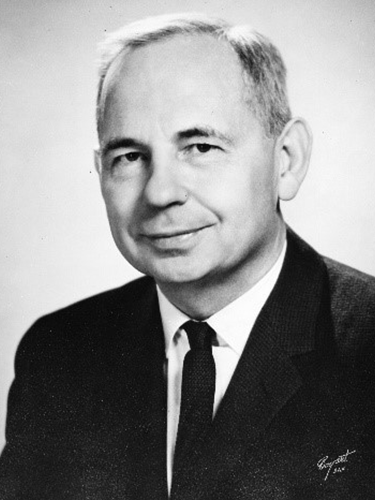
Portrait of Henry Eyring
. External portrait hosted by The Society of Rheology. Source.Heather Maynard coauthored template-directed ring-closing metathesis and polymerization work with Michael J. Marsella and Robert H. Grubbs. A metal template coordinates a polyether chain and influences its cyclization.
The product distribution therefore depends on more than the catalyst's intrinsic reactivity: organization of the starting chain changes the probability of forming a ring of a particular size.[ref]

Portrait of Heather Maynard
. External portrait hosted by University of California, Los Angeles, Samueli School of Engineering. Source.Percival Spencer Umfreville Pickering investigated emulsions stabilized by finely divided solid particles. Attachment of suitably wetted particles at an oil-water interface can hinder droplet merging.
The chemical compound . Thermal decomposition can release oxygen and produce mercury; historical preparations of the red oxide featured in Joseph Priestley's and Antoine Lavoisier's investigations.
An organochlorine insecticide discussed in the Clear Lake case in Silent Spring by Rachel Carson. DDD is chemically distinct from DDT.
An organochlorine insecticide chemically distinct from DDD. Its use and unintended ecological effects were central to Silent Spring by Rachel Carson.
An iron sulfide with composition often written . Its structure and composition determine whether it carries strong magnetization; not all varieties behave identically.
An iron oxide, . It typically has weaker induced magnetic susceptibility than magnetite but can preserve stable remanent magnetization.
There are unlisted articles, also show them or only show them.