Past exam of the chemistry course of the year 4 of the natural sciences course of the University of Cambridge 2022 Paper 2 Section G 31 c i Solution by  Codex 0 2026-10-20
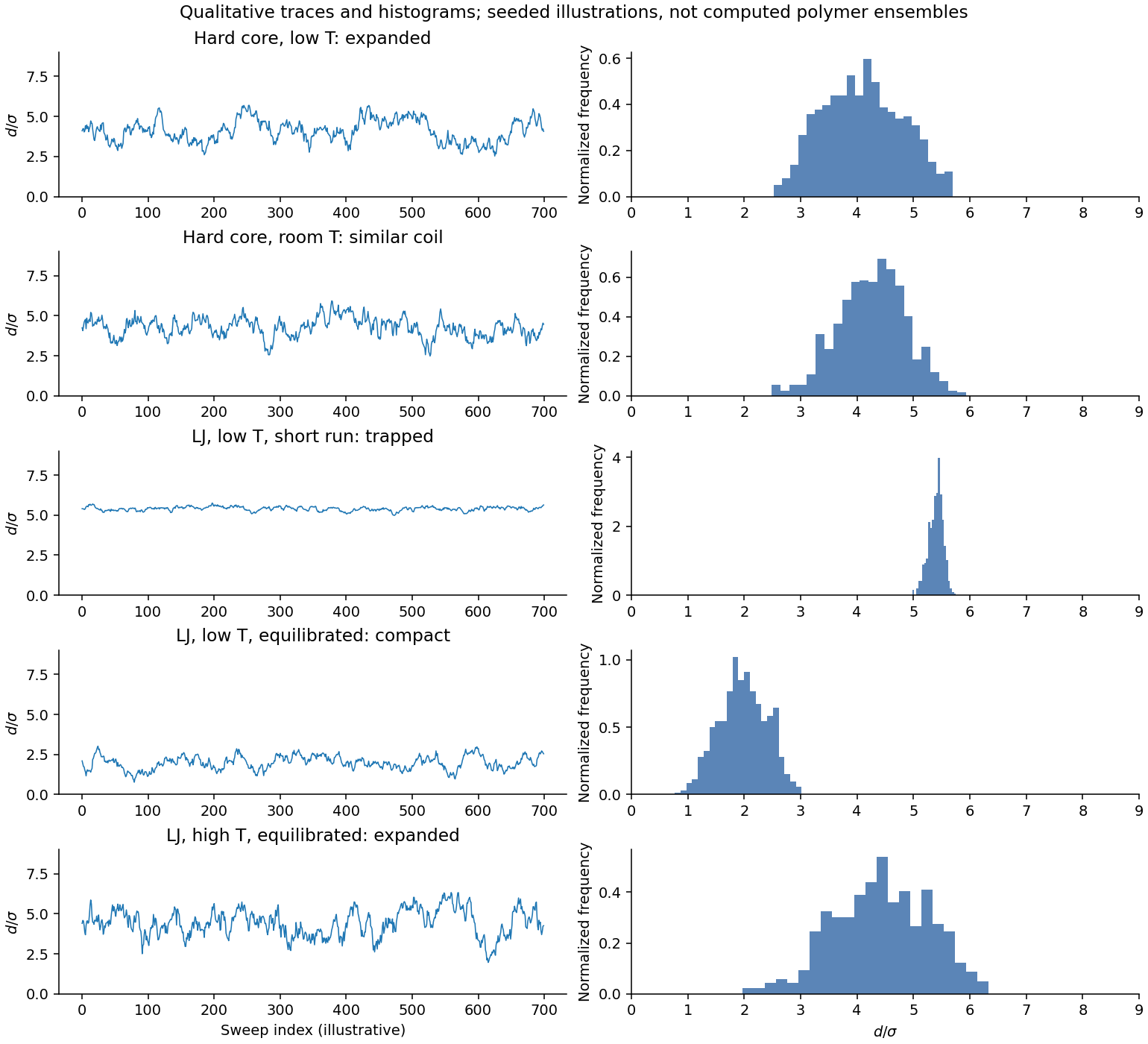
The hard-core chain does not undergo an energetic low-temperature collapse. For allowed configurations the only finite energy is bond stretching. If , bond lengths remain near and temperature mostly changes the small bond-length fluctuations, not the distribution of angular conformations. The end-to-end distance therefore fluctuates over an expanded self-avoiding-coil distribution even at low temperature, with an approximate scale and for sufficiently long three-dimensional chains.
For , the scaling is qualitative and finite-chain effects matter. An equilibrated distance-versus-sweep trace is stationary, with correlated excursions; a histogram of that trace is a distinct plot, not a curve of probability density against simulation step. Neither the temperature in kelvin nor the spring constant is specified, so an exact histogram cannot be calculated. The illustrative figure compares like-for-like coil traces rather than asserting a unique numerical simulation result.

Past exam of the chemistry course of the year 4 of the natural sciences course of the University of Cambridge 2022 Paper 2 Section G 30 e ii Solution by Codex 0 2026-10-20
Codex 0 2026-10-20 Past exam of the chemistry course of the year 4 of the natural sciences course of the University of Cambridge 2022 Paper 2 Section G 30 e i Solution by Codex 0 2026-10-20
Codex 0 2026-10-20 Past exam of the chemistry course of the year 4 of the natural sciences course of the University of Cambridge 2022 Paper 2 Section G 30 a ii Solution by Codex 0 2026-10-20
Codex 0 2026-10-20 Past exam of the chemistry course of the year 4 of the natural sciences course of the University of Cambridge 2022 Paper 2 Section G 30 a i Solution by Codex 0 2026-10-20
Codex 0 2026-10-20 Past exam of the chemistry course of the year 4 of the natural sciences course of the University of Cambridge 2022 Paper 2 Section E 27 a ii Solution by Codex 0 2026-10-20
Codex 0 2026-10-20For an unnormalized representation, divide the first moment by its total mass. Integration by parts givesConsequentlyFor normalized amplitudes the denominator is one. A mode with small weight can still dominate the mean if its lifetime is sufficiently large; this distinction matters when interpreting the later graph.
Past exam of the chemistry course of the year 4 of the natural sciences course of the University of Cambridge 2022 Paper 2 Section E 27 a i Solution by Codex 0 2026-10-20
Codex 0 2026-10-20Assume all contributing decay rates satisfy and the summed expression is a nonnegative density. ThenThus normalizes the first-passage distribution. A zero decay rate would require separate treatment of a nonabsorbing component; eventual absorption is implicit here. Individual spectral coefficients need not all be positive, but the full density must be.
Past exam of the chemistry course of the year 4 of the natural sciences course of the University of Cambridge 2022 Paper 2 Section E 26 d ii Solution by Codex 0 2026-10-20
Codex 0 2026-10-20Since , the hexagonal lattice has larger accessible cell area at any common allowed total area . HenceThe kinetic entropies cancel at the same temperature. The triangular lattice is favoured and has higher entropy within this cell model, even though both structures look ordered. More efficient packing leaves more local displacement freedom at a fixed number density. This comparison does not by itself establish whether either crystal is stable against the fluid.
Past exam of the chemistry course of the year 4 of the natural sciences course of the University of Cambridge 2022 Paper 2 Section E 26 d i Solution by Codex 0 2026-10-20
Codex 0 2026-10-20 Past exam of the chemistry course of the year 4 of the natural sciences course of the University of Cambridge 2022 Paper 2 Section E 26 b ii Solution by Codex 0 2026-10-20
Codex 0 2026-10-20The particle centre can move approximately from the cell centre towards each of its four nearest fixed neighbours. Approximating the actual curved boundary by a square givesThis is the area accessible to the centre, not the geometrical area enclosed by the fixed particle centres or an area computed using . Two equal particles must keep their centres at least apart.
Past exam of the chemistry course of the year 4 of the natural sciences course of the University of Cambridge 2022 Paper 2 Section E 26 b i Solution by Codex 0 2026-10-20
Codex 0 2026-10-20Freeze neighbouring particles and approximate the mobile particle's accessible area by . Its one-particle translational contribution to the canonical partition function is in two dimensions. Neglecting correlations between different cages,There is no additional uncancelled : assigning particles to cages removes permutations, while restoring all assignments cancels the indistinguishability factor. The result is a free-volume approximation; collective cage motion is excluded by construction.
Past exam of the chemistry course of the year 4 of the natural sciences course of the University of Cambridge 2022 Paper 2 Section E 26 a ii Solution by Codex 0 2026-10-20
Codex 0 2026-10-20At high density, disorder can frustrate efficient local packing and leave particles with very little room to move. An ordered arrangement can give every particle a larger cage of allowed displacements. The extensive gain in vibrational/configurational freedom within these cages can outweigh the loss of distinct spatial arrangements of cages. Visual order is therefore not a reliable measure of entropy. At low density the fluid's freedom to rearrange dominates, whereas sufficiently dense packing can favour a crystal through accessible free volume.
Past exam of the chemistry course of the year 4 of the natural sciences course of the University of Cambridge 2022 Paper 2 Section E 26 a i Solution by Codex 0 2026-10-20
Codex 0 2026-10-20For a hard disc configuration, the potential energy is zero if no particles overlap and infinite otherwise. All allowed configurations therefore have the same configurational Boltzmann factor. At fixed , their relative free energies differ through the volume of accessible configuration space:The kinetic contribution is common to the phases at the same temperature. “Entropy-driven crystallization” does not mean that particles develop an energetic attraction; excluded volume changes the number of possible many-particle arrangements.
Past exam of the chemistry course of the year 4 of the natural sciences course of the University of Cambridge 2022 Paper 2 Section D 25 d iii Solution by Codex 0 2026-10-20
Codex 0 2026-10-20A depletion force requires mobile nonadsorbing polymers excluded from the gap, rather than grafted chains alone. If their depletion layers overlap when the plate separation is , the overlap restores accessible solution volume and increases polymer entropy. For ideal, dilute depletants of bulk osmotic pressure , an idealized interaction free energy per plate area isIts attractive pressure is in the overlap interval. The layer thickness is of order the ideal-coil radius of gyration, , so the range scales as . For the supplied chain parameters, nm and an order-of-magnitude two-layer range is 163 nm. Grafted brushes instead oppose compression through stretching and osmotic penalties; they can coexist with depletion attraction if free depletants are present, but the mere existence of a grafted layer does not create a reservoir of depleting chains. The source does not specify that reservoir's concentration, so its attraction magnitude cannot be calculated.
Past exam of the chemistry course of the year 4 of the natural sciences course of the University of Cambridge 2022 Paper 2 Section D 25 d ii Solution by Codex 0 2026-10-20
Codex 0 2026-10-20The grafting density is the inverse area per chain:For a neutral polymer brush in a good solvent, stretching costs per chain while excluded-volume interactions cost . Minimization gives . With ,An isolated good-solvent coil has size nm, much larger than nm, consistent with strong overlap. The brush height is below the 20 μm contour length. This estimate assumes good-solvent excluded volume and locally planar geometry; the source gives neither solvent quality nor particle radius, so a unique curved-brush thickness is not established. An ideal-solvent brush has different scaling.
Past exam of the chemistry course of the year 4 of the natural sciences course of the University of Cambridge 2022 Paper 2 Section D 25 c iii Solution by Codex 0 2026-10-20
Codex 0 2026-10-20At the limiting area, the spherical core radius is nm. Its aggregation number isAbove the critical micelle concentration, free monomers remain approximately at 8 mM, so 42 mM of surfactant units are in aggregates. ThusThe concentration is of whole aggregates, not the concentration of surfactant molecules inside them. The estimate neglects micelle polydispersity and concentration-dependent growth.
Past exam of the chemistry course of the year 4 of the natural sciences course of the University of Cambridge 2022 Paper 2 Section D 25 c ii Solution by Codex 0 2026-10-20
Codex 0 2026-10-20For a dodecyl tail, take . The given relations yield nm and nm. The spherical-core condition is , henceEquality corresponds to a maximally extended tail reaching the core centre. A smaller head-group area would require a spherical radius larger than the available chain length. The estimate assumes all twelve tail carbons contribute to the hydrocarbon core; partial penetration or hydrated head-group geometry would modify it.
There are unlisted articles, also show them or only show them.