Past exam of the chemistry course of the year 3 of the natural sciences course of the University of Cambridge 2022 Paper 2A Section B 24 a iii Solution by  Codex 0 2026-10-20
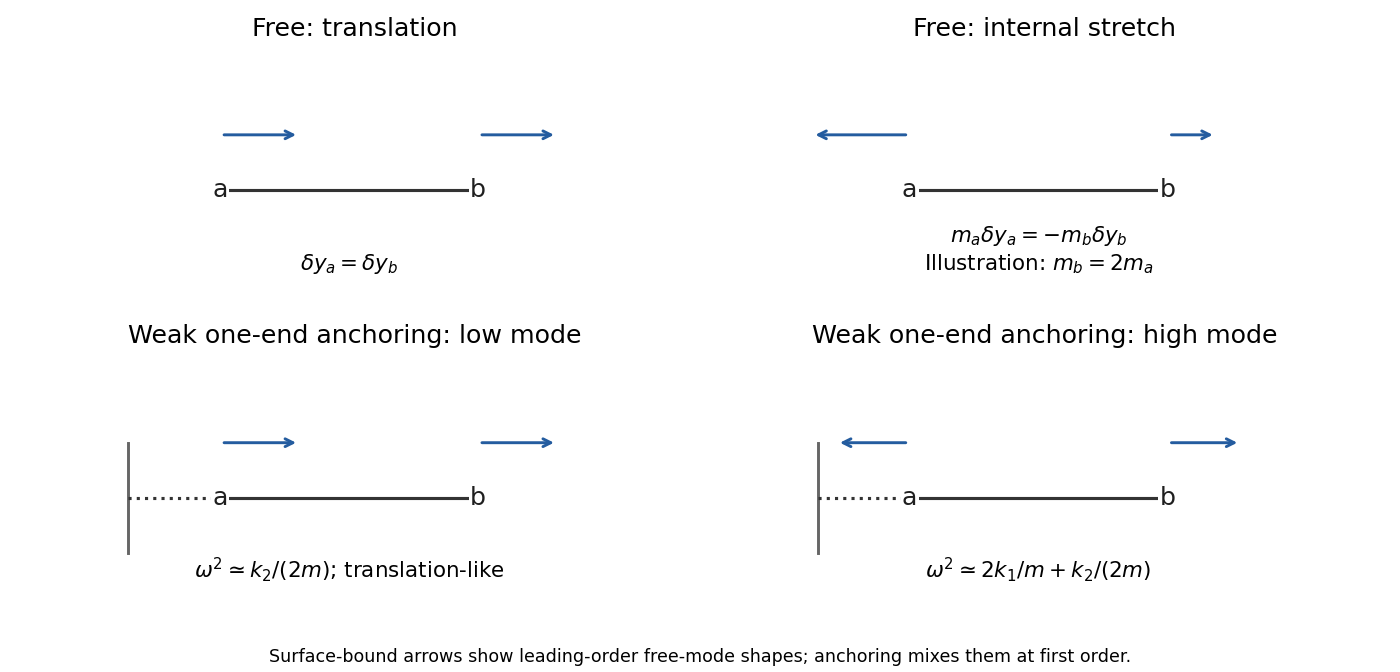
Taking the Hessian of the potential with respect to mass-weighted displacements givesThe equations of motion are , so eigenvalues are squared angular frequencies. Normalized eigenvectors and frequencies areBoth vectors are in the q basis, and . The translation corresponds to equal physical displacements . The stretch has and opposite physical displacements with magnitude ratio . Ordinary frequencies are ; spectroscopic wavenumbers are .
Past exam of the chemistry course of the year 3 of the natural sciences course of the University of Cambridge 2022 Paper 2A Section B 24 a ii Solution by Codex 0 2026-10-20
Codex 0 2026-10-20Substituting givesThe shifted equilibrium coordinates satisfy . Expanding about them replaces q by displacements without changing the kinetic metric or the Hessian.
Past exam of the chemistry course of the year 3 of the natural sciences course of the University of Cambridge 2022 Paper 2A Section B 24 a i Solution by Codex 0 2026-10-20
Codex 0 2026-10-20The missing kinetic contribution is . Both atoms contribute independent translational kinetic energy before the coordinates are changed.
Past exam of the chemistry course of the year 3 of the natural sciences course of the University of Cambridge 2022 Paper 2A Section B 22 b ii Solution by Codex 0 2026-10-20
Codex 0 2026-10-20Averaging the left-minus-right differences across the three rows gives lower-state spacings of about and . Their difference is , soSimilarly, averaging successive down-column differences across the three columns gives upper-state spacings of about and . HenceUsing the first row and first column alone would give approximately and , respectively. The small inconsistency between nominally identical spacings is already present in the entries; it should be treated as limited data/model precision rather than fitted by assigning different lower-state constants to different rows. Values near for the lower state and for the upper state express the supported precision.
Past exam of the chemistry course of the year 3 of the natural sciences course of the University of Cambridge 2022 Paper 2A Section B 22 b i Solution by Codex 0 2026-10-20
Codex 0 2026-10-20Let . For a fixed row, moving one column to the right therefore givesThus adjacent-column entries decrease by the lower-state vibrational spacing, independent of the upper-state row in the ideal model. If the positive difference is instead defined as left minus right, it is . Stating the subtraction direction prevents an artificial negative vibrational frequency.
Past exam of the chemistry course of the year 3 of the natural sciences course of the University of Cambridge 2022 Paper 2A Section B 22 a iii Solution by Codex 0 2026-10-20
Codex 0 2026-10-20Successive differences remove the unknown absolute origin and the unknown initial vibrational quantum number. The five spacings are , , , and . Plot them at relative mid-indices . A straight-line fit givesThe curve reaches zero spacing at . Since a quadratic Morse progression has a spacing equal to its derivative at the interval midpoint, integrating the fitted line from the first observed relative level to estimates the energy still needed to reach the continuous limit:Thus the appropriate graphical conclusion is , not a many-digit threshold. Directly fitting a quadratic to the six measured transition positions puts its vertex at about , which checks the arithmetic but not the physical extrapolation law. The slight variation of second differences shows that extrapolating a constant anharmonicity beyond the observed range is approximate. No assignment of the arbitrary index n to an absolute upper-state v is needed.
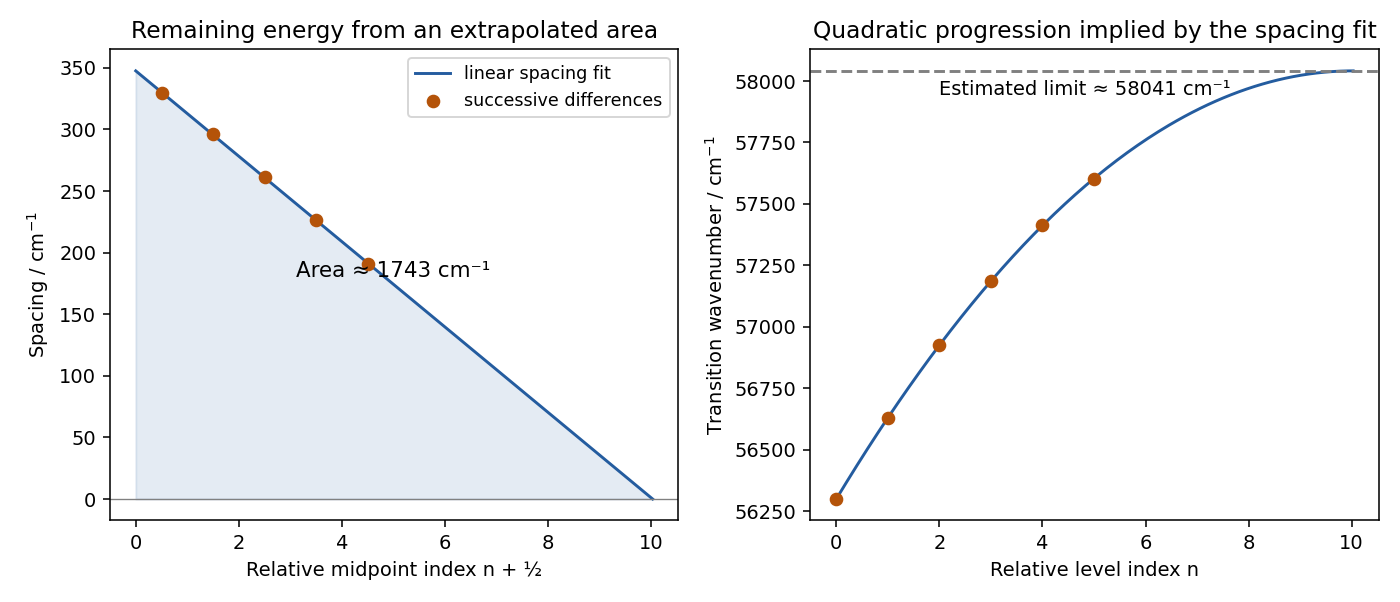
Original relative-index Birge–Sponer extrapolation and the inferred progression limit
. Details. Past exam of the chemistry course of the year 3 of the natural sciences course of the University of Cambridge 2022 Paper 2A Section B 22 a ii Solution by Codex 0 2026-10-20
Codex 0 2026-10-20Write the upper Morse oscillator term values in wavenumber units asThe spacing is . A Birge-Sponer plot therefore falls linearly in this model and can be extrapolated to zero spacing. If its horizontal coordinate is , the plotted line is . Its area from to its zero givesEquivalently a plot against has intercept and triangle area ; subtracting recovers . These conventions distinguish dissociation from the potential minimum and from the lowest vibrational level.
Measured consecutive members fix a local slope and intercept, so unobserved members can be supplied by extrapolation under an explicit spacing law. The upper-state limit on the absorption scale is . A local high-v fit can likewise estimate the remaining energy above an observed member without knowing its absolute v index. Near dissociation a real potential need not remain Morse-like, so an extrapolated triangle has model uncertainty; missing lines must not be silently assumed consecutive.
Past exam of the chemistry course of the year 3 of the natural sciences course of the University of Cambridge 2022 Paper 2A Section B 22 a i Solution by Codex 0 2026-10-20
Codex 0 2026-10-20In the Condon approximation the intensity from to contains the Franck-Condon factorThe lower ground-state vibrational wavefunction is localized near its equilibrium bond length. If the two equilibrium lengths are similar, it overlaps strongly with the upper wavefunction, but its overlap with highly excited upper vibrational states is usually small or suffers oscillatory cancellation. If the equilibrium lengths differ enough that a vertical excitation reaches the outer portion of the upper well, high- transitions can be strong while the overlap is small. Thus the two ends of a long progression are not normally both intense. This is an overlap argument, not a ban on either set of transitions; anharmonicity, a varying electronic transition moment and unusual wavefunctions can modify the intensity envelope.
Past exam of the chemistry course of the year 3 of the natural sciences course of the University of Cambridge 2022 Paper 2A Section B 21 b ii Solution by Codex 0 2026-10-20
Codex 0 2026-10-20The subbranch spacing gives , hence . Rotation about the C–I symmetry axis has momentC and I lie on this axis, so only the three hydrogens contribute to . If is the I–C–H angle, their perpendicular distances are . Taking integer hydrogen mass givesThe molecular arrangement selects the obtuse solution, so . The supplementary acute angle describes the opposite axial direction, not the bond angle to iodine. This is a rigid-geometry estimate based on an effective rotational constant and the stipulated bond length, rather than a precision equilibrium-structure measurement.
Past exam of the chemistry course of the year 3 of the natural sciences course of the University of Cambridge 2022 Paper 2A Section B 21 b i Solution by Codex 0 2026-10-20
Codex 0 2026-10-20A regularly repeated set of sharp features is characteristic of the unresolved Q subbranches of a perpendicular rovibrational band. The transition dipole is perpendicular to the symmetry axis, giving ; for the Q branch . Holding the rotational constants fixed between vibrational states cancels the term, leavingMany J transitions therefore coincide within each K-changing Q subbranch in this approximation. The different K subbranches are separated byThe P and R branches have and , respectively. Their extra J-dependent terms spread many transitions across a broad background at modest resolution. A parallel band, with , would not generate this repeated Q-subbranch spacing under the stated assumptions.
Past exam of the chemistry course of the year 3 of the natural sciences course of the University of Cambridge 2022 Paper 2A Section B 21 a iv Solution by Codex 0 2026-10-20
Codex 0 2026-10-20The largest applied field givesFor parallel polarization, adjacent allowed M values in a component are separated byAlready at this is for and for . Both exceed the stated resolution, and larger gives larger first-order spacings. The spectrometer should resolve suitable Stark components, provided their physical linewidths and signal-to-noise permit it. This predicts resolvable splittings rather than incorrectly comparing the maximum level shift directly with instrumental resolution.
Past exam of the chemistry course of the year 3 of the natural sciences course of the University of Cambridge 2022 Paper 2A Section B 21 a iii Solution by Codex 0 2026-10-20
Codex 0 2026-10-20A spectral component shifts by the difference between its upper- and lower-level Stark shifts. With , and , the supplied energy formula givesFor radiation polarized parallel to the static field, , soThus the assigned feature has no first-order splitting, whereas the features acquire symmetrically arranged magnetic-sublevel components with spacings proportional to . With perpendicular radiation, gives the corresponding different allowed pattern. Recording field-dependent spectra with specified polarization would test both the J values and the K sequence; using an individual level's shift alone would not predict the observed line positions. Higher-order shifts of the nominally unsplit feature are outside this first-order test.
Past exam of the chemistry course of the year 3 of the natural sciences course of the University of Cambridge 2022 Paper 2A Section B 21 a ii Solution by Codex 0 2026-10-20
Codex 0 2026-10-20The lines give two equations independent of :Solving yields and . The small distortion is obtained by subtracting close numbers, so its precision is considerably worse than that of .
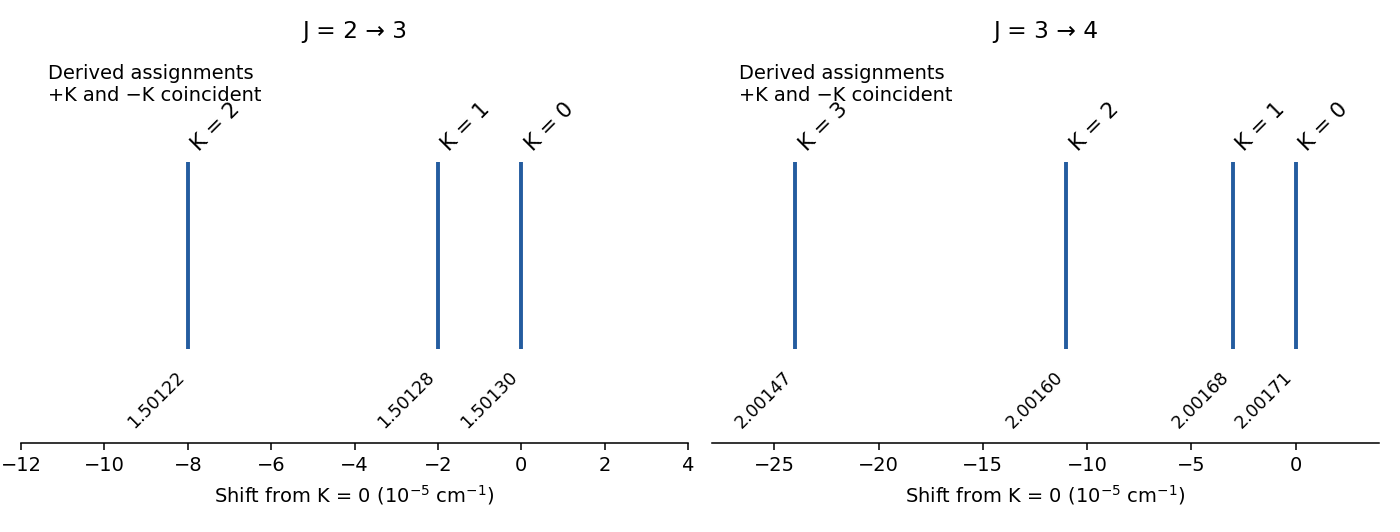
For components in a fixed group,For example the displacement gives , while gives . Both give ; the smaller gaps are consistent after rounding. The pure rotational transitions have , so the and terms cancel. Neither nor can be determined from these zero-field lines.
Past exam of the chemistry course of the year 3 of the natural sciences course of the University of Cambridge 2022 Paper 2A Section B 21 a i Solution by Codex 0 2026-10-20
Codex 0 2026-10-20The coarse spacing is about , so . The two groups near 1.5 and therefore have and , respectively. For positive , increasing moves a component to lower wavenumber. The assignments areWithin one group, successive separations scale as . The observed gaps follow that pattern to their printed precision. There are distinct components because in the lower state; the and members remain coincident without an applied field. A high-resolution feature here is therefore not simply assigned to an arbitrary magnetic sublevel.


Past exam of the chemistry course of the year 3 of the natural sciences course of the University of Cambridge 2022 Paper 2A Section A 19 a iii Solution by Codex 0 2026-10-20
Codex 0 2026-10-20molecular mechanics evaluates a parametrized potential of atomic positions, with terms such as bond stretching, angle bending, torsion and nonbonded interactions. electrons are represented implicitly through the fitted force field, rather than by electronic orbitals, a density or an electronic wavefunction. This example is different from both preceding electronic methods.
Past exam of the chemistry course of the year 3 of the natural sciences course of the University of Cambridge 2022 Paper 2A Section A 19 a ii Solution by Codex 0 2026-10-20
Codex 0 2026-10-20Kohn-Sham equations in density functional theory use an auxiliary one-electron Hamiltonian whose effective potential depends on the density. Its orbitals construct a density representing an interacting electronic system; this is distinct from explicitly diagonalizing a large many-electron determinant Hamiltonian.[ref]
Self-Consistent Equations Including Exchange and Correlation Effects by Walter Kohn and Lu Jeu Sham. 1965, pp. A1133–A1135, ground-state effective one-electron formulation
Past exam of the chemistry course of the year 3 of the natural sciences course of the University of Cambridge 2022 Paper 2A Section A 19 a i Solution by Codex 0 2026-10-20
Codex 0 2026-10-20configuration interaction with singles and doubles (CISD) uses a linear combination of the reference Slater determinant and singly and doubly excited determinants. Its many-electron trial state is therefore not restricted to one determinant; the orbitals may be held fixed while the configuration coefficients are varied.
Past exam of the chemistry course of the year 3 of the natural sciences course of the University of Cambridge 2022 Paper 2A Section A 15 c ii Solution by Codex 0 2026-10-20
Codex 0 2026-10-20Now and the ground term is . Spin-conserving transitions to the labelled doublet excited terms are possible. Reading the diagram gives approximatelyThe first two upper terms are coincident or unresolved at this diagram's resolution. These doublet transitions should dominate over the spin-forbidden transitions to sextet or quartet levels. Their intensity still depends on vibronic or other relaxation of the Laporte rule. The plotted curves justify only approximate wavenumbers, not several-digit band positions.
Past exam of the chemistry course of the year 3 of the natural sciences course of the University of Cambridge 2022 Paper 2A Section A 15 c i Solution by Codex 0 2026-10-20
Codex 0 2026-10-20Here , so the ground term is . There are no spin-allowed d–d bands in the displayed manifold under the spin selection rule: the excited terms shown have doublet or quartet rather than sextet multiplicity. Very weak spin-forbidden absorptions can still gain intensity through spin–orbit coupling, and even spin-allowed d–d transitions would be forbidden by the Laporte rule in ideal centrosymmetric coordination. Thus a strong ordinary d–d spectrum should not be predicted simply by multiplying the splitting by a numerical factor. For scale, the lowest quartet branches read roughly at this abscissa, corresponding to weak features around , and if such forbidden intensity is detectable. These are graphical estimates, not precision assignments of every weak line.
Past exam of the chemistry course of the year 3 of the natural sciences course of the University of Cambridge 2021 Paper 2A Section B 24 c ii Solution by Codex 0 2026-10-20
Codex 0 2026-10-20No: the lowest dissociation channel is , which a doubly occupied helium-centred orbital can describe. In the heteronuclear molecular orbital diagram the helium site lies below the hydrogen site. As separation grows, the bonding orbital tends to helium , the antibonding orbital tends to hydrogen , and the two ground-state electrons remain in the lower orbital.
There is therefore no symmetry requirement to keep both sites equally occupied and no compulsory half-weight mixture of wrong ionic configurations at dissociation. The physical asymptote is already a closed-shell atom plus a bare proton. The alternative limit lies higher. A Restricted Hartree-Fock method curve approaches the Hartree–Fock helium energy rather than the exact correlated helium energy, so ordinary dynamic electron correlation is still missing, but this is not the homonuclear static-correlation catastrophe. In the preceding two-panel sketch, the helium hydride curves have the same qualitative dissociation channel with a small residual correlation offset, whereas the hydrogen restricted curve reaches a qualitatively wrong high limit.
There are unlisted articles, also show them or only show them.