Past exam of the chemistry course of the year 3 of the natural sciences course of the University of Cambridge 2021 Paper 2A Section B 24 c i Solution by  Codex 0 2026-10-20
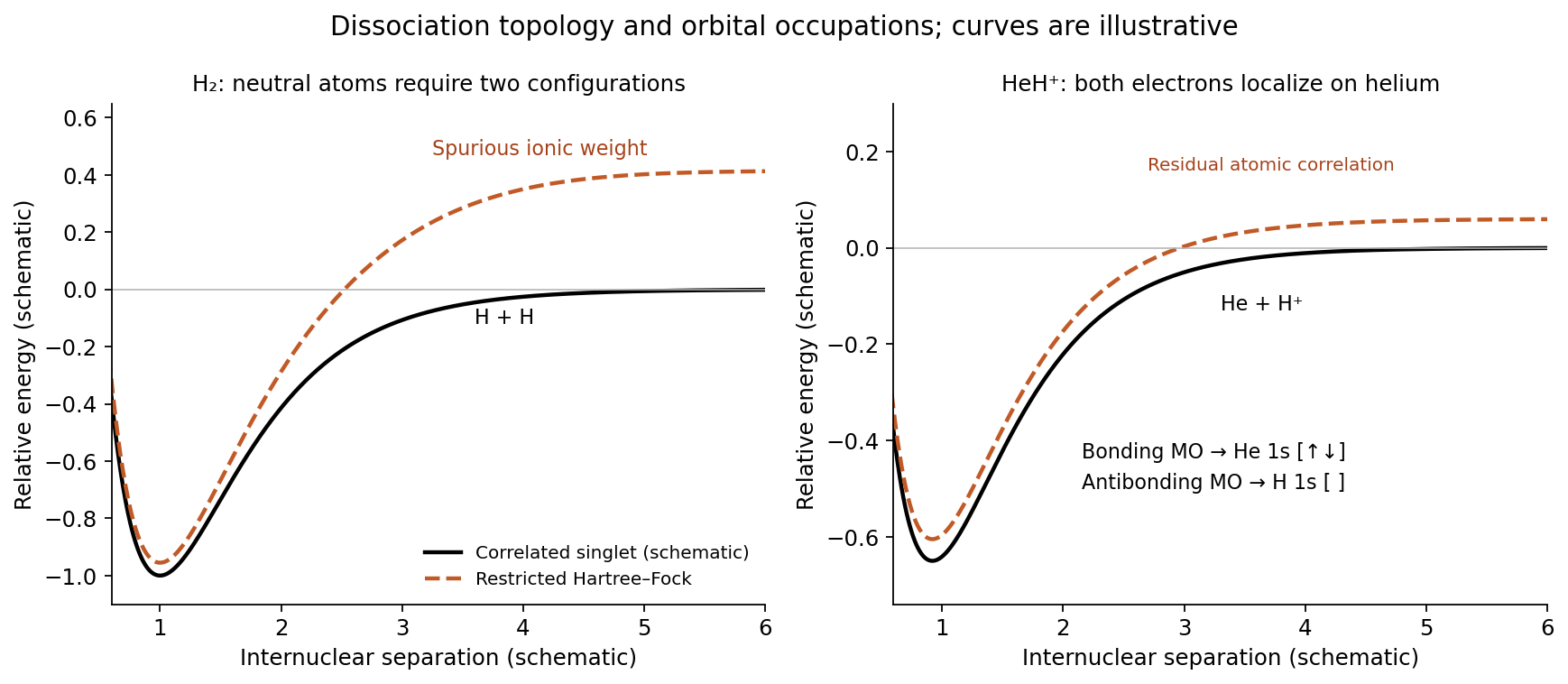
Restricted Hartree–Fock incorrectly retains ionic configurations when a homonuclear bond dissociates. As overlap vanishes, its symmetry-preserving occupied orbital approaches . The doubly occupied spatial product containsThe first and last terms place both electrons on one separated atom. Their combined probability remains one half, while the correct neutral singlet has one electron on each atom. The resulting spurious Coulomb repulsion raises the restricted dissociation limit. This is missing static electron correlation, not a failure of the Born-Oppenheimer approximation.
A two-configuration expansion using both and can cancel the ionic terms and recover the Heitler–London separated-atom singlet. Configuration interaction in the appropriate active space or a multiconfigurational self-consistent treatment supplies this remedy. The Unrestricted Hartree-Fock method can instead localize opposite spins on different atoms and give the correct separated-atom energy, but its single determinant breaks spin symmetry and is not the pure singlet at intermediate separation. The distinction between restricted and symmetry-broken descriptions of stretched hydrogen is treated in the original analysis of Coulson and Fischer.[ref]
XXXIV. Notes on the molecular orbital treatment of the hydrogen molecule by Charles Alfred Coulson and Inga Fischer-Hjalmars. Philosophical Magazine 40 (1949), 386–393, molecular-orbital treatment of hydrogen and its dissociation
Past exam of the chemistry course of the year 3 of the natural sciences course of the University of Cambridge 2021 Paper 2A Section B 24 b ii Solution by Codex 0 2026-10-20
Codex 0 2026-10-20Let be real, with each atomic orbital normalized. ThenTogether with orthonormal spin functions, this also normalizes the Slater determinant: its norm squared is . Under the subsequent zero-overlap assumption,using the specified nonnegative branch for .
Past exam of the chemistry course of the year 3 of the natural sciences course of the University of Cambridge 2021 Paper 2A Section B 24 b i Solution by Codex 0 2026-10-20
Codex 0 2026-10-20A doubly occupied spatial orbital gives a spin-singlet Slater determinant:Equivalently, . The spatial factor is symmetric, and the normalized antisymmetric spin factor enforces the Pauli exclusion principle. Here includes position and spin.
Past exam of the chemistry course of the year 3 of the natural sciences course of the University of Cambridge 2021 Paper 2A Section B 24 a ii Solution by Codex 0 2026-10-20
Codex 0 2026-10-20An effective one-electron Hückel method operator may be writtenThe first term is one-electron kinetic energy. The effective site potentials represent attraction to the nuclei and any averaged screening implicit in the chosen parametrization. They replace the explicit many-electron interaction; they do not contain a coordinate-dependent two-electron operator .
For normalized hydrogen-centred orbitals, symmetry givesThe Hückel Coulomb parameter is an on-site one-electron energy, not the electron–electron Coulomb repulsion integral. The Hückel resonance integral couples the sites; with the usual same-phase atomic-orbital convention it is negative and stabilizes the bonding combination. For zero overlap, the two energies are .
Past exam of the chemistry course of the year 3 of the natural sciences course of the University of Cambridge 2021 Paper 2A Section B 24 a i Solution by Codex 0 2026-10-20
Codex 0 2026-10-20For clamped nuclei and SI units, the many-electron electronic Hamiltonian isThe terms are electron kinetic energy, electron–nucleus attraction, and electron–electron repulsion. The nuclear kinetic operator is omitted in the Born-Oppenheimer approximation. The nuclear repulsionis a constant at fixed separation and is added to electronic energies to form the total potential curve. Some conventions include it in as a constant; the electronic-energy convention used below excludes it so that the two one-electron energies can be compared without double-counting nuclear repulsion.
Past exam of the chemistry course of the year 3 of the natural sciences course of the University of Cambridge 2021 Paper 2A Section B 23 c iii Solution by Codex 0 2026-10-20
Codex 0 2026-10-20 and . With and , the dilute-gas stretch givesUse in here. The shifted line is the higher totally symmetric mode; the other molecular stretch remains at . To first order,The ratio validates the weak-coupling expansion. Inverting the exact eigenvalue instead, with , givesa negligible change at the precision of the model.
Past exam of the chemistry course of the year 3 of the natural sciences course of the University of Cambridge 2021 Paper 2A Section B 23 c ii Solution by Codex 0 2026-10-20
Codex 0 2026-10-20In the totally symmetric basis, the force constant matrix reduces toThe unperturbed eigenvalues are distinct within this symmetry block, so nondegenerate perturbation theory applies even though the full unperturbed matrix has degeneracies in different symmetry sectors. The first-order shifts are both . At second order the off-diagonal matrix element gives for the lower mode and for the upper one. ThereforeIn frequency form,The corresponding eigenvectors are and . As a check, the exact squared-frequency eigenvalues arewhose expansions reproduce the perturbation theory result. The newly lifted zero frequency scales as , so expanding as an ordinary Taylor series in would be inappropriate.
Past exam of the chemistry course of the year 3 of the natural sciences course of the University of Cambridge 2021 Paper 2A Section B 23 c i Solution by Codex 0 2026-10-20
Codex 0 2026-10-20The nontotally symmetric longitudinal modes are the two coordinates and . Both have , so the middle spring is not extended. Hence its spring constant cannot alter their energies:These results are exact for every positive , not just perturbative. The zero mode expresses overall translation invariance.
Past exam of the chemistry course of the year 3 of the natural sciences course of the University of Cambridge 2021 Paper 2A Section B 23 b ii Solution by Codex 0 2026-10-20
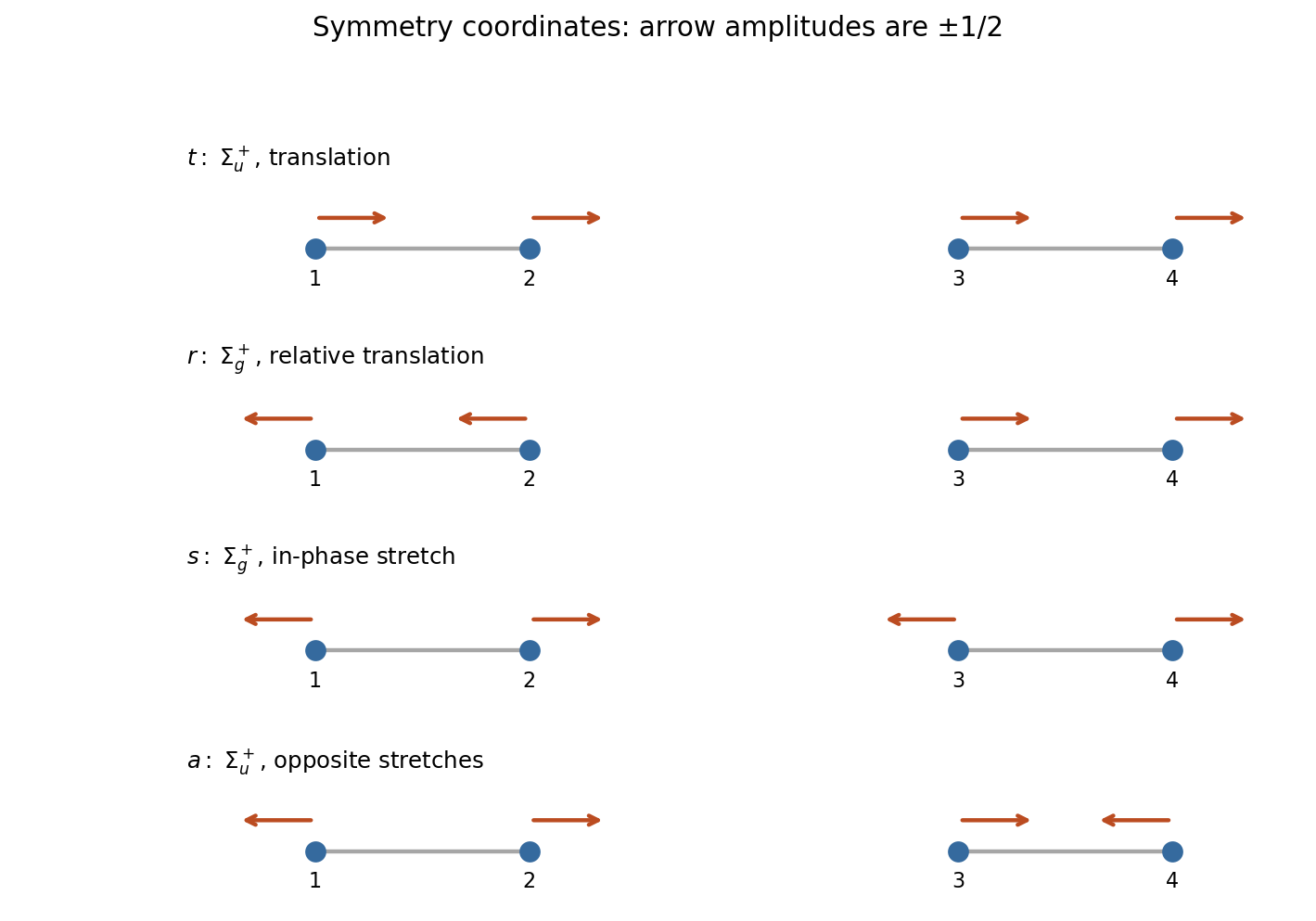
Codex 0 2026-10-20For the collinear centrosymmetric arrangement, the longitudinal coordinates transform in the D infinity h molecular point group. Inversion sends , because displacement is a polar vector. ThereforeAn orthonormal set of symmetry coordinates is:
| Coordinate | Displacement vector | Symmetry | at |
|---|
Here translates the complete system, separates the molecular centres, stretches both molecules together, and lengthens one while shortening the other. Reversing every arrow changes the coordinate sign, not its physical mode.


Past exam of the chemistry course of the year 3 of the natural sciences course of the University of Cambridge 2021 Paper 2A Section B 23 b i Solution by Codex 0 2026-10-20
Codex 0 2026-10-20At , each independent diatomic spring has one translation and one stretch. Consequently the angular frequencies areThe two zero modes are independent centre-of-mass translations of the two molecules. There are no transverse coordinates in this model; adding transverse degrees of freedom would be a different problem.
Past exam of the chemistry course of the year 3 of the natural sciences course of the University of Cambridge 2021 Paper 2A Section B 22 b v Solution by Codex 0 2026-10-20
Codex 0 2026-10-20. The unquenched triplet lifetime isSince the slope is , the bimolecular rate constant isFor comparison, the unquenched phosphorescence yield in the unit-triplet-yield approximation is .
Past exam of the chemistry course of the year 3 of the natural sciences course of the University of Cambridge 2021 Paper 2A Section B 22 b iv Solution by Codex 0 2026-10-20
Codex 0 2026-10-20Without quencher, . Taking the ratio gives the Stern-Volmer equationThus the plot has unit intercept and slope . A triplet formation yield less than one would cancel from this ratio if it remained independent of quencher concentration. The result assumes dynamic triplet quenching and no additional quencher-induced absorption or singlet loss.[ref]
Stern-Volmer kinetic relationships in the IUPAC Gold Book. Definition and dynamic-quenching relation between quantum-yield ratios, quencher concentration and unquenched lifetime
Past exam of the chemistry course of the year 3 of the natural sciences course of the University of Cambridge 2021 Paper 2A Section B 22 b iii Solution by Codex 0 2026-10-20
Codex 0 2026-10-20The steady-state approximation for the excited singlet givesand that for the triplet givesCombining these with the quantum yield definition gives the more general expressionUnder the supplied limit , this becomesThe approximation is the near-unit triplet formation yield, not an assumption that phosphorescence is the only triplet loss process.
Past exam of the chemistry course of the year 3 of the natural sciences course of the University of Cambridge 2021 Paper 2A Section B 22 b ii Solution by Codex 0 2026-10-20
Codex 0 2026-10-20Almost every absorbed photon generates a triplet, within the stated kinetic scheme. The branching fraction from the excited singlet isso under steady illumination. This statement concerns the triplet formation yield; it does not mean that the triplet population or the phosphorescence yield is also one. The triplet can subsequently deactivate or be quenched.
Past exam of the chemistry course of the year 3 of the natural sciences course of the University of Cambridge 2021 Paper 2A Section B 22 b i Solution by Codex 0 2026-10-20
Codex 0 2026-10-20The phosphorescence quantum yield is the number of phosphorescence photons emitted per photon absorbed. In rate form,It is dimensionless. The denominator counts absorbed photons, not incident photons or the instantaneous triplet population.
Past exam of the chemistry course of the year 3 of the natural sciences course of the University of Cambridge 2021 Paper 2A Section B 22 a iv Solution by Codex 0 2026-10-20
Codex 0 2026-10-20For a fluorescence excitation spectrum, hold the emission detector at a fixed wavelength within the fluorescence band and scan the excitation wavelength. Correct for the incident photon flux and instrumental response at each excitation wavelength.
For one emitting molecular species with an approximately excitation-independent fluorescence yield, it should follow the absorption spectrum. In a dilute sample the detected emission is proportional to the photons absorbed, . Without the dilute approximation it follows absorptance rather than absorbance exactly. Impurities, photochemistry or multiple emitting states could invalidate that correspondence.
Past exam of the chemistry course of the year 3 of the natural sciences course of the University of Cambridge 2021 Paper 2A Section B 22 a iii Solution by Codex 0 2026-10-20
Codex 0 2026-10-20The approximate mirror relationship follows from the Franck-Condon principle when the ground and excited electronic states have similar vibrational frequencies and comparable potential shapes displaced along the active coordinates. Absorption samples overlaps, while relaxed emission samples overlaps. For displaced harmonic potentials, the corresponding overlap intensities form similar progressions on opposite sides of the transition between the lowest vibrational levels of the two electronic states.
The symmetry is approximate and is most naturally compared on an energy or wavenumber axis. A wavelength axis is nonlinear in photon energy, and solvent response, frequency changes, differing transition strengths and instrumental corrections can spoil an exact mirror image.
Past exam of the chemistry course of the year 3 of the natural sciences course of the University of Cambridge 2021 Paper 2A Section B 22 a ii Solution by Codex 0 2026-10-20
Codex 0 2026-10-20Vibrational and solvent relaxation remove energy before emission, producing a Stokes shift. Absorption initially excites a vertical transition from the populated ground-state vibrational levels to excited-state vibrational levels. Vibrational relaxation and solvent rearrangement then bring the molecule near the relaxed lowest excited singlet level before fluorescence. Emission ends in vibrationally excited levels of the electronic ground state, so the emitted photon generally has less energy and a longer wavelength. This explanation does not require a change of electronic multiplicity.
There are unlisted articles, also show them or only show them.