Past exam of the chemistry course of the year 4 of the natural sciences course of the University of Cambridge 2022 Paper 2 Section I 35 a ii Solution by  Codex 0 2026-10-20
 Past exam of the chemistry course of the year 4 of the natural sciences course of the University of Cambridge 2022 Paper 2 Section I 35 a i Solution by Codex 0 2026-10-20
Codex 0 2026-10-20 Past exam of the chemistry course of the year 4 of the natural sciences course of the University of Cambridge 2022 Paper 2 Section I 34 c iv Solution by Codex 0 2026-10-20
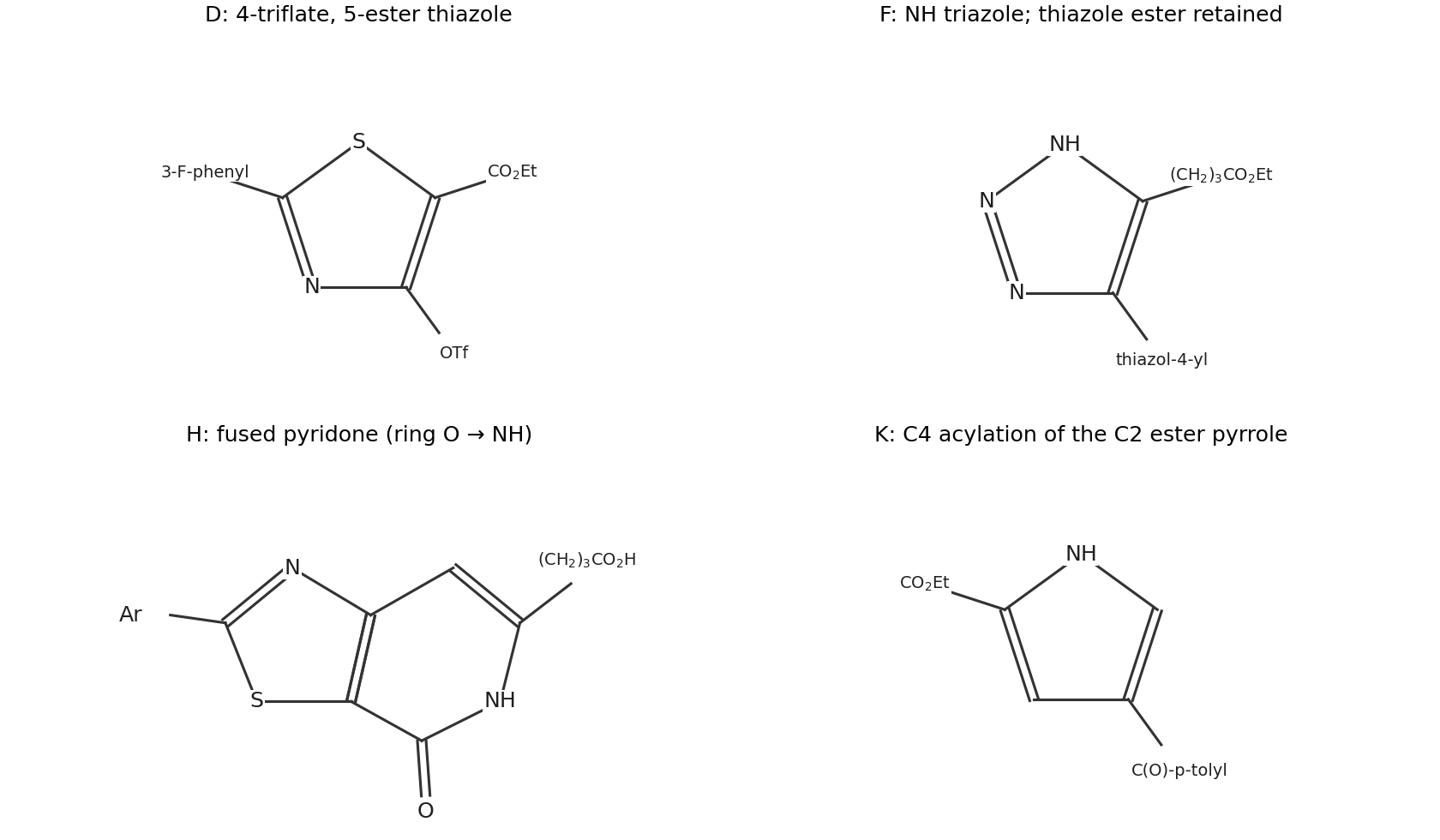
Codex 0 2026-10-20H is the fused pyridone analogue of G: replace the pyrone ring oxygen by NH, retaining its carbonyl and the remote carboxylic acid. Ammonia adds to the electron-poor pyrone system, opening its lactone/enol-ether framework into an amino-containing unsaturated acyl intermediate. Proton transfers permit intramolecular closure through nitrogen and loss of water, giving the conjugated pyridone/lactam ring. Acid work-up restores the neutral acid and the preferred neutral lactam representation.
Past exam of the chemistry course of the year 4 of the natural sciences course of the University of Cambridge 2022 Paper 2 Section I 34 c iii Solution by Codex 0 2026-10-20
Codex 0 2026-10-20KOH hydrolyses the thiazole ethyl ester to a carboxylate; acidification gives the acid. Silver(I) then activates the neighbouring alkyne towards intramolecular six-membered O-cyclization. The carboxylate oxygen attacks the alkyne carbon farther from the thiazole, so the new ring follows carbonyl C–O–distal alkyne C–proximal alkyne C–thiazole C4–thiazole C5. A vinyl-silver intermediate is protonated to give the fused pyrone G.
The remote terminal carboxylic acid survives. Ester hydrolysis changes E's formula by to ; the subsequent addition across the alkyne changes connectivity without altering that formula. This distinguishes the lactonizing carboxyl group at thiazole C5 from the side-chain acid, which is not the group closing the observed fused ring.
Past exam of the chemistry course of the year 4 of the natural sciences course of the University of Cambridge 2022 Paper 2 Section I 34 c ii Solution by Codex 0 2026-10-20
Codex 0 2026-10-20The acidic ethanolic step converts the terminal carboxylic acid to its ethyl ester, leaving the pre-existing thiazole ester. Azide then adds across the alkyne by 1,3-dipolar cycloaddition, followed by protonation at work-up. F contains an NH-1,2,3-triazole replacing the alkyne, with the thiazole and attached to its two carbon atoms. The thiazole's own COEt group remains.
The formula check is decisive:One can represent the cycloaddition with cyclic movement of the azide resonance-form electrons and the alkyne electrons into the two new C–N bonds. Alkali azide initially gives a triazolide; aqueous work-up provides the NH. Interchanging formal 4/5 labels for the carbon substituents in an N-unsubstituted triazole does not establish a separate permanently fixed N-substituted regioisomer.
Past exam of the chemistry course of the year 4 of the natural sciences course of the University of Cambridge 2022 Paper 2 Section I 34 c i Solution by Codex 0 2026-10-20
Codex 0 2026-10-20The thioamide first undergoes sulfur alkylation at the bromomalonate carbon, displacing bromide. Intramolecular attack of nitrogen on one ester carbonyl and ethanol loss produce a five-membered thiazolinone-type intermediate. Tautomerization gives ethyl 2-(3-fluorophenyl)-4-hydroxythiazole-5-carboxylate. For unambiguous atom assignment, write the ring in order as S1–C2(aryl)–N3–C4(OH)–C5(COEt): the thioamide carbon becomes C2, its nitrogen becomes N3, the attacked ester carbonyl becomes C4 and the original bromomalonate methine becomes C5.
Thus the correctly numbered intermediate is ethyl 2-(3-fluorophenyl)-4-hydroxythiazole-5-carboxylate. Triflic anhydride activates the hydroxyl oxygen; triethylamine removes its proton to give D = ethyl 2-(3-fluorophenyl)-4-(trifluoromethanesulfonyloxy)thiazole-5-carboxylate. This aryl triflate undergoes the subsequent palladium-catalysed alkynyl coupling at C4. The explicit ring atom mapping prevents interchanging the 4-hydroxy and 5-ester positions.
Past exam of the chemistry course of the year 4 of the natural sciences course of the University of Cambridge 2022 Paper 2 Section H 33 d iii Solution by Codex 0 2026-10-20
Codex 0 2026-10-20The requested equality is electrons if each unsaturated unit is counted as a four-electron donor to the chosen extended cluster framework. It needs that additional convention; a count confined to the localized skeleton gives instead.
For , an fragment contributes two skeletal electrons, a singly substituted cap contributes three, and the bridging hydrogen contributes one:For the second formula, let be the contribution assigned to each unsaturated unit. The comparison isThus requires . A bookkeeping partition that includes the two alkene pairs in the extended cluster electron pool givesIn contrast, assigning the double bond entirely to the exoskeletal substituent leaves each corresponding cage carbon with two electrons for the cage:The difference is exactly the two pairs, four electrons, rather than an arithmetic discrepancy. These are different electron partitions: do not compare from one partition with from the other as though both were the same skeletal count, and do not infer a structural classification merely by inserting the extended count into Wade's rules for twelve localized skeletal vertices.
Both the original and revised question pages print the same neutral molecular formula; the revised copy does not supply a charge, a drawing, or an explicit instruction about these electrons.[ref]
Revised question 33 of the 2022 Cambridge Part III Chemistry Paper 2. Part (d)(iii), physical page 81 of the later public bundle; the formula is unchanged from the original question
The primary study identifies the open cluster with the two genuine groups and reports their hydroalumination to give the capped aluminium cube. Its accessible abstract does not establish the orbital partition needed to select the four-electron convention.[ref]New Carbaalanes Containing Clusters of Aluminum and Carbon Atoms by Werner Uhl and others. Abstract: open cluster 2 and its conversion to compound 4; Organometallics 19 (2000), 4536–4543
Conditional conclusion: the advertised -electron equality follows under the explicit extended-framework convention above. Without evidence that those pairs belong in the cluster electron pool, retain the -electron localized count and this qualification. The source checks do not justify asserting a typo or inventing a charge to force agreement.
Past exam of the chemistry course of the year 4 of the natural sciences course of the University of Cambridge 2022 Paper 2 Section H 33 d ii Solution by Codex 0 2026-10-20
Codex 0 2026-10-20Use the neutral-fragment skeletal count: each AlMe supplies two electrons, each CEt supplies three and the bridging H supplies one. HenceThere are 13 nonhydrogen skeletal vertices, eight Al plus five C, and pairs. In the usual PSEP classification this is therefore arachno, corresponding to a 15-vertex closo parent with two vertices absent. The μ-H cap contributes an electron but is not counted as a carbon-like skeletal vertex. The aluminium cube is a convenient subframework; its eight corners alone are not the complete Wade skeleton. Calculations on capped cubic carbaalanes likewise identify 16 skeletal pairs for the five-carbon-cap/one-hydride-cap case.[ref]
Electron Counting in Carbaalane Clusters with Cubic Aluminum Core by Benoit Creton and others. 2007, five conical carbon caps and one hydride cap
Past exam of the chemistry course of the year 4 of the natural sciences course of the University of Cambridge 2022 Paper 2 Section H 33 d i Solution by Codex 0 2026-10-20
Codex 0 2026-10-20Eight AlMe vertices form a cube, five faces are capped by -C(Et) units, and the sixth face is capped by a bridging hydride. Choosing the hydride face as the bottom gives four equivalent side carbon caps and one distinct opposite carbon cap. Their ethyl groups give the 4:1 integrations: four methyl groups contribute 12 H and their methylenes 8 H; the remaining ethyl gives 3 H and 2 H.
The eight aluminium-bound methyl groups divide into two sets of four: the four aluminium atoms bordering the hydride face and the four on the opposite face. Each set gives a 12-proton singlet. The single bridging hydride gives the remaining one-proton signal. This matches the complete integration pattern without postulating five inequivalent ethyl caps. It specifies the symmetry-compatible connectivity; NMR alone does not measure every bond length or rule out solution averaging of small distortions.
Past exam of the chemistry course of the year 4 of the natural sciences course of the University of Cambridge 2022 Paper 2 Section H 33 b v Solution by Codex 0 2026-10-20
Codex 0 2026-10-20For the neutral aluminium cluster,This closes the listed sequence through 1I and supports the jellium description of a large metalloid cluster. Cp* ligands are counted as monovalent electron-withdrawing surface groups; counting each as a five-electron donor to the entire delocalized core would mix a transition-metal local electron-counting convention with the present shell model. Electron closure is a useful stability criterion, not by itself proof of a perfectly spherical nuclear geometry.
Past exam of the chemistry course of the year 4 of the natural sciences course of the University of Cambridge 2022 Paper 2 Section H 33 b iv Solution by Codex 0 2026-10-20
Codex 0 2026-10-20The revised question page explicitly gives the cluster as . Its charge supplies two electrons, soa jellium shell closure, through 1G. The reported structure has a Ga atom inside an eleven-atom Ga shell, with ten further ligand-bearing Ga units outside that core.[ref]
A Metalloid Cluster Compound with a Variation of the Ga22 Framework by Andreas Schnepf and others. 2002, central Ga@Ga11 core and ten external GaR units
The canonical exam copy omits the 2− charge. Taken literally as a neutral formula it gives 56 electrons, which is not a listed shell closure; assigning 58 without identifying this difference would be unjustified. The revised public source resolves the discrepancy rather than requiring an invented charge.[ref]
Revised question 33 of the 2022 Cambridge Part III Chemistry Paper 2. physical page 81, part b(iv)
Past exam of the chemistry course of the year 4 of the natural sciences course of the University of Cambridge 2022 Paper 2 Section H 33 b iii Solution by Codex 0 2026-10-20
Codex 0 2026-10-20The central silicon contributes four electrons to the delocalized metal-core count. Six monovalent Cp* ligands each withdraw one electron, givingThis is a jellium closed shell, through the filled 2P shell. The label identifies an encapsulated silicon with eight aluminium contacts; it should not be counted as an ordinary exterior Wade vertex with an outward lone pair. The gross electron count rationalizes shell closure but does not alone reconstruct every Al–Al bond or all ligand positions.
Past exam of the chemistry course of the year 4 of the natural sciences course of the University of Cambridge 2022 Paper 2 Section H 33 b ii Solution by Codex 0 2026-10-20
Codex 0 2026-10-20In a skeletal description, each of the four naked Sn atoms retains an outward lone pair and contributes two electrons to the framework. Each aryl-substituted Ge atom contributes three electrons after assigning one to its Ge–aryl bond; it is not assigned an additional spectator lone pair in this counting. ThusThe PSEP prediction is a six-vertex closo octahedron, with the two protected Ge vertices and four naked Sn vertices; distortion does not change the topological classification. The alternative gross delocalized count is not a listed jellium shell closure. Subtracting a lone pair from every atom would incorrectly remove electrons from the substituted Ge framework and give the wrong classification.
Past exam of the chemistry course of the year 4 of the natural sciences course of the University of Cambridge 2022 Paper 2 Section H 33 b i Solution by Codex 0 2026-10-20
Codex 0 2026-10-20A shell with angular momentum holds electrons. Successively filling the shells listed in the source gives the closed-shell totalsFor the delocalized count is , matching . The tetrahedral aluminium core is consequently consistent with the jellium model. Counting the same eight electrons as though the tetrahedron were an ordinary closo Wade cluster would fail: a four-vertex closo framework would require skeletal electrons. The competing models use different physical assumptions and should not be interchanged just because both involve a polyhedron.
Past exam of the chemistry course of the year 4 of the natural sciences course of the University of Cambridge 2022 Paper 2 Section H 32 c ii Solution by Codex 0 2026-10-20
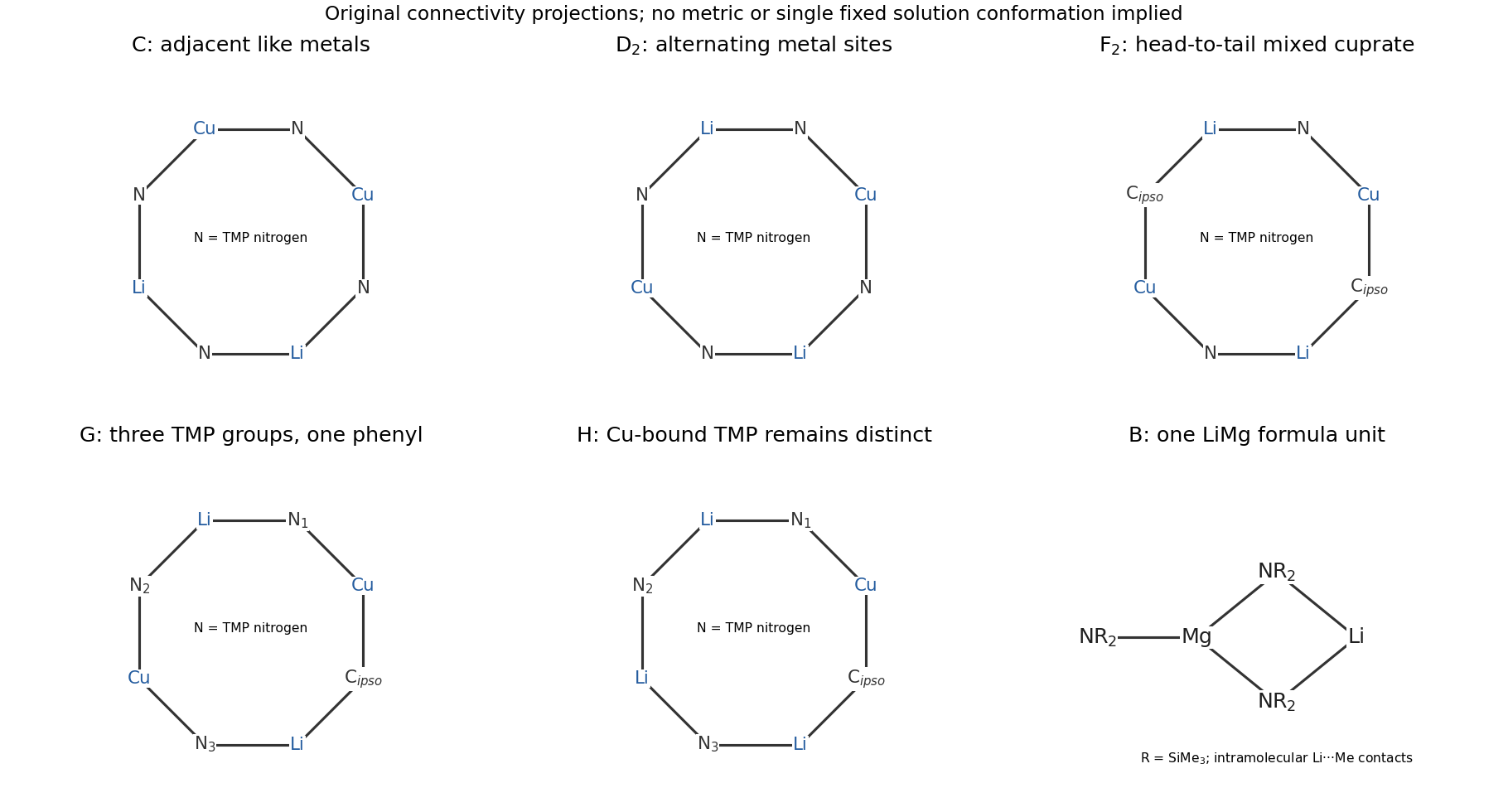
Codex 0 2026-10-20F is an eight-membered ring with sequence , closed back to the first Cu. Each N belongs to TMP; each ipso carbon belongs to a phenyl group. Each Cu is approximately linear between one TMP nitrogen and one phenyl ipso carbon. Each Li contacts a TMP nitrogen and the phenyl group bound to the other Cu, so the dimer is assembled head-to-tail rather than from two independent separated ion pairs.
G has the eight-membered sequence , closed to Cu. The three N atoms belong to three TMP groups and the carbon belongs to the single phenyl group. Both copper sites remain approximately two-coordinate. The Li next to phenyl can also interact with its aromatic surface; this secondary contact need not have the same hapticity as in F. The figure gives a connectivity projection, not idealized square bond angles or an X-ray metric reconstruction.


Past exam of the chemistry course of the year 4 of the natural sciences course of the University of Cambridge 2022 Paper 2 Section H 32 c i Solution by Codex 0 2026-10-20
Codex 0 2026-10-20C and the dimer of D have the same composition, , but different metal ordering around an eight-membered metal–nitrogen ring. C has adjacent Cu sites and adjacent Li sites; in the conventional Gilman dimer D, Cu and Li alternate around the four metal positions. D is represented by per formula unit. The salt by-product is LiCl.
A TMP anion has formula and mass about 140.25. Therefore the mass per empirical unit is , giving for the dimer, consistent with . A monomer would be near 351 and is excluded. In C, inequivalent Cu/Cu, Cu/Li and Li/Li amide surroundings, combined with the constrained TMP orientations, permit the three methyl environments in the observed 1:2:1 integral ratio. D has the higher exchange-averaged methyl equivalence needed for one methyl signal. One signal need not imply that all instantaneous solid-state methyl environments are identical.
The remaining formulae follow from atom and charge balance:E can itself aggregate; its formula here specifies the copper-amide unit. F is a mixed organyl/amido Gilman cuprate, and G combines one F unit with one D unit. The distinct metal-ordering isomers and these mixed aggregates have experimental precedent.[ref]
A new route for the efficient metalation of unfunctionalized aromatics by Andrew J. Peel and others. 2019, metal-exchange isomers and mixed organyl/amido aggregates
Past exam of the chemistry course of the year 4 of the natural sciences course of the University of Cambridge 2022 Paper 2 Section G 31 d iii Solution by Codex 0 2026-10-20
Codex 0 2026-10-20At , attractive contact energies are weak compared with thermal fluctuations, so expanded coil-like conformations are favoured and the end-to-end distribution broadens towards larger distances. Strong short-range repulsion still limits overlap over an effective, temperature-dependent diameter. The soft Lennard-Jones model is therefore not exactly identical to a temperature-independent hard-sphere chain, even when attraction is relatively unimportant.
A sufficiently stiff spring keeps the chain contour length near in all three comparisons. If temperature instead becomes comparable with , increased bond stretching introduces an additional size change and the intended fixed-bond coil comparison breaks down. Every equilibrated trace should fluctuate around a stationary distribution; an expanding running mean caused by incomplete relaxation is not evidence for an equilibrium high-temperature state.
Past exam of the chemistry course of the year 4 of the natural sciences course of the University of Cambridge 2022 Paper 2 Section G 31 d ii Solution by Codex 0 2026-10-20
Codex 0 2026-10-20For a genuinely equilibrated low-temperature attractive chain, many nonbonded contacts lower the energy. Compact conformations normally dominate, giving a smaller characteristic end-to-end distance than the high-temperature coil. The trace can remain near particular compact basins for long periods but must, under the stated premise, sample their correct equilibrium weights. The end-to-end distribution may have structure associated with distinct compact shapes; the end beads need not be nearest neighbours, so a compact globule does not force .
For there is a rounded finite-system crossover rather than a sharply defined bulk coil–globule phase transition. The exact histogram requires the dimensionless temperature, stiffness and treatment of bonded-pair Lennard-Jones interactions, none of which is numerically specified.
Past exam of the chemistry course of the year 4 of the natural sciences course of the University of Cambridge 2022 Paper 2 Section G 31 d i Solution by Codex 0 2026-10-20
Codex 0 2026-10-20With an attractive Lennard-Jones potential and , a short run can remain trapped in an initial conformation or a metastable compact state. A distance trace may show a long apparently stationary segment, an initial collapse, or occasional jumps between local structures; its histogram depends on initialization and is not necessarily an equilibrium distribution. An extended start need not collapse on the available run length, and a compact start need not already be the global minimum.
Accepting only downhill moves would make this trapping worse and would not sample the specified finite-temperature canonical ensemble. The sketch should therefore label this trace as unequilibrated and avoid assigning its mean a thermodynamic interpretation.
Past exam of the chemistry course of the year 4 of the natural sciences course of the University of Cambridge 2022 Paper 2 Section G 31 c ii Solution by Codex 0 2026-10-20
Codex 0 2026-10-20At room temperature, the same hard-core exclusion remains temperature independent. If the spring remains stiff, the conformational distribution remains broadly similar to the low-temperature expanded-coil distribution. Finite bond-length fluctuations increase with and can slightly enlarge the length scale and distribution width. The radial bond measure also favours lengths slightly above the harmonic minimum.
The comparison depends on the dimensionless stiffness , not on the word “room” alone. There is no attractive energy in this model to produce a low-temperature globule and high-temperature coil transition. Monte Carlo decorrelation speed can change with temperature and proposal scale, but the premise already stipulates adequate equilibrium sampling in both cases.
There are unlisted articles, also show them or only show them.