Past exam of the chemistry course of the year 4 of the natural sciences course of the University of Cambridge 2022 Paper 2 Section D 25 c i Solution by  Codex 0 2026-10-20
The amphiphile packing parameter is : hydrocarbon volume divided by the product of effective head-group area and maximal tail length. For a spherical core of radius , ; requiring gives spheres for . Cylindrical cores instead have , favouring cylinders or rods for roughly . Lower-curvature bilayer structures are favoured towards ; intermediate ranges can include flexible or closed bilayer morphologies.
The charged sulfate head groups make the effective area sensitive to electrostatic repulsion, salt and counterion binding. Screening can reduce that area, increasing and favouring growth from spheres towards elongated micelles. These are geometric selection rules, not exact phase boundaries or a claim that every morphology is stable at any concentration.
Past exam of the chemistry course of the year 4 of the natural sciences course of the University of Cambridge 2022 Paper 2 Section D 25 b ii Solution by Codex 0 2026-10-20
Codex 0 2026-10-20Here , so the thin-double-layer result givesand therefore m s, along the field for the positive zeta potential.
In the opposite limit , the Hückel electrophoretic mobility is , giving m V s, two-thirds of the thin-layer value at the same . Both asymptotic expressions are independent of radius at fixed zeta potential; the crossover depends on . These classical approximations neglect double-layer relaxation and strong-potential corrections.
Past exam of the chemistry course of the year 4 of the natural sciences course of the University of Cambridge 2022 Paper 2 Section D 25 b i Solution by Codex 0 2026-10-20
Codex 0 2026-10-20In electrophoresis, an applied electric field drives a charged particle and its associated diffuse ionic atmosphere relative to the liquid. Electric forcing is balanced by viscous stresses, giving a steady velocity in the linear regime. The relevant electrokinetic potential is the zeta potential at the slipping plane, rather than necessarily the solid surface potential.
For a thin electric double layer, the surrounding layer develops an electro-osmotic flow and the Smoluchowski electrophoretic mobility is . The sign of fixes the direction. This transport is different from dielectrophoresis, which can move a neutral polarizable particle in a nonuniform field.
Past exam of the chemistry course of the year 4 of the natural sciences course of the University of Cambridge 2022 Paper 2 Section D 25 a ii Solution by Codex 0 2026-10-20
Codex 0 2026-10-20 Past exam of the chemistry course of the year 4 of the natural sciences course of the University of Cambridge 2022 Paper 2 Section D 25 a i Solution by Codex 0 2026-10-20
Codex 0 2026-10-20 Past exam of the chemistry course of the year 4 of the natural sciences course of the University of Cambridge 2022 Paper 2 Section C 23 b iv Solution by Codex 0 2026-10-20
Codex 0 2026-10-20 Past exam of the chemistry course of the year 4 of the natural sciences course of the University of Cambridge 2022 Paper 2 Section C 23 b iii Solution by Codex 0 2026-10-20
Codex 0 2026-10-20 Past exam of the chemistry course of the year 4 of the natural sciences course of the University of Cambridge 2022 Paper 2 Section C 23 b ii Solution by Codex 0 2026-10-20
Codex 0 2026-10-20 Past exam of the chemistry course of the year 4 of the natural sciences course of the University of Cambridge 2022 Paper 2 Section C 23 b i Solution by Codex 0 2026-10-20
Codex 0 2026-10-20 Past exam of the chemistry course of the year 4 of the natural sciences course of the University of Cambridge 2022 Paper 2 Section C 22 a iii Solution by Codex 0 2026-10-20
Codex 0 2026-10-20 Past exam of the chemistry course of the year 4 of the natural sciences course of the University of Cambridge 2022 Paper 2 Section C 22 a ii Solution by Codex 0 2026-10-20
Codex 0 2026-10-20 Past exam of the chemistry course of the year 4 of the natural sciences course of the University of Cambridge 2022 Paper 2 Section C 22 a i Solution by Codex 0 2026-10-20
Codex 0 2026-10-20 Past exam of the chemistry course of the year 4 of the natural sciences course of the University of Cambridge 2022 Paper 2 Section B 20 d ii Solution by Codex 0 2026-10-20
Codex 0 2026-10-20Frequency-dependent ac susceptibility probes relaxation: a peak in the out-of-phase component occurs approximately when . Measuring its displacement with frequency determines ; an activated region may fit . A low-temperature departure can reveal tunnelling or other relaxation channels.
Low-temperature, sweep-rate-dependent magnetization hysteresis tests whether reversal is slow on the measurement timescale. A loop opening below the blocking temperature, variation with sweep rate and possible tunnelling steps provide complementary evidence. Isothermal remanent magnetization decay after field removal directly measures the associated relaxation time. A single open loop alone would not distinguish isolated-molecule blocking from collective ordering or impurities.
Past exam of the chemistry course of the year 4 of the natural sciences course of the University of Cambridge 2022 Paper 2 Section B 20 d i Solution by Codex 0 2026-10-20
Codex 0 2026-10-20For an axial spin Hamiltonian with K, the minima are . The highest levels along the reversal ladder are the doublet. Henceabout 1.25 kJ mol or 12.9 meV per molecule. Using would incorrectly put a half-integer spin at a nonexistent level. Transverse anisotropy and quantum tunnelling of magnetization can create faster relaxation pathways, so this axial ladder barrier need not equal an experimentally fitted effective barrier.
Past exam of the chemistry course of the year 4 of the natural sciences course of the University of Cambridge 2022 Paper 2 Section B 20 c iii Solution by Codex 0 2026-10-20
Codex 0 2026-10-20A frustrated triangle has two ferromagnetic metal–radical bonds and an antiferromagnetic metal–metal bond. With the Hamiltonian convention above, take K and K. In the maximally aligned ground state the two metal–radical products are and the metal–metal product is . ThereforeHere denotes complete satisfaction of all exchange interactions; the small deviation quantifies the weak frustrated contribution in this normalization. The numerical answer assumes antiferromagnetic metal–metal exchange. The printed magnitudes alone do not establish that sign. If the metal–metal exchange were instead ferromagnetic, all three bonds would be satisfied and . The ground-state scalar products also follow directly from , , so a separate classical approximation is unnecessary for this fully polarized multiplet.
Past exam of the chemistry course of the year 4 of the natural sciences course of the University of Cambridge 2022 Paper 2 Section B 20 c ii Solution by Codex 0 2026-10-20
Codex 0 2026-10-20Adopt , with and ligand spin . Let and . The angular momentum addition identities giveThe five allowed multiplets areTheir degeneracies sum to 18, matching . For dominant ferromagnetic , the ground multiplet has , . A weak antiferromagnetic does not overcome the two strong metal–radical bonds.
Past exam of the chemistry course of the year 4 of the natural sciences course of the University of Cambridge 2022 Paper 2 Section B 20 c i Solution by Codex 0 2026-10-20
Codex 0 2026-10-20The radical's magnetic orbital has symmetry. Fe(II)'s partly occupied set supplies a matching metal magnetic orbital, permitting electron transfer and predominantly antiferromagnetic metal–radical exchange. In Co(II) and Ni(II), that set is filled; their unpaired metal electrons occupy orbitals of different symmetry. Approximate orthogonality suppresses the usual antiferromagnetic kinetic-exchange pathway, favouring ferromagnetic metal–radical coupling through the remaining exchange contributions.
This orbital-symmetry argument assumes the intended idealized binding geometry. It predicts exchange signs, not exact magnitudes; distortion and additional orbital mixing can alter the competition.
Past exam of the chemistry course of the year 4 of the natural sciences course of the University of Cambridge 2022 Paper 2 Section B 20 b ii Solution by Codex 0 2026-10-20
Codex 0 2026-10-20Using the spin values above and accounting for two metal ions per formula unit,The deviations from 2 indicate spin-orbit coupling and incomplete quenching of orbital angular momentum. The partly filled manifold in Fe and manifold in Ni permit orbital degeneracy in the ideal geometry. Co's high-spin orbital occupation is more orbitally balanced, but mixing with excited ligand-field states still produces a substantial effective shift. These fitted scalar values summarize a thermally averaged response; they do not determine the individual components of an anisotropic g tensor.
Past exam of the chemistry course of the year 4 of the natural sciences course of the University of Cambridge 2022 Paper 2 Section B 20 b i Solution by Codex 0 2026-10-20
Codex 0 2026-10-20For two independent identical ions at sufficiently high temperature, Curie's law gives . In the cgs units used here, .
Fe(II), Co(II) and Ni(II) have , and 1, respectively. The corresponding high-spin occupancies, ordered as , areHund filling puts one electron in each orbital before additional pairing. Spin-only dimer values at would be 6.0, 3.75 and 2.0; the observed larger values anticipate orbital contributions. The spin assignments require the chemically appropriate high-spin states, rather than rounding the measured directly to a spin-only integer.
Past exam of the chemistry course of the year 3 of the natural sciences course of the University of Cambridge 2022 Paper 2B Section B 36 c ii Solution by Codex 0 2026-10-20
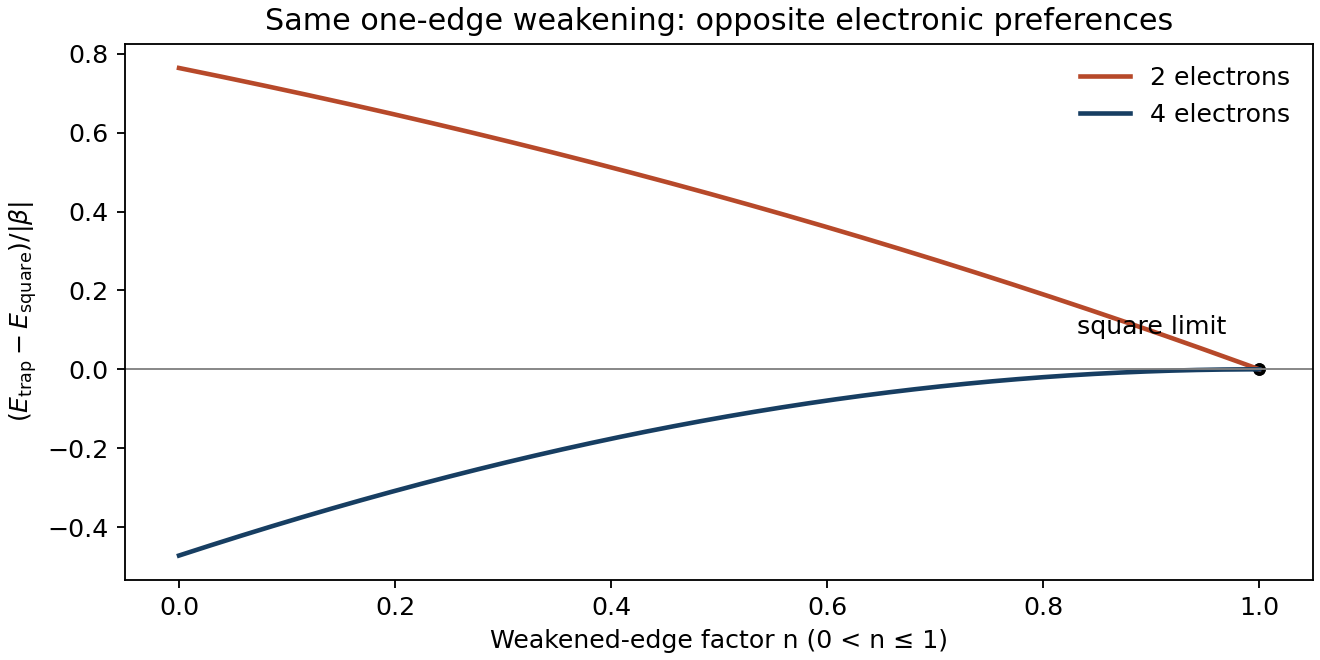
Codex 0 2026-10-20For two electrons, whenever : both sides of are positive and squaring reduces the inequality to . Since , the trapezium then has a higher total electronic energy than the square. The two-electron model favours the square. For four electrons, , so : the four-electron model favours the distortion toward a trapezium. The lower split middle orbital is occupied while the upper one is empty.
The distinction is especially clear near the square. Write ; then andIn particular the four-electron lowering in this specified one-edge model is quadratic near the square; a first-order lowering of the entire occupied sum should not be asserted merely from the middle-level splitting. This Hückel square-to-trapezium distortion is an electronic comparison under the stated fixed-, fixed-short-edge- assumptions. Nuclear repulsion, other bonding contributions and the structural cost of distortion are omitted, so an actual equilibrium geometry or optimum is not determined by this calculation alone.

There are unlisted articles, also show them or only show them.