Past exam of the chemistry course of the year 3 of the natural sciences course of the University of Cambridge 2022 Paper 2B Section B 36 c i Solution by  Codex 0 2026-10-20
Put . For , , since . Remembering , the two lowest trapezium molecular orbital energies areThe remaining levels lie at and . Filling the lowest spatial orbitals with opposite-spin pairs givesFor the square four-electron case, two electrons occupy the lowest orbital and two occupy the degenerate set. Their summed one-electron energy is fixed here, but this Hückel method calculation alone does not decide the spin or correlation within that open shell.
Past exam of the chemistry course of the year 3 of the natural sciences course of the University of Cambridge 2022 Paper 2B Section B 36 b iii Solution by Codex 0 2026-10-20
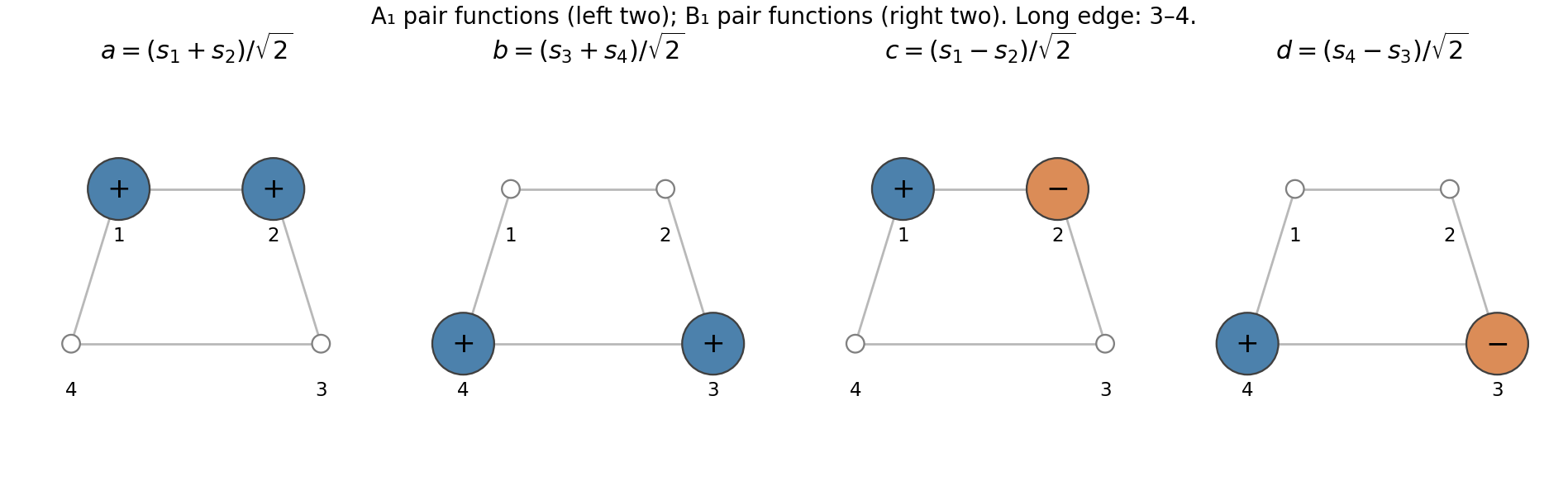
Codex 0 2026-10-20The long edge is –. In the orthonormal pair basis , its weaker resonance integral changes the second diagonal element. The two short side edges contribute an inter-pair matrix element , givingWith , its secular equation isThe eigenvalues are thereforeAt they become and , agreeing with the square limit. Symmetry permits mixing of the two pair functions; treating each pair as an isolated bond would miss the off-diagonal term.
Past exam of the chemistry course of the year 3 of the natural sciences course of the University of Cambridge 2022 Paper 2B Section B 36 b ii Solution by Codex 0 2026-10-20
Codex 0 2026-10-20Within each pair the in-phase and out-of-phase combinations have and symmetry respectively. One normalized choice isThe sign convention for is chosen to make the off-diagonal interaction positive in the corresponding two-by-two block. It does not change the physical predictions. These are pair symmetry-adapted linear combinations; the actual molecular orbitals are linear combinations within each of the two equal-symmetry pairs, found by diagonalizing the blocks.
Past exam of the chemistry course of the year 3 of the natural sciences course of the University of Cambridge 2022 Paper 2B Section B 36 b i Solution by Codex 0 2026-10-20
Codex 0 2026-10-20Use the trapezium's printed axes, with principal axis in its plane and perpendicular to the plane. For either site pair or , the group representation has characters of a representation in the order : identity and the molecular-plane mirror fix both s orbitals, while the other two operations exchange them. The character inner products give in the C2v molecular point group.
Past exam of the chemistry course of the year 3 of the natural sciences course of the University of Cambridge 2022 Paper 2B Section B 36 a iv Solution by Codex 0 2026-10-20
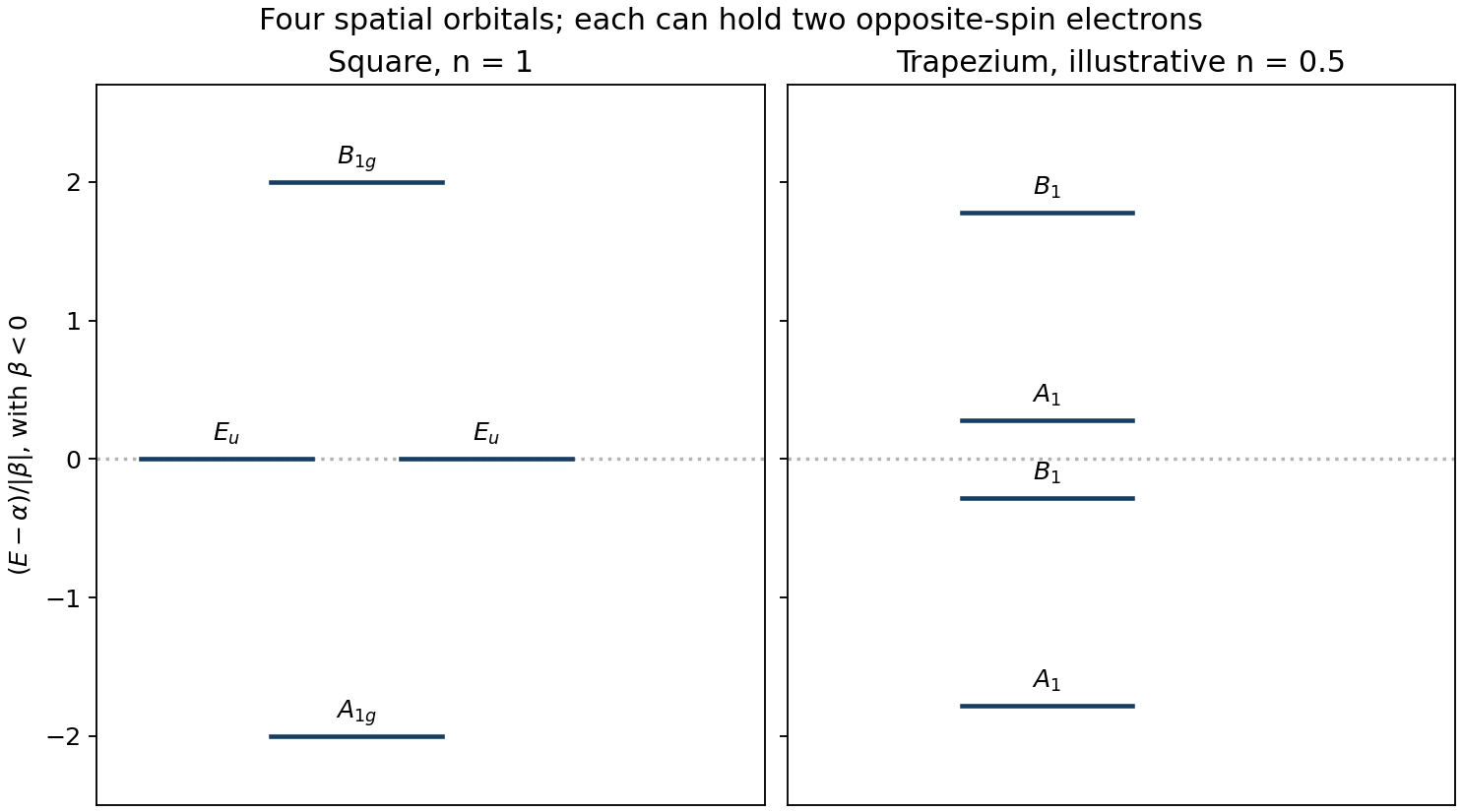
Codex 0 2026-10-20The molecular orbital diagram has one level at labelled , two degenerate levels at labelled , and one level at labelled , in increasing energy for . Each spatial molecular orbital admits two opposite-spin electrons. The diagram below also shows how one representative distortion lifts the middle degeneracy; the distorted scale is illustrative, not a fitted molecular spectrum.
Past exam of the chemistry course of the year 3 of the natural sciences course of the University of Cambridge 2022 Paper 2B Section B 36 a iii Solution by Codex 0 2026-10-20
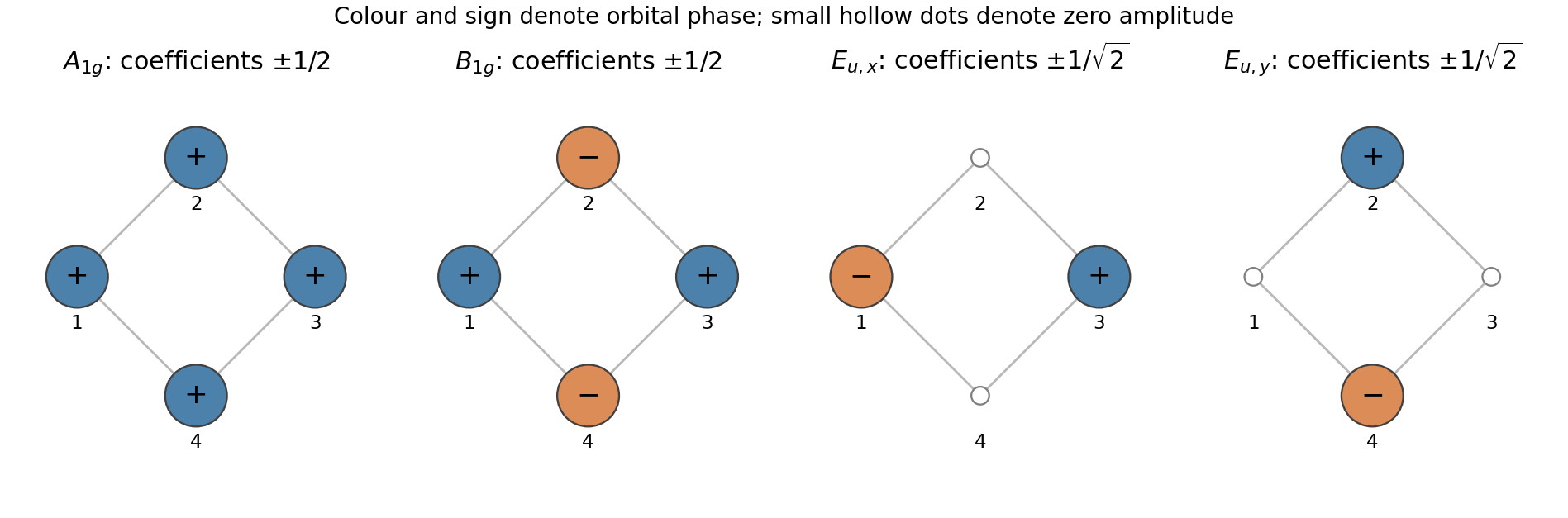
Codex 0 2026-10-20Use a common Coulomb integral on each site, a resonance integral on each adjacent pair, zero interaction across a diagonal, and the identity overlap matrix. In site order the Hückel method givesApplying it to the four symmetry-adapted linear combinations givesFor the conventional bonding sign , the all-in-phase combination is lowest and the alternating combination is highest. The combinations have canceling nearest-neighbour interactions and are nonbonding within this model.
Past exam of the chemistry course of the year 3 of the natural sciences course of the University of Cambridge 2022 Paper 2B Section B 36 a ii Solution by Codex 0 2026-10-20
Codex 0 2026-10-20Treat the site atomic orbitals as orthonormal, as in the Hückel method. A normalized set of symmetry-adapted linear combinations isThe first combination is unchanged by every operation; the alternating combination has the transformation signs of for the printed axes. The last two transform together like . The squared coefficients sum to one in each case, and their pairwise inner products vanish. Any orthogonal rotation of the two combinations is an equally valid basis for that degenerate subspace.
Past exam of the chemistry course of the year 3 of the natural sciences course of the University of Cambridge 2022 Paper 2B Section B 36 a i Solution by Codex 0 2026-10-20
Codex 0 2026-10-20The drawn axes pass through opposite sites, rather than along the square edges. In the D4h molecular point group class order , an s orbital contributes whenever its centre is fixed and zero otherwise. ThusFor example, a transverse twofold rotation about the printed axis fixes sites 1 and 3, while its diagonal counterpart exchanges all four sites. Reflection in the square plane fixes every site. Taking character inner products, with class sizes , givesThese have dimensions . The label is tied to the printed diagonal-axis convention; rotating the transverse coordinate labels by would interchange and .
Past exam of the chemistry course of the year 3 of the natural sciences course of the University of Cambridge 2022 Paper 2B Section B 35 c ii Solution by Codex 0 2026-10-20
Codex 0 2026-10-20Express the rotational constant as a spectroscopic wavenumber . The rotational absorption selection rule givesSuccessive lines therefore have spacing , regardless of the starting . Both observed spacings are , giving . The three lines are consequently the , and transitions within the stated precision; the first observed line is not the line.
Using the given isotopic masses, the reduced mass isWith and in , the bond length follows fromThe small common offset relative to integer multiples of the spacing is immaterial at the precision of this model. A real ground-vibrational-state rotational constant determines an effective vibrationally averaged bond length; it need not equal the exact equilibrium separation.
Past exam of the chemistry course of the year 3 of the natural sciences course of the University of Cambridge 2022 Paper 2B Section B 35 c i Solution by Codex 0 2026-10-20
Codex 0 2026-10-20For a linear rigid rotor, dividing the angular momentum squared eigenvalue by twice the moment of inertia givesThe quantum degeneracy counts the values with the same energy. It excludes nuclear-spin multiplicity and any fine or hyperfine splitting absent from this model.
Past exam of the chemistry course of the year 3 of the natural sciences course of the University of Cambridge 2022 Paper 2B Section B 35 b ii Solution by Codex 0 2026-10-20
Codex 0 2026-10-20The azimuthal derivative is , so . For the polar part of the angular Laplacian,Their sum is , hence . Comparing these two eigenvalues with and gives , . The sign of follows from both minus signs in the calculation.
Past exam of the chemistry course of the year 3 of the natural sciences course of the University of Cambridge 2022 Paper 2B Section B 35 b i Solution by Codex 0 2026-10-20
Codex 0 2026-10-20Normalization of a wavefunction on the unit sphere uses solid angle , not the flat measure . Since ,where . ThereforeWith the usual phase convention this is the spherical harmonic . An arbitrary global unit-modulus factor would not change normalization or any observable.
Past exam of the chemistry course of the year 3 of the natural sciences course of the University of Cambridge 2022 Paper 2B Section B 34 d iii Solution by Codex 0 2026-10-20
Codex 0 2026-10-20The molecule with the larger inferred dissociation energy is assigned the stronger hydrogen–halogen bond: and . Moving from bromine to the larger iodine atom generally lengthens the bond and reduces effective overlap with the compact hydrogen orbital, so hydrogen iodide is more weakly bound. Independently, the tabulated ground-state harmonic constants near for hydrogen bromide and for hydrogen iodide agree with the inferred assignment.[ref]
Hydrogen bromide: Constants of diatomic molecules by Klaus P. Huber and others. Ground X 1Sigma+ row, harmonic wavenumber 2648.975 cm−1
[ref]Hydrogen iodide: Constants of diatomic molecules by Klaus P. Huber and others. Ground X 1Sigma+ row, harmonic wavenumber 2309.014 cm−1
The ordering is the identification criterion; the low-level Morse oscillator extrapolations above should not be presented as measured dissociation energies. Past exam of the chemistry course of the year 3 of the natural sciences course of the University of Cambridge 2022 Paper 2B Section B 34 d ii Solution by Codex 0 2026-10-20
Codex 0 2026-10-20Let and denote the measured fundamental and first-overtone wavenumbers, and put . Differences of the Morse oscillator levels giveConsequently , and . Substituting the two pairs of measured bands gives the following derived quantities:The conversion is , after multiplication by and consistent length units. Therefore the requested ground-state dissociation energies are and . The corresponding potential-well depths are and . These are extrapolations under the stipulated Morse oscillator model; two low-lying bands do not establish the accuracy of the real potential near dissociation.
Past exam of the chemistry course of the year 3 of the natural sciences course of the University of Cambridge 2022 Paper 2B Section B 34 d i Solution by Codex 0 2026-10-20
Codex 0 2026-10-20The strong band is the vibrational fundamental, and the weaker band near twice its wavenumber is the first vibrational overtone. At room temperature these high-frequency oscillators have overwhelmingly ground-state vibrational populations. In the harmonic-potential, linear-dipole limit the infrared selection rule is ; anharmonicity and nonlinear dipole dependence make the overtone weakly allowed. A hot band would lie near, and slightly below, the fundamental wavenumber, rather than near twice it.
Past exam of the chemistry course of the year 3 of the natural sciences course of the University of Cambridge 2022 Paper 2B Section B 33 c iii Solution by Codex 0 2026-10-20
Codex 0 2026-10-20Exact solutions of the Schrödinger equation are unavailable for most interacting or realistic molecular systems. The quantum variational principle turns the search for a ground-state wavefunction into optimization of a computable energy quotient in a tractable trial family. The result is an upper bound: enlarging a nested trial space can only lower or preserve the optimized energy, providing a systematic convergence check. Trial functions can incorporate boundary conditions and known symmetry before calculation. Near an exact normalized ground state, a small orthogonal wavefunction error changes the energy only to second order, which explains why useful energies can result from imperfect trial functions. This does not ensure that every other observable is equally accurate, nor that a restricted trial family captures correlation adequately. Excited states require orthogonality or appropriate symmetry restrictions; unrestricted minimization seeks the ground state, as the preceding calculation demonstrates.
Past exam of the chemistry course of the year 3 of the natural sciences course of the University of Cambridge 2022 Paper 2B Section B 33 c ii Solution by Codex 0 2026-10-20
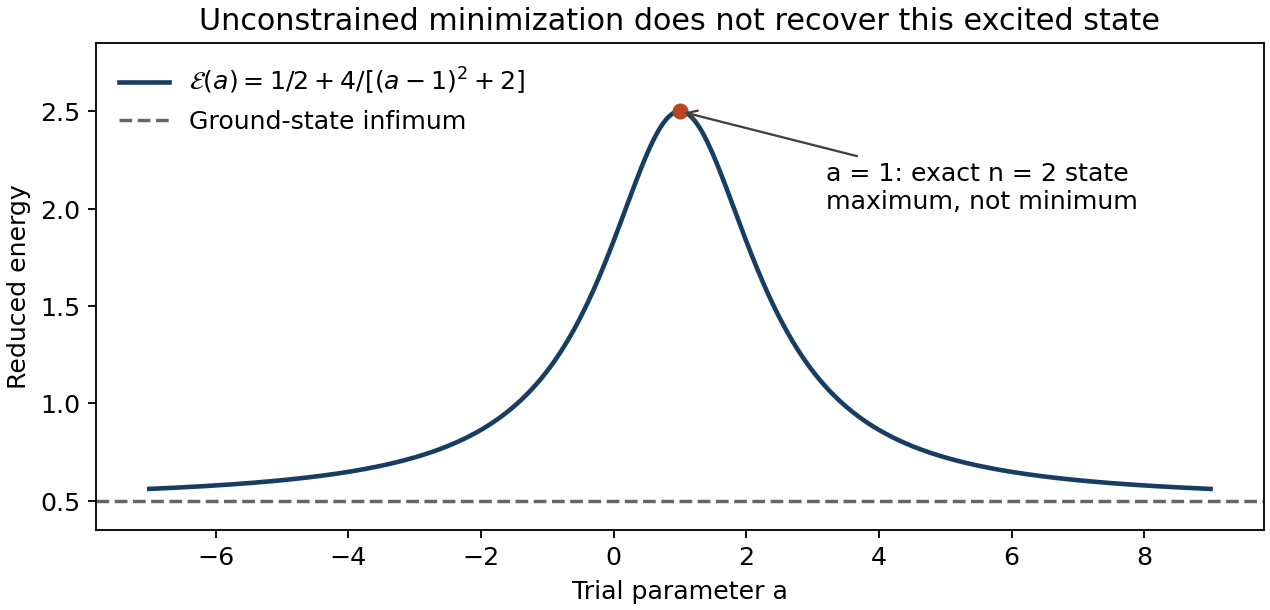
Codex 0 2026-10-20Direct evaluation of the Rayleigh quotient exposes a problem with the requested minimization. Using the supplied Gaussian integrals,ThusThe eigenfunction value is a maximum, not a minimum. Indeed , whereas is already lower. There is no finite minimizing in this family: its infimum is , approached as , when the normalized trial wavefunction approaches the ground state. This is consistent with the quantum variational principle. The original printed instruction in this subpart is therefore inconsistent as an unconstrained minimization; a stationary Rayleigh quotient need not be a minimum.
The intended excited state can instead be obtained by imposing an excited-state variational constraint. Orthogonality to the ground state requireswhich fixes . Every member of the family is even, so it is already orthogonal to the odd state. With the ground state excluded, the lowest allowed oscillator energy is therefore . In the exact oscillator basis, is proportional to , making both the maximum and the orthogonality correction transparent.


Past exam of the chemistry course of the year 3 of the natural sciences course of the University of Cambridge 2022 Paper 2B Section B 33 c i Solution by Codex 0 2026-10-20
Codex 0 2026-10-20Write and . Product differentiation for the reduced quantum harmonic oscillator givesFor an eigenfunction, this must equal at every . Matching the coefficients gives , and matching constants then gives . Hence and . This is the even oscillator state. Its normalized wavefunction is .
Past exam of the chemistry course of the year 3 of the natural sciences course of the University of Cambridge 2022 Paper 2A Section B 24 b ii Solution by Codex 0 2026-10-20
Codex 0 2026-10-20For weak anchoring, , use the normalized free-molecule eigenvectors and . The perturbation isIts diagonal matrix elements in this basis are both . First-order time-independent perturbation theory for the eigenvalues therefore givesHence and . The zero free translation requires taking a square root of its new eigenvalue, rather than Taylor-expanding the frequency about zero. It is not a degenerate eigenvalue in the stipulated one-dimensional two-coordinate model.
As a check, the exact squared frequencies areExpansion gives the same first-order results; the next lower-mode correction is . The perturbed eigenvectors contain small translation/stretch admixtures of order , consistent with the failure of uniform translation to remain an exact mode in orientation (1).
Past exam of the chemistry course of the year 3 of the natural sciences course of the University of Cambridge 2022 Paper 2A Section B 24 b i Solution by Codex 0 2026-10-20
Codex 0 2026-10-20With equal masses m, the two mass-weighted Hessians areFor a uniform displacement vector ,Therefore uniform translation is not a normal mode in orientation (1) when : anchoring only one atom mixes translation with internal stretching. It is an exact normal mode displacement in orientation (2) because both atoms have identical restoring terms. Its frequency is nevertheless nonzero, ; the antisymmetric stretch has . The rigid surface breaks free translational invariance in both orientations. A vector resembling a uniform translation need not be a zero-frequency mode when the molecule is anchored.
There are unlisted articles, also show them or only show them.