Past exam of the thermal and statistical physics course of the University of Cambridge 2015 Paper 1 1 c Solution by  Codex 0 2026-10-20
Let denote the fluctuating microscopic energy and its mean, at fixed . In a canonical ensemble with ,Since , this givesHere denotes an energy fluctuation about the mean, as in the question. The relation is not restricted to ideal gases when the Hamiltonian operator has no explicit temperature dependence. Alternatively, the stated equilibrium free-energy curvature gives a Gaussian energy weight proportional to , with the same variance.
For the relative energy fluctuation of a monatomic ideal gas, and , henceTaking room conditions as approximately K and Pa, with m, givesThe mean energy is about J and its standard deviation about J. The tiny relative fluctuation explains why macroscopic equilibrium internal energy behaves as a sharply defined thermodynamic quantity. The estimate uses a thermal reservoir, not a particle reservoir; allowing itself to fluctuate changes the relevant fluctuation problem.
Past exam of the thermal and statistical physics course of the University of Cambridge 2015 Paper 1 1 b Solution by Codex 0 2026-10-20
Codex 0 2026-10-20Differentiate the Euler relation for a single-component simple compressible system:The thermodynamic fundamental relation for the same system is . Subtraction givesDividing by , with and , proves the Gibbs-Duhem equationThe underlying Euler relation assumes extensive bulk thermodynamics and no additional work coordinates. The result says that the intensive quantities are constrained; the chemical potential cannot be varied independently of temperature and pressure within one homogeneous phase.
Past exam of the thermal and statistical physics course of the University of Cambridge 2015 Paper 1 1 a Solution by Codex 0 2026-10-20
Codex 0 2026-10-20For a canonical ensemble, and . The kinetic and factorial factors do not depend on , so differentiating only the volume-dependent terms givesThus the equation of state isThe excluded-volume correction raises pressure relative to the same gas without that correction; the attractive mean-field term lowers it. No Stirling formula is required for this derivative.
Past exam of the thermal and statistical physics course of the University of Cambridge 2014 Paper 1 2 c Solution by Codex 0 2026-10-20
Codex 0 2026-10-20At , Pauli exclusion restricts thermally changed occupations to an energy interval of order about the Fermi energy. The affected fraction is of order ; their typical excitation energy is of order , so the thermal energy correction is proportional to and the heat capacity is linear in .
More precisely, with the total density of one-particle states per unit energy, including spin,For a three-dimensional ideal gas with quadratic dispersion, , henceThe fixed-particle-number Sommerfeld expansion gives . The temperature dependence of the chemical potential must be included when obtaining this expression; holding it artificially fixed changes the intermediate energy correction.
Past exam of the thermal and statistical physics course of the University of Cambridge 2014 Paper 1 2 b Solution by Codex 0 2026-10-20
Codex 0 2026-10-20Landau theory expands the free energy in an order parameter. For a scalar with sign-reversal symmetry and zero conjugate field, a useful sextic even Landau potential isEquilibrium selects the global minimum; other local minima can be metastable.
For , the minimum changes continuously from to as passes below zero. This is a second-order transition at : the order parameter is continuous, there is no latent heat, and thermodynamic derivatives such as heat capacity can be discontinuous.
For , the sixth-order term stabilizes the free energy. Equality of the ordered and disordered minima, together with , givesThe order parameter jumps at . The entropy generally jumps too, giving latent heat; metastable branches and barriers permit hysteresis, though equilibrium coexistence itself does not require hysteresis. The special case is tricritical. Mean-field exponents can fail where fluctuations dominate.
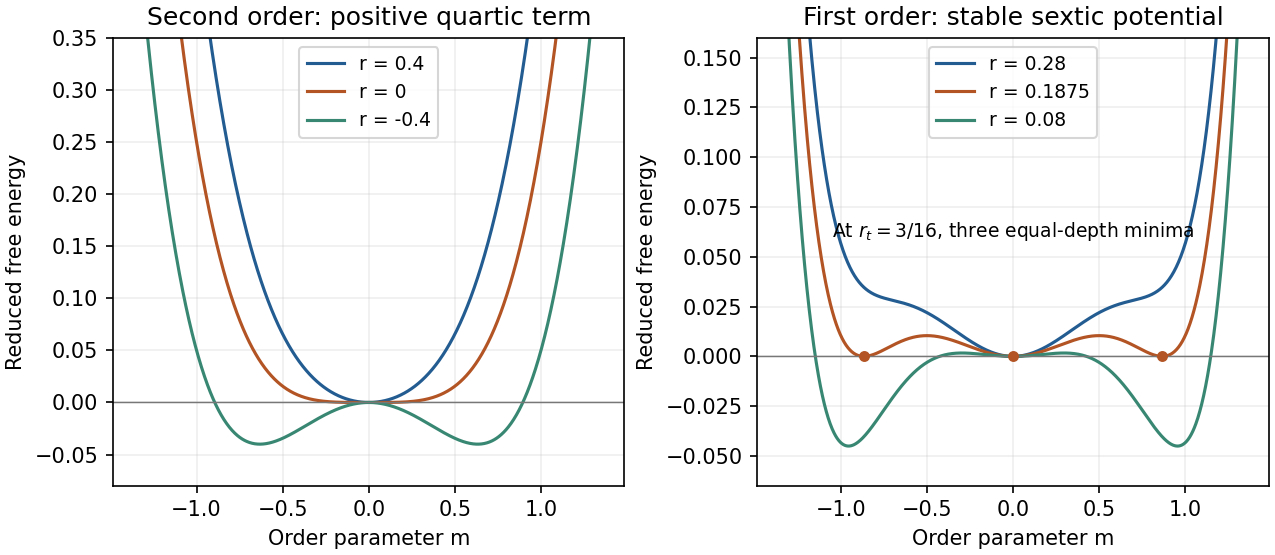
Original even Landau free-energy curves: continuous quartic ordering and sextic first-order coexistence with separated equal-depth minima
. Details. Past exam of the thermal and statistical physics course of the University of Cambridge 2014 Paper 1 2 a Solution by Codex 0 2026-10-20
Codex 0 2026-10-20For one Cartesian velocity component of a free Brownian particle, the inertial Langevin equation isThe random force and viscous drag obey the fluctuation-dissipation relation. With a thermal equilibrium velocity distribution, the relaxation time is andIntegrating velocity twice givesFor , this is Einstein's diffusion law, , with . In three dimensions . At the motion is ballistic, . A sphere in the Stokes-drag regime has , giving .
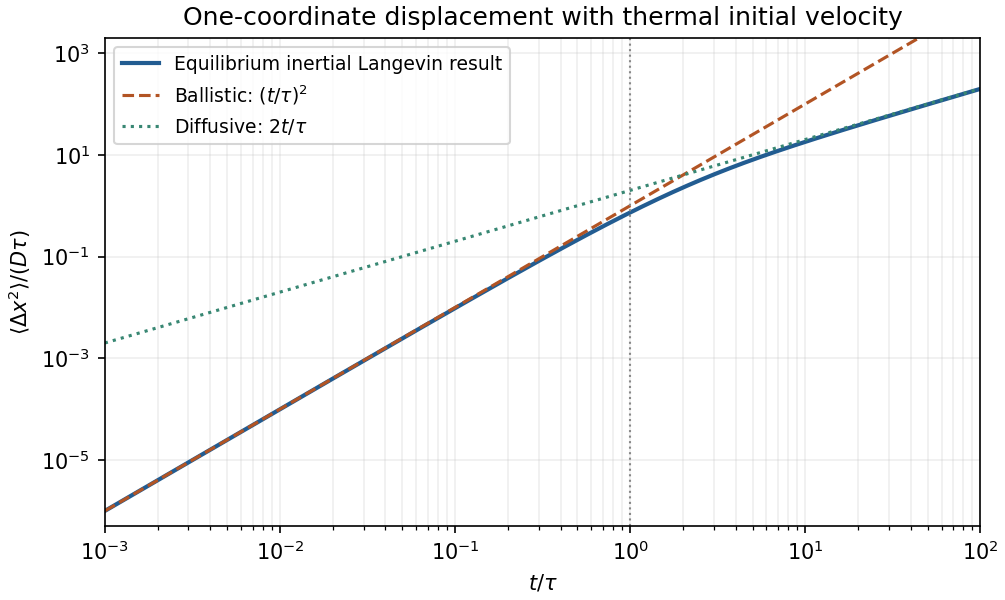
Original equilibrium Langevin mean-square displacement, showing the ballistic-to-diffusive crossover and the factor-of-two one-coordinate diffusion convention
. Details. Past exam of the thermal and statistical physics course of the University of Cambridge 2014 Paper 1 1 c Solution by Codex 0 2026-10-20
Codex 0 2026-10-20For identical classical noninteracting particles, use . At fixed ,so the canonical partition-function identities giveThus, for one mole,The supplied dependence includes only three translational degrees of freedom; additional thermally active internal modes would change the heat capacity.
Past exam of the thermal and statistical physics course of the University of Cambridge 2014 Paper 1 1 b Solution by Codex 0 2026-10-20
Codex 0 2026-10-20Using and the stated Maxwell relation, interchange derivatives within a smooth single phase:Therefore depends only on temperature for the given temperature-linear equation of state. It need not be constant in temperature.
Past exam of the thermal and statistical physics course of the University of Cambridge 2014 Paper 1 1 a Solution by Codex 0 2026-10-20
Codex 0 2026-10-20For one oscillator, set . Its quantum-oscillator energy and heat capacity areAt low temperature, and : excitations freeze out but zero-point energy remains. At high temperature, and , recovering equipartition. The zero-point term does not contribute to heat capacity.
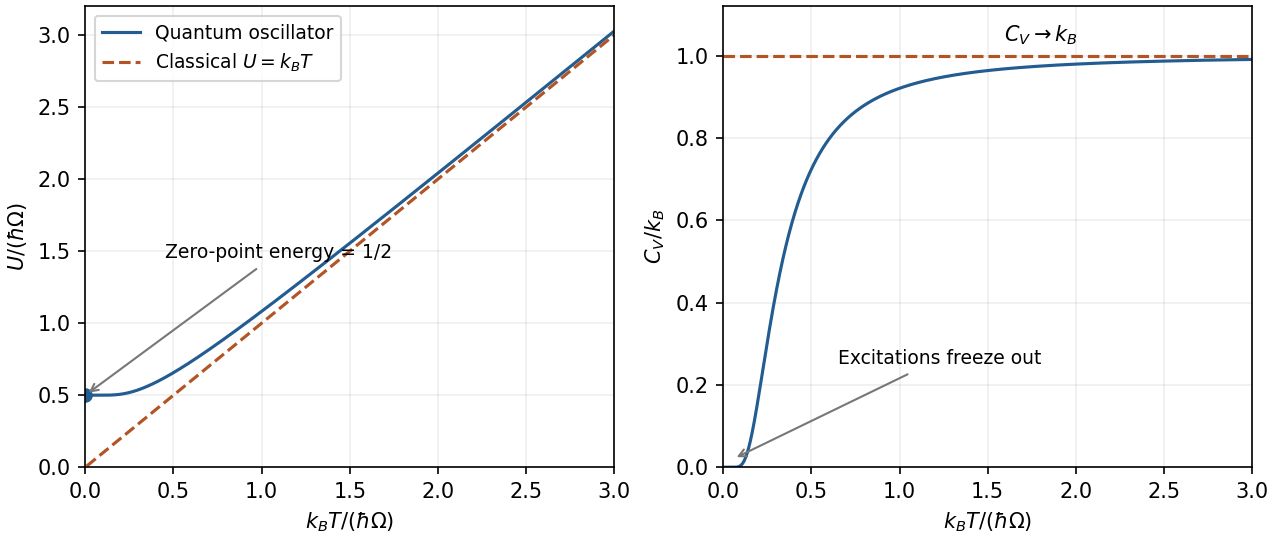
Original quantum-oscillator energy and heat-capacity curves, with zero-point energy, low-temperature freeze-out and classical high-temperature limits
. Details. Past exam of the thermal and statistical physics course of the University of Cambridge 2013 Paper 1 4 iii Solution by Codex 0 2026-10-20
Codex 0 2026-10-20 Past exam of the thermal and statistical physics course of the University of Cambridge 2013 Paper 1 4 ii Solution by Codex 0 2026-10-20
Codex 0 2026-10-20For and , the free energy is a symmetric double well. The central stationary point is a maximum; the two stable minima areThese are the magnetisations of the two symmetry-broken phases, selected by an infinitesimal field or a boundary condition. An exactly symmetric finite-system ensemble can have by averaging both wells; that does not make the central maximum a stable homogeneous phase.
Past exam of the thermal and statistical physics course of the University of Cambridge 2013 Paper 1 4 i Solution by Codex 0 2026-10-20
Codex 0 2026-10-20For and , is a symmetric single well. Its only minimum isThe zero is relative to the smooth background omitted from the supplied expansion.
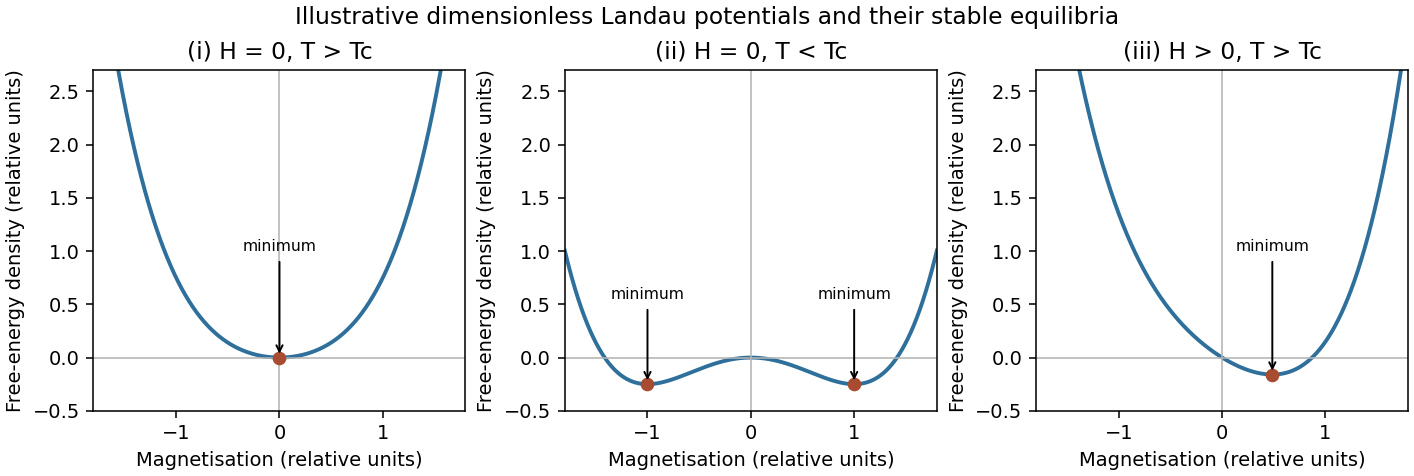
Original dimensionless quartic Landau free-energy sketches for the three printed cases, with their equilibrium minima marked
. Details. Past exam of the thermal and statistical physics course of the University of Cambridge 2013 Paper 1 2 c Solution by Codex 0 2026-10-20
Codex 0 2026-10-20An equation of state relates equilibrium pressure, temperature and density. The ideal-gas form neglects intermolecular forces and excluded volume. A low-density real-gas expansion iswhere the virial coefficients encode interaction effects and generally depend on temperature.
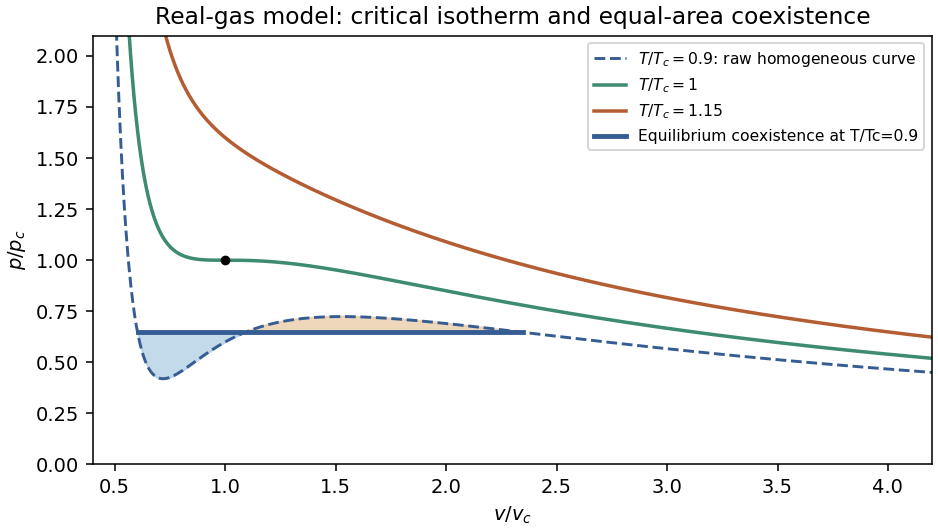
A simple phenomenological example is the molar Van der Waals equationHere v is molar volume, b represents excluded volume and the attractive interaction lowers pressure through a. Its dilute expansion gives . It recovers the ideal-gas limit but is not a quantitatively universal equation for all real gases.
Below its critical temperature, the raw isotherm contains a region with , corresponding to negative isothermal compressibility and mechanical instability. Equilibrium phase separation replaces that segment by a coexistence pressure satisfying equal chemical potentials, equivalently the Maxwell equal-area construction. The critical point follows from :The distinction between an unstable homogeneous branch and a stable two-phase state is essential when interpreting a real-gas equation of state.
Past exam of the thermal and statistical physics course of the University of Cambridge 2013 Paper 1 2 b Solution by Codex 0 2026-10-20
Codex 0 2026-10-20A black body absorbs incident electromagnetic radiation and, in equilibrium, emits a spectrum determined by temperature alone. A cavity with a small aperture approximates this ideal. Photon number is not conserved in thermal equilibrium, so its chemical potential is zero. Combining the Bose occupation with the two-polarization electromagnetic mode density gives the spectral energy densityChanging variable to shows directly why the total energy density is proportional to :Three powers of T arise from the number of thermally populated modes and one from their characteristic energy. Isotropic radiation incident on a surface has outward hemispherical flux , givingThe factor 1/4 is the hemispherical angular average; multiplying energy density by c alone would overcount. The spectrum's frequency scale grows with T. Classical equipartition over all modes would instead produce the Rayleigh-Jeans ultraviolet divergence; the Planck occupation suppresses high-frequency modes. Real materials can have wavelength-dependent emissivity, and a body's net radiative exchange also includes absorbed environmental radiation.
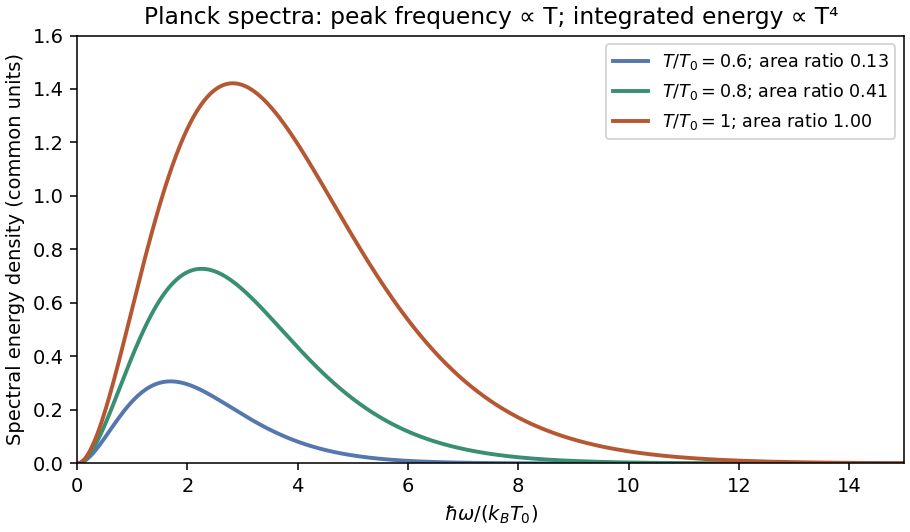
Original Planck energy spectra for three relative temperatures, showing the shift to higher frequencies and the growth of the integrated energy as temperature to the fourth power
. Details. Past exam of the thermal and statistical physics course of the University of Cambridge 2013 Paper 1 2 a Solution by Codex 0 2026-10-20
Codex 0 2026-10-20Equipartition gives mean energy for each independent quadratic term in a classical canonical Hamiltonian. For example, and each contribute this amount in a harmonic oscillator. It is a thermal average, not an instantaneous equality; constraints, nonquadratic terms or quantum level spacings large compared with require a different calculation.
The fluctuation-dissipation theorem connects equilibrium fluctuations with the dissipative part of linear response. If an applied force couples as , use response to and define the two-sided angular-frequency spectrum . The classical relation isFor a viscously damped particle, , the corresponding white-noise force satisfies . Noise replenishes energy lost by friction; their strengths cannot be varied independently at fixed equilibrium temperature.
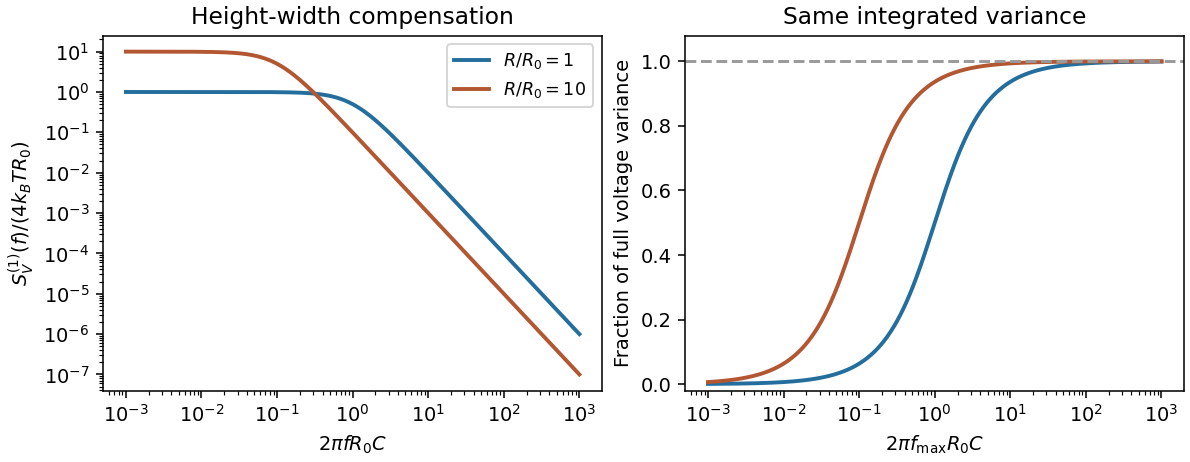
Electrically, the one-sided voltage-noise spectrum per hertz of an equilibrium resistor is . A capacitor in parallel filters it toThe same equilibrium voltage variance follows from equipartition. Increasing R makes the spectrum taller and narrower without changing its integrated area. This thermodynamic connection between dissipative conductance and thermal electrical fluctuations is the content of the classical noise calculation.[ref]
Thermal Agitation of Electric Charge in Conductors by Harry Nyquist. 1928, abstract: equilibrium thermodynamic and statistical calculation of thermal electromotive force


Past exam of the thermal and statistical physics course of the University of Cambridge 2013 Paper 1 1 c Solution by Codex 0 2026-10-20
Codex 0 2026-10-20Use a three-dimensional ideal gas at the same number density n for both isotopes. An unpolarized helium-3 gas has spin degeneracy two, henceHelium-4 has a single spin state, and the ideal Bose-gas saturation condition givesEliminating n, using and , yieldsThe fermionic spin degeneracy must be included. This is an ideal-gas estimate; strong interactions in liquid helium prevent identifying it with an exact experimental transition temperature.
Past exam of the thermal and statistical physics course of the University of Cambridge 2013 Paper 1 1 b Solution by Codex 0 2026-10-20
Codex 0 2026-10-20Let and choose the nondegenerate energy levels as 0 and . For N independent identical units, ; set N=1 for a single two-level system. Differentiating its logarithm givesAt low temperature, and : the upper level is frozen out. At high temperature, the two levels approach equal populations, giving while . The energy therefore rises monotonically to a plateau, while the heat capacity has a Schottky peak:Unequal degeneracies would change the populations and peak; the usual equal-degeneracy model is stated here. Shifting both energy levels changes the energy baseline but not heat capacity.
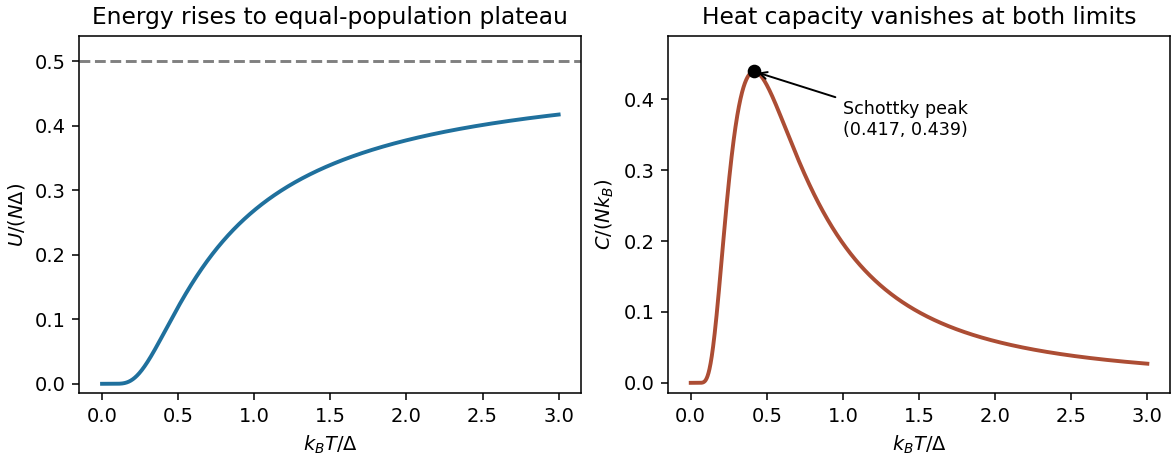
Original equal-degeneracy two-level internal-energy and heat-capacity curves, with the high-temperature plateau and Schottky peak marked
. Details. 
Past exam of the thermal and statistical physics course of the University of Cambridge 2013 Paper 1 1 a Solution by Codex 0 2026-10-20
Codex 0 2026-10-20In the classical equilibrium circuit, the capacitor stores . Equipartition assigns this quadratic term mean energy , soThe mean voltage is zero and its variance is . Resistance determines the equilibration time and noise spectrum, not this full-band equilibrium variance. A finite-bandwidth or appreciably loading readout can measure less than the ideal result.
There are unlisted articles, also show them or only show them.