Past exam of the chemistry course of the year 4 of the natural sciences course of the University of Cambridge 2022 Paper 1 4 d iii Solution by  Codex 0 2026-10-20
The Stern layer is the compact near-surface layer of specifically adsorbed or closely associated ions. The diffuse layer is the more extended, thermally distributed excess of counterions that screens the surface charge.
For water near , the Debye length can be writtenFor M KCl, M and nm. For a fully dissociated 2:2 electrolyte at the same formula-unit concentration, M, giving nm, half as large. These are linear-screening estimates, not sharp boundaries of the diffuse layer.
Past exam of the chemistry course of the year 4 of the natural sciences course of the University of Cambridge 2022 Paper 1 4 d ii Solution by Codex 0 2026-10-20
Codex 0 2026-10-20For two equal spheres of radius , the effective radius in the Derjaguin approximation is . The nonretarded attractive van der Waals potential isDifferentiating with respect to the surface gap givesThus the requested approximation gives an attraction of about pN. Here , whereas the Derjaguin approximation requires . This is the formal estimate requested by the hint, not a quantitatively reliable near-contact approximation for the printed dimensions.
Past exam of the chemistry course of the year 4 of the natural sciences course of the University of Cambridge 2022 Paper 1 4 d i Solution by Codex 0 2026-10-20
Codex 0 2026-10-20For the same geometry, separation and intervening medium, the attractive Van der Waals force scales with the effective Hamaker constant. With the constants treated as applying to those same conditions,The silver particles attract more strongly. This comparison is conditional on a common geometry and on using the appropriate constants across the actual medium. Constants for particles in vacuum cannot automatically be applied unchanged across a solvent.
Past exam of the chemistry course of the year 4 of the natural sciences course of the University of Cambridge 2022 Paper 1 4 c ii Solution by Codex 0 2026-10-20
Codex 0 2026-10-20A longer hydrophobic tail makes transfer from water into a micelle more favorable, lowering the critical micelle concentration within this homologous series. Ranking the four quoted concentrations therefore givesThis assignment uses the chain lengths and concentration ranking printed in the question; it does not identify the compounds by substituting an external table of measured concentrations.
Past exam of the chemistry course of the year 4 of the natural sciences course of the University of Cambridge 2022 Paper 1 4 c i Solution by Codex 0 2026-10-20
Codex 0 2026-10-20The critical micelle concentration is the approximate total surfactant concentration above which additional surfactant predominantly enters micelles. Below it, most surfactant is present as separate molecules; above it, the free-monomer concentration changes much more slowly while the micelle population increases.
Past exam of the chemistry course of the year 4 of the natural sciences course of the University of Cambridge 2022 Paper 1 3 c iii Solution by Codex 0 2026-10-20
Codex 0 2026-10-20TODO: user-deferred biology. Multiple-mutant metalloenzyme selectivity is deferred under the current nonbiology scope.
Past exam of the chemistry course of the year 4 of the natural sciences course of the University of Cambridge 2022 Paper 1 3 c ii Solution by Codex 0 2026-10-20
Codex 0 2026-10-20 Past exam of the chemistry course of the year 4 of the natural sciences course of the University of Cambridge 2022 Paper 1 3 c i Solution by Codex 0 2026-10-20
Codex 0 2026-10-20 Past exam of the chemistry course of the year 4 of the natural sciences course of the University of Cambridge 2022 Paper 1 2 b ii Solution by Codex 0 2026-10-20
Codex 0 2026-10-20Formal ionic counting gives La(III), N(−III), and therefore Re(VI), with a configuration. An isolated localized center would carry a saturation magnetic moment of order , much larger than the value quoted. It is not a ion made diamagnetic simply by an octahedral ligand field.
The spatially extended Re orbitals overlap strongly with N orbitals. Re–N interactions raise the -derived antibonding states, while interactions mix the states with the nitrogen network. Repetition through corner-sharing octahedra turns these combinations into broad energy bands. The nominal electron occupies a delocalized, partially filled band rather than an isolated magnetic orbital.
Only electrons close to the Fermi energy change their occupations appreciably in an applied magnetic field. Consequently a Pauli paramagnetism has a small, nonzero field-induced magnetization:when is the density of states including both spin directions, expressed per formula unit and per unit energy. This band model explains a very small moment without requiring the absence of electrons in the Re-derived band. The reported material has metallic transport and a Pauli-like response.[ref]
Preparation of bulk-phase nitride perovskite LaReN3 and topotactic reduction to LaNiO2-type LaReN2 by Simon D. Kloß and others. Magnetic and transport measurements, Figure 4
The description “saturated” in the question should not be interpreted as complete alignment of one localized spin per Re: a nearly linear metallic response over a laboratory field range need not be a true fully spin-polarized saturation moment.
Past exam of the chemistry course of the year 4 of the natural sciences course of the University of Cambridge 2022 Paper 1 2 b i Solution by Codex 0 2026-10-20
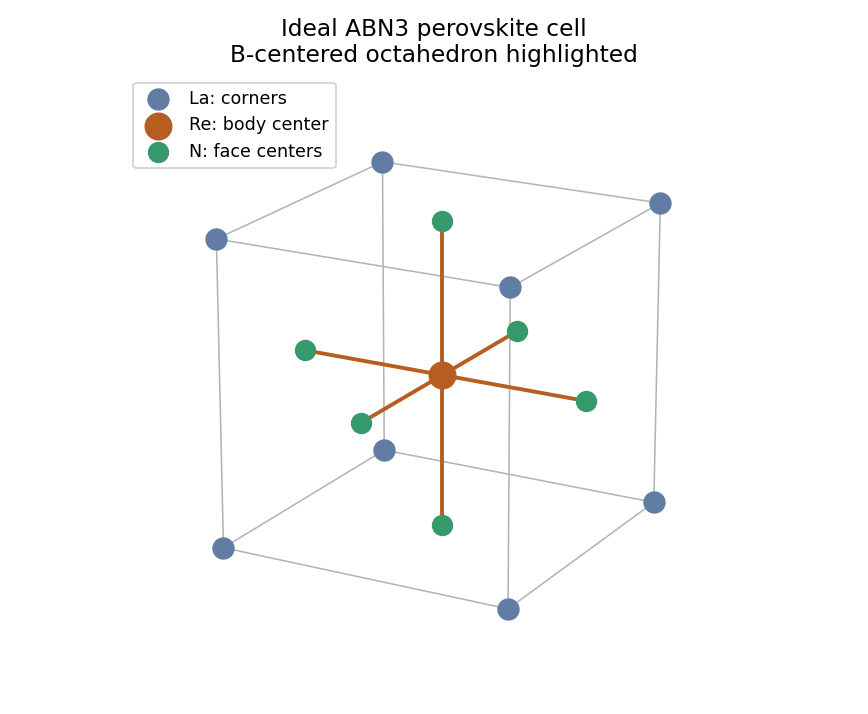
Codex 0 2026-10-20An ideal cubic perovskite structure is obtained by putting La at the cube corners, Re at the body center, and N at the face centers. In fractional crystal coordinates one convenient basis isThe counting is La, one Re and N per cell. Corner-sharing octahedra form the network, with La in the larger interstices. The ideal cell illustrates the connectivity; octahedral tilting can lower the actual crystal symmetry.

Past exam of the chemistry course of the year 4 of the natural sciences course of the University of Cambridge 2022 Paper 1 2 a ii Solution by Codex 0 2026-10-20
Codex 0 2026-10-20At high temperature, tends towards the nearly constant Curie constant of weakly correlated centers. On cooling, falls because neighboring spins increasingly correlate antiparallel. The broad maximum in marks the crossover from the high-temperature Curie-like regime to substantial short-range order.
At still lower temperature, the Magnetic susceptibility becomes small because the antiferromagnetic ladder favors a singlet-like ground state and has few thermally accessible magnetic excitations. An even-leg spin ladder can have a spin gap, which reinforces this suppression. A broad Magnetic susceptibility maximum and falling support short-range antiferromagnetic correlations; they do not establish a three-dimensional Néel transition. Such a transition would require independent evidence, rather than identifying the broad maximum itself as the ordering temperature.
Past exam of the chemistry course of the year 4 of the natural sciences course of the University of Cambridge 2022 Paper 1 2 a i Solution by Codex 0 2026-10-20
Codex 0 2026-10-20The four shortest contacts are the three Cu–N bonds and Cu–OR bond. They define an approximately square equatorial set. The two remaining Cu–O contacts are longer and define a strongly elongated axial direction, as expected for the Jahn-Teller effect of Cu(II).
Choose along the long contacts and towards the short equatorial donors. The singly occupied, predominantly metal magnetic orbital is then , with substantial Ligand in coordination chemistry admixture. All three pyrazine nitrogen donors lie in this equatorial set, so both ladder directions have strong metal–Ligand in coordination chemistry orbital overlap. Neighboring copper centers communicate through comparable pyrazine superexchange pathways. Virtual electron transfer between half-filled orbitals stabilizes the antiparallel arrangement, giving antiferromagnetic interactions in both directions with comparable magnitudes. The axial oxygen donors are much less effective exchange routes.
Past exam of the chemistry course of the year 4 of the natural sciences course of the University of Cambridge 2022 Paper 1 17 a ii Solution by Codex 0 2026-10-20
Codex 0 2026-10-20 Past exam of the chemistry course of the year 4 of the natural sciences course of the University of Cambridge 2022 Paper 1 17 a i Solution by Codex 0 2026-10-20
Codex 0 2026-10-20TODO: user-deferred biology. Biosynthetic interpretation of isotope labelling is deferred under the current nonbiology scope.
Past exam of the chemistry course of the year 4 of the natural sciences course of the University of Cambridge 2022 Paper 1 13 a ii Solution by Codex 0 2026-10-20
Codex 0 2026-10-20The trivalent dopant is comparable in radius to Na and is naturally accommodated on a sodium site rather than a chloride site. One charge-balanced incorporation reaction isThree cation sites are filled by one Y ion and two vacancies; the three chloride ions occupy the corresponding anion sites. The effective substitutional charge is balanced by two singly negative sodium vacancies.
YCl doping primarily increases sodium-vacancy-mediated ionic conductivity, provided the vacancies remain mobile rather than strongly bound to the dopant. In contrast, sodium-rich doping introduces electrons and anion vacancies or interstitial-related defects. Neither mechanism requires holes as its compensating carrier, and an increase in vacancy number need not translate proportionally into conductivity if defect association reduces mobility.
Past exam of the chemistry course of the year 4 of the natural sciences course of the University of Cambridge 2022 Paper 1 13 a i Solution by Codex 0 2026-10-20
Codex 0 2026-10-20One standard description of sodium-rich NaCl is removal of lattice chloride into a NaCl reservoir, leaving a positively charged chloride vacancy and an electron:This Kröger–Vink notation equation conserves atoms, chloride sites and effective charge. The electron can be trapped in the vacancy, forming an electrically neutral F center:Thus sodium excess introduces electronic defects and can give coloration. It does not imply that every added electron is a mobile conduction electron: electronic transport depends on trapping and thermal release. Chloride vacancies can also assist anion transport. An alternative microscopic incorporation route is a sodium interstitial plus an electron, but the vacancy–electron model describes the usual alkali-metal-colored halide.
Past exam of the chemistry course of the year 4 of the natural sciences course of the University of Cambridge 2022 Paper 1 12 a iii Solution by Codex 0 2026-10-20
Codex 0 2026-10-20TODO: user-deferred biology. Protein-labelling applications and their associated cycloaddition discussion is deferred under the current nonbiology scope.
Past exam of the chemistry course of the year 4 of the natural sciences course of the University of Cambridge 2022 Paper 1 12 a ii Solution by Codex 0 2026-10-20
Codex 0 2026-10-20Treat this as standalone organophosphorus chemistry. The phosphorus(III) lone pair attacks the terminal nitrogen of the organic azide. Cyclization of the initial phosphazide and loss of nitrogen give an iminophosphorane:The ortho amide provides a neighboring acidic NH proton and a carbonyl oxygen donor. A proton relay to the imino nitrogen and intramolecular OP attack generate a five-membered, O-bound pentacoordinate phosphorus intermediate. Water can then attack phosphorus, with proton transfer to nitrogen, followed by P–N cleavage and opening of the neighboring-group contact.
The overall hydrolysis products areThe carbonyl group assists the hydrolysis and is regenerated; the product is an aniline and the ortho-carboxamide phosphine oxide, rather than an amide-linked ligation product. The favorable five-membered intramolecular interaction and proton delivery help hydrolyze a normally rather persistent aryl iminophosphorane. This explanation concerns only the printed chemical transformation.
Past exam of the chemistry course of the year 4 of the natural sciences course of the University of Cambridge 2022 Paper 1 12 a i Solution by Codex 0 2026-10-20
Codex 0 2026-10-20 Past exam of the chemistry course of the year 4 of the natural sciences course of the University of Cambridge 2022 Paper 1 1 a iv Solution by Codex 0 2026-10-20
Codex 0 2026-10-20An approximately alternating styrene–maleic anhydride copolymer is produced. Its backbone alternates a segment with the two former alkene carbons of a maleic anhydride unit; those latter carbons remain connected to the intact five-membered cyclic anhydride ring.
Homolysis of benzoyl peroxide supplies initiating free radicals. Cross-propagation between electron-rich styrene and electron-poor maleic anhydride is favored over successive additions of the same monomer. Both carbon–carbon double bonds become backbone sigma bonds, without loss of a small molecule from each monomer. Initiator-derived benzoyloxy or phenyl fragments can occur at chain ends, with carbon dioxide formed when benzoyloxy free radicals decarboxylate.
There are unlisted articles, also show them or only show them.