Past exam of the chemistry course of the year 1 of the natural sciences course of the University of Cambridge 2021 Paper 1 2 b ii Solution by  Codex 0 2026-10-20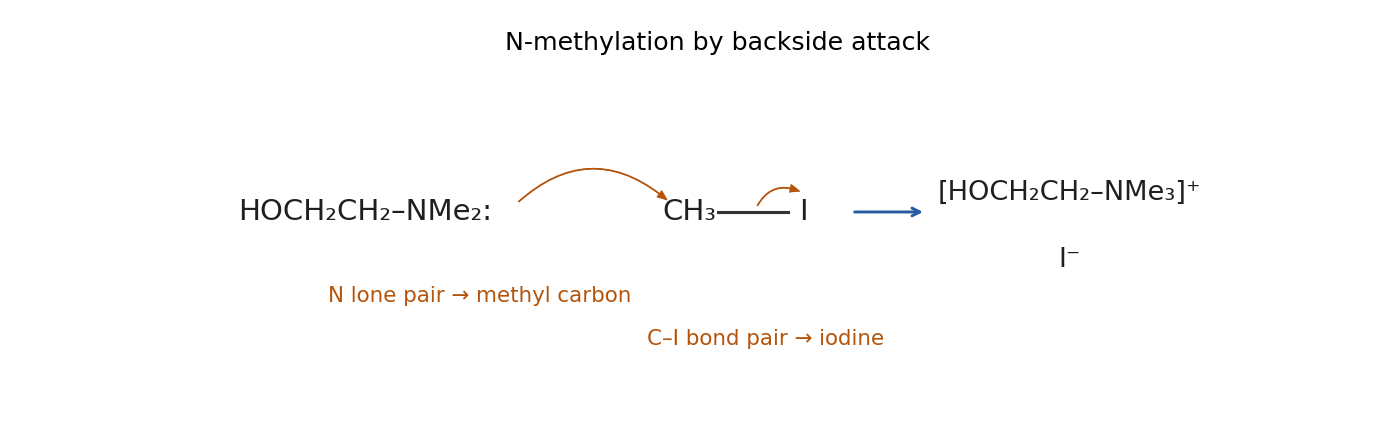
Past exam of the chemistry course of the year 1 of the natural sciences course of the University of Cambridge 2021 Paper 1 2 a vi Solution by Codex 0 2026-10-20
Codex 0 2026-10-20BeLi has three valence electrons: two occupy a bonding sigma orbital and the third its higher partner. The elementary bond order is therefore , with one unpaired electron: expect a relatively weak, paramagnetic, doublet diatomic molecule. Because Be attracts valence charge more strongly than Li, the bond is polar toward Be. This is a qualitative prediction, not a numerical dissociation energy.
This is the elementary picture of the lithium beryllium diatomic molecule.
Past exam of the chemistry course of the year 1 of the natural sciences course of the University of Cambridge 2021 Paper 1 2 a v Solution by Codex 0 2026-10-20
Codex 0 2026-10-20No ordinary covalent bond is expected. He's filled 1s orbital is very low in energy, whereas Be supplies another filled shell and much higher empty valence orbitals. Mixing the two occupied s combinations gives no net elementary bond-order gain, and their large energy mismatch limits useful shared covalent character. A very weak dispersion-bound encounter is a different possibility; the answer concerns a conventional covalent bond.
Past exam of the chemistry course of the year 1 of the natural sciences course of the University of Cambridge 2021 Paper 1 2 a iv Solution by Codex 0 2026-10-20
Codex 0 2026-10-20Both Be's occupied bonding and antibonding 2s levels cancel in the simplest diagram. Beryllium's relatively accessible empty 2p orbitals allow mixing and correlated configurations to change that cancellation and produce a weak bond. An s-only single-configuration picture is therefore insufficient; spectroscopy and accurate correlated calculations establish its binding.[ref]
For He, similarly gives zero elementary covalent bond order, but the empty-shell excitation gap is much larger and there is no comparable low-energy 2s/2p near-degeneracy. Thus it has no ordinary stable covalent bond.
The literal claim that He does not exist needs qualification: an extraordinarily weak, cold van der Waals helium dimer has been observed. That does not contradict the zero covalent-bond-order diagram.[ref]
The beryllium dimer and helium dimer illustrate two physically different ways that the elementary bond-order picture can miss weak binding.
Past exam of the chemistry course of the year 1 of the natural sciences course of the University of Cambridge 2021 Paper 1 2 a iii Solution by Codex 0 2026-10-20
Codex 0 2026-10-20 Past exam of the chemistry course of the year 1 of the natural sciences course of the University of Cambridge 2021 Paper 1 2 a ii Solution by Codex 0 2026-10-20
Codex 0 2026-10-20O: the two orbitals are the highest occupied, singly occupied spatial orbitals. The next completely empty spatial orbital is . An added electron can instead occupy the opposite-spin vacancy in a singly occupied pi-star orbital; this distinction matters if “LUMO” is being used for an electron-addition spin orbital.
Li: Homo ; next empty sigma orbital conventionally denoted in this elementary diagram. Be: Homo ; the low empty 2p manifold supplies the LUMO candidates, drawn as in the stated light-diatomic ordering. Mixing makes these labels descriptions of dominant atomic-orbital character, not strictly unmixed atomic functions.
This distinction is the open-shell frontier orbital convention.
Past exam of the chemistry course of the year 1 of the natural sciences course of the University of Cambridge 2021 Paper 1 2 a i Solution by Codex 0 2026-10-20
Codex 0 2026-10-20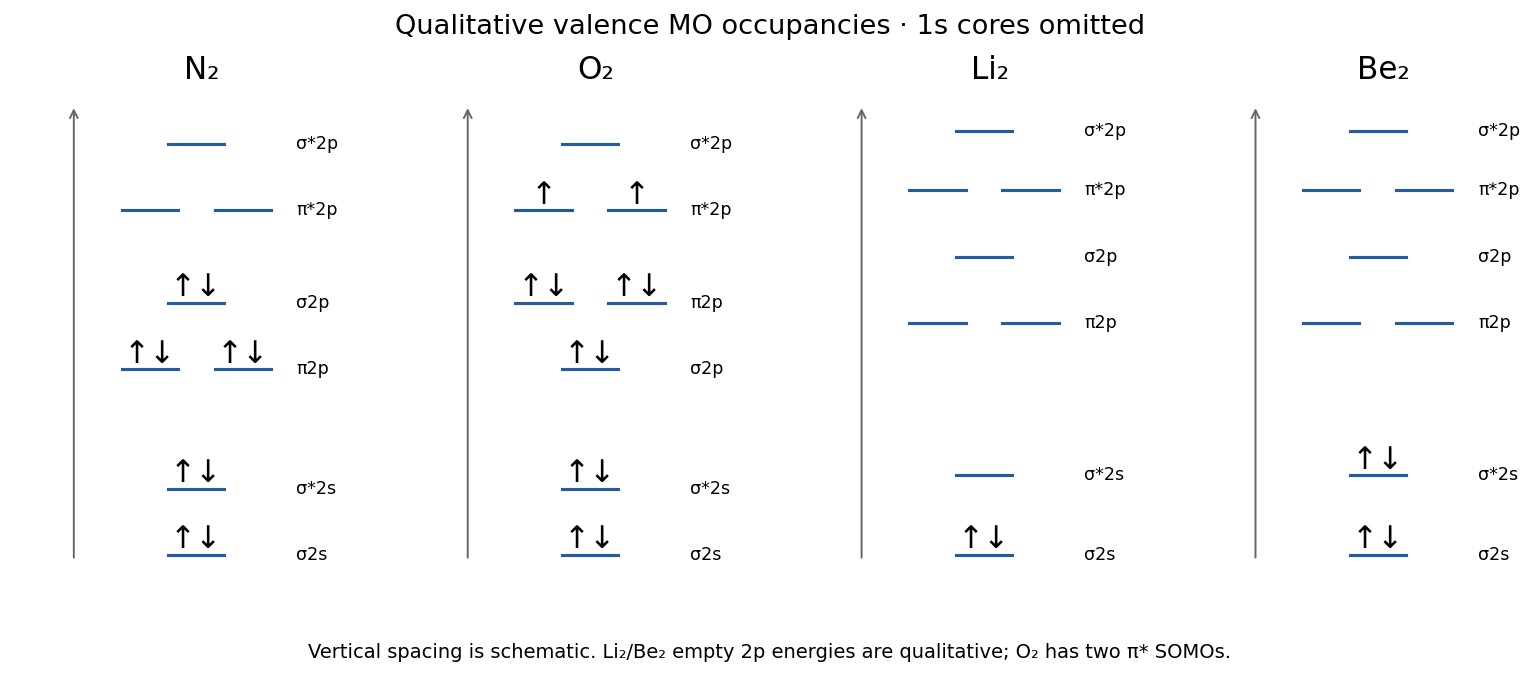
Qualitative valence molecular-orbital occupancies for nitrogen, oxygen, lithium and beryllium dimers
. Details. Suppress the filled 1s core pair, which contributes zero net bond order. For N, use the valence orderingand occupy it as .
For O, the ordering of the bonding 2p levels is reversed: . Occupancy is , with parallel spins in the two degenerate antibonding pi orbitals.
Li has ; Be has in the elementary valence description. Empty 2p-derived levels must also be included to discuss mixing and Be's weak bonding; their precise energies are not set by this qualitative diagram.
Past exam of the chemistry course of the year 1 of the natural sciences course of the University of Cambridge 2021 Paper 1 1 c iii Solution by Codex 0 2026-10-20
Codex 0 2026-10-20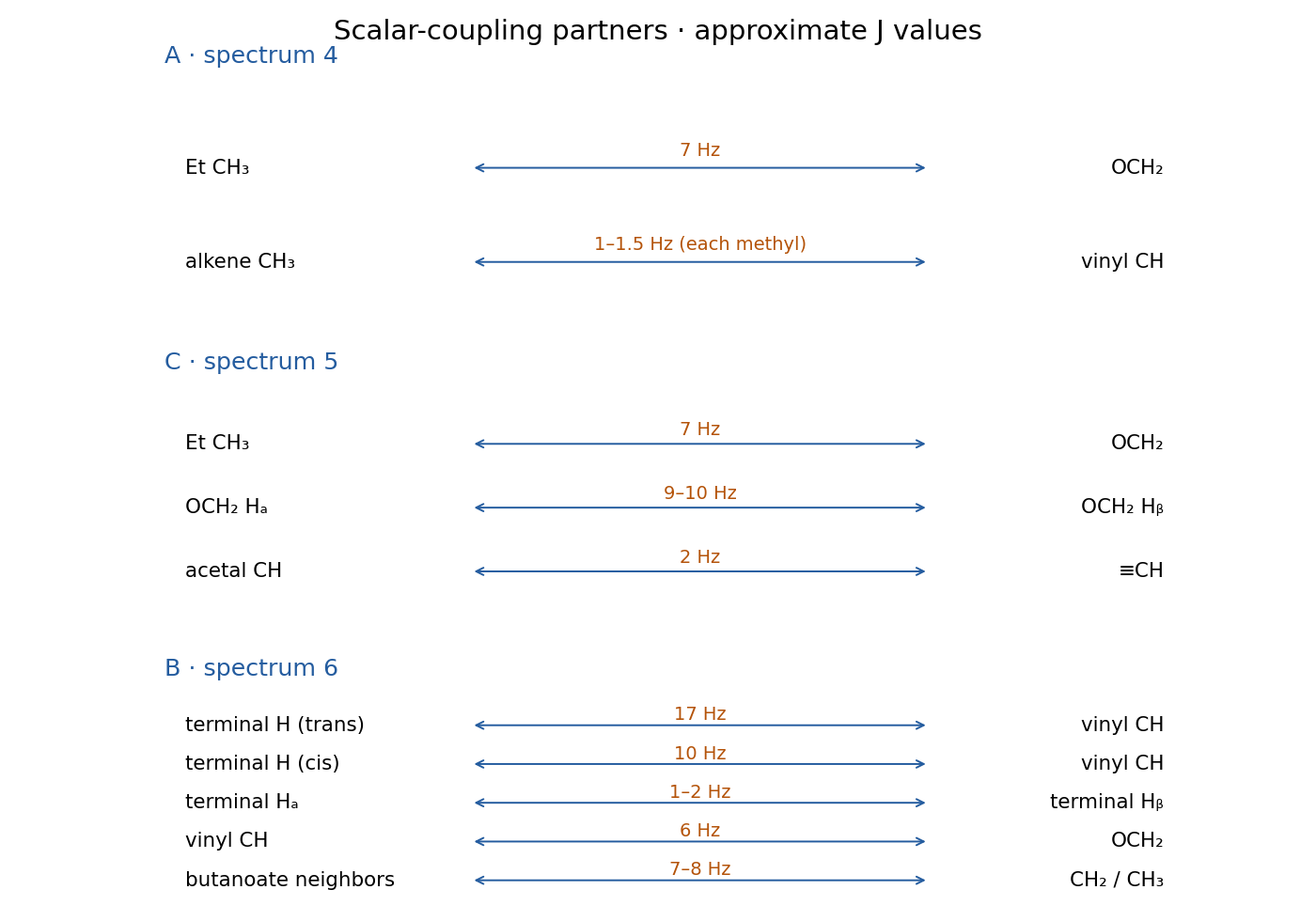
Coupling partners and approximate coupling constants, with line separations converted using 300 Hz per ppm
. Details. C: ethoxy CH ↔ CH, about ; the two OCH proton types have a geminal coupling of about –; acetal CH ↔ C≡CH has .
B: internal vinyl CH ↔ trans terminal H, about ; ↔ cis terminal H, about ; terminal CH geminal coupling about –. Vinyl CH ↔ OCH is about . Both vicinal links along the butanoate alkyl chain are about –.
Use when a separation is measured in ppm. Thus corresponds to about , whereas corresponds to about . These are approximate readings, not a fitted spin simulation.
The small four-bond splittings illustrate allylic scalar coupling and acetal-alkyne long-range coupling.
Past exam of the chemistry course of the year 1 of the natural sciences course of the University of Cambridge 2021 Paper 1 1 c ii Solution by Codex 0 2026-10-20
Codex 0 2026-10-20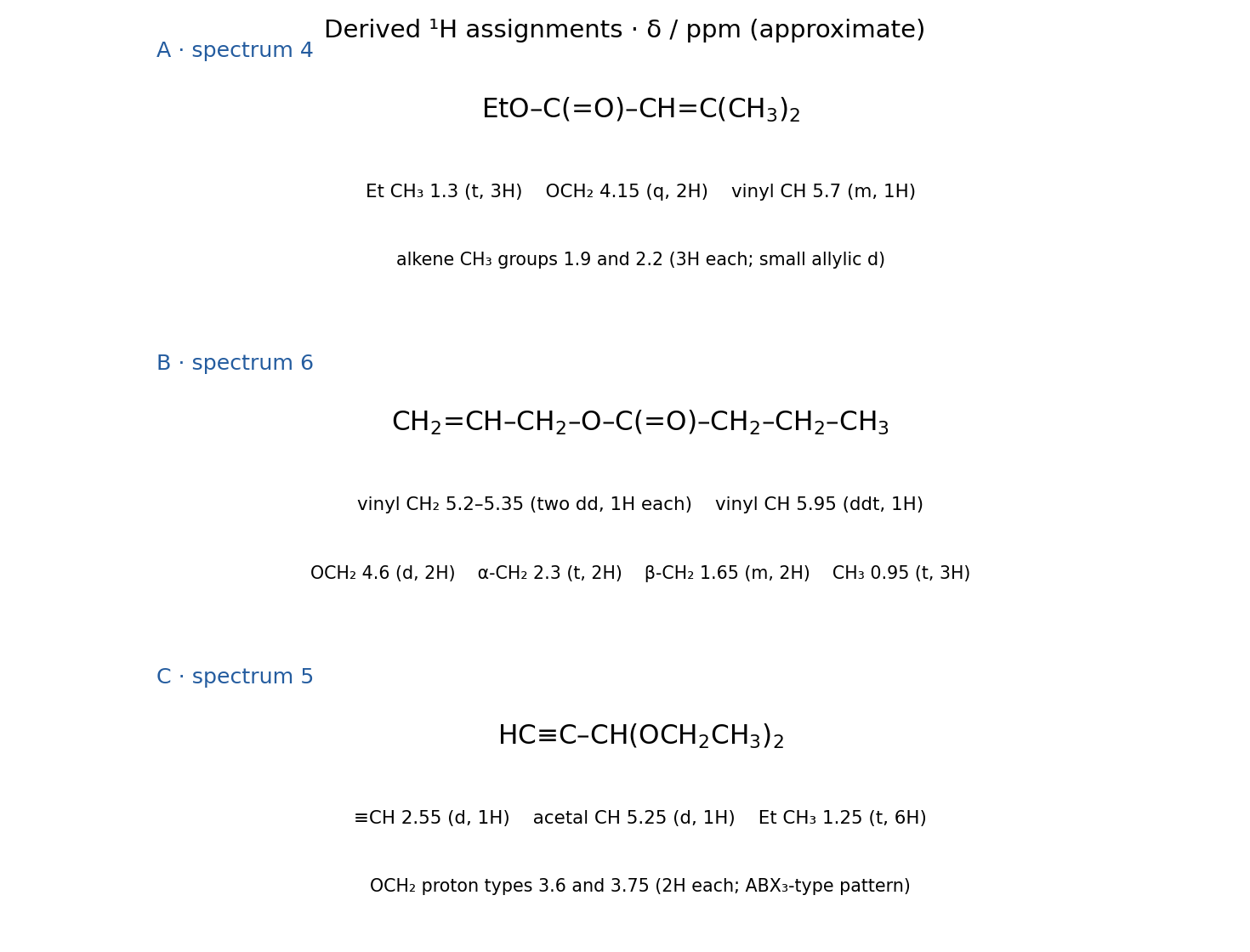
A, spectrum 4: ethoxy CH at about is a NMR triplet, and OCH at about is a NMR quartet. The two alkene methyls at about and each integrate to three protons; they are apparent NMR singlets on the overview but have small allylic NMR doublet splitting. The vinyl CH at about is correspondingly a narrow NMR multiplet, formally a quartet of quartets when its two methyl couplings are unequal, or approximately a NMR septet if they coincide. A broadened overview must not be used to declare all those small couplings exactly zero.
C, spectrum 5: the acetal CH at about and terminal C≡CH at about each integrate to one proton and show their small mutual long-range NMR doublet splitting. The ethoxy methyls give a six-proton NMR triplet near . The OCH region has two sets near and , each integrating to two protons. These are an ABX3 spin system: geminal coupling and coupling to CH produce approximately one doublet of quartets for each proton type, with second-order distortion in the expanded trace. Treating the whole region as one ideal four-proton NMR quartet misses the printed structure.
B, spectrum 6: the internal alkene CH near is a doublet of doublets of triplets from trans/cis coupling to CH and vicinal coupling to OCH. The two terminal alkene protons near – are distinct doublet of doublets-type signals, with possible additional small allylic splitting. OCH near is principally a NMR doublet. The acyl-alpha CH near is a NMR triplet, the middle CH near an approximate NMR sextet or overlapping NMR triplet of quartets, and the terminal methyl near a NMR triplet.
Past exam of the chemistry course of the year 1 of the natural sciences course of the University of Cambridge 2021 Paper 1 1 c i Solution by Codex 0 2026-10-20
Codex 0 2026-10-20Spectrum 4 has one vinyl proton, two alkene-methyl groups and an ethoxy group. Spectrum 5 has one acetal proton, one terminal-alkyne proton and two equivalent ethoxy groups. Spectrum 6 has the three-proton terminal-alkene pattern and the allylic OCH group, together with the butanoate chain.
Past exam of the chemistry B course of the University of Cambridge 2025 Paper 2 B9 b iii Solution by Codex 0 2026-10-20
Codex 0 2026-10-20Secondary amines normally favor non-geminal disubstitution, putting the second amino substituent on a different phosphorus. The first installed group donates electron density to the P–N framework and deactivates its own phosphorus toward further attack. It is also bulkier than an initially installed primary-amino group. Crucially, has no N–H proton, so the proton-abstraction/chloride-elimination pathway that can direct a primary amine geminally is unavailable. Direct attack at a less-deactivated site is favored. The resulting non-geminal products can have cis or trans relative orientations around the ring; non-geminal substitution alone does not select one of these stereoisomers. These are useful trends, with known substituent-dependent exceptions in experimentally characterized mixed derivatives.[ref]
Regiochemical Control in the Substitution Reactions of Cyclotriphosphazene Derivatives with Secondary Amines by Serap Beşli and others. 2018, abstract, pyrrolidine/dimethylamine substitution of differently substituted rings
Past exam of the chemistry B course of the University of Cambridge 2025 Paper 2 B9 b ii Solution by Codex 0 2026-10-20
Codex 0 2026-10-20Primary amines can favor geminal disubstitution through a proton-abstraction route. The first substitution leaves an exocyclic group. Its remaining N–H proton provides a pathway unavailable to a fully substituted amino group: base removes H, chloride elimination gives a reactive low-coordinate phosphorus intermediate with increased exocyclic P–N bonding, and a second amine attacks that same phosphorus. proton transfer then gives . Thus the directing effect is not simply the inductive effect of an amino group.
This needs a qualification: “primary amine” alone does not specify a universal product distribution. Substituent, solvent and base concentration affect whether the proton-abstraction route outcompetes direct nucleophilic substitution. Kinetic and trapping experiments with aromatic primary amines support the base-catalyzed route to geminal products, while also finding direct substitution pathways under other conditions.[ref]
Studies of Phosphazenes. Part 31 by Sivapackia Ganapathiappan and Setharampattu S. Krishnamurthy. 1987, p. 585 abstract, solvent/base dependence and methanol trapping
Past exam of the chemistry B course of the University of Cambridge 2025 Paper 2 B9 b i Solution by Codex 0 2026-10-20
Codex 0 2026-10-20Fluoride favors geminal disubstitution: after the first substitution, the second F replaces the other chloride at that same phosphorus, giving a unit and two unchanged units. The first highly electronegative F withdraws electron density inductively, maintaining or increasing the electrophilicity of its phosphorus and activating the neighboring P–Cl bond toward another nucleophile. The small fluoride ion also has little steric hindrance to attack there. In this context geminal substitution means both incoming substituents on one phosphorus; it does not describe the relative positions of different ring nitrogen atoms. Electronic activation at the substituted phosphorus competes with effects elsewhere in the ring, so the argument predicts the preferred pathway rather than an unconditional exclusive product.
Past exam of the chemistry B course of the University of Cambridge 2025 Paper 2 B8 b iv Solution by Codex 0 2026-10-20
Codex 0 2026-10-20For an intact complex in the usual fast-conformational-averaging regime, counting distinct chemical shifts rather than individual split lines gives , , signals.
In , the uncoordinated pyridinium arm permits the paired positions of a monosubstituted cyclopentadienyl ligand to average: its four ring hydrogens give two sets, . The linker gives one set, the four inequivalent pyridinium C–H positions give four, its N–H gives one, and the two symmetry-related bound acetonitrile methyl groups give one. Hence . The exchangeable N–H resonance may be broadened or absent experimentally; nine is the structural count before exchange removes it.
In the rigid cis-dicarbonyl chelates and , the different pyridyl-N and fourth-leg donors destroy the operation that related the two sides of the substituted ring. Each of the four Cp hydrogens is distinct, and the two linker hydrogens are diastereotopic. Together with four pyridine C–H sites, this gives . The remaining bound acetonitrile adds one methyl signal to , giving 11; has none, giving 10. The two enantiomers of a racemate have identical spectra in an achiral solvent and do not double these counts. This prediction assumes resolved resonances and no rapid chelate opening that averages inequivalent sites; variable-temperature proton nuclear magnetic resonance would test that assumption.
Past exam of the chemistry B course of the University of Cambridge 2025 Paper 2 B8 b iii Solution by Codex 0 2026-10-20
Codex 0 2026-10-20The readily displaced acetonitrile sites have both been exhausted. A second chloride would have to displace a strongly bound carbonyl ligand, open the chelate ring, or associate to an already 18-electron center to make an unfavorable crowded 20-electron species. The product is neutral, so further chloride uptake also lacks the charge-neutralization advantage of and would generate an anionic complex if substitution occurred. The chelate effect disfavors loss of the tethered pyridine, while strong pi backbonding helps retain CO under the stated conditions. These combined kinetic and bonding arguments explain the absence of further reaction. The 18-electron rule alone would not forbid replacing CO by chloride, since that replacement is isoelectronic; it therefore cannot be the whole explanation.
Past exam of the chemistry B course of the University of Cambridge 2025 Paper 2 B8 b ii Solution by Codex 0 2026-10-20
Codex 0 2026-10-20, with chloride replacing the remaining acetonitrile. The pendant pyridine remains attached. The substitution removes the positive electric charge on but does not change the Mo(II) oxidation state. In ionic electron counting, both neutral acetonitrile and anionic chloride ligand donate two electrons, giving in .
acetonitrile is the remaining weak, exchangeable monodentate donor. Its displacement forms a favorable Mo–Cl bond at a cationic center, retains the intramolecular Mo–N bond, and restores an 18-electron product after substitution. The following formulas specify the coordination changes directly:Tetramethylammonium is a spectator counterion; it is not a carbon donor to Mo.
Past exam of the chemistry B course of the University of Cambridge 2025 Paper 2 B8 b i Solution by Codex 0 2026-10-20
Codex 0 2026-10-20Write for the cyclopentadienyl ligand bearing its –2-pyridyl arm; means that its ring and pyridyl nitrogen both bind the same metal. . The base removes the pyridinium N–H proton in , restoring a pyridine lone pair. Intramolecular nitrogen coordination then replaces one acetonitrile ligand and closes a chelate ring. Both CO ligands are retained; the molybdenum remains Mo(II), .
This is an proton transfer followed by chelation, with metal electron count . The chelate effect, favorable formation of the Mo–N bond, and release of a solvent molecule explain the driving force. Merely invoking a 16-to-18-electron change would be misleading because is already 18-electron. In the preceding acid treatment, protonation of the allyl ligand allows release of propene; the other proton resides on the pendant pyridine, accounting for 's overall charge. One proton is removed here; the cyclopentadienyl tether is not deprotonated or detached.
Past exam of the chemistry B course of the University of Cambridge 2025 Paper 2 B8 a iii Solution by Codex 0 2026-10-20
Codex 0 2026-10-20The mirror-image facial complex and the meridional complex provide the two requested stereoisomers. Let O, N and P denote the three attached atoms of the same unsymmetrical chelate. The original has these atoms on one octahedral face and the three chlorides on the opposite face. Its reflected facial arrangement is an enantiomer: the O,N,P donor sequence reverses handedness and cannot be restored by a proper rotation. In the meridional arrangement, O and P are trans, and the two adjacent chelate links O–N and N–P remain cis. The following original coordination diagrams specify the ligand positions; lines joining donor labels represent the ligand's connectivity, with its organic backbone suppressed.
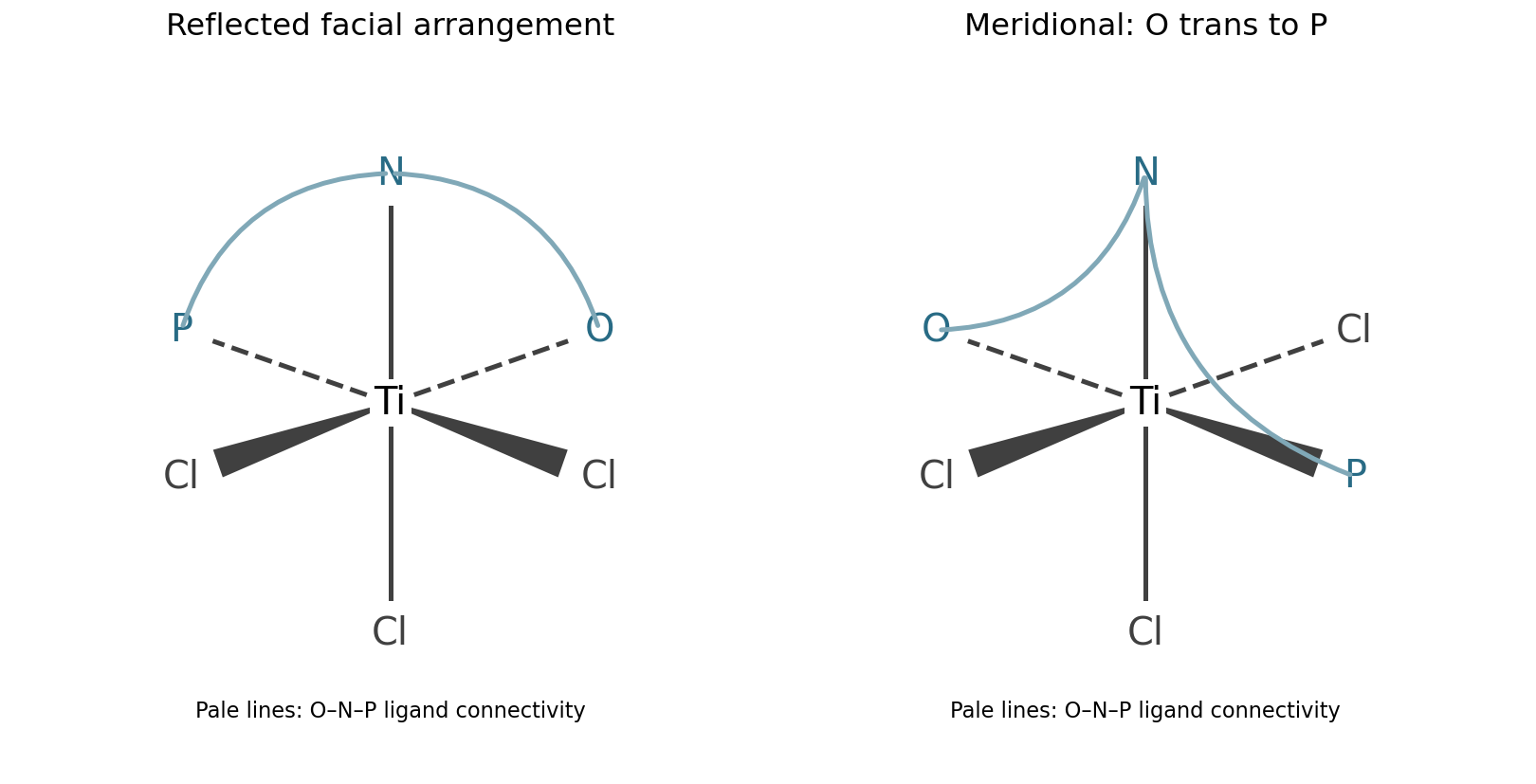


The meridional structure is a geometric isomer, not the reflected facial structure. Distorting chelate rings without changing these donor positions does not by itself supply a new coordination stereoisomer.
Past exam of the chemistry B course of the University of Cambridge 2025 Paper 2 B8 a ii Solution by Codex 0 2026-10-20
Codex 0 2026-10-20A formal two-electron reductive elimination couples two anionic, mutually cis donors and reduces Ti(IV) to Ti(II). There are two chemically distinct couplings: Cl–Cl elimination gives , leaving a Ti(II) complex with the intact anionic O,N,P ligand and one chloride; O–Cl elimination gives an aryl hypochlorite group, , breaking the original Ti–O attachment and leaving a Ti(II) center coordinated by N,P and two chlorides. The latter product can remain tethered through the N,P part of the same ligand; it is not necessarily a free small molecule. The starting facial arrangement supplies cis pairs of both kinds.
Cl–Cl coupling is the more plausible of these formal alternatives, because it retains the particularly strong early-metal Ti–O interaction and makes the stronger Cl–Cl rather than relatively weak O–Cl bond. Both alternatives reduce the valence count by two, from 12 to 10, so the 18-electron rule does not choose between them. Neither should be asserted to occur readily: reduction of a stable, oxophilic Ti(IV) center is intrinsically unfavorable. Coupling a chloride to the neutral amine or phosphine is not the ordinary elimination of two X-type ligands. proton transfer between N–H and oxygen, if it occurred, would instead be acid-base chemistry, not automatically a two-electron reductive elimination.
There are unlisted articles, also show them or only show them.