Past exam of the chemistry course of the year 1 of the natural sciences course of the University of Cambridge 2022 Paper 1 4 b ii Solution by  Codex 0 2026-10-20
At coexistence of the two pure solid forms, their chemical potentials are equal and . Treating the tabulated enthalpy and entropy differences as constant givesAbove this temperature the model favours the higher-entropy yellow form; below it the red form is favoured. This is a prediction from the given thermodynamic data, not a guarantee of an immediately visible colour change: kinetic trapping, particle-size effects and temperature-dependent heat capacities are not included. A ratio of masses of two coexisting pure solids is not the equilibrium constant, since their bulk solid activities are each unity.
Past exam of the chemistry course of the year 1 of the natural sciences course of the University of Cambridge 2022 Paper 1 4 b i Solution by Codex 0 2026-10-20
Codex 0 2026-10-20For red-to-yellow conversion, subtract the red values from the yellow values:HenceThe positive value makes the red form the lower-Gibbs free energy form at 298 K within the supplied bulk-phase model. The calculation uses 298 K as the conventional reference temperature; the paper supplies no separate numerical temperature for this subpart. Keeping enthalpy and entropy in the same energy units is essential.
Past exam of the chemistry course of the year 1 of the natural sciences course of the University of Cambridge 2022 Paper 1 4 a vii Solution by Codex 0 2026-10-20
Codex 0 2026-10-20The exponential function makes modest Gibbs free energy differences correspond to extreme equilibrium ratios. At 298 K, ; for example,The minor equilibrium component may therefore lie below detection, or a species' required thermodynamic activity may be experimentally inaccessible. Apparently complete conversion supplies a bound on , rather than an accurate finite value. Additionally, some reactions do not reach chemical equilibrium within a practicable observation time because of kinetic barriers. The thermodynamic identity still holds even when direct room-temperature determination of both sides of the equilibrium ratio fails.
Past exam of the chemistry course of the year 1 of the natural sciences course of the University of Cambridge 2022 Paper 1 4 a vi Solution by Codex 0 2026-10-20
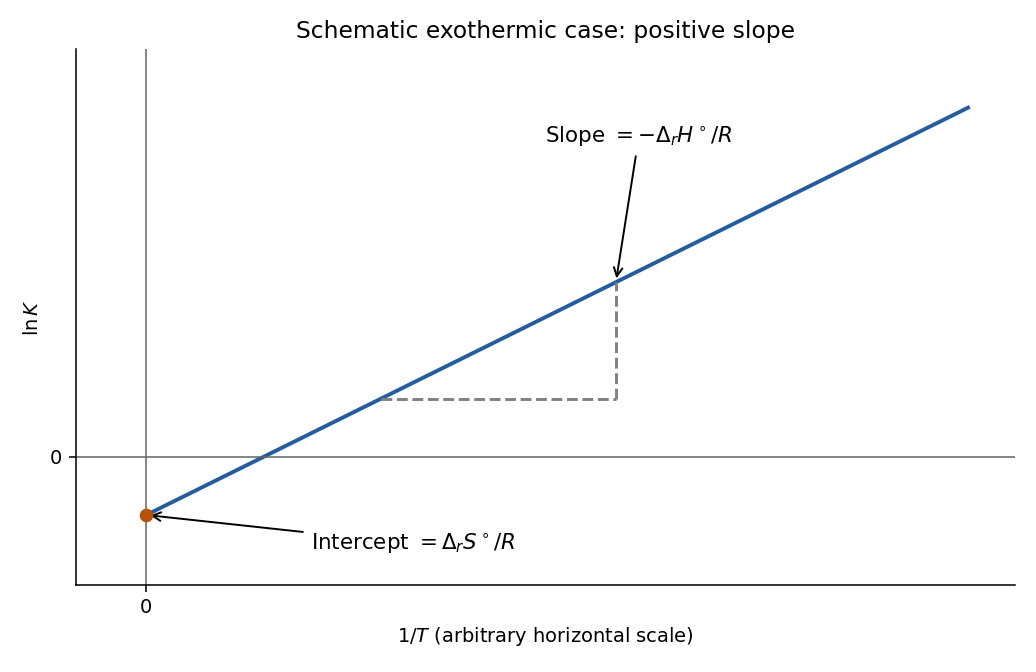
Codex 0 2026-10-20Combining with the equilibrium relation givesIf reaction enthalpy and reaction entropy are approximately constant over the measurement interval, a plot of against is straight, with slope and intercept . An exothermic reaction therefore has a positive slope. In the more general local form, the Gibbs–Helmholtz equation giveswhich is the Van't Hoff equation without assuming a constant enthalpy.
Use a dimensionless equilibrium constant built from thermodynamic activities. Measure sufficiently separated temperatures after verifying true equilibrium, and avoid phase changes or a changing chemical reaction. Temperature-dependent heat capacities cause curvature: the fitted straight-line slope then estimates an interval-dependent enthalpy. Small errors in the equilibrium measurements can produce large slope errors over a narrow range. The entropy intercept is particularly sensitive because requires distant extrapolation, and slope/intercept errors are correlated. A numerical line through a few points is not, by itself, evidence that all these assumptions hold.
Past exam of the chemistry course of the year 1 of the natural sciences course of the University of Cambridge 2022 Paper 1 4 a v Solution by Codex 0 2026-10-20
Codex 0 2026-10-20For , reversing the standard formation reaction gives . Thus decomposition is thermodynamically favoured under the corresponding standard conditions. benzene persists because it is kinetically stable on the laboratory timescale. Breaking and reorganizing its bonding framework requires access to high-activation energy pathways, and suitable reactive intermediates or catalysts are absent under ordinary storage conditions. A negative Gibbs free energy change specifies the favoured thermodynamic direction, not a rapid reaction rate; thermal energy does not automatically overcome a large barrier.
Past exam of the chemistry course of the year 1 of the natural sciences course of the University of Cambridge 2022 Paper 1 4 a iv Solution by Codex 0 2026-10-20
Codex 0 2026-10-20The Clausius statement of the second law forbids a cyclic device whose sole effect is transfer of heat from a colder thermal reservoir to a hotter one. The Kelvin-Planck statement of the second law forbids a cyclic device whose sole effect is complete conversion of heat drawn from a single thermal reservoir into work. These are equivalent formulations of the Second law of thermodynamics; an ordinary refrigerator is allowed because supplied work is an additional effect.
Past exam of the chemistry course of the year 1 of the natural sciences course of the University of Cambridge 2022 Paper 1 4 a iii Solution by Codex 0 2026-10-20
Codex 0 2026-10-20The standard enthalpy of formation is the enthalpy change on forming exactly one mole of the specified compound in its stated standard state from its constituent chemical elements in their reference states at the same specified temperature. The reference states are normally the stable elemental forms at the standard pressure. A standard state does not itself mean 298 K; temperature must be stated separately.
Past exam of the chemistry course of the year 1 of the natural sciences course of the University of Cambridge 2022 Paper 1 4 a ii Solution by Codex 0 2026-10-20
Codex 0 2026-10-20The ideal gas model takes the particles' own volume to be negligible compared with the container volume and neglects intermolecular interactions except during idealized elastic collisions. These assumptions remove excluded-volume and attractive-force corrections to the ideal gas law. A classical dilute gas also requires that quantum-statistical effects be negligible, but the first two are the requested mechanical assumptions.
Past exam of the chemistry course of the year 1 of the natural sciences course of the University of Cambridge 2022 Paper 1 4 a i Solution by Codex 0 2026-10-20
Codex 0 2026-10-20Here is absolute pressure, is volume, is amount of substance in moles, is the molar gas constant and is absolute thermodynamic temperature in kelvin. This is the ideal gas law; consistent SI units give pressure in pascals, volume in cubic metres and in .
Past exam of the chemistry course of the year 1 of the natural sciences course of the University of Cambridge 2022 Paper 1 3 b ii Solution by Codex 0 2026-10-20
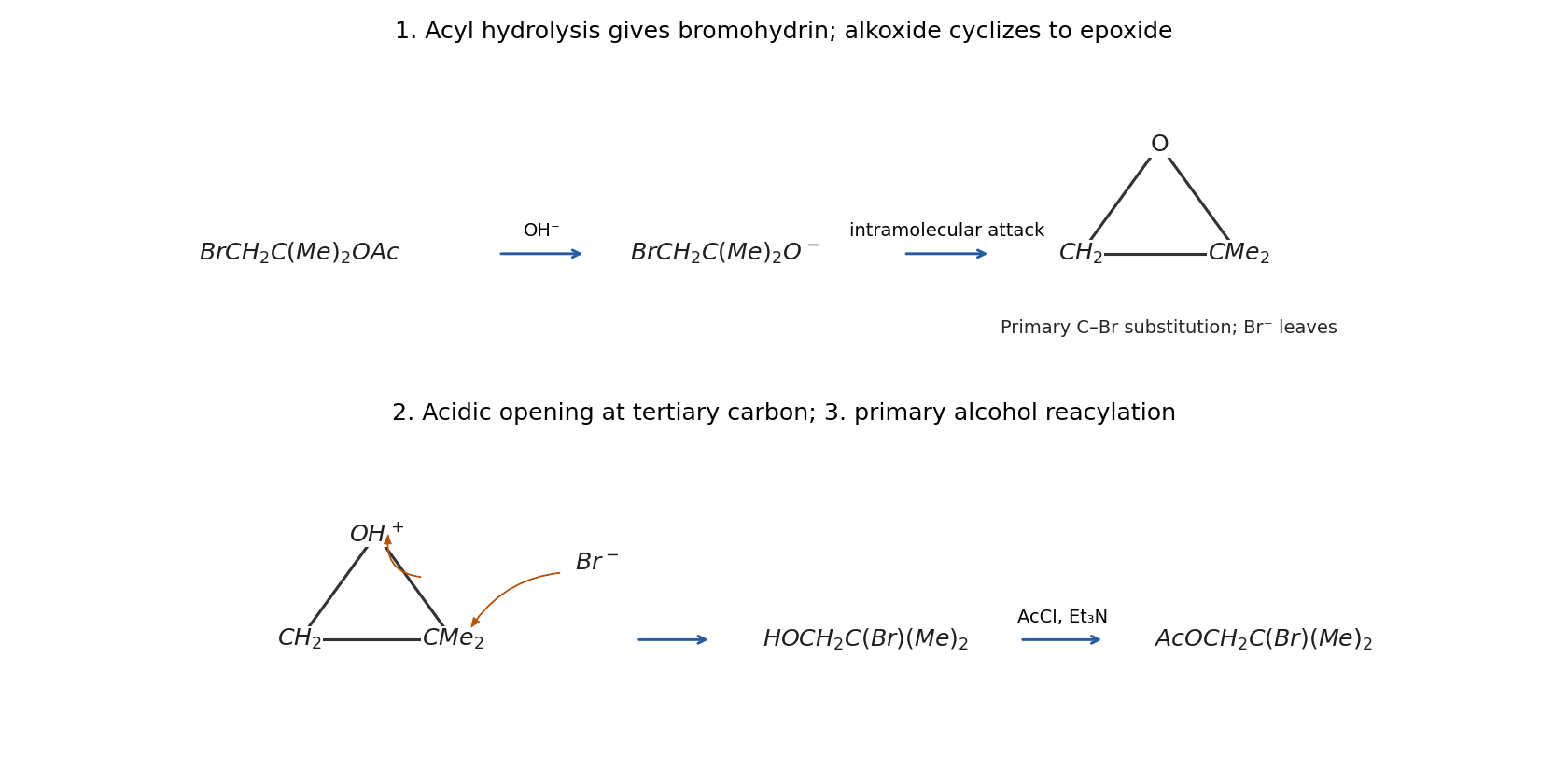
Codex 0 2026-10-20The oxygen substituent changes position through a halohydrin–epoxide sequence. First, hydroxide attacks the acetate carbonyl of , giving a tetrahedral intermediate. Collapse expels the substrate alkoxide, and proton transfer gives plus acetate. This is saponification, breaking the acyl–oxygen bond rather than replacing bromide directly with hydroxide.
A small equilibrium population of undergoes intramolecular SN2 reaction at the adjacent primary carbon: the O lone pair attacks and its C–Br pair leaves with bromide. The result is 2,2-Dimethyloxirane. Addition of HBr protonates the ring oxygen. bromide then attacks preferentially at the more substituted carbon, where the protonated ring has greater carbocation character, breaking that C–O bond and leaving oxygen attached to the former primary carbon:The middle formula denotes a three-membered epoxide, not an open-chain ether. Acidic opening of this highly unsymmetrical epoxide has the opposite regioselectivity to a simple basic nucleophilic opening at its less substituted carbon.
Finally, the primary alcohol oxygen attacks acetyl chloride. The tetrahedral intermediate collapses with chloride departure, and triethylamine removes the O–H proton and captures HCl. The product is . oxygen is carried through the epoxide to the other carbon; it is not necessary to invent a methyl migration or a carbon-skeleton rearrangement.
Past exam of the chemistry course of the year 1 of the natural sciences course of the University of Cambridge 2022 Paper 1 3 b i Solution by Codex 0 2026-10-20
Codex 0 2026-10-20The two starting ester groups are adjacent on the benzene ring. Select one ester carbon as the site receiving both incoming methyl groups. A first methyl addition gives a tetrahedral intermediate; its collapse expels methoxide to give the ortho-substituted ketone . A second methyl addition produces , with the alkoxide bound to magnesium.
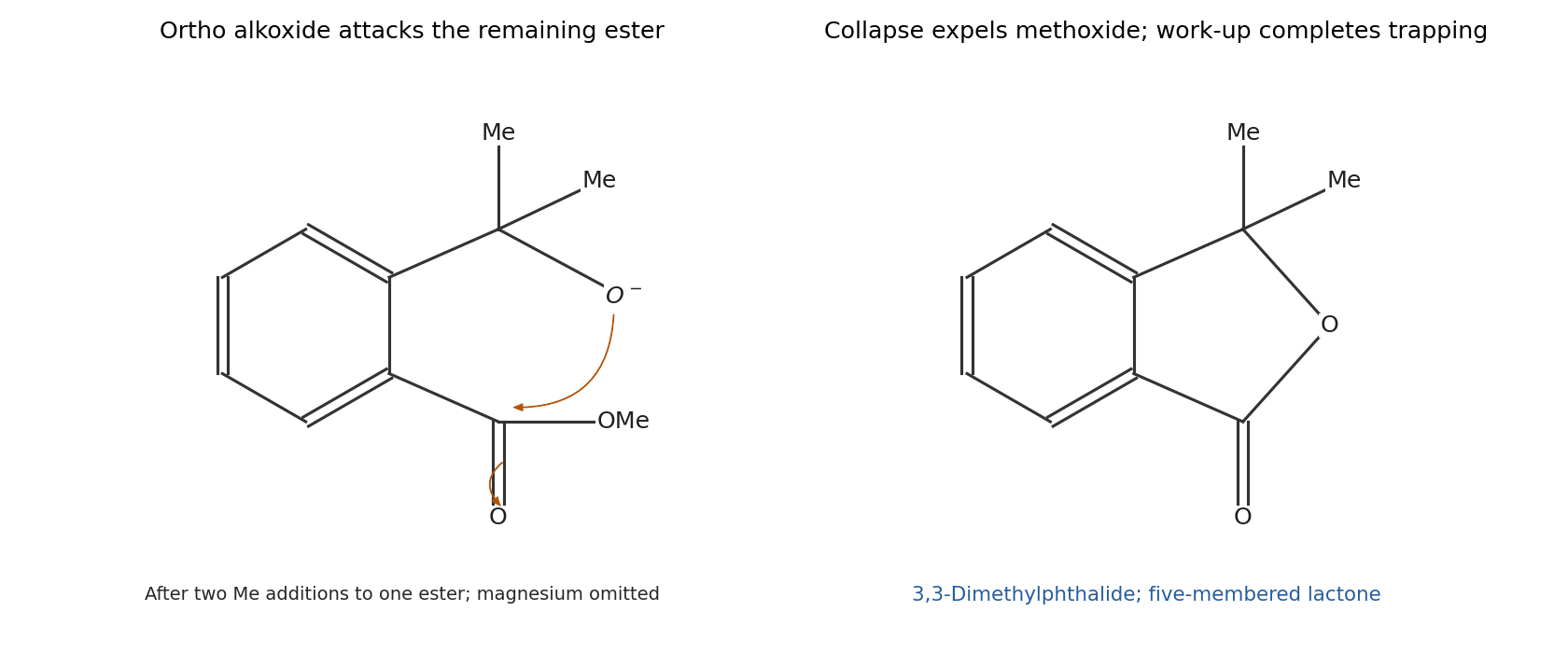
The newly generated oxygen is now positioned to attack the remaining ester intramolecularly. Draw an arrow from its lone pair to that ester carbonyl and another from the C=O pi bond to its oxygen. Collapse of the resulting tetrahedral intermediate reforms the carbonyl and expels methoxide, closing a five-membered lactone. Protonation of magnesium-bound species in the work-up gives 3,3-Dimethylphthalide. Equivalently, protonation can first give the ortho hydroxy ester, followed by acid-assisted lactonization with loss of methanol; both descriptions show the same required bond formation.
The oxygen in the new ring is the oxygen of the first ester's original carbonyl; the surviving lactone carbonyl comes from the second ester. The product retains the six ring carbons and both original acyl carbons, loses the two ester methoxy carbons, and gains two carbons from methylmagnesium bromide. The favourable intramolecular five-membered closure accounts for the displayed product. It does not make the isolated lactone universally inert to a large excess of grignard reagent; stoichiometry and trapping/work-up conditions matter.
Past exam of the chemistry course of the year 1 of the natural sciences course of the University of Cambridge 2022 Paper 1 1 c iv Solution by Codex 0 2026-10-20
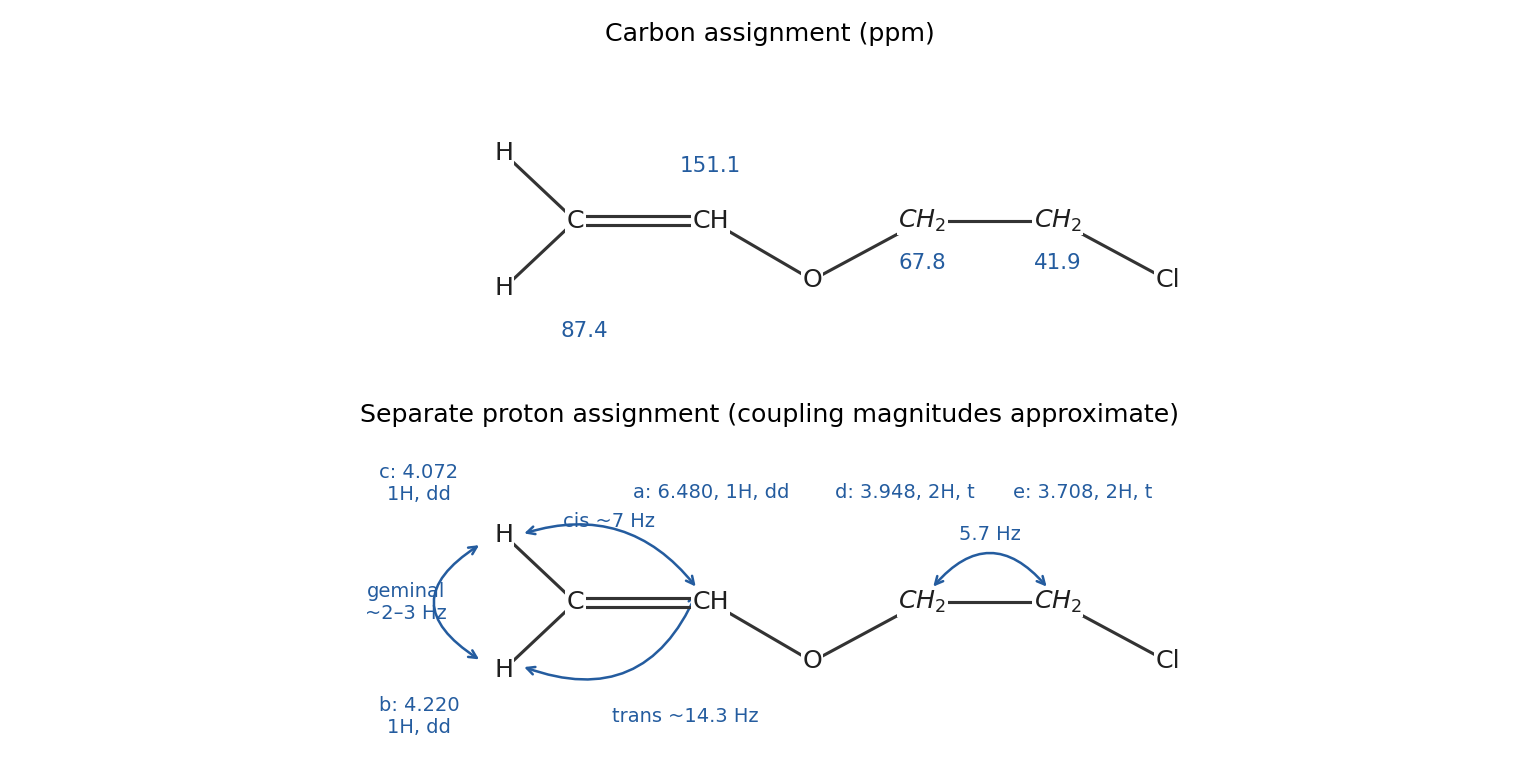
Codex 0 2026-10-20The vinyl ether has an important resonance contributorDonation from oxygen into the conjugated system increases electron density at the terminal unsaturated carbon, helping explain its unusually shielded ppm and its terminal protons near 4.1–4.2 ppm. The directly oxygen-bound unsaturated carbon is strongly deshielded at ppm; its proton at ppm also experiences the oxygen substituent and alkene magnetic anisotropy. These trends are consistent with the whole delocalized electronic structure; a chemical shift is not simply a meter for an atom's partial atomic charge.
For the saturated part, the stronger local deshielding by oxygen places at , , while lies at and ppm. The two terminal vinylic protons have different geometrical relationships to the oxygen substituent and therefore different chemical shifts as well as different vicinal couplings.
Past exam of the chemistry course of the year 1 of the natural sciences course of the University of Cambridge 2022 Paper 1 1 c iii Solution by Codex 0 2026-10-20
Codex 0 2026-10-20Let be the internal vinylic proton, the terminal proton trans to , the terminal proton cis to , the oxygen-bound methylene and the chlorine-bound methylene. The assignments areFor the doublet of doublets, pairing corresponding lines gives Hz and Hz. The larger value identifies trans vinylic coupling; the smaller identifies cis vinylic coupling. The resonance confirms the large splitting, approximately Hz, and has a small geminal coupling to .
The small spacings are not perfectly reciprocal if treated as exact First-order NMR multiplets: the lines imply Hz, whereas the lines imply Hz and Hz. Thus report Hz, Hz and – Hz, rather than asserting incompatible exact constants. Printed precision and departures from a simple first-order pattern limit this line-picking estimate; a full spin-system fit would be needed for refined values. Splittings alone do not establish the signs of these couplings.
The two methylene groups split one another into approximate NMR triplets, with Hz; the oxygen-bound triplet gives approximately the same value from its rounded line labels. The three vinylic protons plus two methylenes give the required seven-proton integral. The terminal vinylic protons are diastereotopic, because replacing one or the other creates different alkene geometries.
Past exam of the chemistry course of the year 1 of the natural sciences course of the University of Cambridge 2022 Paper 1 1 c ii Solution by Codex 0 2026-10-20
Codex 0 2026-10-20The absorption is predominantly the carbon–carbon double-bond stretching vibration of the electron-rich vinyl ether. resonance donation from an oxygen lone pair changes both its frequency and its electric dipole moment variation during stretching. There is no carbonyl in the assigned structure, consistent with the absence of a carbon-13 NMR signal in the usual ketone or acyl chloride region.
Past exam of the chemistry course of the year 1 of the natural sciences course of the University of Cambridge 2022 Paper 1 1 c i Solution by Codex 0 2026-10-20
Codex 0 2026-10-20C is 2-Chloroethyl vinyl ether, . There is one alkene and no carbonyl. Assign the carbon-13 NMR resonances asThe strongly differentiated pair of alkene shifts is characteristic of a vinyl ether; interpreting ppm as a carbonyl would leave the unusually shielded unsaturated ppm carbon and the three distinct vinylic protons unexplained.
Past exam of the chemistry course of the year 1 of the natural sciences course of the University of Cambridge 2022 Paper 1 1 b iii Solution by Codex 0 2026-10-20
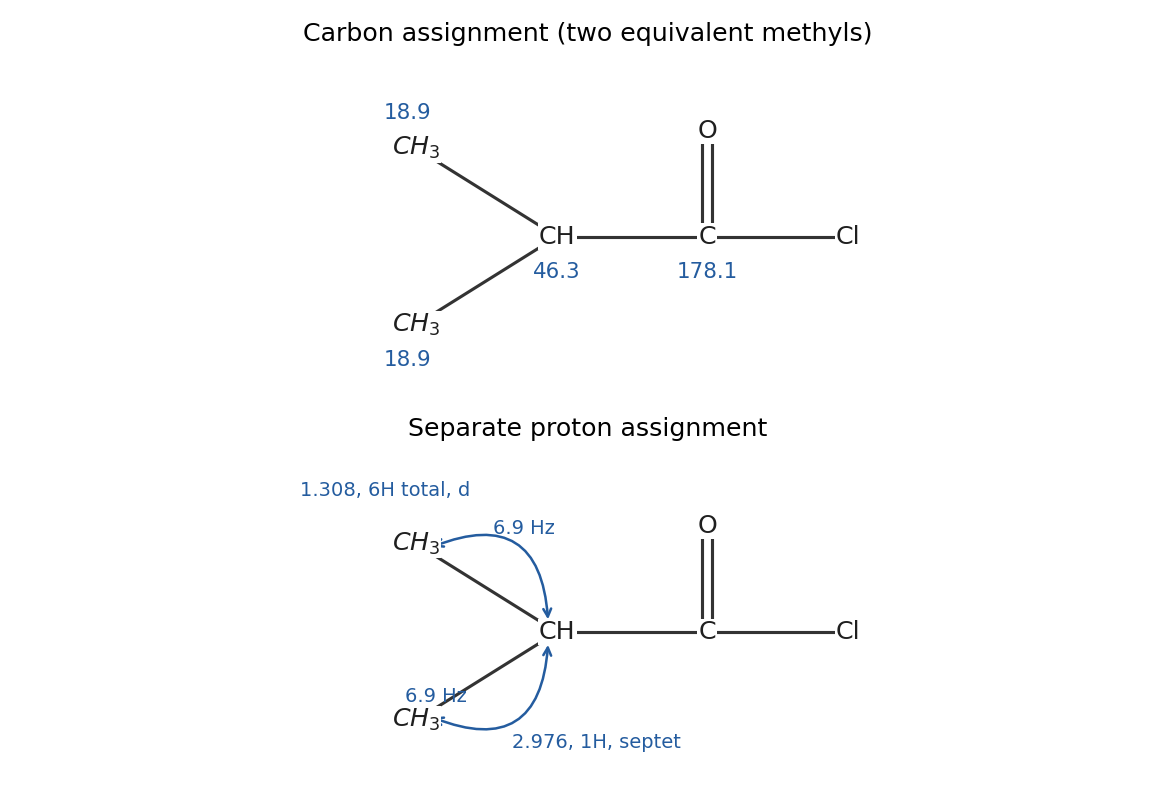
Codex 0 2026-10-20The two methyl groups give one six-proton NMR doublet centred at ppm. The methine gives a one-proton NMR septet centred near ppm. The latter is split by six equivalent methyl protons, producing the first-order intensity pattern.This follows exactly from the methyl doublet spacing, , and approximately from the successive septet spacings, which alternate between and ppm within the precision of the printed labels. There is no methylene triplet or quartet: the six-proton integral and septet establish the branched skeleton.
Past exam of the chemistry course of the year 1 of the natural sciences course of the University of Cambridge 2022 Paper 1 1 b ii Solution by Codex 0 2026-10-20
Codex 0 2026-10-20The strong band is an acyl chloride carbonyl stretching vibration. Compared with an ester, donation from a chlorine lone pair into the carbonyl antibonding molecular orbital is relatively ineffective, while chlorine's inductive effect withdraws electron density. The resulting stronger effective carbonyl force constant places the absorption above an ordinary saturated ketone band. Bond polarity alone is not a universal quantitative frequency rule.
Past exam of the chemistry course of the year 1 of the natural sciences course of the University of Cambridge 2022 Paper 1 1 b i Solution by Codex 0 2026-10-20
Codex 0 2026-10-20B is 2-Methylpropanoyl chloride, . The single index of index of hydrogen deficiency is supplied by the carbonyl. Its relatively high-frequency infrared spectroscopy band identifies an acyl chloride, while two equivalent methyl groups explain why four carbons produce only three carbon-13 NMR resonances.
Assign to the acyl chloride carbonyl, to the methine and ppm to both methyl groups. Their chemical equivalence in NMR follows from the symmetry of the isopropyl fragment in this achiral environment.
Past exam of the chemistry course of the year 1 of the natural sciences course of the University of Cambridge 2022 Paper 1 1 a iii Solution by Codex 0 2026-10-20
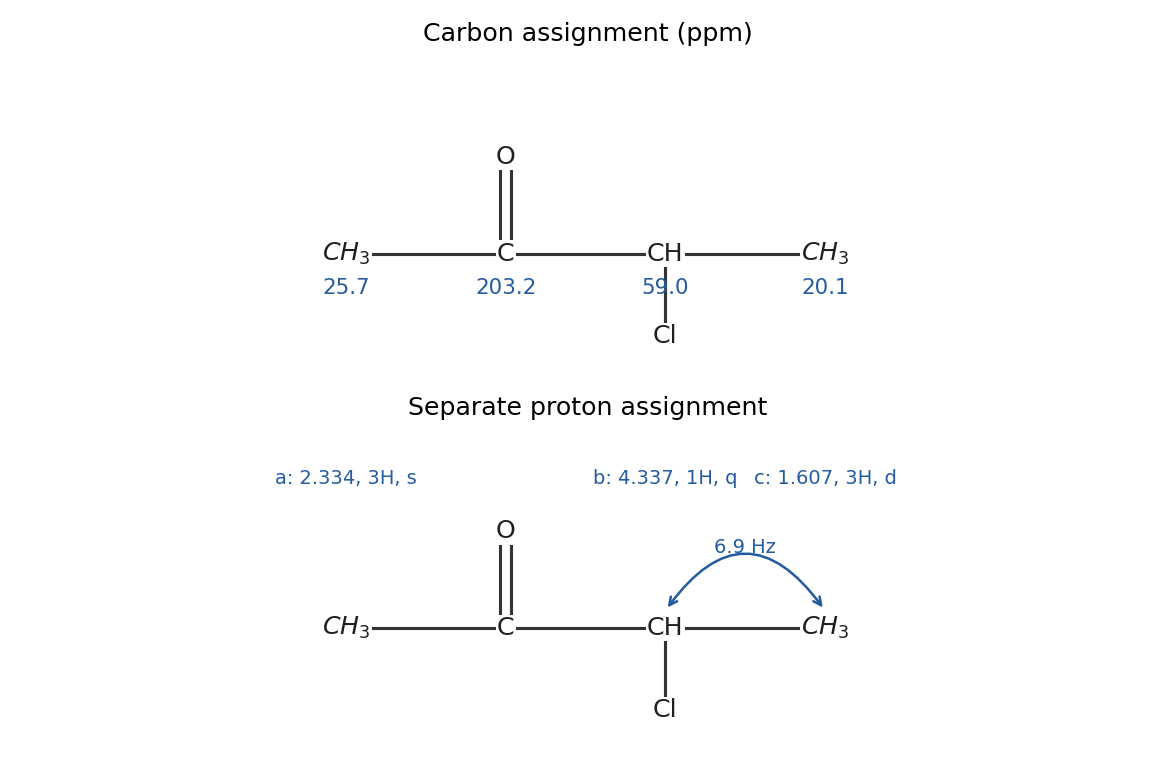
Codex 0 2026-10-20Write the proton-labelled structure as . The assignments areThe NMR quartet is centred at ppm; each adjacent line differs by ppm. The NMR doublet has the same spacing, ppm. At 300 MHz,Three equivalent methyl protons split into a NMR quartet; the single methine proton splits into a NMR doublet. No resolved long-range scalar coupling splits the acetyl methyl, giving its NMR singlet. The integrals total seven protons.


Past exam of the chemistry course of the year 1 of the natural sciences course of the University of Cambridge 2022 Paper 1 1 a ii Solution by Codex 0 2026-10-20
Codex 0 2026-10-20The strong absorption is the carbonyl stretching vibration of a saturated ketone. Its exact wavenumber depends on substitution and measurement conditions; the important discrimination is that it is far below the high-frequency acyl chloride band in B and is accompanied by a carbonyl carbon-13 NMR resonance near 200 ppm.
There are unlisted articles, also show them or only show them.