Past exam of the chemistry B course of the University of Cambridge 2025 Paper 1 B4 b v Solution by  Codex 0 2026-10-20
Each isomer has one favourable anomeric interaction. A has the favourable axial exocyclic oxygen in the upper-ring chair; B has it in the lower-ring chair. The NMR-constrained conformations therefore do not provide a doubly anomeric versus non-anomeric comparison.
Both can keep important carbon substituents equatorial and each obtains one anomeric stabilization. Appreciable amounts of both are therefore a reasonable prediction, rather than a strong preference based solely on counting anomeric interactions. The environments of the two ring oxygens are not identical, so this argument does not determine an exact one-to-one equilibrium ratio; quantitative preference would require further energetic information.
Past exam of the chemistry B course of the University of Cambridge 2025 Paper 1 B4 b iv Solution by Codex 0 2026-10-20
Codex 0 2026-10-20The anomeric effect is the preference, in suitable cyclic acetals, for an electronegative substituent at an anomeric carbon to occupy an axial position even when simple steric reasoning favours equatorial. An important orbital contribution is donation from an endocyclic oxygen lone pair into the antibonding orbital of the adjacent exocyclic C–O bond, . The chair's axial arrangement supplies favourable antiperiplanar overlap. Electrostatic and solvation contributions can also affect the observed conformational preference.
Past exam of the chemistry B course of the University of Cambridge 2025 Paper 1 B4 b iii Solution by Codex 0 2026-10-20
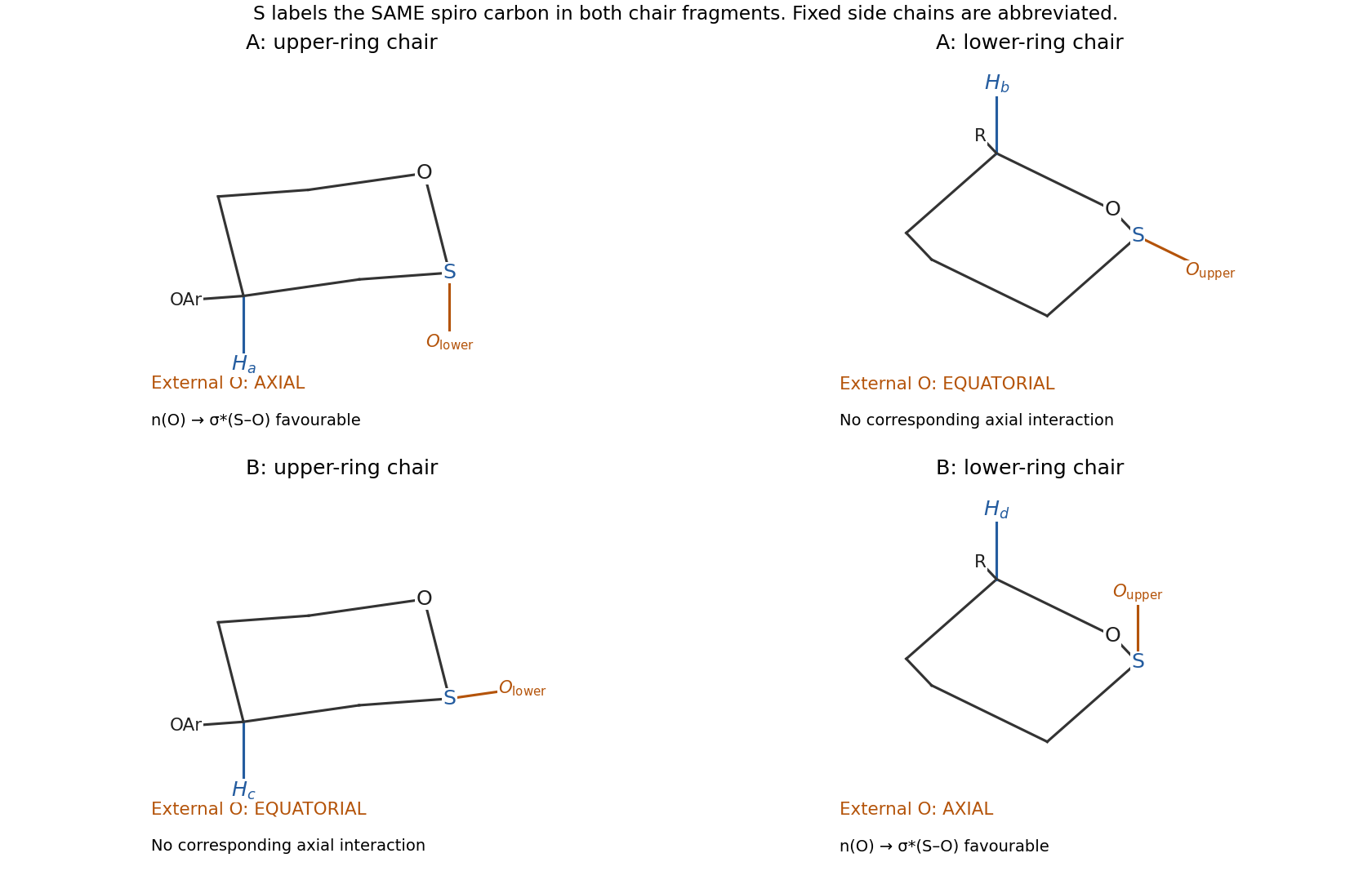
Codex 0 2026-10-20Use the upper-ring chair placing or axial. The aryl ester substituent on that carbon is then equatorial. Use a lower-ring chair placing or axial, with the attached side chain equatorial. The spiro configuration distinguishes the two structures: in A, the lower-ring oxygen bond is axial with respect to the upper ring, while the upper-ring oxygen bond is equatorial with respect to the lower ring. In B, those roles reverse.
Thus the oxygen placements at the shared spiro carbon are axial/equatorial for A and equatorial/axial for B. Side-chain conformations are unnecessary, but changing the lower chair without tracking its substituent positions would change this conclusion.
Past exam of the chemistry B course of the University of Cambridge 2025 Paper 1 B4 b ii Solution by Codex 0 2026-10-20
Codex 0 2026-10-20The diagnostic feature is the large vicinal coupling characteristic of an axial–axial relationship in a chair. The td patterns for and contain two large couplings to neighbouring axial hydrogens, so both are axial. The ddd patterns for and also include a large ring vicinal coupling, with the smaller values reflecting the other ring hydrogen and the side chain. The assignments areThe chemical shifts alone do not determine this assignment. In particular, three unequal splittings of a methine are not a geminal-coupling pattern.
Past exam of the chemistry B course of the University of Cambridge 2025 Paper 1 B4 b i Solution by Codex 0 2026-10-20
Codex 0 2026-10-20Protonation of a spiroacetal oxygen makes the adjacent C–O bond easier to cleave. Reversible opening gives an oxocarbenium ion, in which the spiro carbon is locally planar. The tethered alcohol can attack either face; deprotonation closes the acetal and regenerates acid. Repetition interconverts the spiro epimers while retaining the other stereogenic centres. Methanol can participate in reversible proton transfer or trapping, but there is no need to invert the remote carbon centres.
Past exam of the chemistry B course of the University of Cambridge 2025 Paper 1 B3 c ii Solution by Codex 0 2026-10-20
Codex 0 2026-10-20Only the low-coupling pair remains, so the detected product is the trans diastereomer, with approximate coupling 4 Hz. The reaction is highly diastereoselective within the spectrum's detection limit. Its possible absolute configurations are and .
A conventional proton NMR spectrum in an achiral environment cannot distinguish those enantiomers: they have the same shifts and couplings. Thus a chiral catalyst plus one set of resonances does not establish an enantiomeric excess or an absolute configuration. Chiral chromatography, an appropriate chiral NMR method, or a calibrated stereochemical comparison would be needed.
Past exam of the chemistry B course of the University of Cambridge 2025 Paper 1 B3 c i Solution by Codex 0 2026-10-20
Codex 0 2026-10-20At 400 MHz, a separation in ppm corresponds to Hz. The two multiplets near 5.10 and 4.47 ppm each have a quoted separation of 0.02 ppm, giving Hz. The multiplets near 4.625 and 3.865 ppm each have separation 0.01 ppm, giving Hz. These are approximate values from the rounded peak labels.
The fused unsaturated/aromatic framework restricts the five-membered ring, as in the comparison in (a). Assign the larger coupling to cis and the smaller to trans. Matching equal couplings and integrals pairs the 5.10/4.47 signals with one another, and the 4.625/3.865 signals with one another. The integral ratio isWith an achiral substrate and achiral catalytic environment, each diastereomer is expected as a racemic enantiomeric pair: cis and trans . The reported spectrum requires both diastereomers; the reagent label alone cannot override that evidence. Their ratio does not establish whether the selectivity arose in the initial surface addition or after product epimerization.
Past exam of the chemistry B course of the University of Cambridge 2025 Paper 1 B2 b ii Solution by Codex 0 2026-10-20
Codex 0 2026-10-20The qualitative nucleophilicity order is -OMe -Me H -Cl -NO, matching the product-yield order at the stated stopping time. Electron donation raises the availability of the aniline lone pair for attack. A para methoxy group donates by resonance, while methyl is a weaker donor. Chlorine withdraws inductively and gives an aniline less nucleophilic than the unsubstituted compound. A para nitro group strongly withdraws by resonance: electron flow from nitrogen through the ring into the nitro group stabilizes a charge-separated form and greatly reduces nucleophilicity.
The key arrows for the nitroaniline comparison move the nitrogen lone pair into its own aromatic ring, shift the ring bonds toward the para nitro group, and shift a nitro N=O bond toward oxygen. The methoxy donor produces the opposite electronic bias. These are finite-time yields, so they support a kinetic explanation qualitatively; they are not by themselves measured rate constants or equilibrium constants.
Past exam of the chemistry B course of the University of Cambridge 2025 Paper 1 B2 b i Solution by Codex 0 2026-10-20
Codex 0 2026-10-20The aniline nitrogen attacks the ipso carbon bearing fluorine. The aromatic electrons shift to give a Meisenheimer complex, with negative charge delocalized to the positions ortho and para to the attacked carbon. At either nitro substituent, that charge can be delocalized further onto nitro oxygen. Subsequent proton transfer and fluoride elimination restore aromaticity and give the diarylamine.
Both the ortho and para nitro groups stabilize the addition intermediate in 1-fluoro-2,4-dinitrobenzene. The para-mononitro compound lacks the additional ortho stabilization, so addition is less favourable and generally slower under the stated conditions. This comparison concerns stabilization of the addition pathway; the presence of fluorine does not make the reaction an ordinary aliphatic SN2 reaction.
Past exam of the chemistry B course of the University of Cambridge 2025 Paper 1 B2 a ii Solution by Codex 0 2026-10-20
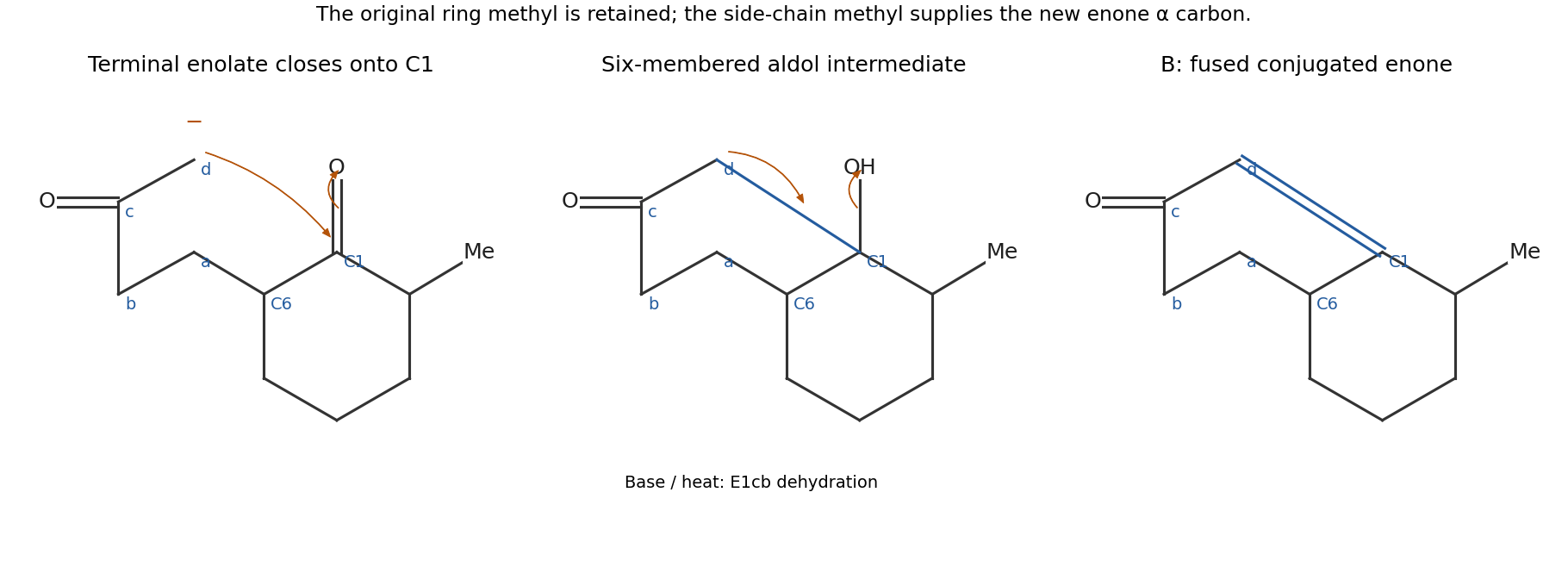
Codex 0 2026-10-20A undergoes a Robinson annulation. For an unambiguous connectivity description, call the original ring carbonyl carbon C1 and the side-chain-bearing alpha carbon C6. Label the appended chain , where d is initially methyl. Base makes the enolate at d, which attacks C1 intramolecularly to close the six-membered ring . The carbonyl electrons move to oxygen, and protonation gives the beta-hydroxy ketone.
An E1cb elimination then removes the proton on d and the hydroxy group on C1, giving the conjugated enone with C1=d and a carbonyl at c. The original ring methyl remains on the carbon next to C1 on the other side. The two rings share the C1–C6 bond. The molecular formula is consistent with loss of one water molecule from the diketone.
Past exam of the chemistry B course of the University of Cambridge 2025 Paper 1 B2 a i Solution by Codex 0 2026-10-20
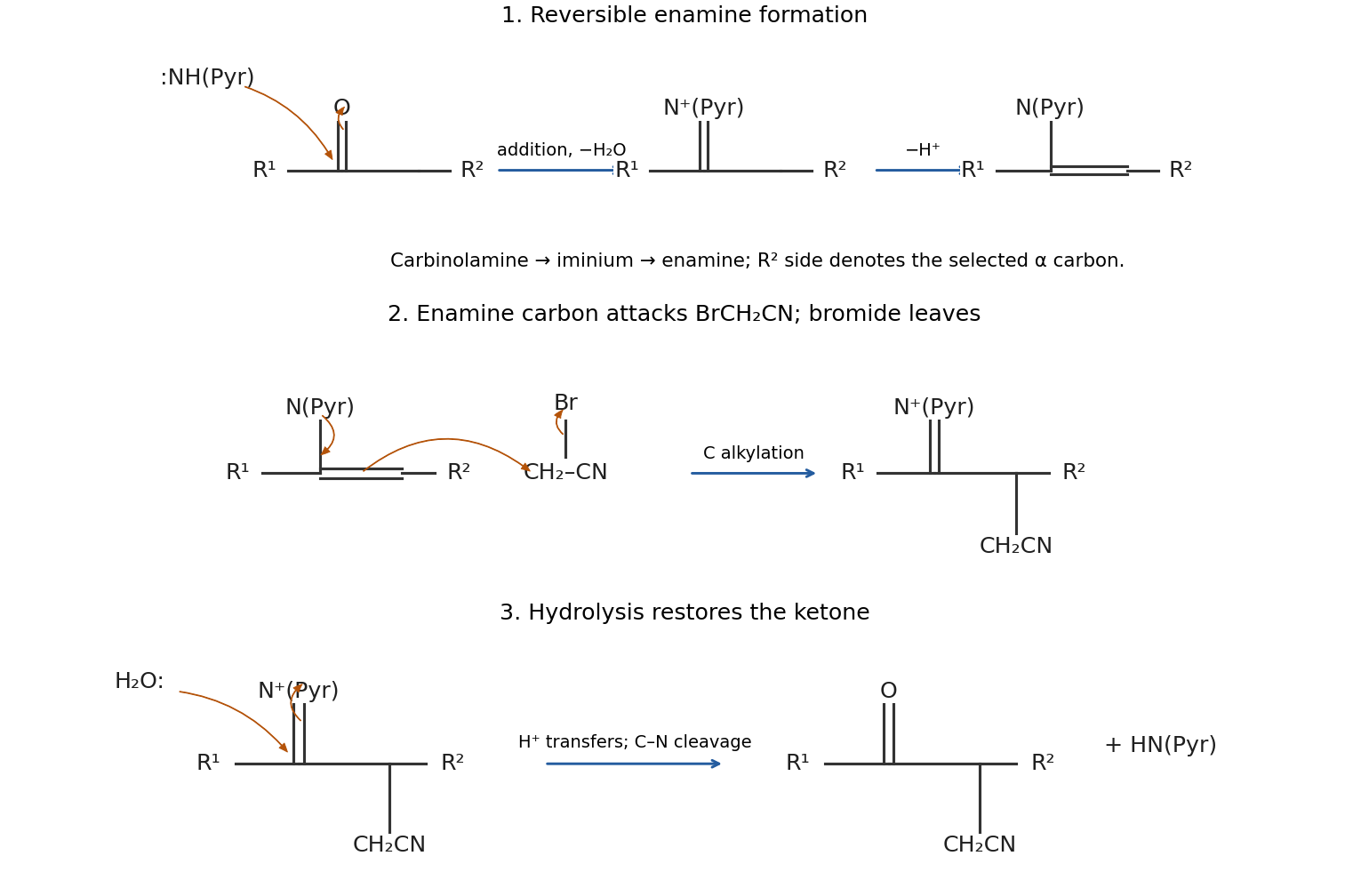
Codex 0 2026-10-20Pyrrolidine and 2-methylcyclohexanone first form an enamine, through carbonyl addition, carbinolamine formation, dehydration to an iminium ion, and alpha deprotonation. The less hindered enamine carbon is on the side opposite the methyl-bearing alpha carbon. It attacks the terminal beta carbon of methyl vinyl ketone, while the conjugated system shifts to oxygen. Protonation gives an alkylated iminium species; aqueous acid then hydrolyses it back to the ketone.
The result is a Michael addition product: the previously unsubstituted alpha carbon bears . In drawing the arrows, start the new C–C bond at the enamine carbon, not at nitrogen. The iminium bond is restored during addition and removed by hydrolysis. The sequence is an enamine-mediated conjugate addition, rather than direct addition to the methyl vinyl ketone carbonyl.
Past exam of the chemistry B course of the University of Cambridge 2025 Paper 1 B1 b ii Solution by Codex 0 2026-10-20
Codex 0 2026-10-20Hydride removes the remaining alpha proton at the substituted benzylic carbon, releasing hydrogen and forming the conjugated enolate. Its oxygen attacks the carbonyl carbon of allyl chloroformate. Collapse of the tetrahedral intermediate expels chloride and gives the allyl enol carbonate, with the double bond between the original carbonyl carbon and the cyanomethyl-bearing carbon.
This is O-acylation of an enolate: the carbonyl oxygen is trapped as , retaining the enol double bond. The competing carbon-centred resonance representation explains possible C-acylation in other circumstances, but it would give a different connectivity from E. The indicated product selects the oxygen-trapping pathway and the conjugated enolate regioisomer.
Past exam of the chemistry B course of the University of Cambridge 2025 Paper 1 B1 b i Solution by Codex 0 2026-10-20
Codex 0 2026-10-20The first stage is a Stork enamine reaction. Pyrrolidine attacks the ketone carbonyl, and proton transfers give a carbinolamine. Loss of water gives an iminium ion; removal of the benzylic alpha proton produces the enamine conjugated with the aromatic ring. Removal of water and prolonged heating favour this condensation. That conjugated enamine is preferred over the alternative with its double bond on the other side of the original carbonyl.
The nucleophilic enamine carbon attacks the methylene carbon of bromoacetonitrile by an SN2 reaction, displacing bromide and making the carbon–carbon bond. It is the carbon beside the aromatic fusion that acquires , as in D. Finally, water adds to the alkylated iminium carbon; proton transfers and cleavage of the C–N bond regenerate the ketone and release pyrrolidine. This explains carbon alkylation, its position, and restoration of the carbonyl rather than treating the amine as a permanent substituent.
Past exam of the chemistry B course of the University of Cambridge 2025 Paper 1 B1 a ii Solution by Codex 0 2026-10-20
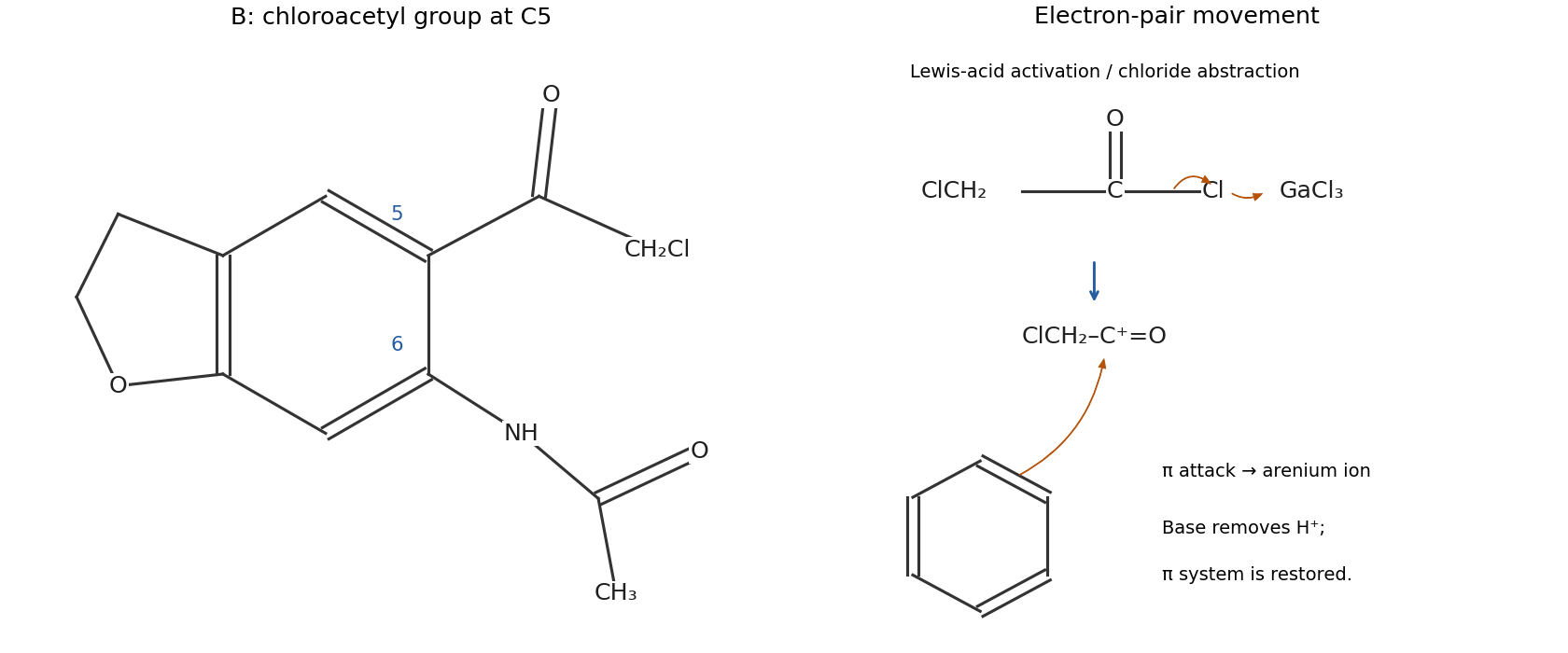
Codex 0 2026-10-20The product is N-[5-(2-chloroacetyl)-2,3-dihydrobenzofuran-6-yl]acetamide, with an aromatic substituent at position 5. Substitution of one aromatic hydrogen by gives the stated molecular formula. This positional assignment also agrees with the isolated intermediate reported in the original process study.[ref]
GaCl3 activates chloroacetyl chloride by Lewis-acid coordination and chloride abstraction, represented by the acylium/contact-ion-pair limit . The position-5 aromatic bond attacks the acyl carbon, giving a Wheland intermediate. Removal of the proton at that carbon restores aromaticity. Product–Lewis-acid coordination is reversed on work-up. The carbon-bound chlorine survives; the chlorine on the acyl carbon is the leaving group.
Past exam of the chemistry B course of the University of Cambridge 2025 Paper 1 B1 a i Solution by Codex 0 2026-10-20
Codex 0 2026-10-20Number the fused heterocycle as a 2,3-dihydrobenzofuran: oxygen is position 1 and the acetamido substituent occupies aromatic position 6. Position 5 is the preferred site of electrophilic substitution. It is para to the ring oxygen and ortho to the acetamido group, so both groups stabilize its Wheland intermediate by resonance donation. Position 7 also receives donation, but lies between the two substituents and is more crowded. Position 4 lacks the same combination of directing effects.
The aryl oxygen donates a lone pair into the aromatic system. The acetamido nitrogen can also donate into the ring, although its lone pair is shared with its own carbonyl group, so it is less activating than a free amino group. Comparing resonance-stabilized intermediates and steric accessibility gives the position-5 prediction; simply counting heteroatoms does not.
Past exam of the chemistry B course of the University of Cambridge 2024 Paper 2 B9 c ii Solution by Codex 0 2026-10-20
Codex 0 2026-10-20oxidative addition inserts Pt into one B–Br bond. All three B–Br positions of the starting ring are equivalent, so there is no distinct choice among them before the first substitution. The product is the square-planar Pt(II) boryl bromide , with the two phosphines trans, the Pt–B bond trans to Pt–Br, and the six-membered ring intact. The third panel shows this connectivity. This is a metal–boron sigma bond, not attachment of the whole ring as an pi ligand. Formal electron counting gives Pt(II), , with electrons, appropriate for square-planar coordination. The primary synthesis establishes this trans-bromo(borazinyl) structure.[ref]
Synthesis of η1-borazine complexes of palladium and platinum by Holger Braunschweig and others. 2008, pp. 3531–3534, oxidative addition products and their structural characterization
The electron-rich Pt(0) reacts at the polarized B–Br bond, whose electrophilic boron and departing bromide provide a favorable bond-activation pathway. This accounts for B functionalization without needing cleavage of a ring B–N bond or selection of a nitrogen-bound product. It does not imply that arbitrary N–H activation is impossible under every condition.
Replacing an electronegative bromine substituent by a metal fragment changes the boron's electron demand. Relative to the B–Br sites, the metal-bound boron is less effective at accepting N-to-B pi donation, so its adjacent B–N bonds are expected to have less multiple-bond character and be longer; donation toward the remaining B–Br sites produces compensating unequal ring bonds. The original threefold equivalence is lost. The detailed lengths depend on the full electronic structure; a localized drawing with three rigid alternating double bonds would conceal the redistribution that the unequal lengths reveal.
Past exam of the chemistry B course of the University of Cambridge 2024 Paper 2 B9 c i Solution by Codex 0 2026-10-20
Codex 0 2026-10-20A ring-retaining bromination replaces the three hydridic B–H positions while preserving N–H. Its net stoichiometry isUse controlled bromination and conditions allowing elimination of hydrogen bromide from addition intermediates, rather than identifying the first bromine adduct as the final ring product. Boron-bound hydrogen has hydride-like character because boron is less electronegative than hydrogen; its replacement is consistent with electrophilic attack by bromine. The primary preparative work reports B-tribromoborazines obtained by bromination of borazine and its N-methyl analogue.[ref]
B-Tribromoborazines from the Bromination of Borazine and N-Trimethylborazine by Reed F. Riley and Carl J. Schack. 1964, pp. 1651–1653, bromination and formation of B-tribromoborazines
Past exam of the chemistry B course of the University of Cambridge 2024 Paper 2 B9 b ii Solution by Codex 0 2026-10-20
Codex 0 2026-10-20 is a 1:1 nitrogen-bound adduct, with at one ring nitrogen. Its lone pair is diverted from N-to-B pi donation into the new coordinate bond. That nitrogen becomes approximately tetrahedral and the ring can pucker. The two B–N bonds adjacent to it lose pi character and lengthen; the neighboring unbound nitrogen atoms can donate more strongly into those borons, shortening the next pair of B–N bonds. The remaining pair forms a third class. The second structural panel marks these three two-bond sets; it represents connectivity and bond classes, not a measured geometry.
In the slow-exchange structure, two boron atoms flank the bound nitrogen and are equivalent to one another, while the third boron is unique. This gives two B environments in a ratio. At room temperature, rapid exchange of the Lewis acid among the three equivalent nitrogen sites averages every boron over the same environments, giving one boron-11 nuclear magnetic resonance signal. Cooling slows exchange relative to the resonance-frequency difference and resolves the two environments.
This is Chemical exchange in NMR, not restoration of equal instantaneous B–N bonds. A spectrum alone cannot distinguish intramolecular migration from reversible dissociation and reassociation; concentration dependence and crossover experiments would test that distinction. Related N-bound borazine adducts have been characterized by diffraction and variable-temperature NMR, supporting the structural logic while not supplying the exact temperature dependence of this particular hexamethyl compound.[ref]
Aluminium and gallium trihalide adducts of 2,4,6-triorganylborazines and the synthesis of triorganylborazinium tetrabromoaluminates by B. Gemünd and others. 2008, pp. 137–142, N-bound adduct structures and variable-temperature NMR
Past exam of the chemistry B course of the University of Cambridge 2024 Paper 2 B9 b i Solution by Codex 0 2026-10-20
Codex 0 2026-10-20The methyl nucleophile attacks an electrophilic ring boron. That boron becomes tetrahedral, bearing its original methyl, the incoming methyl, and its two ring nitrogen neighbors. This interrupts its p-orbital participation, so the metal attaches to the remaining five-atom conjugated segment. is the anionic heptamethylated-ring Cr(CO) complex, paired formally with ; solvent ligation and ion pairing at magnesium are not specified by the spectrum. The original connectivity, with the attacked boron labeled , is shown in the first panel below.
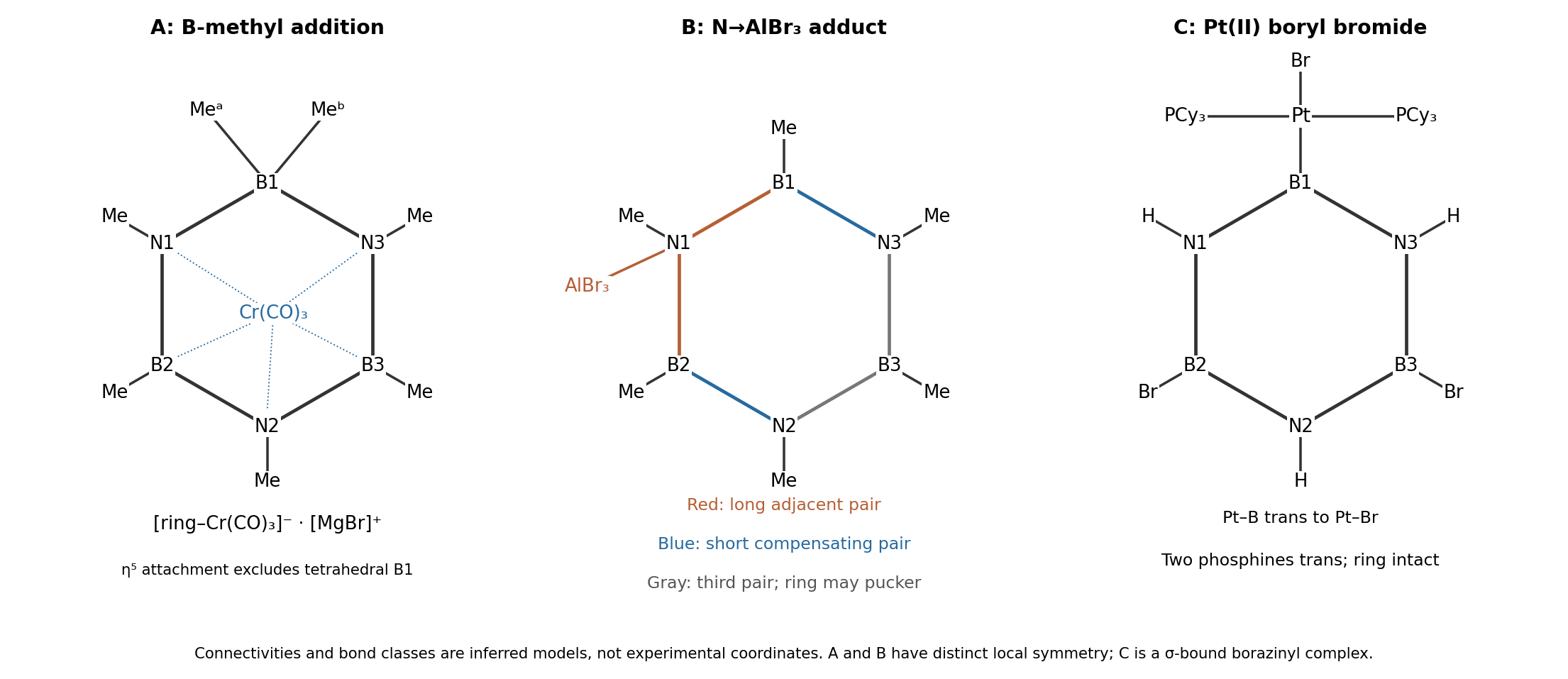


There are seven methyl groups. The two attached to tetrahedral are inequivalent because the chromium-bound face distinguishes their environments: one signal of relative integral one for each. The other two B–Me groups are equivalent to one another, giving a signal of integral two. The two N–Me groups adjacent to form another equivalent pair, while the N–Me opposite is unique. The predicted methyl-group multiplicities are therefore , the same unordered set as the observed ratio. Multiplying by three gives proton integrals totaling 21. This assignment assumes no fast process interchanging the two methyl environments.
Past exam of the chemistry B course of the University of Cambridge 2024 Paper 2 B8 b iv Solution by Codex 0 2026-10-20
Codex 0 2026-10-20A plausible explanation is a stronger, less labile Hf–C interaction, reflecting the different bonding of the heavier metal. Breaking and reorganizing that interaction in migratory insertion can raise the propagation barrier and reduce the insertion rate. At the same time, stronger retention of the metal-bound alkyl can suppress beta-hydride elimination or other chain transfer in chain polymerization processes even more strongly.
The chain length depends on competing rates, not on propagation speed alone. In a simple stationary competition,where the denominator includes the operative chain-transfer or chain-stopping rates per active chain. The Hf catalyst can propagate more slowly yet make longer chains if transfer is suppressed by a still larger factor. Slower insertion alone would not explain longer polymers. Distinguishing particular transfer pathways would require polymer end-group analysis and the concentration dependence of molecular mass and polymerization rate.
There are unlisted articles, also show them or only show them.