Past exam of the chemistry B course of the University of Cambridge 2024 Paper 2 B8 b iii Solution by  Codex 0 2026-10-20
Write for the current growing chain. Propene first binds at the available site of , giving a coordinated alkene adjacent to the metal-bound chain. In the Cossee-Arlman mechanism, the chain migrates to the substituted alkene carbon while the terminal carbon forms the new Zr–C bond:The electron-pair arrows for insertion take the old Zr–R bond toward the substituted alkene carbon and the alkene pi bond toward the new Zr–terminal-carbon bond. A four-center arrangement permits both bonds to change in one migratory insertion; Zr remains Zr(IV). The product again has an accessible site, so coordination and insertion can repeat.
Predominant 1,2 insertion leaves a primary Zr–CH chain end and generates head-to-tail polypropylene. It avoids the more crowded alternative secondary Zr–CH(Me) end and unfavorable methyl contacts with the cyclopentadienyl ligands in the insertion geometry. This explains regioselectivity. An unbridged, unsubstituted zirconocene does not by itself establish a fixed tacticity; the schematic alignment of methyl groups in a polymer drawing is not evidence for an isotactic product.
Past exam of the chemistry B course of the University of Cambridge 2024 Paper 2 B8 b ii Solution by Codex 0 2026-10-20
Codex 0 2026-10-20The trityl cation acts as an electrophile and removes one metal-bound methyl by methyl abstraction. The balanced conversion isThus and , 1,1,1-triphenylethane. Transfer is formally of to carbon, not transfer of a hydride or a methyl radical. zirconium remains Zr(IV), . Ionic electron counting changes from in the dimethyl to at the cation, creating an accessible coordination site. The borate is a weakly coordinating anion, although ion pairing can still occur in solution.
Past exam of the chemistry B course of the University of Cambridge 2024 Paper 2 B8 b i Solution by Codex 0 2026-10-20
Codex 0 2026-10-20The filled alkene molecular orbital donates into a vacant metal acceptor orbital directed toward the center of the C=C bond. In the reverse direction, a filled metal orbital can overlap with the alkene antibonding molecular orbital. These are the donation and pi backbonding components of the Dewar-Chatt-Duncanson model, illustrated in the lower part of the bonding schematic. The alkene is an alkene ligand, attached through both carbons. Increasing backbonding weakens and lengthens C=C and can push the bonding toward a metallacyclopropane description.
Zr(IV) is , so alkene-to-metal donation predominates. It has suitable empty orbitals but no occupied metal set to provide substantial conventional backbonding. An electron-deficient cationic zirconocene can consequently bind and activate an alkene largely through its Lewis acidity; it should not be drawn as a strongly backbonded late-metal alkene merely because its formal coordination mode is .
Past exam of the chemistry B course of the University of Cambridge 2024 Paper 2 B8 a ii Solution by Codex 0 2026-10-20
Codex 0 2026-10-20iron remains Fe(II), , in both states; the change is a spin crossover, rather than a change in oxidation state. At the higher temperature the high-spin complex has : four unpaired electrons, , andThis matches the observed moment. At low temperature a low-spin complex with has and shows diamagnetism. Cooling switches high-spin to low-spin . Emptying the metal–ligand antibonding orbitals strengthens and shortens the Fe–N bonds, accounting for the contraction by roughly .
The octahedral splitting and electron pairing energy must be sufficiently close for both states to be accessible. The low-spin state gains electronic energy, while the high-spin state has greater spin degeneracy and usually greater vibrational entropy because of its softer bonds. The resulting Gibbs free energy balance favors high spin at higher temperature. The two endpoint observations do not by themselves specify hysteresis or transition cooperativity; those require a temperature series. Coupled structural and magnetic measurements distinguish this explanation from a mere bond-length anomaly.
Past exam of the chemistry B course of the University of Cambridge 2024 Paper 2 B8 a i Solution by Codex 0 2026-10-20
Codex 0 2026-10-20Treat the two donors of 2-Picolylamine as distinct: denotes pyridyl N and denotes amino N. Each ligand must join two adjacent octahedral positions because its five-membered chelate ring cannot span a trans pair. The three sites can either occupy a triangular face, giving a facial isomer, or a meridian containing a trans pair, giving a meridional isomer. Each geometry has a pair of nonsuperposable mirror images. Therefore there are four configurational stereoisomers: fac-, fac-, mer- and mer-. Rapid ring puckering or amine inversion does not introduce additional persistent configurations in this count.
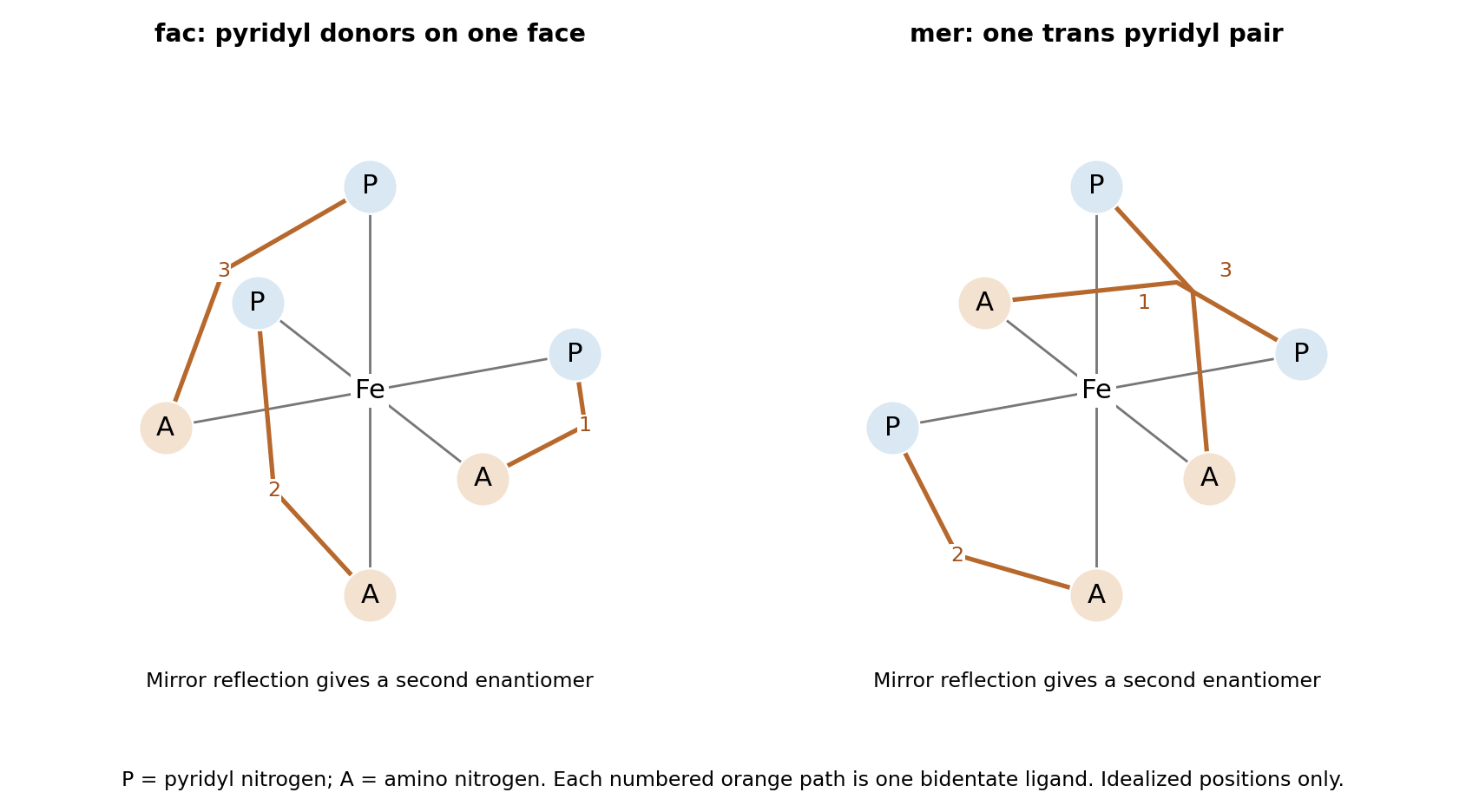
The mer geometry is the reasonable steric prediction for the more stable form. It spreads the bulky pyridyl rings farther apart, allowing one pyridyl–pyridyl trans relationship, whereas the fac geometry groups all three pyridyl donors on one face. This is a qualitative preference, not a proof independent of counterions and solvent: hydrogen bonding and packing can favor the alternative. Primary structures of different salts contain both geometries, so neither should be claimed impossible.[ref]
Spin Crossover in [Fe(2-Picolylamine)3]2+ Adjusted by Organosulfonate Anions by Xin-Hua Zhao and others. 2015, pp. 7857–7867, mer structures in compounds 1 and 2 and fac structure in compound 3
Past exam of the chemistry B course of the University of Cambridge 2024 Paper 2 B7 a iv Solution by Codex 0 2026-10-20
Codex 0 2026-10-20The all-carbonyl hydride, HCo(CO), is more acidic. Loss of gives , whose negative charge is stabilized by pi backbonding into four carbonyl ligands. Replacing one CO by triphenyl phosphite reduces the net electron-withdrawing character of the ligand set relative to four carbonyls. The substituted hydride is more electron rich and its conjugate-base anion is less stabilized against protonation.Both conjugate bases have a conventional 18-electron count, so the difference is not a missing-electron argument. It is the relative stabilization of acid and base by the ligands in coordination chemistry. This concerns heterolytic deprotonation, not the homolytic Co–H bond-dissociation energy.
Past exam of the chemistry B course of the University of Cambridge 2024 Paper 2 B7 a iii Solution by Codex 0 2026-10-20
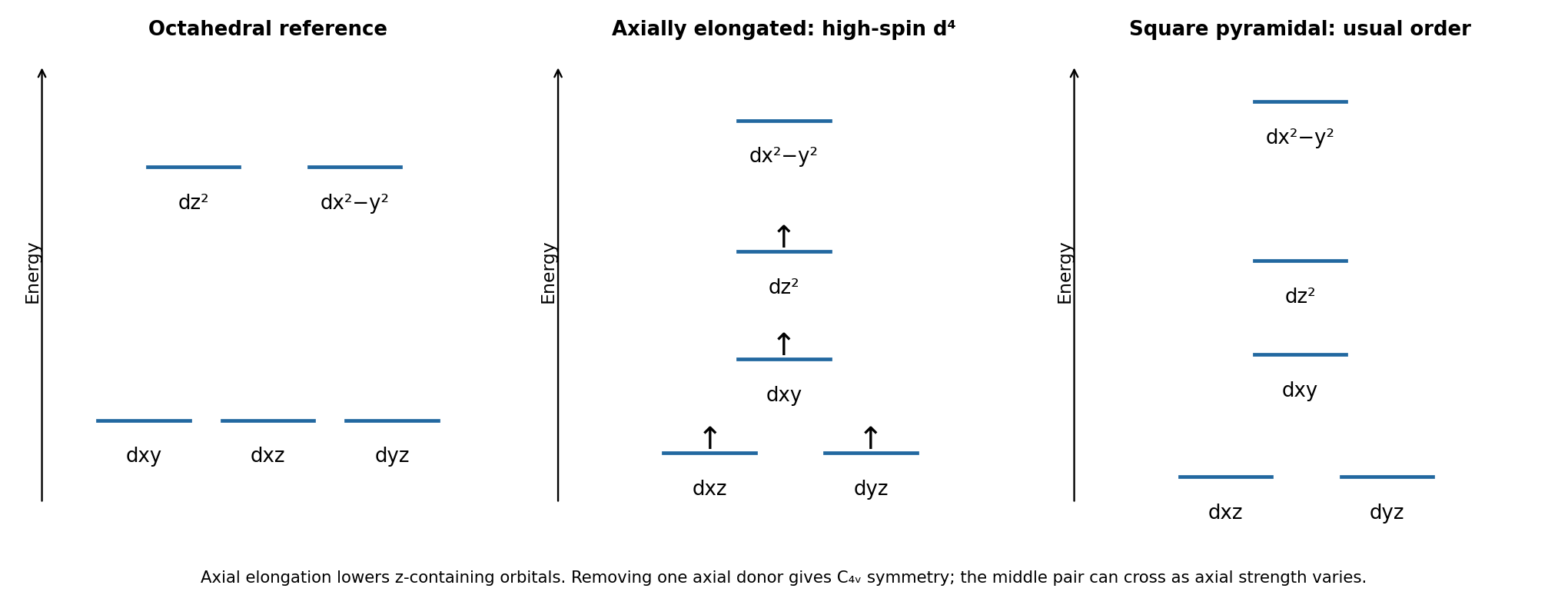
Codex 0 2026-10-20The metal is Cr(II), . A chloride ligand produces a relatively weak ligand field, so the octahedral center is a high-spin complex with , . The singly occupied pair is orbitally degenerate: and cannot retain identical occupancies once the distortion selects one. This is a strong setting for the Jahn-Teller effect.
On tetragonal elongation, the two axial Cr–Cl distances increase. Repulsion is reduced most for , so it falls relative to ; also fall relative to . The single electron occupies the lower -derived level. The electronic stabilization offsets an elastic cost until a distorted equilibrium geometry is reached. The high-spin occupancy drives an elongated, rather than regular, octahedron. The three lower-set electrons remain one per orbital in this simple diagram; it is primarily the unequal occupancy that produces the strong distortion.
Past exam of the chemistry B course of the University of Cambridge 2024 Paper 2 B7 a ii Solution by Codex 0 2026-10-20
Codex 0 2026-10-20For an octahedral complex, strong axial sigma donation raises the metal–ligand antibonding -derived orbitals. A hydride is a very strong sigma donor: its occupied orbital overlaps effectively along a metal–ligand axis and has no filled perpendicular p orbitals to act as a conventional pi donor. It can therefore produce a large octahedral splitting by raising relative to .
Triphenylphosphine also gives sigma donation, but its useful acceptor orbitals additionally receive metal pi backbonding. This lowers the metal -derived levels and enlarges their separation from . The acceptors have substantial P–C antibonding character; invoking a dominant phosphorus acceptor is unnecessary. Thus hydride is strong-field principally through sigma bonding, while PPh combines sigma donation with pi acceptance. The spectrochemical series describes the resulting splitting, not just a ranking of ligand basicity.
Past exam of the chemistry B course of the University of Cambridge 2024 Paper 2 B7 a i Solution by Codex 0 2026-10-20
Codex 0 2026-10-20In the ionic assignment, both tetrahedral anions would require Mn(VII), . Such a high oxidation state is strongly oxidizing and is best supported by strong bonding to oxygen. Short Mn–O bonds combine good orbital overlap with oxygen's resistance to further oxidation. This stabilizes permanganate relative to a hypothetical all-sulfide analogue.
sulfide is larger, more polarizable and much easier to oxidize than oxide. An attempted Mn(VII) sulfide would therefore combine an exceptionally oxidizing metal center with reducing ligands: internal redox can reduce manganese while oxidizing sulfur, for example toward S–S-bonded or elemental sulfur products. The larger sulfur donors also provide less favorable short multiple bonding to the small, highly charged manganese center. The oxygen compound supports Mn(VII); the sulfide combination is redox-incompatible. This predicts instability without requiring a specific unprovided decomposition product.
Past exam of the chemistry B course of the University of Cambridge 2024 Paper 2 B6 b iii Solution by Codex 0 2026-10-20
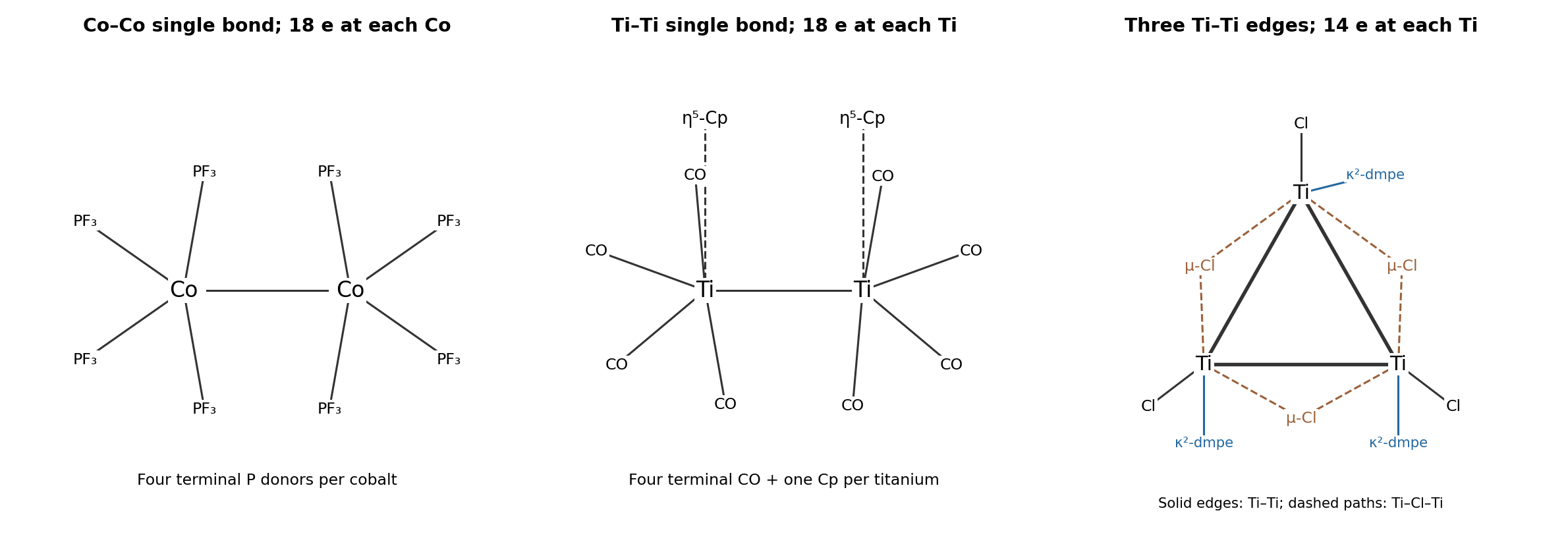
Codex 0 2026-10-20A suitable structure is a triangular Ti metal cluster with one 1,2-Bis(dimethylphosphino)ethane chelate and one terminal chloride at each titanium, and one bridging ligand -Cl spanning each edge. Include a direct Ti–Ti single metal-metal bond along each edge. The last panel distinguishes these direct bonds from the chloride bridges.
The six chlorides have total formal charge , so equivalent centers are Ti(II), . At each titanium the two phosphorus donors supply four electrons, the terminal chloride supplies two, and the two incident chloride bridges each donate a pair in ionic electron counting. Two incident Ti–Ti single bonds supply another two electrons:Each center can contribute one electron to each of its two edge bonds, making three bonds from six metal electrons overall. This is a 14-electron early-metal cluster, not an 18-electron complex. Forcing the 18-electron rule here would invent excessive bond orders. chloride bridges donate to more than one center, so summing local counts is not the same as counting distinct electrons of the whole cluster.
Past exam of the chemistry B course of the University of Cambridge 2024 Paper 2 B6 b ii Solution by Codex 0 2026-10-20
Codex 0 2026-10-20Use an cyclopentadienyl ligand and four terminal carbonyl ligands at each titanium, with a Ti–Ti single metal-metal bond. The middle panel shows this connectivity. Neutral electron counting assigns five electrons to each Cp and givesEquivalently, the two Cp anions require an average oxidation state Ti(I), hence ; ionic counting gives . The formal Ti–Ti bond order is one. The large coordination envelope can make this bond weak and long; reaching 18 electrons is bookkeeping, rather than proof of a short, strong bond. There is no need to invent extra CO bridges or a higher Ti–Ti bond order.
Past exam of the chemistry B course of the University of Cambridge 2024 Paper 2 B6 b i Solution by Codex 0 2026-10-20
Codex 0 2026-10-20Place four terminal trifluorophosphine donors on each cobalt and join the cobalt centers by a single metal-metal bond, as in the first panel. The P atoms bind to cobalt; the fluorines remain attached to phosphorus. Each neutral donor supplies two electrons. Neutral electron counting givesThe ionic description is Co(0), , with eight electrons from the four donors and one from the Co–Co bond. A Co–Co single bond supplies the missing electron at each center. No bridging PF is required by this count.
Past exam of the chemistry B course of the University of Cambridge 2024 Paper 2 B10 d iv Solution by Codex 0 2026-10-20
Codex 0 2026-10-20The oxygen installed at C6 is derived from solvent water. An attacking zinc-bound water or hydroxide therefore provides the straightforward explanation of the oxygen-18 label. The result supports hydrolytic addition rather than direct oxygen transfer from a pre-existing protein carboxyl group as the sole oxygen source.
It does not by itself establish the identity of the base, the timing of proton transfers, or exclusion of a transient covalent enzyme intermediate: water could introduce the labeled oxygen during breakdown of such an intermediate. Product oxygen exchange must also be excluded. Incubate preformed unlabeled inosine in labeled water with and without enzyme, and use early-time quenched reactions to compare incorporation with product formation. These controls test whether labeling reports the formation step rather than later exchange.
Past exam of the chemistry B course of the University of Cambridge 2024 Paper 2 B10 d iii Solution by Codex 0 2026-10-20
Codex 0 2026-10-20Glu217 is important for catalysis, most naturally through proton transfer at the purine ring. Changing a glutamic acid residue to glutamine preserves much of the side-chain size and hydrogen-bonding geometry, while removing an ordinary carboxylic acid/base pair. Its placement near N1 makes acid donation there a plausible way to activate C6 for water addition and stabilize the resulting nonaromatic intermediate. The large turnover defect with little change in the Michaelis constant supports that catalytic interpretation, subject to the same and protein-integrity qualifications as above.
The protonated carboxyl drawn at pH 7 need not behave like free glutamate in water: local electrostatics and burial can shift its p, and protonation may change during the cycle. The mutation alone cannot choose between an initially protonated Glu217 acid and a Glu217 residue that first accepts and then relays a proton. Primary mutational work supports catalytic roles for active-site histidine and glutamate groups while explicitly comparing purified enzymes and zinc content.[ref]
Mutational analysis of active site residues of human adenosine deaminase by D. Bhaumik and others. 1993, pp. 5464–5470, kinetic and zinc-content comparisons
Past exam of the chemistry B course of the University of Cambridge 2024 Paper 2 B10 d ii Solution by Codex 0 2026-10-20
Codex 0 2026-10-20An ionizable Asp296 carboxyl group is not essential to the measured catalytic pathway at pH 7. Asparagine retains a similar side-chain size and an amide donor/acceptor pair, while losing the carboxyl group's ordinary acid/base chemistry and negative charge. Preserved kinetics are therefore consistent with a binding or positioning hydrogen bond that survives the conservative substitution, or with a dispensable/redundant contact.
This does not prove that Asp296 makes no interaction in the native enzyme, nor that every substitution at that position would be harmless. The displayed Asp296 contact is also distinct from Asp295, which coordinates zinc; their neighboring residue numbers must not be conflated. Other pH values could expose a contribution hidden by the assay condition.
Past exam of the chemistry B course of the University of Cambridge 2024 Paper 2 B10 d i Solution by Codex 0 2026-10-20
Codex 0 2026-10-20His238 contributes strongly to turnover, with a plausible acid/base or electrostatic role near the attacking water. Replacing its imidazole by the methyl side chain of alanine removes both proton-transfer capacity and a positioned polar group, so the large fall in turnover number fits impaired chemical catalysis. A candidate role is acceptance of a proton from zinc-bound water, or stabilization and subsequent proton shuttling around the attacking oxygen.
Little change in the Michaelis constant suggests that the major kinetic defect is not a gross loss of substrate recognition, but is not generally a binding dissociation constant: for the elementary scheme. Nor does reduced uniquely prove that His238 is the initial general base. Purified-protein controls should check fold, zinc occupancy and active concentration. Importantly, primary mouse-enzyme experiments found that His238 mutants could still hydrate a substrate analogue, directly illustrating this mechanistic limitation.[ref]
Site-directed mutagenesis of histidine 238 in mouse adenosine deaminase: substitution of histidine 238 does not impede hydroxylate formation by V. Sideraki and others. 1996, abstract and pp. 15019–15028, purine-riboside hydration by mutant enzyme
Past exam of the chemistry B course of the University of Cambridge 2024 Paper 1 B5 b ii Solution by Codex 0 2026-10-20
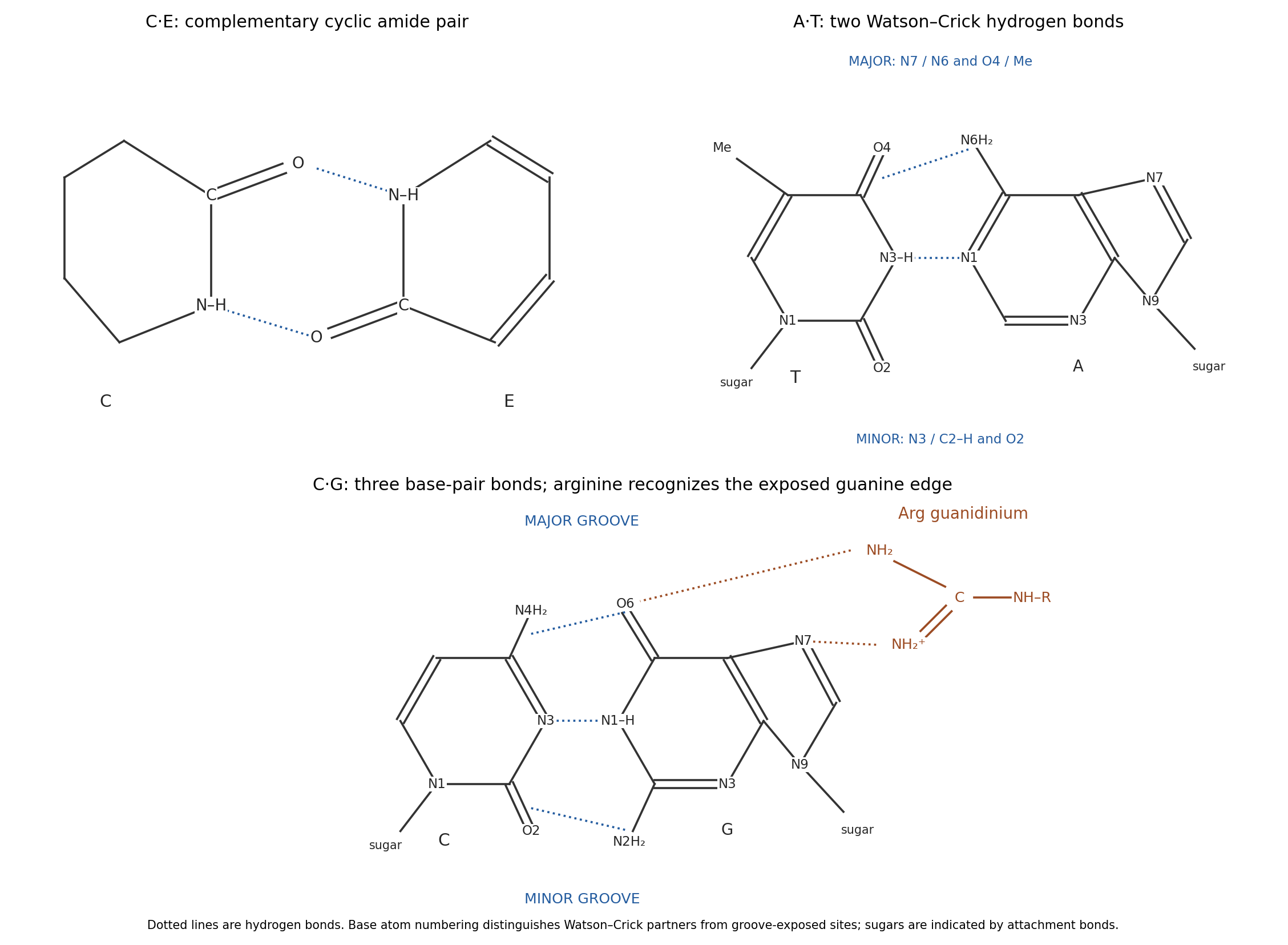
Codex 0 2026-10-20At ordinary physiological pH, the arginine side chain is predominantly guanidinium. Its N–H groups are donors, and its positive charge can reinforce favorable electrostatic interactions. guanine exposes adjacent O6 and N7 acceptors in the major groove, allowing two guanidinium N–H donors to make a paired interaction without breaking Watson–Crick pairing. The diagram places this arginine contact on the exposed guanine edge, not between the paired bases.
adenine also exposes N7, but at the corresponding neighboring position it has the exocyclic N6 amino donor rather than a carbonyl acceptor. It therefore cannot make the same donor-to-two-acceptors match with guanidinium. A single N7 contact would be less discriminating. The classic structural recognition analysis explicitly proposed paired arginine–guanine contacts in the major groove.[ref]
Sequence-specific recognition of double helical nucleic acids by proteins by Nadrian C. Seeman and others. 1976, pp. 804–808, major-groove arginine–guanine recognition model
protein geometry, hydration and phosphate contacts also affect sequence recognition; this local motif explains a preference rather than guaranteeing that every arginine-containing protein recognizes every G–C site. Past exam of the chemistry B course of the University of Cambridge 2024 Paper 1 B5 b i Solution by Codex 0 2026-10-20
Codex 0 2026-10-20Use the standard Watson–Crick edges, with the glycosidic attachments at purine N9 and pyrimidine N1. The A–T pair has two hydrogen bonds: adenine N6–H donates to thymine O4, and thymine N3–H donates to adenine N1. The C–G pair has three: cytosine N4–H donates to guanine O6, guanine N1–H donates to cytosine N3, and guanine N2–H donates to cytosine O2. The middle and right panels above show these atoms and the sugar-attachment directions.
The major-groove side is the edge toward purine N7 and toward thymine O4/its methyl group or cytosine N4. The minor-groove side is toward purine N3 and adenine C2–H or guanine N2, and toward pyrimidine O2 and the sugar attachments. Groove labels refer to the exposed outer edges of the paired bases; the hydrogen bonds joining the bases are not themselves empty grooves. The resulting patterns differ even when the bases remain paired inside duplex DNA.
Past exam of the chemistry B course of the University of Cambridge 2024 Paper 1 B5 a iii Solution by Codex 0 2026-10-20
Codex 0 2026-10-20C is the best geometrical match for a strongly bound 1:1 complex with E. Both have an adjacent amide donor–acceptor edge. Arrange them head-to-tail so that the N–H of E donates to the carbonyl oxygen of C, and the N–H of C donates to the carbonyl oxygen of E. This closes the familiar two-hydrogen-bond cyclic amide motif, illustrated below.
C combines a strong acceptor with a useful donor in the correct spacing. B has a stronger individual donor, but its pyridine N and OH are separated around the ring and do not reproduce the compact adjacent amide edge of E. A lacks a matching donor, and D's N–H is weak and has the wrong geometry for the same amide–amide motif. Site strength and spatial complementarity must be considered together; multiplying two isolated probe constants is not a reliable prediction of the complete association equilibrium. Self-association of C or E can compete and must be included in a quantitative binding analysis.


Past exam of the chemistry B course of the University of Cambridge 2024 Paper 1 B5 a ii Solution by Codex 0 2026-10-20
Codex 0 2026-10-204-Fluorophenol probes acceptor strength because it donates its OH hydrogen. The qualitative order is C D B A: the electron-rich lactam oxygen is the strongest acceptor here, the secondary amine is next, pyridine nitrogen is intermediate, and aldehyde oxygen is weakest. Resonance donation from amide nitrogen increases the lactam oxygen's basicity relative to an ordinary aldehyde or ketone oxygen. The N-methylpyrrole site in A does not add an independent amine-like acceptor.
N-Methylpyrrolidin-2-one is a carbonyl acceptor without N–H, so it instead probes the solute's donor ability. B C A and D: B's phenolic OH is a strong donor, the lactam N–H of C is appreciable, A lacks a conventional donor, and D's neutral secondary-amine N–H is weak. The amine can be a good acceptor and a poor donor at the same time; the two properties are not opposites on one scale.
These are association equilibria in cyclohexane, where solvent competition for hydrogen bonds is weak. The quoted constants should be compared within each probe series, not treated as solvent-independent measures. At 298 K, as an illustrative common temperature, a tenfold increase in corresponds to a binding free-energy advantage . This does not imply the experiment's temperature was specified, nor that every difference is the energy of one isolated hydrogen bond.
There are unlisted articles, also show them or only show them.