Past exam of the atmospheric physics course of the University of Cambridge 2013 Paper 1 1 Solution by  Codex 0 2026-10-20
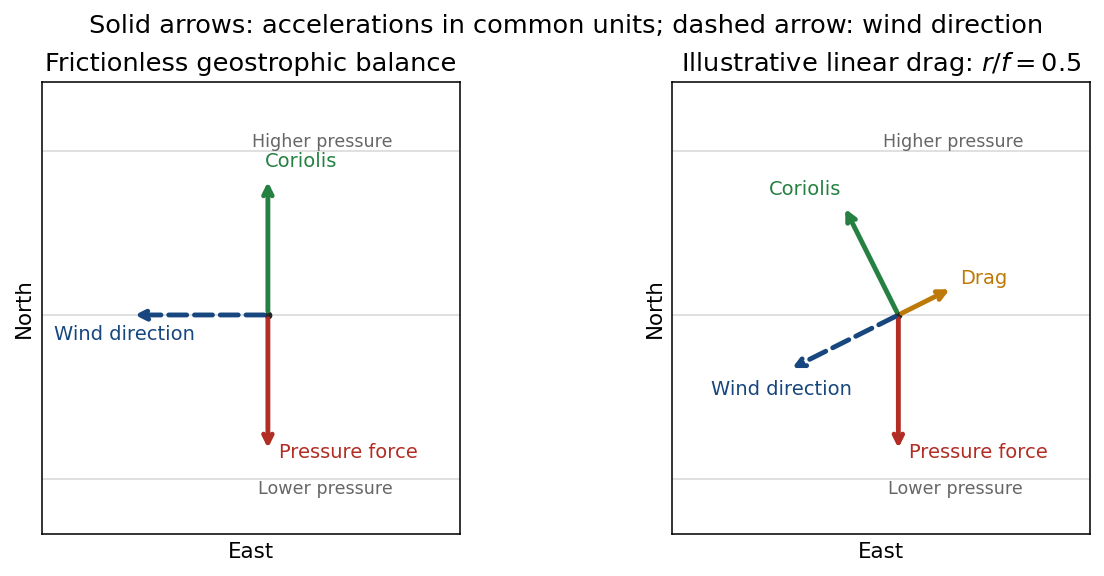
In the rotating terrestrial frame, horizontal pressure gradient force and Coriolis force balance in geostrophic balance. Gravity establishes the approximately vertical hydrostatic equilibrium; it is not an additional horizontal force in this balance. With eastward , northward , upward unit vector and Coriolis parameter ,The geostrophic wind runs along atmospheric isobars, with lower pressure on its left in the Northern Hemisphere.
Interpreting the stated south-to-north gradient as , , while . Using the external nominal Earth's rotation rate gives the meridional-pressure-gradient geostrophic windBoth zonal velocities are westward; their signs reverse if the supplied gradient is interpreted as a northward decrease. [ref]
IERS Conventions (2010) by International Earth Rotation and Reference Systems Service. Table1.2, physical PDF p.19: nominal mean angular velocity
The validity criteria for geostrophic balance require horizontal acceleration and friction to be small compared with the balancing forces: Rossby number and slow evolution compared with . The approximation fails near the equator, on sufficiently small or rapidly changing scales, in strongly curved flow needing appreciable centripetal acceleration, and in the frictional surface layer. Neglecting friction near the ground is the stated idealization.
For an illustrative geostrophic wind with linear drag, use acceleration with . The steady horizontal momentum equation givesDrag reduces the wind and hence its Coriolis acceleration; the wind crosses isobars toward lower pressure. Here it points southwest. The pressure-gradient acceleration points south, Coriolis northwest and drag northeast; the three forces sum to zero. The cross-isobar angle satisfies for . A turbulent boundary layer has a vertically varying stress rather than necessarily this constant linear drag.

Past exam of the astrophysical fluid dynamics course of the University of Cambridge 2015 Paper 1 3 Solution by Codex 0 2026-10-20
Codex 0 2026-10-20The Rankine-Hugoniot conditions for a perfect gas express conservation of mass flux, normal momentum flux, and total energy flux through a steady planar shock wave in its rest frame. With mass flux , momentum flux is and specific transported energy is . The last term is pressure work, so the energy equation contains specific enthalpy rather than only specific internal energy. Neglect gravity across the thin front, magnetic stresses and radiative energy loss for the adiabatic case.
For a calorically perfect ideal gas, and . ThereforePut , so . Momentum conservation givesInsert this and into the energy equation. After multiplying out, its two factors areThe first root is the unchanged flow. The compressive shock branch isIt has for upstream supersonic flow. A strong shock approaches : four for a monatomic gas, or six for a fixed rotationally excited diatomic gas with . The assumed fixed heat capacity ceases to describe the gas when dissociation or ionization becomes important. Adiabatic here means no net heat lost from the shock-plus-flow energy budget; the irreversible front still increases entropy.
For an isothermal shock of unchanged composition, let be the common isothermal sound speed squared. Mass and momentum conservation giveThe compressive branch is thereforeUnlike the adiabatic ratio, it has no fixed upper bound as its upstream Mach number grows. Heat removal prevents the pressure increase that would otherwise resist compression. This approximation describes an efficiently cooled jump between equal-temperature far states, not an adiabatic shock with its energy equation left unchanged. For the same upstream physical temperature and velocity, ; the two sound-speed conventions must not be confused.
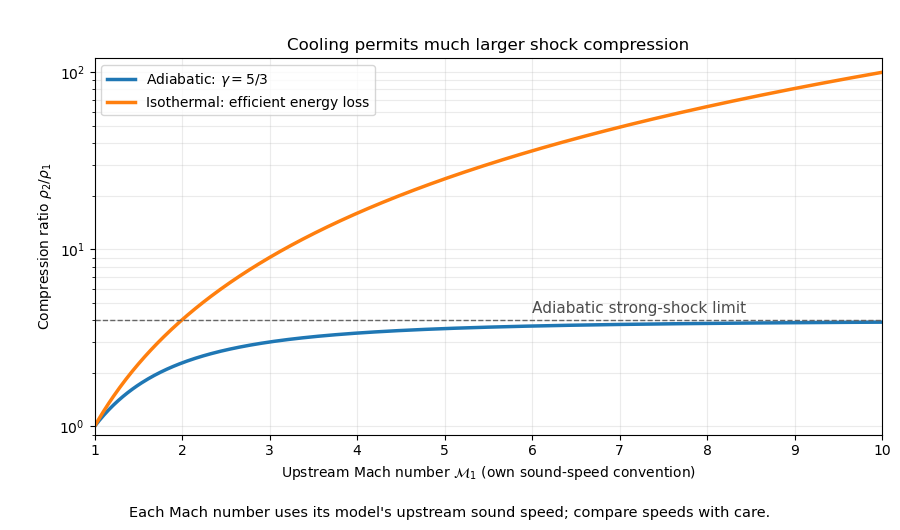
Bounded adiabatic compression and increasing isothermal compression
. Original comparison for fixed composition. The horizontal Mach coordinate uses each model's own upstream sound speed, so equal plotted Mach numbers do not mean identical upstream temperatures and velocities. Details.
Full dissociation changes the equation of state even when the temperature is held constant. With negligible electron and binding-energy mass corrections, upstream molecular hydrogen has and downstream atomic hydrogen has . The conserved quantity is mass flux; particle number flux doubles. ThusEquivalently, the dissociating isothermal shock relation between temperature and the two velocities isWriting givesThe high-compression branch isIts strong-shock limit is , rather than . The pressure per unit mass has doubled, reducing the compression available at a fixed upstream temperature and speed. A real compressive branch in this prescribed fully dissociated, equal-temperature model requires ; the high root has downstream speed no greater than the downstream isothermal sound speed. These mass and momentum conditions do not themselves establish that sufficient energy is available to dissociate every molecule. The chemical energy and any required radiative loss must also be included in a physical energy budget.
There are unlisted articles, also show them or only show them.