Past exam of the atomic and Optical Physics course of the University of Cambridge 2013 Paper 1 2 Solution by  Codex 0 2026-10-20
For the Bogoliubov spectrum, define and . For repulsive interactions and ,Thus the low-momentum excitations are gapless phonons and the high-momentum branch approaches free-particle curvature. The crossover occurs when kinetic and interaction energy are comparable. The Landau criterion follows because an obstacle moving at velocity can supply energy to an excitation. HereThis is the homogeneous phonon kinematic threshold, not a guarantee that every perturbation dissipates immediately above it.
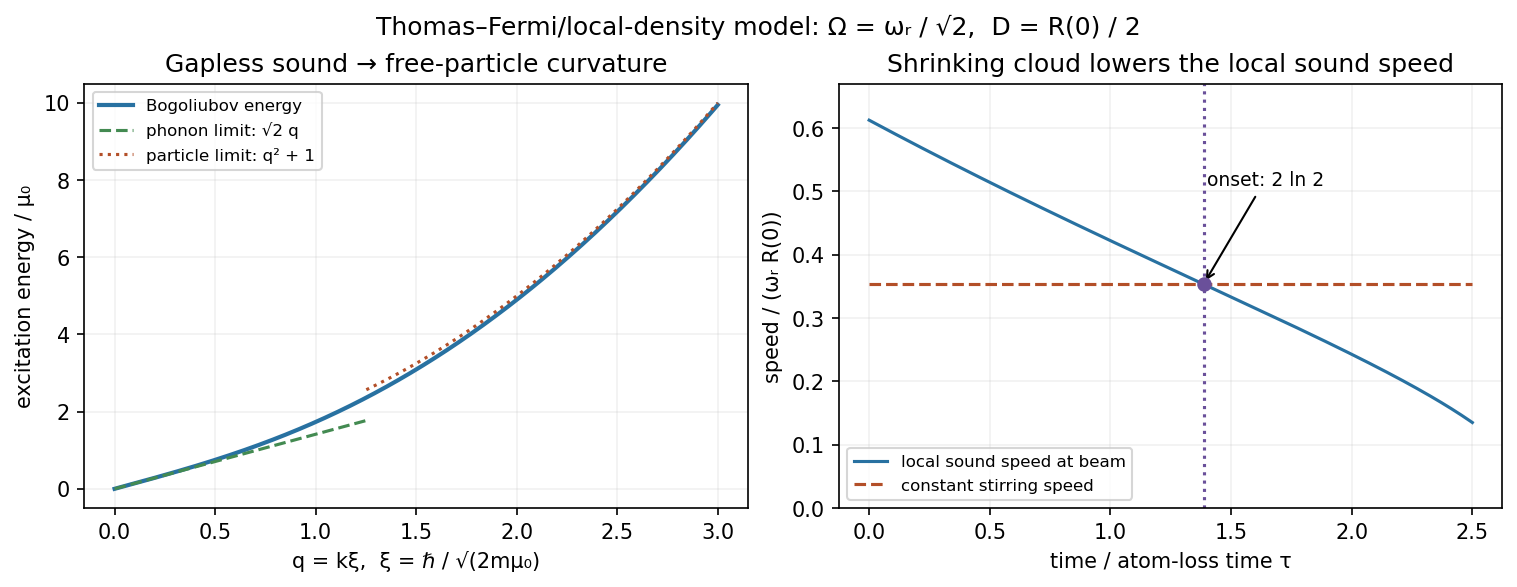

In two dimensions, has units of inverse area and has units of energy times area. Therefore is dimensionless. Neglecting the kinetic term in the Gross–Pitaevskii equation, with positive coupling, giveswith outside the radius in the Thomas–Fermi approximation for a condensate. Multiplication givesThe sharp edge is an approximation; the neglected gradient term rounds it over a healing length scale.
Using the local sound-speed criterion for circular condensate stirring, the moving beam has speed . The local interaction chemical potential is , soThe onset equality is and the permitted excitation condition isThis uses the beam speed as the local relative-flow scale. A finite hole can distort the surrounding flow or nucleate vortices, so the result is the requested local phonon estimate, not a universal necessary condition for all experimental stirring.
For the loss-driven onset of condensate stirring, first integrate the density:At fixed coupling and trap frequency, and . Hence while stays fixed. For , threshold requires . Starting at ,At onset, , and the beam is still inside the cloud. Excitations become kinematically allowed just beyond this equality, provided the stipulated adiabatic regime of the Thomas–Fermi approximation for a condensate remains valid.
Past exam of the atomic and Optical Physics course of the University of Cambridge 2013 Paper 1 1 Solution by Codex 0 2026-10-20
Codex 0 2026-10-20For a free-space electric dipole transition, the spontaneous emission rate in SI units isHere includes the relevant dipole components; a specified single polarization requires its corresponding matrix element.
A complete scattering cycle returns the internal state to the ground state and changes the atomic momentum to . ThusFor photon-scattering recoil heating with isotropic emission of fixed momentum magnitude, , givingThe first term is the velocity-dependent work of absorption and can cool an atom if the photon opposes its motion. The last two are positive absorption and emission recoil energies. If the actual absorbed directions are also isotropic and independent of , the first term averages to zero. For approximately equal incoming and outgoing photon momenta ,Isotropic incident illumination alone would not guarantee isotropic absorption if Doppler-dependent excitation selected directions.
Source qualification for the trapped calculation. Set for the same atom. The printed Gaussian has the wrong width for the specified harmonic oscillator: the printed ground and first-excited functions have squared norms and , respectively. The normalized oscillator states fixed by the given instead useAlso, one common complex phase multiplying both off-diagonal terms does not make the Hamiltonian a Hermitian operator. Use an absorption matrix element and its Hermitian conjugate for emission; choosing the opposite propagation convention reverses the imaginary sideband phase but not a transition probability. The physical results below use these explicitly stated corrections. Parts (i) and (ii) also give the literal integrals of the printed functions.
Conditional motional heating and recoil averaging. With , an oscillator eigenstate has . Therefore the absorption outcomes haveThe same statements hold for the specified emission outcomes and . Internal excitation energy goes into, or comes from, the photon and is distinct from this external energy change. Emission into the first motional state makes the emitted photon correspondingly less energetic.
A sudden recoil from gives probabilities , so while . The rare first sideband transfers a whole trap quantum, much larger than ; the mean is neverthelessThe emission average is the same for a one-dimensional recoil of the same magnitude. Projecting isotropic three-dimensional emission onto one axis instead gives a factor for that axis.
A sudden unobserved kick initially raises kinetic energy by and leaves the position distribution, hence potential energy, unchanged. It creates a coherent superposition of motional states. The equal kinetic/potential increments above concern energy-eigenstate-conditioned outcomes, or time-averaged/dephased motion; these are different measurement conditions. There is no contradiction.
With , motional sidebands are not cleanly resolved, and a short-lived excited atom has little time to move before decay. In the stronger sudden limit the recoil-kick picture is direct. For only the stated inequality, finite linewidth weights can change numerical factors; it does not fix an exact continuous-wave scattering rate. The average heating remains of recoil order per absorption or emission, and of order when both absorption and emission kicks are counted at full magnitude. For the axial component of isotropic three-dimensional emission, the emission contribution instead carries the factor noted above. Strong confinement suppresses the chance of changing , but does not make its averaged recoil energy disappear. This agrees with free-space recoil heating while replacing small continuous energy changes by rare quantized motional changes.
Past exam of the atmospheric physics course of the University of Cambridge 2013 Paper 1 2 Solution by Codex 0 2026-10-20
Codex 0 2026-10-20Use spectral radiant exitance per unit wavelength. The Planck law isA hotter blackbody radiates more at every wavelength, its wavelength peak moves to shorter wavelengths according to Wien's displacement law, and its integrated flux rises as by the Stefan–Boltzmann law. The wavelength convention matters: a spectrum plotted per unit frequency has a different peak transformation.
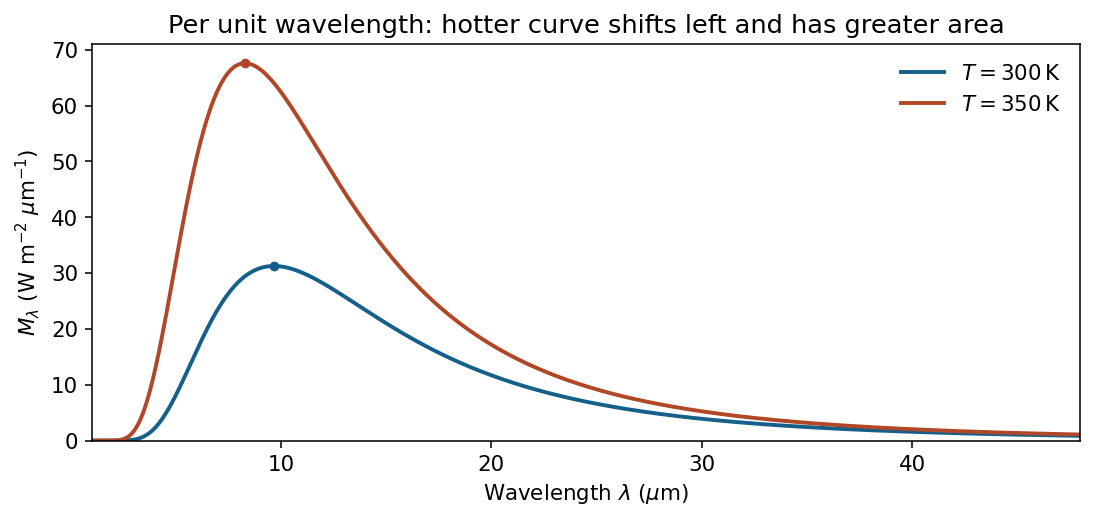
Illustrative wavelength spectra: a hotter blackbody has a larger total flux and a shorter peak wavelength
. Source. Details. 
For planetary equilibrium temperature, assume an isotropic blackbody star, a circular orbit, negligible internal heating, unit surface thermal emissivity and efficient global heat redistribution so the surface has one temperature. The received stellar irradiance is . A planet of radius intercepts but radiates over , giving the projected-area factor in planetary energy balanceWithout the uniform-temperature assumption, this calculation gives , not a unique arithmetic mean of surface temperature.
With Bond albedo , the absorbed fraction is . Hencea decrease of approximately . This albedo weights incident stellar light and does not imply thermal emissivity .
Define the planetary effective emissivity by outgoing top-of-atmosphere flux . Maintaining the same absorbed stellar power with givesThe greenhouse effect allows thermal radiation to escape from colder layers, so the outgoing flux is less than a black surface at would emit. Downward atmospheric emission contributes to the surface energy balance; this does not violate the top-of-atmosphere energy balance.[ref]
Climate and Earth's Energy Budget by NASA Earth Observatory. Thermal radiation, atmospheric absorption and effective radiating versus surface temperature
A single-layer greenhouse model makes the distinction quantitative. Take a shortwave-transparent, isothermal layer with infrared absorptivity and emissivity , above a surface black in the thermal infrared. Writing , its surface and atmospheric balances areFor , . Radiation escaping to space is , soThus is the planet's effective emissivity; is the layer's infrared emissivity within this particular model. They are not interchangeable. Real atmospheres require wavelength-dependent absorption, a vertical temperature profile and nonradiative heat transport; the measured temperatures alone do not uniquely retrieve an atmospheric optical profile.
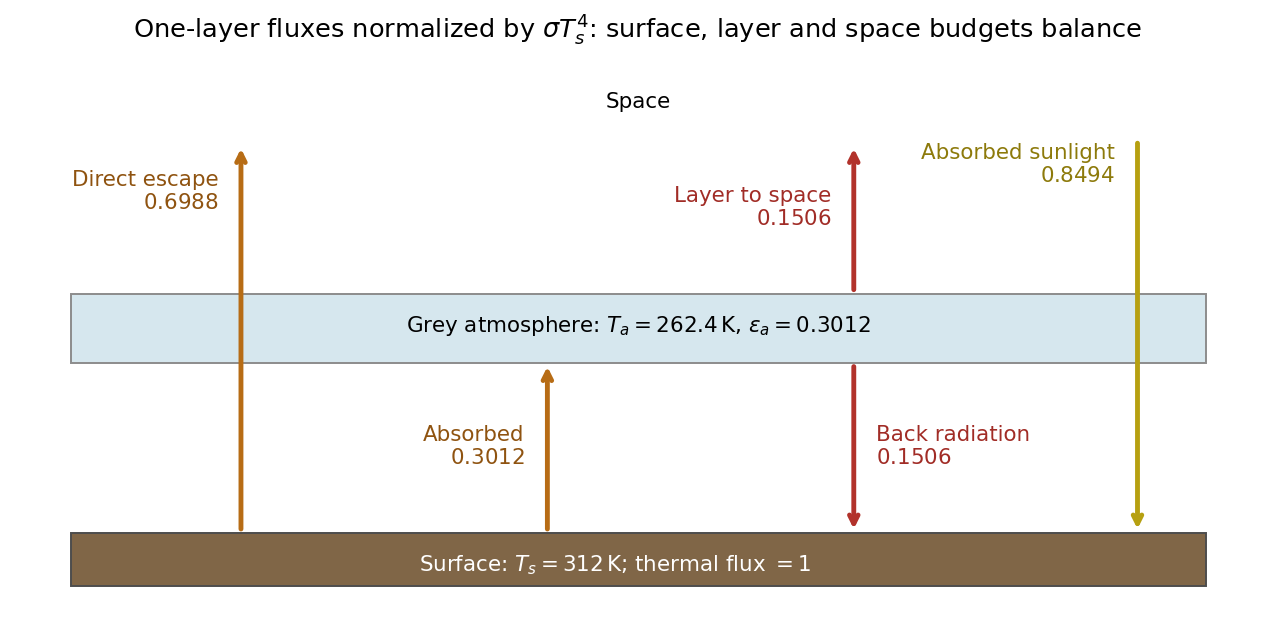
One-layer radiative equilibrium distinguishes planetary effective emissivity from the infrared emissivity of the atmosphere
. Source. Details. 
There are unlisted articles, also show them or only show them.