Past exam of the astrophysical fluid dynamics course of the University of Cambridge 2012 Paper 1 4 Solution by  Codex 0 2026-10-20
Follow a fluid element with position satisfying . The chain rule gives the material derivativeApply Newton's second law to a material element of volume and mass . The net pressure force is , and gravity gives . Dividing by the element mass, neglecting viscosity and using the chain rule componentwise gives the Euler equation
For a static spherical isothermal gas, and . Trial density gives enclosed mass , soThis is the singular isothermal sphere. Its central density diverges, although the enclosed mass tends to zero linearly and its total mass inside a finite radius is finite. It is not the finite-central-density regular isothermal solution.
Truncate at with boundary pressure . Then and , givingThe external medium is being treated as a prescribed pressure boundary; its own gravitational field is excluded from the cloud self-energy calculation.
For a monatomic perfect gas, the equilibrium is isothermal but the internal-energy relation still uses its adiabatic index :The gravitational self-energy follows by assembling shells:Both integrals remain finite at the singular center. ConsequentlyThe pressure-confined singular isothermal gas sphere therefore satisfies the virial theorem including the work of the confining surface pressure. One can see its origin directly by integrating : integration by parts gives , whose surface term is . An isolated vacuum-boundary version would omit that term and could not truncate this same positive-temperature isothermal profile at finite radius. The equality expresses equilibrium force and energy balance, rather than proving dynamical stability.
Past exam of the astrophysical fluid dynamics course of the University of Cambridge 2012 Paper 1 3 Solution by Codex 0 2026-10-20
Codex 0 2026-10-20Interstellar shocks arise when relative flow is supersonic: stellar winds, supernova ejecta, colliding clouds and gas moving through strong disturbances can drive them. Neighboring compressive characteristics steepen or a fast flow encounters material it cannot decelerate through upstream sound communication. A thin dissipative front then converts directed kinetic energy into thermal energy and increases entropy.
Integrate mass, normal momentum and total energy conservation through a planar steady shock in its rest frame. With no mass source, negligible external impulse across the thin layer and no radiative energy loss, their normal fluxes are respectivelyFor a perfect gas of constant adiabatic index, . Equality of the fluxes on the two sides yields the three Rankine-Hugoniot conditions in the question. Adiabatic means no energy escapes this control volume; it does not make the shock isentropic.
In the strong-shock limit, let and neglect . Momentum conservation gives . Substitution into energy conservation givesThe nontrivial compressive root isThe root describes no shock. A monatomic gas has the familiar compression four.
For identical colliding clouds in their center-of-momentum frame, reflection symmetry fixes the contact plane and the uniform compressed material on either side at rest. The unshocked clouds still approach at speeds ; their supersonic upstream flow has not received a smooth pressure adjustment ahead of the shock. Let the right shock move to the right at speed . In its own frame the upstream and downstream normal speed magnitudes are and . The same shock compression ratio therefore givesThis is the shock speed in a symmetric cloud collision. For , the shocks move outward at , not at the upstream speed or the relative cloud speed . As a check, the post-shock pressure is ; in the monatomic case , giving specific internal energy , exactly the initial bulk kinetic energy per unit cloud mass when brought to rest.
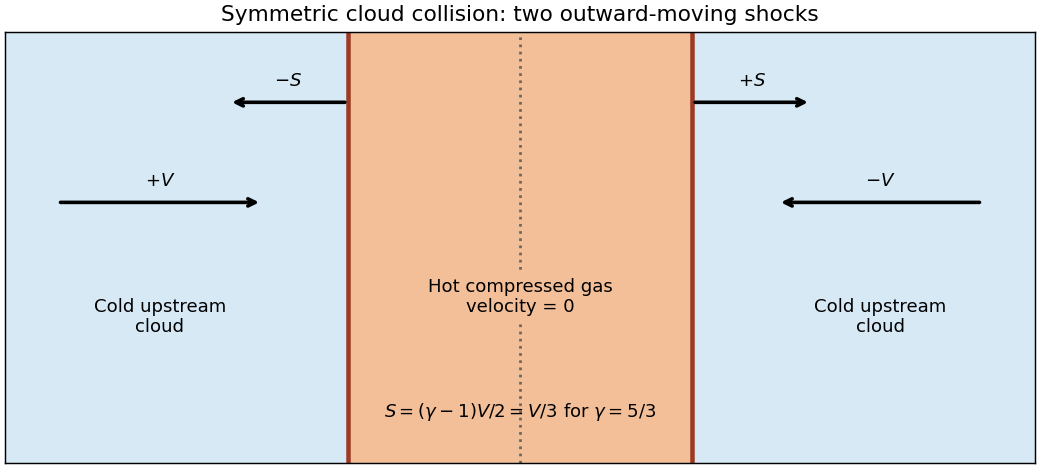
When a shock reaches a cloud's rear boundary, its supply of cold upstream gas ends. If the surrounding pressure is low, the hot compressed gas expands outward and a rarefaction travels back into it, converting thermal energy into motion and cooling the gas. A sustained uniform stationary shocked region is no longer the solution. Interaction with an appreciable exterior medium can instead drive another outward disturbance; the boundary pressure determines that part of the evolution. The stated adiabatic model provides no radiative mechanism that would keep a permanently cold dense sheet at the contact.
Past exam of the advanced quantum physics course of the University of Cambridge 2016 Paper 1 4 Solution by Codex 0 2026-10-20
Codex 0 2026-10-20Uniform system and dispersion. A plane wave reduces the differential Hamiltonian to a two-by-two matrix acting on its spinor:The Pauli anticommutation relations imply . Choosing a spinor in one of its eigenspaces therefore givesAn arbitrary constant spinor multiplying a plane wave is not necessarily an energy eigenstate; it must be an eigenvector of this matrix. For example, for the upper branch and , one can useaway from the coordinate singularity , where another normalized eigenvector chart is used.
For the usual convention, the massless branches are . For nonzero , the two branches have a gap and are quadratic near :Changing the sign of does not change these energies. It reverses the out-of-plane spin polarization of a given band at the origin. The plots for equal positive and negative mass magnitudes therefore have identical dispersion curves, despite their different spinors.
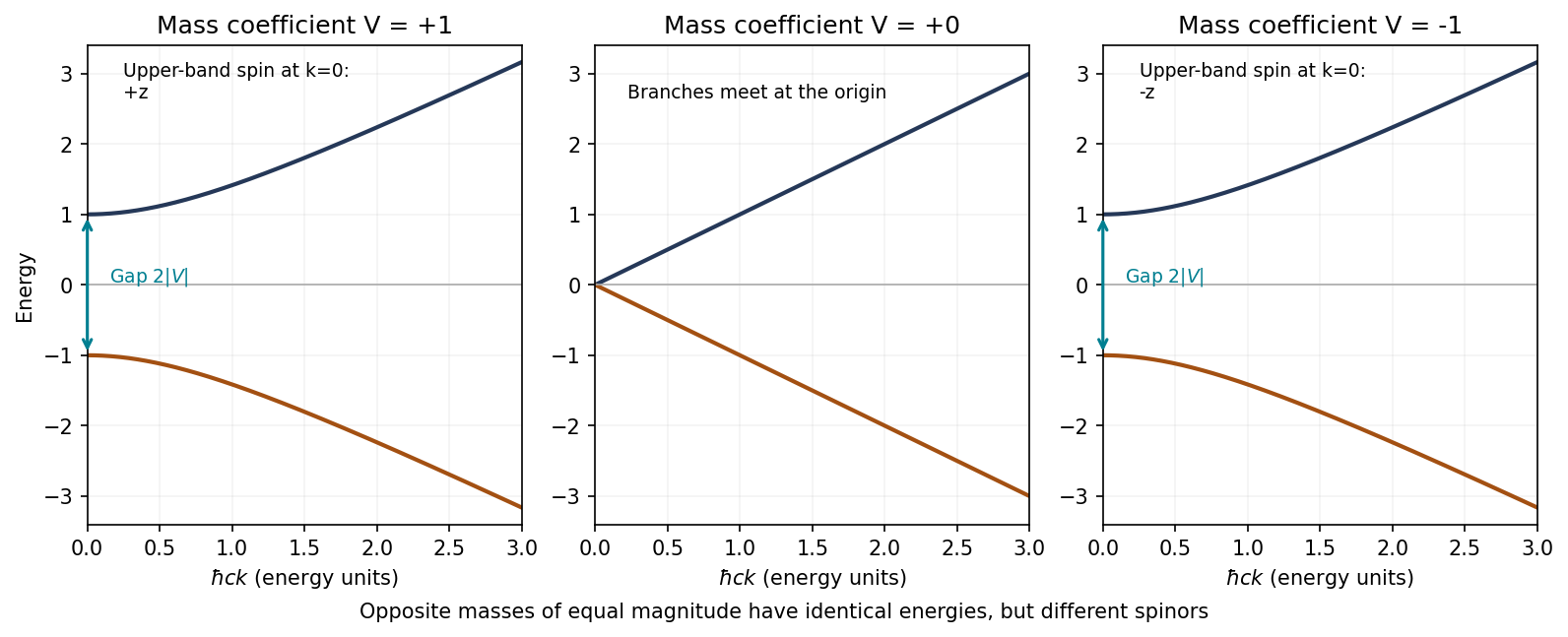
Original calculated massive and massless two-dimensional Dirac dispersions; equal and opposite masses share energies but reverse the band spin at zero momentum
. Details. Spin direction in the massless case. For put . The normalized eigenspinors can be chosen asDirect multiplication gives , and . Since the Pauli matrices represent physical spin in this question,The spin is parallel to momentum on the positive-energy branch and antiparallel on the negative-energy branch. Thus the branch-independent statement is collinearity; the printed parallel claim needs the positive-branch qualification. At , the Hamiltonian is zero and spin is not fixed by a wavevector direction.
Mass-domain-wall eigenstate. Assume for the stated normalizable wall state and writeThen , , and . Applying the full operator givesThe transverse derivative and mass terms cancel pointwise. Hence the specified state is an eigenstate with .
For a step mass above the interface and below it,The Localization length at a step Dirac mass wall sets the two exponential tails. The amplitude is continuous, peaks at the interface and decays on both sides, with generally unequal decay lengths. The probability density decays with lengths . A normalized transverse function is when multiplying the unit spinor . The longitudinal plane wave can independently be box-normalized. A step in allows a step in ; the first-order Dirac equation does not impose continuity of that derivative.
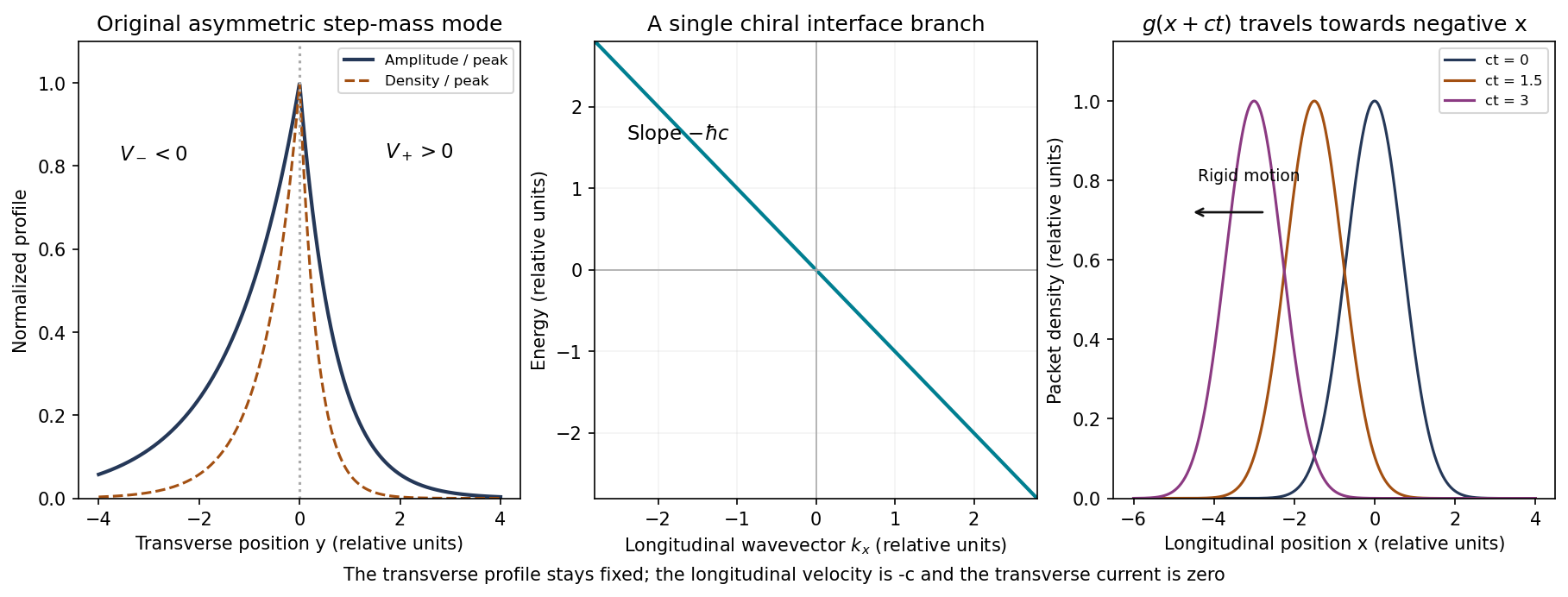
Original mass-wall solution: asymmetric exponential confinement, the chiral energy branch and rigid longitudinal translation of a localized packet
. Details. Propagation. The interface dispersion is the straight lineEvery component on this branch travels in the negative direction. A packet has the formThis dispersionless chiral interface wavepacket therefore translates rigidly with speed in that direction, without dispersion in this exactly linear model. It remains confined in ; there is no free transverse group velocity, because the bound-state family is not labelled by a transverse travelling-wave momentum.
The continuity equation gives the current components and . This explicitly confirms absence of probability transport away from the interface. For the step-mass case the profile is normalizable because its tails have positive decay constants and . A general sign-changing profile also requires ; nonzero asymptotic masses suffice, whereas signs alone do not guarantee confinement if their integrated magnitudes grow too slowly. If , the supplied exponential instead grows at infinity; a normalizable state requires the opposite spinor and envelope sign. Reversing the wall orientation also reverses the propagation chirality.
Past exam of the advanced quantum physics course of the University of Cambridge 2016 Paper 1 3 Solution by Codex 0 2026-10-20
Codex 0 2026-10-20Spin and spatial exchange symmetry. Write the normalized spin singlet and triplet states asThe singlet is antisymmetric under exchange and has total spin zero; the triplet is symmetric and has total spin one. For orthogonal orbitals defineIdentical spin one-half particles are fermions, so the complete state must be antisymmetric. Thus is allowed, and is allowed for each triplet component. The spatially symmetric same-orbital states also require the singlet. A same-orbital triplet vanishes by the Pauli exclusion principle.
These products give a spin-adapted basis. More generally the physical state can be writtenA superposition of the singlet and triplet sectors need not factor into one spatial function times one spin function. Factorization holds for a definite-spin sector, as used in the subsequent model. If the original normalized orbitals are not orthogonal, the corresponding normalization is ; the remainder of this calculation uses the stipulated orthogonal orbitals.
Integral matrix elements and positivity. Let and denote the localized spatial orbitals. With fixed proton positions, the one-electron electronic operator isThe proton-proton repulsion is a separate common nuclear energy. The requested one-electron and direct two-electron elements areSince ,Likewise,The integrand is nonnegative and is positive on a set of nonzero measure. This is the repulsion cost of double occupancy; the coincidence singularity is integrable for ordinary smooth localized orbitals.
One electron on each center. Suppress the normalized singlet spin factor and use . For each of the spatial products and , the one-body sum has expectation . The cross terms vanish because a one-body hop leaves an orthogonal spectator orbital. The interaction contribution is the direct integral plus the exchange integral, both neglected in the model. ConsequentlyThis state has no same-center double occupancy, but remains an exchange-symmetric spatial superposition rather than assigning a distinguishable electron permanently to each proton.
Two electrons in the bonding orbital. The normalized one-electron bonding orbital is . The trial spatial state is , whose one-body expectation isExpanding the product gives . The total probability of double occupancy is therefore . Keeping only on-site Coulomb repulsion gives the intended interaction truncation,and the interaction expectation is . HenceThis truncation must be stated. In particular, mixed Coulomb elements such as do not vanish merely by orbital orthogonality or inversion symmetry. The printed list does not explicitly name them. If they are retained and are equal and real by site symmetry, their contribution to is ; the requested expression uses their neglect along with the other off-site interaction terms. No numerical value of is supplied or invented.
Energy comparison and the bond. Put with and . ThenThe straight line starts at and crosses zero at . The purely bonding-orbital trial state is better for , while the singly occupied covalent trial state is better for .
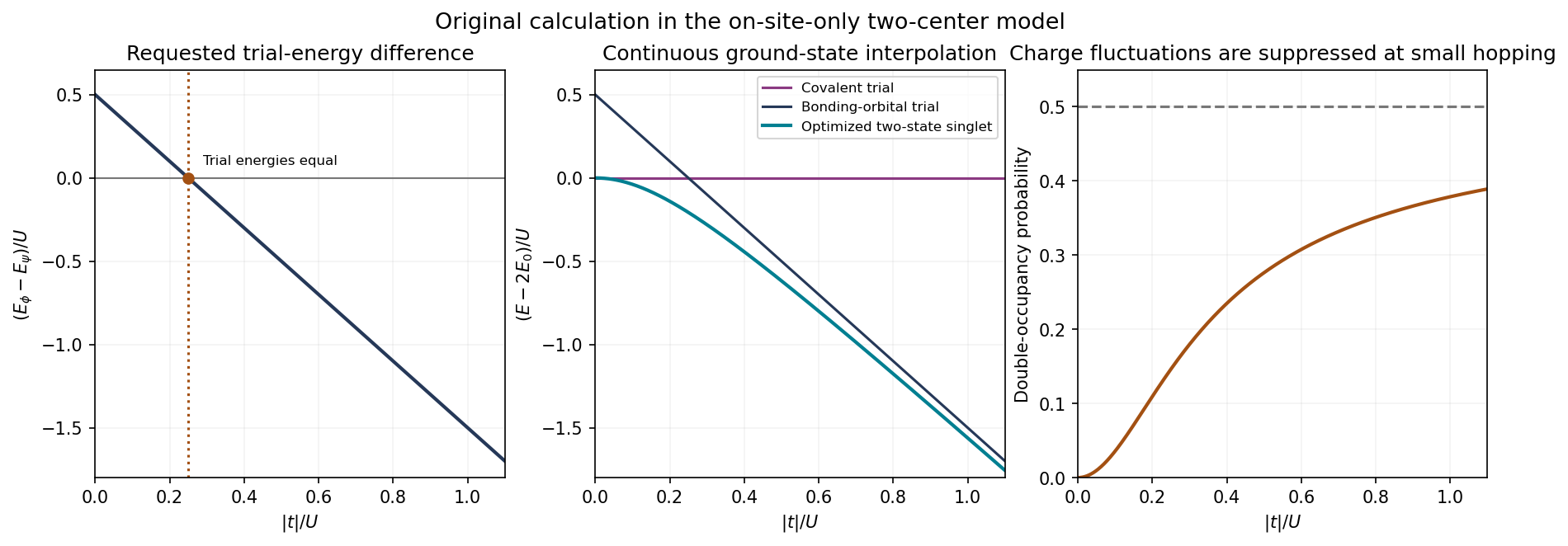
Original two-site singlet calculation: trial-energy comparison, continuous optimized energy and double-occupancy crossover in the stated on-site model
. Details. For localized orbitals of approximately fixed atomic size, the hopping magnitude decreases rapidly, typically exponentially times a polynomial, as the proton separation grows. The on-site integral remains of atomic Coulomb scale and tends to the isolated-orbital value; it does not decay as the intersite repulsion . If the orbitals themselves are allowed to relax, also changes, so no universal monotonic law for follows from the data.
At small , electron correlation suppresses the ionic configurations and , favoring a singlet with roughly one electron on each center. A single doubly occupied bonding orbital has an artificial finite ionic weight even as the centers separate. At large , delocalization gains enough kinetic energy that the bonding-orbital description becomes useful and charge fluctuations are substantial.
The crossing of two restricted trial energies is not a sharp transition of the actual two-site ground state. To see this without adding empirical data, include both and the symmetric ionic state . This two-site Hubbard dimer reduces toIts ground state is , with and . The ionic probability isIt changes smoothly from zero to . At large separation, the electronic lowering is to leading order and vanishes as hopping vanishes. An absolute molecular binding curve would additionally require , the nuclear repulsion and the neglected intersite terms; this simplified comparison alone does not determine an equilibrium bond length.
Past exam of the advanced quantum physics course of the University of Cambridge 2016 Paper 1 1 c by Codex 0 2026-10-20
Codex 0 2026-10-20Using a spherical Bohr-radius volume for the atom, the calculations below give a cutoff electromagnetic vacuum energy density of about , compared with a hydrogen binding-energy density of about . The cutoff vacuum estimate is about times larger. Alternative reasonable definitions of atomic volume change this ratio by a factor of a few, not the main order-of-magnitude conclusion.
The cutoff result is a bare zero-point mode sum. It is not a classical radiation bath incident on the atom, nor a calculation of an observable absolute vacuum energy without a subtraction or renormalization prescription.
Past exam of the advanced quantum physics course of the University of Cambridge 2015 Paper 1 4 Solution by Codex 0 2026-10-20
Codex 0 2026-10-20Insert the interaction-picture expansion into the Schrödinger equation. The phases multiplying the basis states already solve the unperturbed evolution, leavingHermiticity requires , not unless the coupling is real. Since the diagonal matrix elements vanish and , expanding the cosine givesThe conjugate pair of couplings conserves . Near resonance, the difference frequency is slow while the sum frequency is approximately . Rapid terms alternate sign before an appreciable slow transfer accumulates. The rotating-wave approximation retains the slow terms when ; resonance alone is insufficient for a strong drive. Counter-rotating corrections include small shifts of the resonance and need not remain negligible at arbitrary strength or arbitrarily long times.
For the spin preparation, use and . Choose and to fix helicity, with , and . The initial is the lower state. For negative , reverse the RF rotation sense; pulse areas use , and signed Larmor precession determines the corresponding phase adjustment.
A circularly rotating magnetic drive uses two transverse fields in quadrature during :With , their interaction Hamiltonian is exactly constant,The minus sign in the second RF component selects co-rotation for the specified positive gyromagnetic ratio. Exponentiating this Pauli matrix givesThe laboratory phase of a resonant spin pulse includes free precession. Returning to the laboratory frame and removing a common phase,Unlike a linearly polarized RF field, this exactly co-rotating field has no counter-rotating component. A single linearly polarized field gives the same slow rotation in the weak-drive rotating-wave approximation with . For the circular field above, . Keeping these amplitude conventions distinct avoids a factor-of-two pulse-duration error.
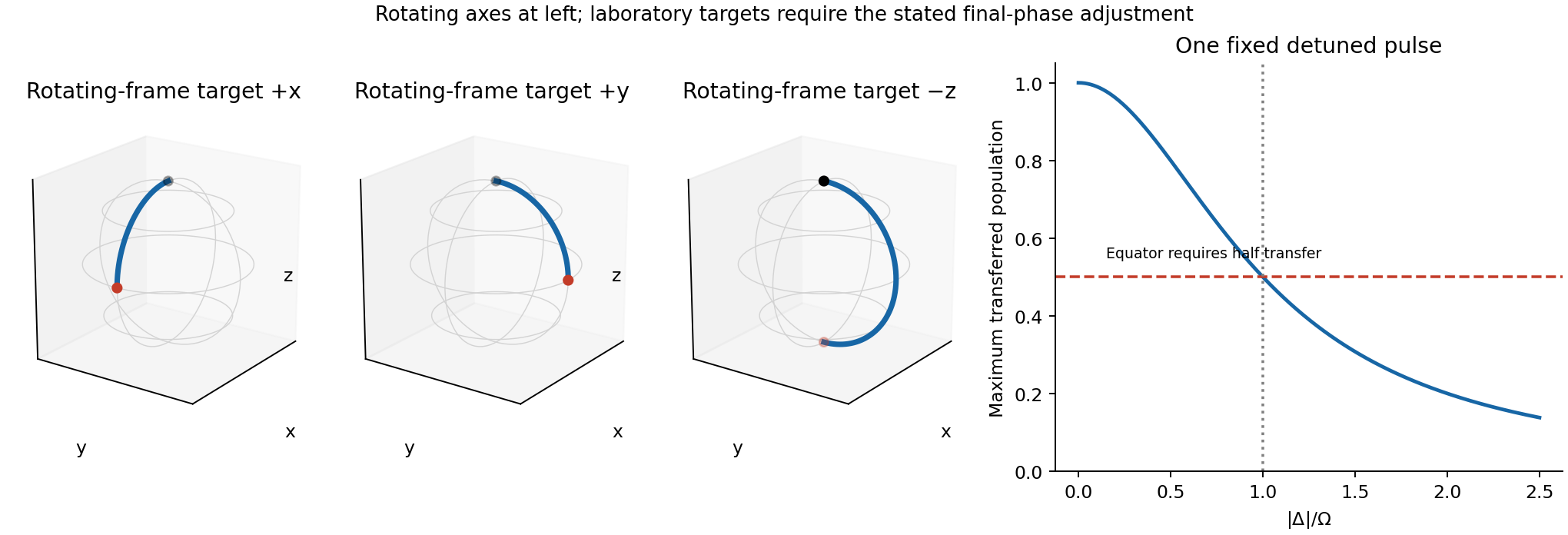


For a single harmonic pulse detuned by , the effective rotating-frame field tilts out of the transverse plane. Its rotation rate becomes , and its maximum population transfer is . Exact inversion to is impossible with one fixed nonzero-detuning pulse. Half transfer, needed for a transverse eigenstate, gives the equatorial reachability of a detuned spin pulse criterion . With that condition, changing the duration and RF phase can still prepare or at the chosen laboratory stopping time. The mere statement does not ensure this condition, because the drive can be much weaker than either frequency. If , neither transverse target is reached by that single pulse. These restrictions concern fixed-frequency, fixed-amplitude single-pulse control; retuning, chirping or phase-controlled composite pulses change the available controls and can remove the restriction. No dissipative spin relaxation is included in this coherent two-state model.
There are unlisted articles, also show them or only show them.