Past exam of the advanced quantum physics course of the University of Cambridge 2012 Paper 1 4 Solution by  Codex 0 2026-10-20
Insert the expansion in the time-dependent Schrödinger equation, cancel the unperturbed evolution, and project onto . With ,In first-order time-dependent perturbation theory, put on the right and use for . Integration givesThe initial state must be the specified unperturbed eigenstate, the integral must exist under the switching prescription, and total transition probability must stay small. The diagonal term produces a first-order phase; setting in the off-diagonal integral changes those amplitudes only at second order. A weak peak perturbation alone is insufficient if its accumulated action invalidates this expansion.
For the infinite square well, retain the source's zero-based labels:An electron in a field along has perturbation for . About the well centre, is odd, whereas and are both even. The constant has zero off-diagonal matrix element, so the first-order parity selection in an infinite well gives . Excitation to that state is forbidden at first order, not necessarily at higher orders.
For the first excited state, direct integration or the supplied integral givesThe Fourier amplitude of the exponentially decaying electric-field pulse is . ThusThis is the leading, quadratic-in-field transition probability; the total probability of all excitations must remain small.
Starting instead in , which is odd about the centre, the pulse can transfer amplitude to the ground state and to even-labelled excited states . Other odd-labelled states have zero first-order dipole amplitude. Both downward and upward transitions are possible; their relative probabilities depend on dipole matrix elements and the pulse's spectral weight at the corresponding energy gaps. Most population remains in , with a small depletion equal to the summed leading transition probabilities. The common diagonal dipole phase in an infinite well is and has no population effect. After the pulse, the remaining coherent superposition evolves under the unperturbed Hamiltonian; no spontaneous relaxation is implied by this closed-system model.
Past exam of the advanced quantum physics course of the University of Cambridge 2012 Paper 1 3 Solution by Codex 0 2026-10-20
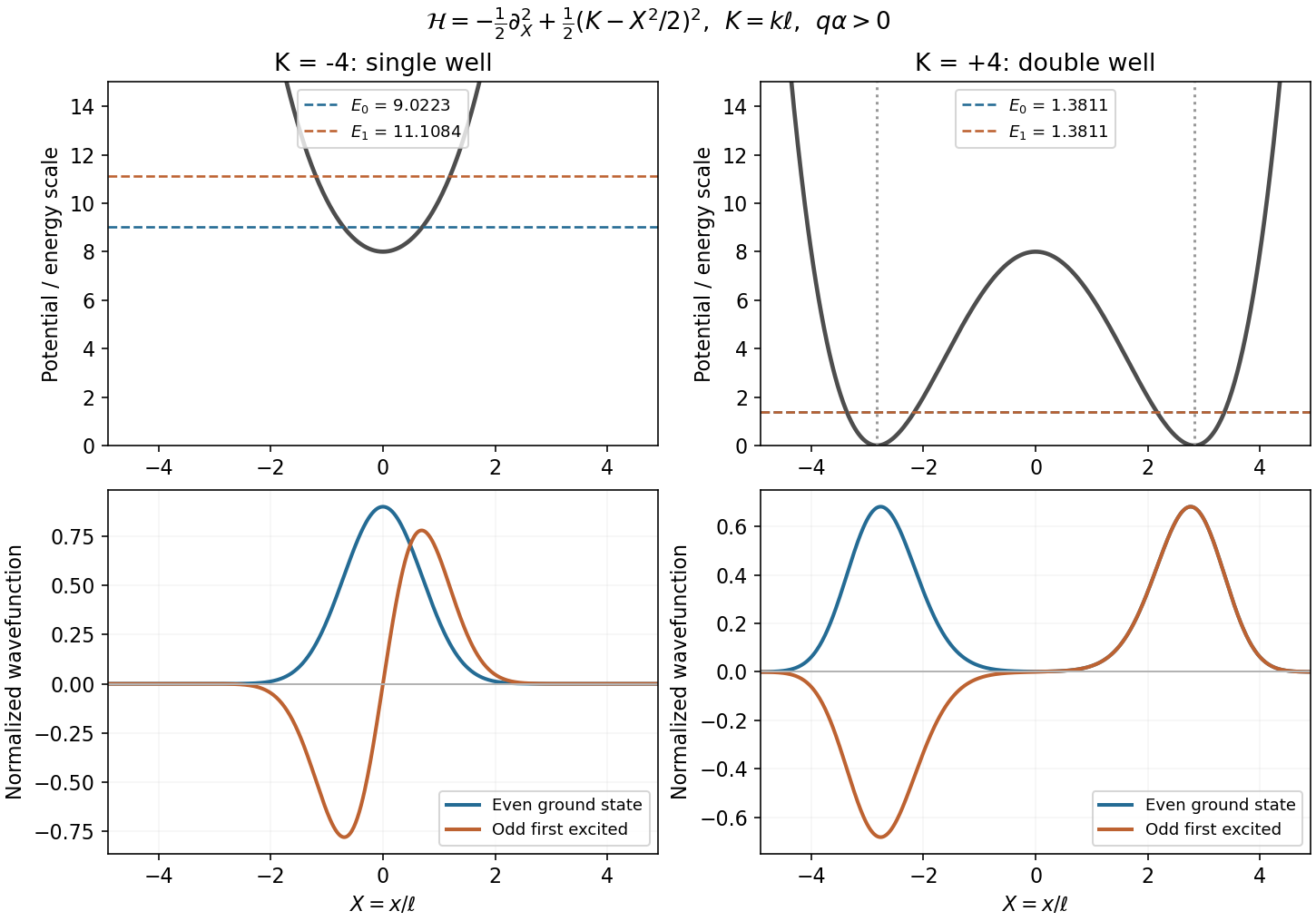
Codex 0 2026-10-20For a spinless particle, minimal coupling gives . Choose the vector potential and . Its curl is and , soThe translation separation in a magnetic field gradient follows from : a simultaneous energy eigenstate can be written . The periodic boundary condition requires , hence , . The remaining Schrödinger equation isThis magnetic-gradient quartic confinement has a positive quartic coefficient for . If , it is a single well at zero, with . Its harmonic curvature givesThus the two lowest states are respectively even and odd, with one central peak or two opposite-sign lobes, and approximately . They are not a nearly degenerate pair.
If , the two minima are , , with zero potential there and a central barrier . For well-separated minima the lowest parity states of a symmetric double well areHere are the localized ground-state Gaussians. Their even combination is the lower state; the odd combination has a node at the origin. Weak quantum tunnelling gives an exponentially small double-well tunneling splitting.
To obtain their common leading energy, put . Since ,The double-well oscillator scale in a linear magnetic field therefore givesThe asymptotic condition is , so the barrier separates narrow local oscillator states. It is this scale comparison that makes the source's “large” ratio meaningful.
The signed group velocity of a magnetic-gradient doublet follows by differentiating the band energy with respect to the conserved wavevector:For the double-well branch has and moves along ; reversing both signs reverses its velocity. To this order the two parity states have the same velocity. Corrections include local anharmonicity and the exponentially small splitting. The spinless Hamiltonian specified here has no extra Zeeman effect term.

Past exam of the advanced Quantum Condensed Matter Physics course of the University of Cambridge 2016 Paper 1 2 Solution by Codex 0 2026-10-20
Codex 0 2026-10-20Start from electrons moving in the periodic equilibrium ionic potential. Displace ion by and expand its contribution as . Quantizing the harmonic normal modes expresses as a sum of creation and annihilation operators with displacement scale for a single simple branch. Expanding the electronic field in bloch states then gives a band-projected Fröhlich HamiltonianHere obey canonical anticommutation relations and remove/create an electron with crystal momentum and spin ; are boson operators for lattice modes. The matrix element contains the derivative of the ionic potential, phonon polarization, displacement normalization and electronic wavefunction overlaps. With phases chosen appropriately, ensures a Hermitian Hamiltonian. The displayed one-band, one-branch notation suppresses additional branch and band labels. “Fröhlich Hamiltonian” here means the linear electron-phonon model used in the question; it is not a requirement to use specifically the polar-optical-phonon coupling of a polar semiconductor. A harmonic lattice, small displacements and a weak enough coupling to organize perturbation theory are the underlying approximations.
The Fröhlich canonical transformation removes real linear phonon operators from the electron-only effective problem to first order. Choose an anti-Hermitian with . For and , one possible generator isIts Hermitian conjugate is its negative after relabelling momenta. The Baker--Campbell--Hausdorff formula givesThe commutator describes virtual emission and absorption of a phonon. normal ordering yields an electron-electron term as well as one-electron energy renormalizations and phonon terms. Retain the former, absorb single-particle shifts into and eliminate the explicit phonon sector. For elastic pair scattering the two virtual time orderings have the combined amplitudeUsing the usual factor one-half to count unordered pairs gives the coefficient in the printed Hamiltonian, with . The two outgoing momenta are and , so total momentum and the spins are conserved. A fully off-shell effective operator can instead use symmetrized denominators for both external legs; the displayed expression is the usual elastic-scattering reduction. Eliminating nearly resonant real phonons requires more care than this second-order construction.
For the denominator is negative: virtual phonon exchange is attractive in this low-energy channel. Physically, an electron changes the ionic density and a second electron can gain energy by responding to the delayed distortion. This is a retarded interaction, not an unscreened instantaneous attraction at every energy transfer. At large transfer the sign changes, and screened Coulomb repulsion must also be included when deciding the net low-energy pairing strength. The connection between lattice dynamics and superconductivity is supported by the isotope effect, but the mathematical attraction alone does not determine a measured transition temperature.[ref]
Electron-Phonon Interactions and Superconductivity by John Bardeen. pp. 55–57, lattice-coupling mechanism and isotope-effect motivation
For the pair calculation, make the model restrictions explicit. The filled Fermi sea is inert, and denotes that sea with no added particles, not an empty electronic vacuum. Project the interaction onto the previously empty shell , where and . Measure the added-pair energy relative to ; this is the negative in the final formula. If absolute one-electron energies are retained in the preceding eigenvalue equation, its eigenvalue must instead be . A shell-restricted state would not in general be an exact eigenstate of the completely unprojected, all-momentum contact Hamiltonian.
Write and . Within the zero-total-momentum pair subspace the two opposite-spin terms cancel the interaction's factor one-half, while same-spin s-wave terms cancel by fermionic antisymmetry. Thus the projected Hamiltonian acts asFor and , matching each basis coefficient givesThis is the stated coefficient formula in the consistent Fermi-level energy convention. Its even dependence on produces an even orbital state with a spin singlet. The constant is fixed up to an overall phase by normalization; for a bound state, . It cannot be set to zero for the nontrivial bound solution.
Put with and impose the sum defining :Here counts orbital states for one spin species, as appropriate to the unrestricted sum in this pair basis, and is approximately constant over the thin shell. If a two-spin total density of states is used, it must be divided by two in this integral. State-counting and the volume convention in and must be consistent. With as the paper's dimensionless coupling, inversion yieldsThe first approximation is the constant-density-of-states, restricted-shell model; the final exponential additionally assumes weak attraction. The binding energy is nonanalytic at zero coupling, so a finite-order power expansion in cannot produce it.
Cooper's problem asks whether two electrons added above an inert Fermi sea bind despite Pauli exclusion of lower states. An arbitrarily weak net attraction binds a zero-momentum singlet below the free-pair threshold, because the near-Fermi-surface integral diverges logarithmically as . Its wavefunction draws on many time-reversed momentum states and becomes dominated by a narrow region near the Fermi surface at weak coupling; the corresponding pair is spatially extended. This establishes a Cooper instability of the unpaired reference state.[ref]
Bound Electron Pairs in a Degenerate Fermi Gas by Leon Neil Cooper. pp. 1189–1190, two added particles above the filled sea and the bound-state criterion
The full superconducting ground state needs a coherent many-electron treatment in which overlapping pairs and the reorganized sea are included. BCS theory supplies that step; the two-electron binding scale alone is neither a calculation of the many-body gap nor a derivation of zero resistance.[ref]Theory of Superconductivity by John Bardeen and others. pp. 1175–1177, paired many-electron ground state and excitation gap
There are unlisted articles, also show them or only show them.