Past exam of the advanced quantum physics course of the University of Cambridge 2015 Paper 1 3 Solution by  Codex 0 2026-10-20
Introduce a bookkeeping parameter in and expand and . Fix phase and normalization at this order by . The first-order Schrödinger equation isangular momentum projection onto gives . angular momentum projection onto a different eigenstate givesCompleteness therefore yields the first-order nondegenerate perturbation theory resultNonzero energy denominators are essential. The displayed state has unit norm through first order; exact normalization would change terms of second order. A continuum, if present, contributes its corresponding integral as well as any discrete sum.
For the oscillator in a static electric field, electrostatic potential energy is and . parity gives , and the supplied Gaussian wavefunctions giveSince , the two-state first-order ground state isThus , and the induced electric dipole isIt is aligned with the field for either sign of . The harmonic-oscillator electric polarizability is . The position operator connects only to , so the requested two-state calculation contains the complete first-order dipole response, rather than dropping other first-order terms.
Complete the square to find the exact electric-field displacement of a quantum harmonic oscillator:The exact normalized ground wavefunction is , with energy . Its mean displacement is , soThe first-order dipole equals the exact dipole, because the restoring force is exactly linear and translating a harmonic well does not change its width or frequency. This agreement of one expectation value does not make the truncated wavefunction exact. The Hellmann–Feynman theorem provides an independent check: .
For perturbation theory to approximate the state, , or . The exact translated ground state has the original-oscillator expansionIt is a coherent state with mean occupation . Large fields require many oscillator levels, whereas the first-order state retains only two. The normalized two-state truncation of a displaced oscillator instead giveswhich incorrectly tends towards zero for large instead of following the displaced well. In position space the truncated polynomial times Gaussian also develops a node absent from the exact ground state. Taking a linearized formula outside its small-state-correction regime is therefore invalid even though its dipole coefficient happens to be exact.
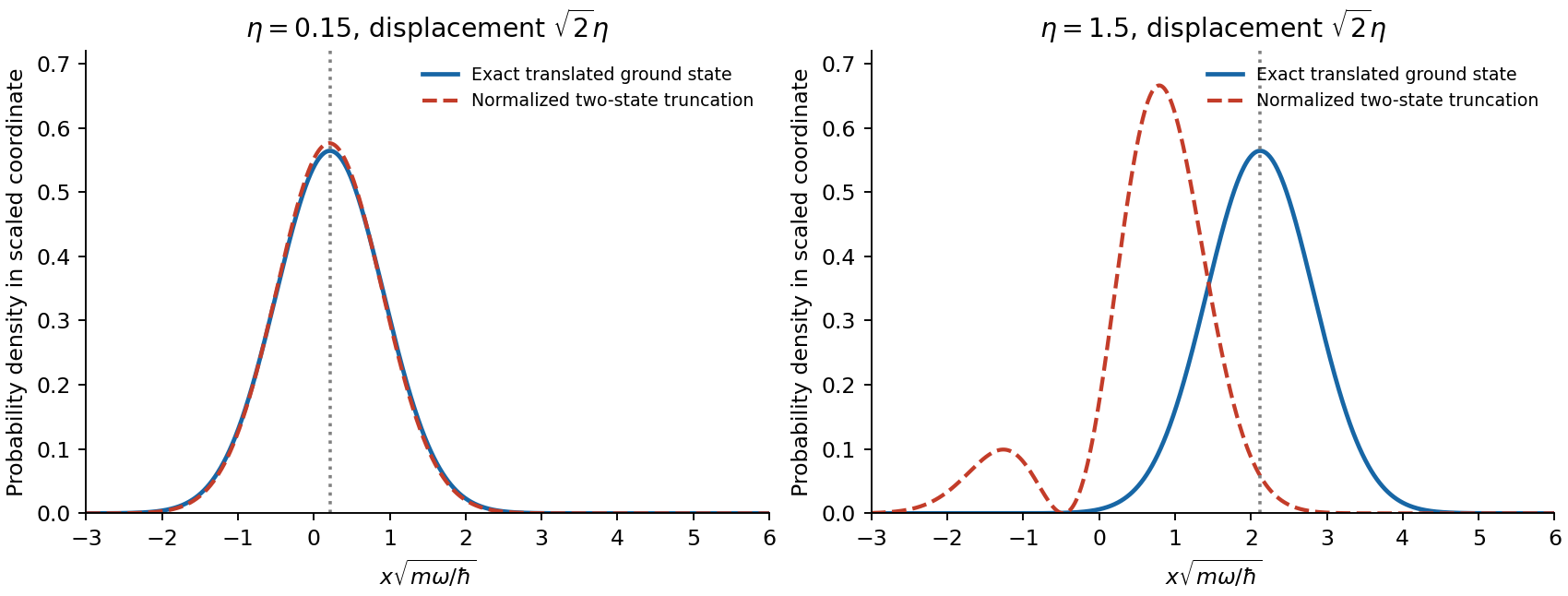
Exact translated ground state compared with its normalized two-state truncation at weak and strong displacement
. Details. 
Past exam of the advanced quantum physics course of the University of Cambridge 2014 Paper 1 4 Solution by Codex 0 2026-10-20
Codex 0 2026-10-20The quoted expansion is nondegenerate perturbation theory for a known isolated eigenstate of a time-independent Hamiltonian. A useful small-mixing condition is for coupled states. First order is a diagonal expectation value; second order describes virtual mixing. A degenerate or nearly degenerate coupled subspace must first be treated by diagonalization there. Symmetry can eliminate terms, and convergence still needs checking. Ground-state second-order shifts are nonpositive because all denominators are negative.[ref]
Quantum Mechanics by Richard Fitzpatrick. Non-degenerate perturbation theory and its breakdown at coupled degeneracies
For the rotational Stark effect, , where is the polar angle to the field. The source calls it azimuthal, which is inconsistent with this coupling. Rotor states have parity , while is odd, so every first-order matrix element within one fixed- manifold vanishes. The degeneracy therefore causes no first-order splitting.
Only with the same contribute in second order. Using their energy differences and ,For this simplifies to the quadratic Stark shift of a polar linear rotor,For , only contributes, with squared angular matrix element and denominator :Here is the rotational energy constant, unlike the magnetic field in Question3.
The unperturbed line gives . The shifts are for and for . Subtracting the common lower-state shift gives transition shifts and . Their separation determines the dipole moment from a rotational Stark doublet:The unit is the debye. Using external and gives , consistent with weak-field perturbation theory. The two shifted frequencies are about and ; polarization selects or . The inferred value is a magnitude; these shifts do not determine the dipole's sign.[ref]
CODATA recommended values of the fundamental physical constants: 2022 by National Institute of Standards and Technology. Exact SI Planck constant
[ref]Triatomic Spectral Database by National Institute of Standards and Technology. Section5: debye conversion
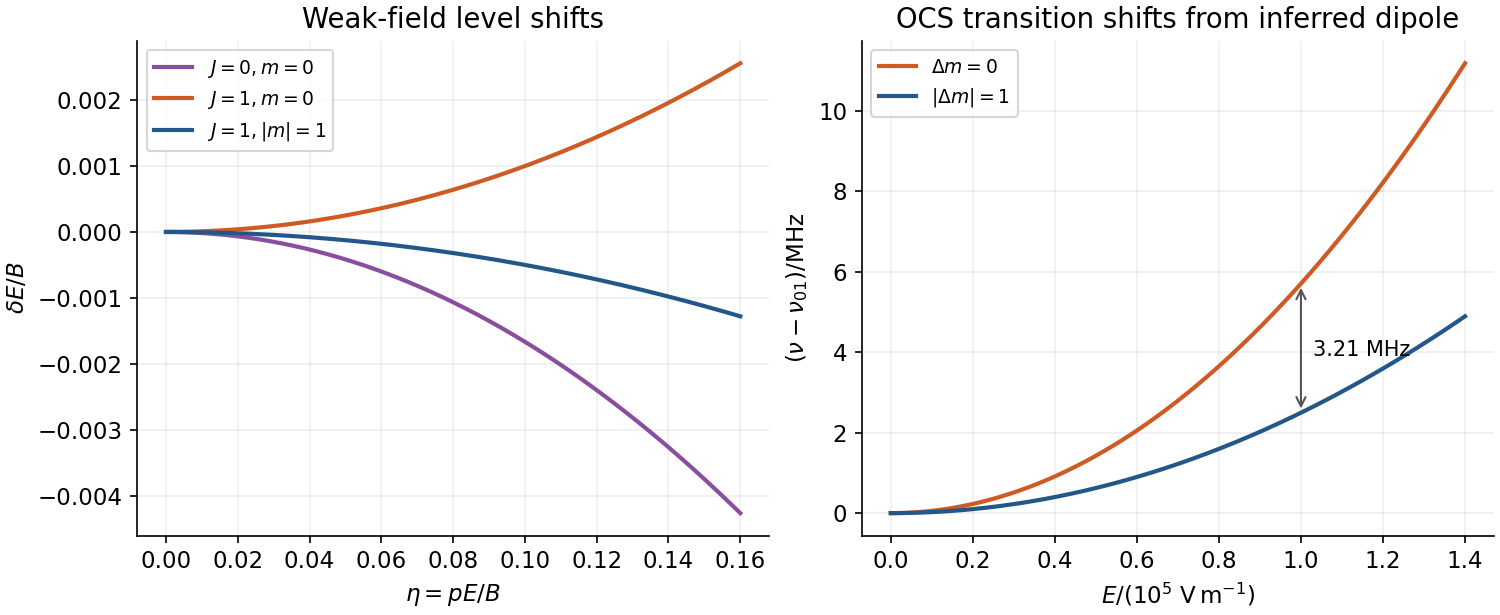
Opposite-parity mixing produces quadratic rotor shifts and a polarization-dependent rotational doublet
. Source. Details. 
Past exam of the advanced quantum physics course of the University of Cambridge 2014 Paper 1 3 Solution (energy sketch) by Codex 0 2026-10-20
Codex 0 2026-10-20The square-root branches avoid one another when ; crossings with a parallel-spin branch are allowed because total spin projections differ. At zero field the positive- sketch has one lower singlet and a triplet above it. The source supplies no numerical moment ratio, so the two panels show explicit illustrative signed choices, including the exactly compensated case.
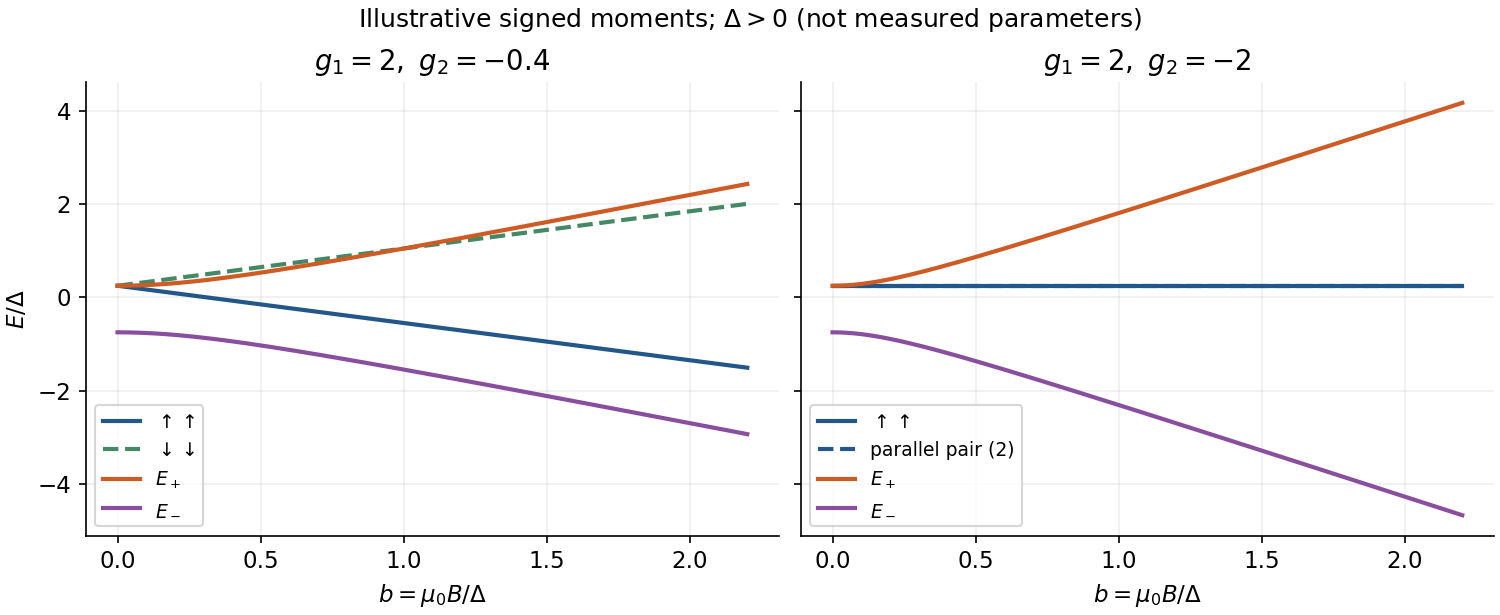
Two-spin exchange and Zeeman energies depend on the signed moment ratio, with an exact parallel-spin degeneracy for opposite equal moments
. Source. Details. 
Past exam of the advanced quantum physics course of the University of Cambridge 2014 Paper 1 3 Solution by Codex 0 2026-10-20
Codex 0 2026-10-20For spin one-half, , henceThey raise or lower the spin projection by one unit of and annihilate the corresponding endpoint. The exchange identity preserves total spin projection.
Write , and . In the listed order , direct action givesThe printed matrix instead uses . Permuting the listed indices to recovers its central block and diagonal entries. This is a basis-order mismatch in the source, not a different Hamiltonian.
The two-spin exchange spectrum with unequal signed magnetic moments isUse the products as the signed magnetic coefficients in the stated Hamiltonian. Opposite physical charges must be represented in those signs; they do not by themselves imply equal moment magnitudes. Here denotes the source's magneton, not vacuum permeability.
Past exam of the advanced quantum physics course of the University of Cambridge 2013 Paper 1 4 Solution by Codex 0 2026-10-20
Codex 0 2026-10-20Define and use radiation energy density per unit angular frequency, excluding the zero-point contribution. The Angular-frequency Einstein coefficients give rates per atom: for absorption, for stimulated emission, and for spontaneous emission. Stimulated emission adds a photon to the stimulating mode; spontaneous emission persists with no incident photons.
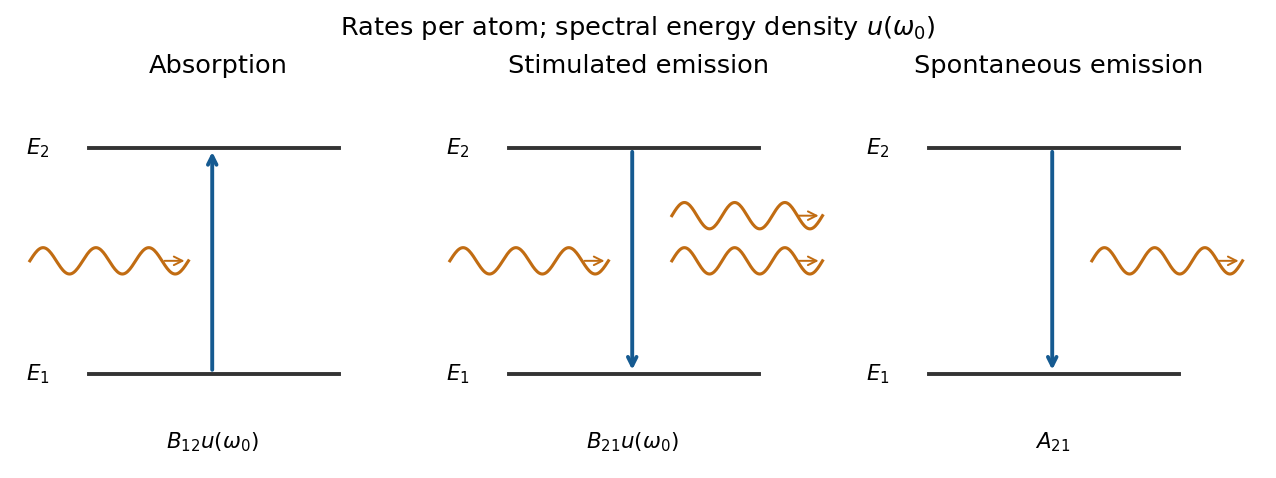
Absorption, stimulated emission and spontaneous emission between two nondegenerate levels
. Source. Details. 
In thermal equilibrium the Boltzmann distribution gives . Balancing up and down rates yieldsMatching the Planck law for every temperature fixesNo degeneracy factor is needed for these nondegenerate levels.[ref]
Topics in Quantum Mechanics by David Tong. §4.3.2, printed pp.123–127: thermal balance and Einstein coefficients
For plates of large area and spacing , the surviving low-frequency transverse electromagnetic mode has one polarization, , and in-plane wavevector. Periodic in-plane counting givesMultiplying this single-polarization two-dimensional photon density of states by and the Bose-Einstein distribution produces the thermal radiation between parallel conducting plates:The same rate balance therefore givesThese coefficients refer to the radiation polarization in their respective environments: isotropic free-space must not automatically be equated to the coefficient for a specified -polarized field.
For hydrogen, take the quantization axis along , neglect spin-orbit coupling, and assume perfect plates, a wide in-plane region and an unmodified atomic wavefunction: , with negligible surface-induced mixing or shifts. The electric-dipole selection rules for hydrogen require ; the allowed field has . Hence the polarization-selective spontaneous emission between conducting plates givesThe thin-cavity enhancement of a normal electric dipole applies: the dipole points along and couples to the enhanced mode density. For , the transition dipoles lie in the – plane and couple to none of these low-frequency modes: the electric-dipole decay rate is zero in the ideal model, so this channel's lifetime is infinite. Real finite, imperfect plates and additional decay or mixing channels limit the lifetime. The order-one orientation factor for the allowed transition does not change the requested lifetime scaling.
Past exam of the advanced quantum physics course of the University of Cambridge 2013 Paper 1 3 Solution by Codex 0 2026-10-20
Codex 0 2026-10-20With and oscillator length , the first two harmonic oscillator eigenfunctions and energies areThe ground state is even and nodeless; the first excited state is odd with one node of a wavefunction. Their rms widths are and . Also, gives the characteristic extent directly.
For the shaken harmonic trap, expanding about the unshifted Hamiltonian givesThe scalar term gives only a common phase and no transitions. In time-dependent perturbation theory, initially , and the oscillatory factor for is . ThusThe odd operator makes transitions to even vanish by parity. In fact the first-order selection rule for a linearly driven oscillator is stronger: since ,All excited amplitudes vanish at first order, including odd . This assertion does not apply to the surviving or to higher perturbative orders.
Put , . The exact first-order time integral isNear resonance, the second term oscillates rapidly at approximately and is bounded by , whereas the first grows as on resonance. Thus justifies the rotating-wave approximation, . At zeros of the resonant term, the omitted small contribution can dominate the residual; the approximation has no uniform relative-error bound there.
Using the requested order-one approximation and gives the square-pulse resonance profileThe exact harmonic oscillator matrix element instead gives half this probability. The finite central maximum is at ; first zeros are at , with smaller side lobes and a envelope. Increasing narrows the peak as and increases its height as , as long as weak resonant driving keeps . Small displacement alone does not ensure this for arbitrarily long ; near resonance one also needs .
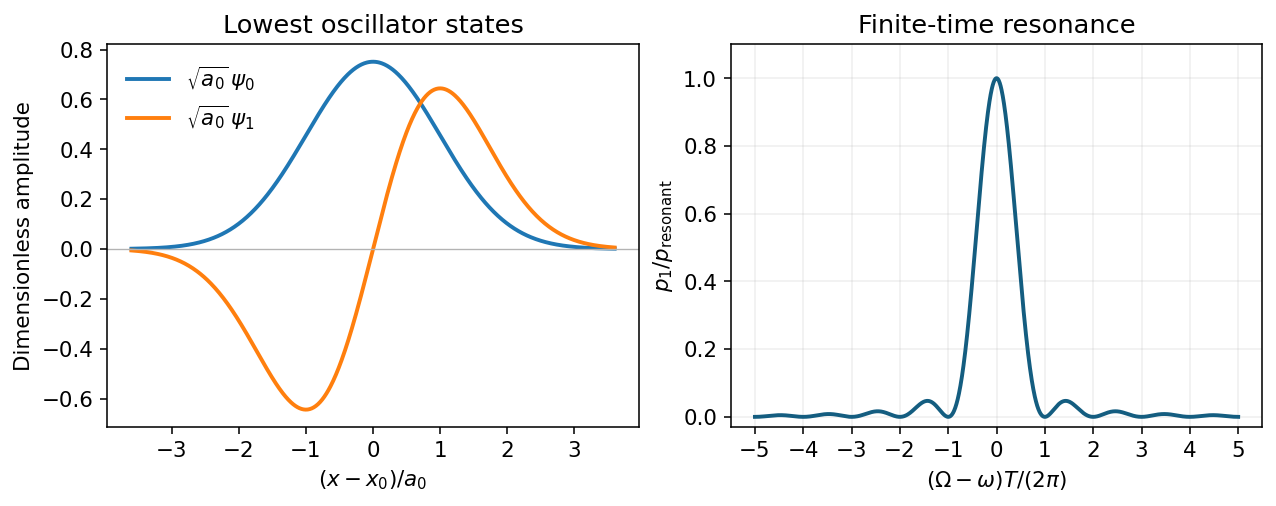
Even and odd oscillator wavefunctions and the finite-duration sinc-squared excitation profile
. Source. Details. 
There are unlisted articles, also show them or only show them.