
A paleontologist who studied a Cretaceous bird fossil that informs the inferred palate of the crown group ancestor of living birds.[ref]
A paleontologist who investigated changes in the vomer and their relationship to cranial kinesis in the lineage containing birds.[ref]
A paleontologist who studied the skull of Ichthyornis, using its mixture of characters to reconstruct the stepwise assembly of the modern avian head.[ref]
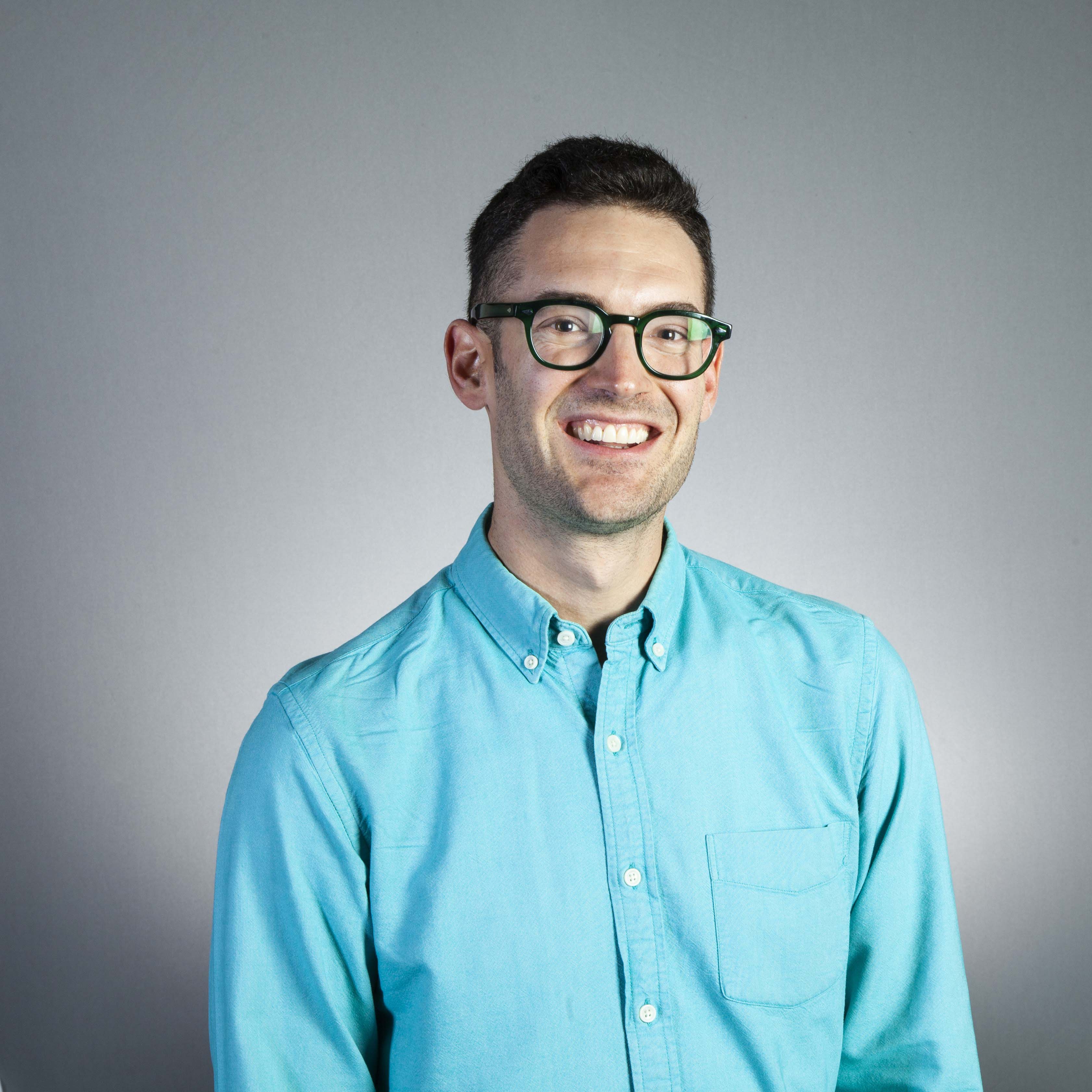
Portrait of Daniel J. Field
. External portrait hosted by Christ's College, University of Cambridge. Source.A paleontologist who investigated Triadobatrachus massinoti using three-dimensional imaging, reassessing its anatomy and the evolution of trunk length in early amphibians.[ref]
A paleontologist who studied early frog locomotion, testing how the endoskeleton of an early relative constrains hypotheses about the origin of jumping.[ref]
A paleontologist who coauthored experiments on soft-tissue fossilization, testing how mineral preservation can retain structures that would otherwise decay.[ref]
A paleontologist who used Acanthodes anatomy to test the reconstruction of the last common ancestor of modern jawed vertebrates.[ref]
A paleontologist who studied skull characters in early jawed vertebrates, testing how combinations of bony-fish-like features inform relationships near the base of the jawed-vertebrate tree.[ref]
A paleontologist who investigated early jawed vertebrate anatomy, including fossil evidence relevant to the origin of the pectoral girdle.[ref]
A paleontologist who investigated the anatomy of early jawless vertebrates, using galeaspid evidence to test hypotheses about the origin of paired appendages.[ref]

Portrait of Zhikun Gai
. External portrait hosted by Institute of Vertebrate Paleontology and Paleoanthropology, Chinese Academy of Sciences. Source.A researcher who coauthored a quantitative measure of small-world networks. Comparing clustering coefficients and path lengths with a reference network made the classification testable rather than a purely visual judgement.[ref]
A researcher who coauthored the cloning and comparison of genes encoding human visual pigments. Relating their sequences helped connect molecular variation to the different spectral sensitivities underlying colour vision.[ref]
A researcher who coauthored genetic crosses and mapping studies of opsin gene expression in cichlids. The results implicated both nearby and distant regulatory regions, showing that differences in visual sensitivity can involve regulation as well as changes in pigment sequence.[ref]
Genetic basis of differential opsin gene expression in cichlid fishes by Karen L. Carleton and others. 2010, abstract and genetic mapping
A researcher who coauthored an experiment adding an opsin to the retina of adult Primates through gene therapy. Subsequent behavioral testing showed new colour vision discrimination, connecting a molecular intervention to a measured perceptual ability.[ref]
Gene therapy for red-green colour blindness in adult primates by Katherine Mancuso and others. 2009, abstract and behavioral results
A researcher who coauthored the cloning of a large candidate odorant-receptor gene family from olfactory tissue. The molecular result supplied a possible mechanism for distinguishing a very large variety of odorants.[ref]
A novel multigene family may encode odorant receptors: a molecular basis for odor recognition by Linda B. Buck and others. study design and results; author roster

Portrait of Linda B. Buck
. The Royal Society. CC BY-SA 3.0, via Wikimedia Commons. Source.
A neuroscientist who coauthored experiments visualizing projections of olfactory sensory neurons expressing a particular odorant receptor. Genetic labeling and receptor replacements helped connect receptor identity to organization of the olfactory bulb.[ref]
Visualizing an Olfactory Sensory Map by Peter Mombaerts and others. 1996, receptor-expressing neurons and receptor-swap experiments
A researcher who coauthored experiments linking expanded Hedgehog signalling to eye degeneration in cavefish. Manipulating signaling in surface fish connected a developmental mechanism to a difference between populations.[ref]
Researcher in computational RNA biology. Barash and collaborators investigated the splicing code, connecting combinations of sequence features with predictions of how transcripts are processed.[ref]
Researcher in RNA splicing. Ule and collaborators developed an RNA map of Nova-dependent regulation, connecting binding positions of a regulatory protein with the direction of its effect on splicing.[ref]
An RNA map predicting Nova-dependent splicing regulation by Jernej Ule and others. Title, author list and reported study
There are unlisted articles, also show them or only show them.