
A coordinate system assigns numerical labels to positions so that the labels determine the point in the region described. A Cartesian coordinate system uses components along chosen axes; polar coordinates use a radius and an angle. For example, has polar coordinates on the usual angular branch. On a manifold, a coordinate chart gives a homeomorphism from an open region to an open subset of Euclidean space. Coordinates describe points but do not alone specify a metric.
Chapter 6 of Genomes, 2nd edition by Terence A. Brown. Terence A. Brown, printed as T. A. Brown, is the whole-book author; no independent chapter-author byline is established. The second edition is dated 2002. NCBI Bookshelf hosts the online text.
Online text: www.ncbi.nlm.nih.gov/books/NBK21117/
Cited passages: Official indexed chapter text, section 6.1.1, Chain termination sequencing in outline; Figure 6.1 and Figure 6.2 captions; single-nucleotide resolution and bottom-to-top autoradiographic interpretation; Technical Note 6.1, polyacrylamide versus agarose separation.
A selectable marker is a gene or other inherited feature that permits recovery of carriers under specified growth conditions. Selection for a marker does not identify every other nucleotide sequence in its carrier.
A gravitational singularity theorem gives sufficient conditions for geodesic incompleteness: some freely falling worldline or light-ray geodesic cannot continue through an unlimited proper time or affine parameter within the stated spacetime. The conclusion concerns the failure of complete geodesic evolution; it does not by itself establish a curvature singularity.
A typical argument combines a focusing assumption such as the null energy condition, the focusing of a geodesic congruence, and assumptions on the global causal structure. The Penrose singularity theorem uses a trapped surface to show that collapse need not preserve exact spherical symmetry to force null incompleteness under its other hypotheses. This is useful because highly symmetric exact solutions alone cannot establish what happens during generic collapse.[ref]
Gravitational Collapse and Space-Time Singularities by Roger Penrose. Pages 57–59: symmetry-independent collapse argument, trapped surface and null-geodesic incompleteness
In synchronous coordinates, fixed spatial-coordinate worldlines are timelike geodesics, and is their proper time. The metric has unit lapse function and zero shift vector in time units consistent with the displayed factor . Indeed and give . Locally, an irrotational freely falling congruence permits this construction before crossings of the coordinate worldlines. Comoving observers in a Friedmann-Lemaître-Robertson-Walker metric provide the standard cosmological example.
The later angular test used an evacuated chamber with a radon source and scattering foil fixed in place. A diaphragm served as a collimator; a zinc sulfide screen and attached optical microscope rotated about the foil on a graduated platform. Particle scintillation counts sampled successive angles. Foil-out counts supplied background subtraction, with corrections for source radioactive decay and finite beam width. Shielding reduced interfering radiation, but screen glow limited large angles. This tested the Rutherford differential cross-section.[ref]
The Laws of Deflexion of Alpha Particles through Large Angles by Hans Geiger and Ernest Marsden. The Laws of Deflexion of α Particles through Large Angles, transcription PDF pp. 3–7, Variation of Scattering with Angle, Fig. 1 and Tables I–II
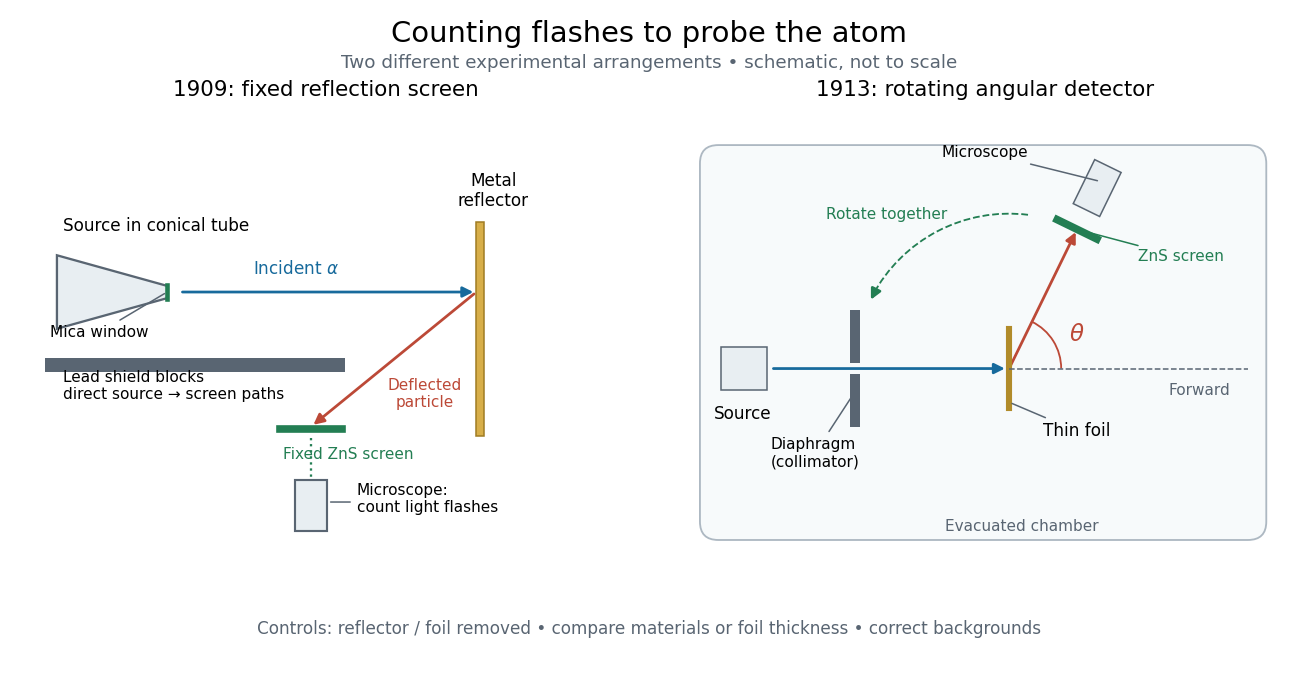
Fixed backscattering screen and later rotating angular detector
. Original schematic distinguishing the 1909 shielded reflection arrangement from the 1913 evacuated angular arrangement. Arrows indicate example particle paths, not calculated trajectories; component sizes and distances are schematic. The later screen and microscope rotate together while the source and foil remain fixed. Details.
In an ideal matched-port two-port network for an antenna pair, the incident amplitude traverses the link, reflects from the receiver's load with amplitude coefficient , then traverses the reciprocal link again. If each one-way power transfer factor is , the returned power fraction is . With fixed gains, and this echo scales as . Actual antenna structural scattering or an existing input mismatch can add a coherent return not specified by the Friis transmission equation alone.
Two aligned lossless Hertzian dipoles in one another's broadside radiation zone have gain and one-way received-power fraction . If the second remains conjugately matched, its matched-load scattering of a Hertzian dipole reradiates the same power as its load absorbs. Applying the reciprocal far-field link on the return gives , proportional to . The statement concerns physical dipole reradiation; a pure antenna load-mismatch echo model omits that scattering and is not interchangeable with it.
A radio frequency is a frequency in the range used for radio waves. It describes the rapid oscillation of a radio wave, which can differ from the rate at which information is transmitted in radio communication.
The frequency ratio of two nonzero frequencies is a dimensionless ratio. Ordinary and angular frequencies give the same result because both are converted by the same factor . Rational ratios imply a common period for their sinusoidal motions, while the special ratio two means that one mode completes two cycles during one cycle of the other.
Reflux is condensed liquid returned toward the heated part of a distillation apparatus. In a fractionating column, descending reflux contacts rising vapor. Returning more condensate also changes the amount available for collection, so enrichment and product recovery must be considered together.[ref]
Distillation by Hong Kong University of Science and Technology. Introduction, reflux paragraph; Intended Learning Outcomes, reflux-ratio dependence
There are unlisted articles, also show them or only show them.