
Wave turbulence describes the statistical transfer of energy between interacting waves. The wave period, nonlinear interaction time, phase correlations and resonances determine the transfer rate. A weak wave cascade treats the change in one interaction as small; critical balance instead makes the nonlinear interaction rate comparable to the linear wave frequency.
A fixed observation point alternates between turbulent and non-turbulent fluid because a fluctuating interface passes it. This is distinct from internal intermittency, which concerns variations within fluid that remains turbulent.
Reynolds averaging separates a resolved mean from zero-mean fluctuations. The idealized averaging operation is linear and idempotent, commutes with the derivatives under consideration and treats resolved mean factors as constant inside its averaging scale. Products then satisfy . Actual finite spatial filters need scale separation or corrections when these rules are only approximate.
Glyceraldehyde 3-phosphate is a three-carbon sugar phosphate with an aldehyde group. It is an intermediate of glycolysis and of carbon assimilation in photosynthesis.
The tangent half-angle substitution converts rational trigonometric expressions into rational functions: , and .
The inverse trigonometric functions invert trigonometric functions on branches where they are one-to-one. Standard real ranges are for , for , and for . Thus but : the inverse returns the selected branch. The notation usually means , not . Implicit differentiation gives for .
Every infinite finitely branching rooted tree has an infinite branch. Starting at the root, repeatedly choose a child above which infinitely many vertices remain.
For an integer , let be the set of labelled trees with fixed vertex set . Each tree is a finite simple graph, with no distinguished root of a tree, and two trees are different exactly when their sets of edges differ. ThenEquivalently, this is the number of spanning trees of the complete graph . The labelled combinatorial structure includes the fixed labels: drawings, positions, and the order in which edges are listed do not create extra trees. For , the single vertex with no edges is the unique tree; count it separately, since the Prüfer sequence construction requires . For , the unique tree has edge and corresponds to the empty Prüfer sequence. [ref]
https://users.math.msu.edu/users/magyarp/math481/. Peter Magyar, Michigan State University, Math 481: Cayley's theorem and inverse Prüfer transformations
For four fixed labels, there are labelled trees, but only two unlabelled trees: the star graph and the path graph. There are four star graphs, one for each choice of centre. There are path graphs: arrange the labels along a graph path, then identify each ordering with its reversal, which describes the same set of edges. Thus . For instance, star graphs centred at and at have different sets of edges even though they have the same shape.
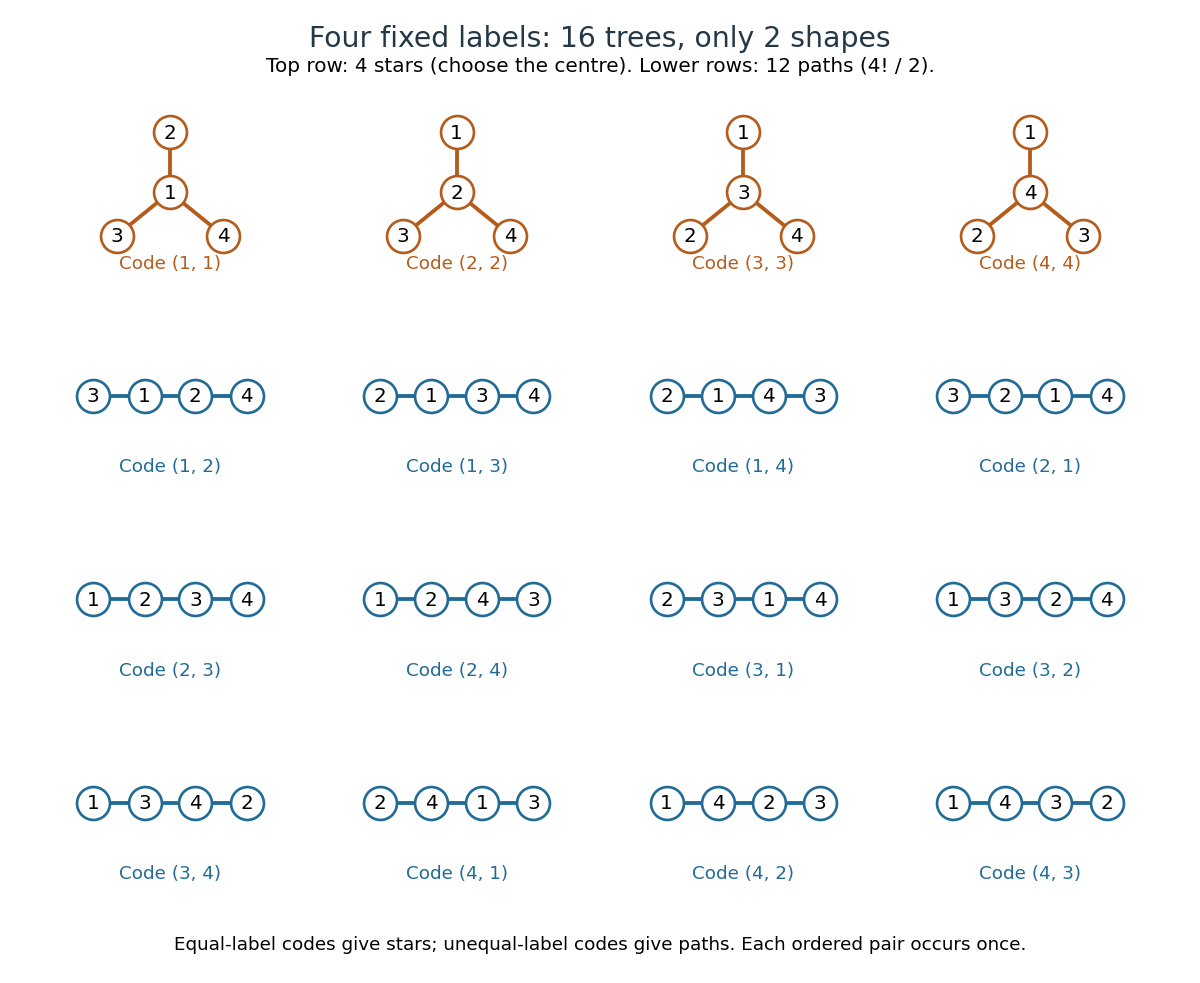
All sixteen labelled trees on four fixed vertices: four star graphs and twelve path graphs, each with its Prüfer sequence
. Details. 
The striking point is that connectedness and the absence of a graph cycle are global restrictions on edges, yet the answer is a power with no correction factor. The Prüfer sequence supplies a bijection that turns those restrictions into freely chosen labels. The rule of product then gives immediately. The same representation makes vertex degrees easy to count and supports uniform labelled tree generation for simulations and algorithm experiments.
Arthur Cayley's 1889 paper "A theorem on trees", published in the Quarterly Journal of Pure and Applied Mathematics, volume 23, pages 376–378, treats the counting problem and its refinement by vertex degrees. It was reprinted as paper 895 in volume XIII of his Collected Mathematical Papers, pages 26–28. This publication is the historical context for the name Cayley's formula; the name alone is not a claim of priority. [ref]
https://gdz.sub.uni-goettingen.de/id/PPN600494829_0023. Cayley, A theorem on trees (1889), original journal volume, pages 376–378
[ref]https://doi.org/10.1017/CBO9780511703799.010. Cayley, A theorem on trees, collected-paper reprint and publisher's first-page preview
An oriented tree is an orientation of every edge of an undirected tree. Its arrows need not all point towards, or away from, any one root. It is acyclic as a directed graph, but different orientations can have different embedding behaviour in tournaments.
A tree considered up to graph isomorphism, with vertex names ignored. For example, all four labelled trees that are star graphs on represent one unlabelled tree. Dividing the total in Cayley's formula by does not count unlabelled trees: different shapes can have different numbers of distinct labellings.
A tree whose vertices carry distinct labels from a fixed finite set, as a labelled combinatorial structure. Two labelled trees on the same vertex set are equal when their sets of edges are equal: any comparison must keep every label fixed. Cayley's formula counts these trees.
For with , a decreasing travelling wave connecting to satisfies , . If , choose with . The triangle , is forward invariant: on its sloping side, . The descending unstable manifold of the saddle equilibrium stays in this triangle and tends to , producing a positive heteroclinic orbit. Below the threshold the origin is a stable spiral for positive , forcing sign changes; at conserved energy also excludes the connection.
Fisher's equation is a reaction-diffusion equation combining diffusion with logistic growth. For positive , one-dimensional fronts joining to zero have minimum speed . The phase-plane construction of a Fisher travelling front and the linearized leading edge explain this threshold.
A front is a spatial profile connecting different asymptotic states on its two sides. A travelling wave front moves with a constant speed; a stationary front has zero speed. In a one-dimensional stationary reduction it is a heteroclinic orbit between the corresponding homogeneous equilibria. Equal first-integral values are necessary for a stationary front in a scalar conservative spatial equation.
Find a maximum-weight Hamiltonian cycle in a complete weighted graph or complete directed graph. Nonnegative weights admit a cycle-cover patching half-approximation for Max-TSP without a triangle inequality. For integer weights, changing to , with , changes an -vertex tour's weight from to . Consequently the strict-threshold decision version is NP-complete: minimum-tour threshold becomes maximum-tour threshold .
Use binary directed-edge variables , one incoming and one outgoing edge at each city, and integer order variables for cities other than a distinguished city. The constraints for distinct nondistinguished cities force order increase along every selected edge away from the distinguished city. Summing around any cycle avoiding that city gives a contradiction, so the degree equations describe a single tour. There are nonzero constraint entries apart from the degree equations, also totaling entries. With costs at most , the objective requires bits and the remaining sparse constraint encoding bits. Omitting zero matrix entries is essential for this particular size bound.
Binary arc variables with one outgoing and one incoming arc at each vertex describe a cycle cover of a directed graph. For every nonempty proper vertex subset , the displayed inequality forbids a directed cycle confined to . Together these inequalities make the cycle cover one Hamiltonian cycle. They can be generated as violated cuts or used in branch and bound, rather than all being stored initially.
Add a dummy job . Give the arc cost equal to job 's initial setup, the arc its changeover cost, and every arc zero cost. A Hamiltonian cycle through the dummy represents a schedule, starting just after and ending just before it. The total processing time is constant on a single machine, so minimizing cycle cost minimizes completion time. Dropping subtour elimination constraints gives an assignment problem lower bound.
A 2-opt tour move removes two boundary arcs and reverses the intervening block to reconnect one tour. Such moves define a local-search neighbourhood; block reversals of length two include adjacent swaps and hence connect permutation schedules. For directed costs the asymmetric 2-opt reversal cost must include every reversed internal arc, not just the boundary changes.
There are unlisted articles, also show them or only show them.