
The th symmetric product of a space is , where the symmetric group permutes the factors. Its points are unordered -tuples, with repetitions allowed. If is a Riemann surface, elementary symmetric functions in local complex coordinates make its symmetric product a smooth complex manifold, including along the locus of repeated points. A collection of disjoint circles in gives a product torus in this symmetric product.
The lower limit topology on has basis of a topology . Every such nonempty interval contains a rational, so this topological space is separable. Its topology is finer than the usual Euclidean topology; the one-sided basic neighbourhoods allow its square to have an uncountable discrete antidiagonal.
On an infinite set, the family consisting of all finite subsets and the whole set need not be closed under arbitrary unions. On , the union of the singleton subsets of is infinite and proper, so this family is not a topology. It must not be confused with the cofinite topology, whose proper open sets have finite complements.
Given a partition of a set, declare a subset open precisely when it is a union of partition blocks. Arbitrary unions and finite intersections of such unions are again unions of blocks, giving a topology. The quotient map to the block set with its discrete topology pulls that topology back to the original set. For the partition of into its two parity classes, the only open sets are the empty set, those two classes, and all of .
A closed cover of a topological space is a family of closed sets whose union is the whole space. A finite closed cover can be used in separation and antipodal arguments: in a metric space, vanishing distance to a closed member means actual membership. Unlike an open cover, a closed cover does not automatically have a partition of unity subordinate to its members.
A topological space is hyperconnected if any two nonempty open sets intersect. Every continuous map from a nonempty hyperconnected space to a Hausdorff space is constant: two distinct image points would have disjoint open neighbourhoods whose nonempty inverse images contradict hyperconnectedness. Every infinite set with the cofinite topology is hyperconnected.
These sets form a topology: a nonempty union of upper rays is another upper ray, or all of when their endpoints have no lower bound; a finite intersection of rays has endpoint the maximum of their endpoints. The whole line must be included. The continuous map from with the cofinite topology to this space is nonconstant, because each upper ray has cofinite inverse image.
The Fell topology on the closed subsets of a locally compact space has subbasic open sets requiring intersection with an open set or avoidance of a compact set. On a locally compact separable metric space, its sequential convergence says that every convergent subsequence of points from the varying sets has its limit in the limiting set, and every point of the limiting set is approximated by points from the varying sets.
The nonempty open sets are the upper tails of the natural numbers. Arbitrary nonempty unions select the smallest starting index, and finite intersections select the largest, so these sets form a topology. A map into this space is continuous exactly when the inverse image of every upper tail is open.
A Stone space is a compact Hausdorff space that is totally disconnected, equivalently a compact Hausdorff space with a basis of clopen sets. The topology on a type space gives an important example.
A non-Hausdorff manifold is a locally Euclidean topological space for which distinct points need not have disjoint neighborhoods. The real line with two origins is a basic example. Nonseparated algebraic schemes exhibit analogous gluing phenomena, but are not generally topological manifolds.
Orientability asks whether local choices of handedness can agree everywhere on a manifold. On a smooth manifold, an orientation of a smooth manifold chooses an orientation of a vector space for each tangent space, continuously with position. An ordered basis describes the same handedness as another one when the change-of-basis determinant is positive. An oriented atlas implements this condition through positive Jacobian determinants of the smooth transition maps.
A paper strip makes the obstruction visible. Join its short ends without twisting: the resulting untwisted band admits a consistent choice of unit normal. Add a half-turn before joining: on the Möbius band, following the core circle of a Möbius band reverses that choice when you first return to the same point. A local decision about handedness has encountered a global contradiction. The normal reversal around the Möbius core makes this precise for an explicit model.
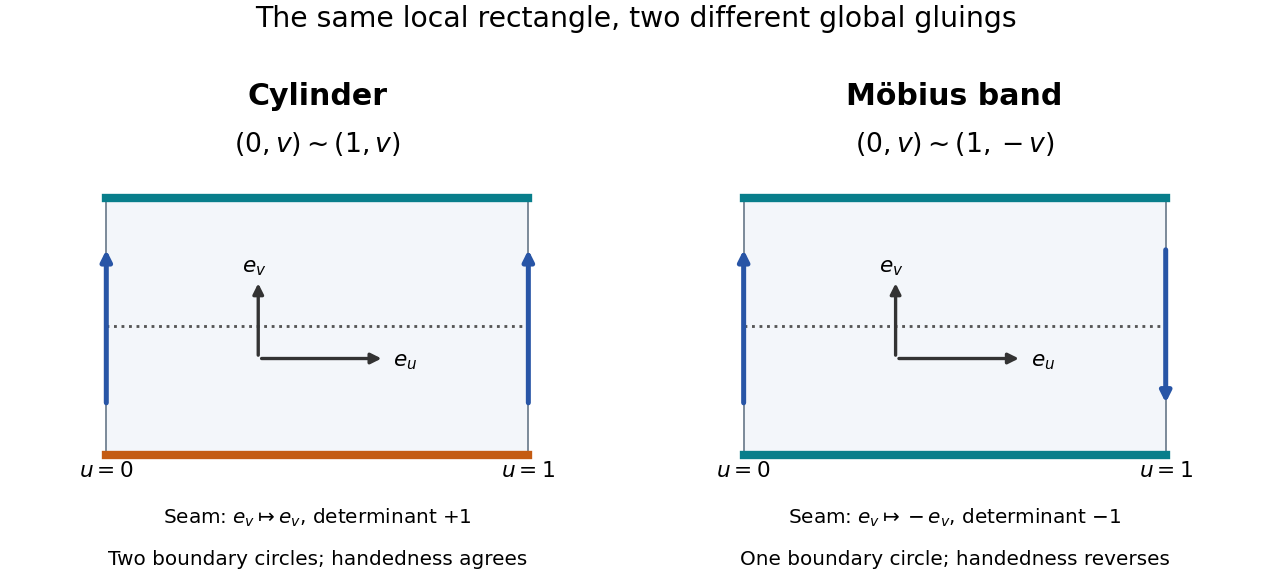

Both rectangles have coordinates . The untwisted band identifies with ; the Möbius band identifies with . Across a seam the corresponding local coordinate changes preserve or reverse , giving determinants and . This sign explains the handedness change; the drawing also tracks the two boundary circles of the untwisted band and the single boundary circle of the Möbius band.
For a smooth topological surface embedded in , choosing an orientation of a surface is equivalent to choosing a continuous unit normal. This picture is specific to surfaces in three-dimensional space: the general definition uses compatible local orientations, without requiring an embedding. Orientability is a topological invariant, so a homeomorphism cannot turn a Möbius band into a untwisted band. The sphere and torus are orientable surfaces; the Klein bottle is not. [ref]
The distinction matters when a sign has geometric meaning. A signed flux surface integral needs an orientation of a surface, and Stokes theorem relates that choice to the outward-normal-first boundary orientation. Ordinary unsigned surface area does not require orientability. Thus a Möbius band still has a perfectly meaningful area even though it has no continuous global unit normal.
A connected orientable manifold of positive dimension has two possible orientations: reversing every local choice gives the other one. If a manifold has several connected components, each component can be oriented independently when it is orientable. For topological surfaces, a useful obstruction criterion is the presence of a Möbius band: a surface is nonorientable exactly when it contains such a band. [ref]
https://pi.math.cornell.edu/~mec/Winter2009/Victor/part3.htm. Cornell Mathematical Explorers' Club, Orientable and Nonorientable Surfaces
An end of a noncompact topological space describes a coherent way to escape every compact subset. For a cofinal compact exhaustion, when one exists, , it is represented by nested connected components of the complements. A connected noncompact manifold is disconnected at infinity when it has more than one end.
A topological invariant is a property or mathematical object preserved by homeomorphisms of topological spaces. Connectedness and compactness are examples. The fundamental group is an invariant up to group isomorphism; it is also preserved up to isomorphism by homotopy equivalence, a stronger invariance property which does not hold for every topological invariant.
A recurrent point of a discrete dynamical system returns arbitrarily close to its starting state at arbitrarily late positive times. In a metric space, this means that there is a strictly increasing sequence withEquivalently, every neighborhood of contains for arbitrarily large . A finite early return near the point does not suffice.
Every periodic point is recurrent: if , take . An irrational rotation of the circle gives recurrent points that are not periodic. For with irrational , the pigeonhole principle applied to modulo one supplies an integer with distance from to an integer at most . These approximating must be unbounded, since no fixed positive multiple of an irrational number is an integer. An increasing subsequence therefore gives the required returns for every starting angle.
Recurrence concerns returning close, whereas convergence to an attracting equilibrium point need not give recurrence of any other starting state. The map has zero as a recurrent point, but a nonzero converges to zero rather than back to itself.
A subset is syndetic if it has bounded gaps: some positive integer makes every block meet . The quantifier applies at every integer location, including negative ones. A corresponding one-sided definition uses and nonnegative starting locations.
For example, the even integers are syndetic with , while the positive perfect squares are not: the gap between and is and grows without bound. In a one-sided syndetic set, partitioning the first integers into blocks of length gives at least elements, so its lower asymptotic density is at least .
Positive lower density alone does not ensure bounded gaps. Remove from each block for . The removed blocks have unbounded lengths, but at most removed points lie below . The remaining set has asymptotic density one and is not syndetic. Thus a condition on every interval is stronger than a condition on the long-run proportion.
A continuous map on a nonempty topological space is point-transitive if it has a dense forward orbit. This is one convention for topological transitivity, but on spaces with isolated points it must be distinguished from the open-set intersection definition. On a nonempty compact metric space, the positive-time open-set intersection property implies point transitivity: for each member of a countable basis of a topology, is open and dense, and the Baire category theorem supplies a point in their intersection. Conversely, a surjective point-transitive continuous map has every tail of its dense orbit dense, since and continuity sends its orbit closure into the closure of that tail. The map , on is point-transitive but fails the open-set intersection property.
Two continuous maps are topologically conjugate if a homeomorphism between their state spaces satisfies the displayed intertwining identity. It is conjugate maps with a topology-preserving conjugating map. On compact metric spaces, pulling back a compatible metric through preserves every Bowen metric, and hence topological entropy.
A family of maps between metric spaces is equicontinuous when, near each point, one input tolerance controls the output variation uniformly for every . Uniform equicontinuity uses one input tolerance over the whole domain.
A family of maps between metric spaces is equicontinuous at when, for every , one works for all : implies .
In a positive-time patch, proper-time first integrals give and . If , the unparametrized timelike geodesics are on an appropriate branch; in the expanded quadratic form their discriminant is positive. If , there is the separate family , . A description using only the nonvertical quadratic family omits genuine timelike geodesics.
There are unlisted articles, also show them or only show them.