
If a number field has real embeddings and conjugate pairs of complex embeddings, thenwhere is the finite group of roots of unity in .
If is a full lattice and a measurable convex centrally symmetric set has volume greater than , then contains a nonzero lattice point.
The factorization of a defining polynomial modulo a prime, provided the index is coprime to that prime, determines the prime ideals, ramification indices and residue degrees in the corresponding ring of integers.
A Hecke character of a number field is a continuous character of its idèle class group. Its finite conductor records the local unit subgroups on which it is trivial. As an ideal character it is defined on fractional ideals prime to that conductor, with a prescribed rule on principal ideals coming from its archimedean character. A CM elliptic curve yields an algebraic Hecke character with one CM embedding in its infinity type of a Hecke character.
Elliptic units are algebraic units constructed by evaluating suitably normalized elliptic functions at CM torsion points and taking products or norms into ray class fields. Their distribution relations make them norm compatible in CM division towers. They generate an Euler system of elliptic units and their local Coleman power series for a CM formal group have logarithmic derivatives encoding critical Hecke L-function values.
The Grothendieck group of finitely generated projective right -modules under direct sum. An element is a formal difference . Equality of two positive classes means for some projective ; adding a complement of converts this into an isomorphism after a common finite free summand. This stabilization criterion is essential in patching arguments.
Stable invertible matrices, with stabilization , form the stable general linear group. Its elementary subgroup is its commutator subgroup, and the displayed quotient is its abelianization. Elementary matrices lift along any surjective ring map, even when arbitrary invertible matrices do not lift. Over a field, determinant identifies with its multiplicative unit group.
A cartesian square of unital rings is a Milnor square when at least one map is surjective. Finitely generated projective modules over can then be assembled from projective modules over the two upper rings together with an isomorphism of their reductions over .
Ramification is branching in a geometric or algebraic map, detected by multiplicity greater than one. For number fields, ramification of a prime means that some prime ideal occurs with exponent greater than one in the extended prime ideal. For a map of smooth algebraic curves, a local parameter pulls back to a parameter with order greater than one at a ramification point.
The degree of a projective algebraic variety of dimension is the length, with intersection multiplicities, of its intersection with a sufficiently general linear subspace of complementary codimension. Equivalently, its Hilbert polynomial has leading coefficient . For a projective curve, a general hyperplane section measures this degree.
An abelian variety of dimension has complex multiplication when its rational endomorphism ring contains a commutative semisimple -algebra of dimension . For an elliptic curve in characteristic zero, this means its geometric endomorphism ring of an elliptic curve is an order in an imaginary quadratic field. The resulting rank-one Tate module representations connect torsion points to class field theory.
An algebraic set is a zero locus of polynomial equations, allowing reducible sets. An affine algebraic set uses ordinary polynomial equations; a projective algebraic set uses homogeneous equations in projective coordinates. On affine or projective space, closed sets in the Zariski topology are algebraic sets, and an irreducible algebraic set is an algebraic variety in the classical convention.
Étale cohomology is sheaf cohomology on the site whose objects are étale morphisms and whose coverings are jointly surjective families of such morphisms. It provides cohomological invariants for algebraic varieties over fields of positive characteristic. In Deligne-Lusztig theory, compactly supported groups with -adic coefficients, for different from the field characteristic, give finite-dimensional representations of the finite groups acting on the varieties.
For a projective scheme and a fixed Hilbert polynomial , the Hilbert scheme parametrizes flat families of closed subschemes of with that polynomial. This turns a family of embedded algebraic curves into an algebraic parameter space.
A property holds at a very general point of an irreducible complex algebraic parameter space if it holds outside a countable union of proper Zariski-closed subsets. This permits countably many exceptional conditions. Over that complement is nonempty and dense, for example by the Baire category theorem on a local smooth analytic chart.
For a projective variety over the complex numbers, analytification gives an equivalence between algebraic and analytic coherent sheaves, preserves their cohomology, and is fully faithful on their morphisms. In particular, a holomorphic isomorphism between algebraic line bundles is algebraic. This allows a complex-torus proof of a line-bundle identity to establish the corresponding algebraic identity on a projective elliptic curve.
A Poisson algebra has two compatible products on one vector space: a commutative, associative multiplication and a Lie bracket . Compatibility is the Leibniz ruleThus fixing makes an algebraic derivation. The Lie bracket also satisfies the Jacobi identity; an arbitrary bilinear bracket satisfying antisymmetry of a Lie bracket and the product rule need not do so.[ref]
Lectures on Symplectic Geometry by Ana Cannas da Silva. §18.3, Definition 18.7: the two algebra structures and their Leibniz compatibility
For example, the polynomial ring becomes a Poisson algebra with the canonical Poisson bracketThe partial derivatives give and , illustrating how the Leibniz rule extends the bracket from generators to their products. More generally, smooth functions on a symplectic manifold form a Poisson algebra. A finite-dimensional Lie algebra of moment map components need not be closed under ordinary multiplication: adding all their products normally gives a much larger Poisson algebra.
Consider an idealized planet that is a sphere of radius , illuminated by parallel sunlight of irradiance , measured on a plane perpendicular to the rays. Its intercepting projected area is , whereas its total surface area is . Therefore the incoming power averaged per unit total surface area iswhere is the broadband Bond albedo. The factor four is a sphere geometry result, not an atmospheric transmission factor. Local sunlight still varies over the illuminated hemisphere and vanishes on the dark side.
Now stipulate a single spatially uniform temperature , no atmosphere, no internal heating, and emissivity one for outgoing thermal radiation. This is a thermal blackbody model using the Stefan–Boltzmann law; the prescribed solar-band reflection is treated separately, so the body is not a perfect absorber at all wavelengths. Let be the effective heat capacity per unit surface area, in . Conservation of energy gives the ordinary differential equationHere is net heating per unit surface area, in , and is the Stefan-Boltzmann constant. Use , rounded from the exact constant reported by NIST. [ref]
https://physics.nist.gov/cgi-bin/cuu/Value?sigma%7Csearch_for=stefan+boltzmann. NIST, CODATA value: Stefan-Boltzmann constant
The uniform temperature is a model assumption: generally the surface average of differs from the fourth power of the surface-average temperature.For fixed Bond albedo , radiative equilibrium requires , givingWith the illustrative solar constant , the global incoming average is :
| Fixed Bond albedo | Reflected average () | Absorbed average () | Equilibrium temperature () |
|---|---|---|---|
Doubling albedo here lowers the equilibrium temperature by , rather than halving it: the absorbed fraction changes from to , and thermal radiation scales as . These stipulated Bond albedos are whole-planet examples, not measurements of bare water and ice. The model predicts neither Earth's modern surface temperature nor its response to actual climate change; it omits the greenhouse effect, spatial heat transfer and seasons.
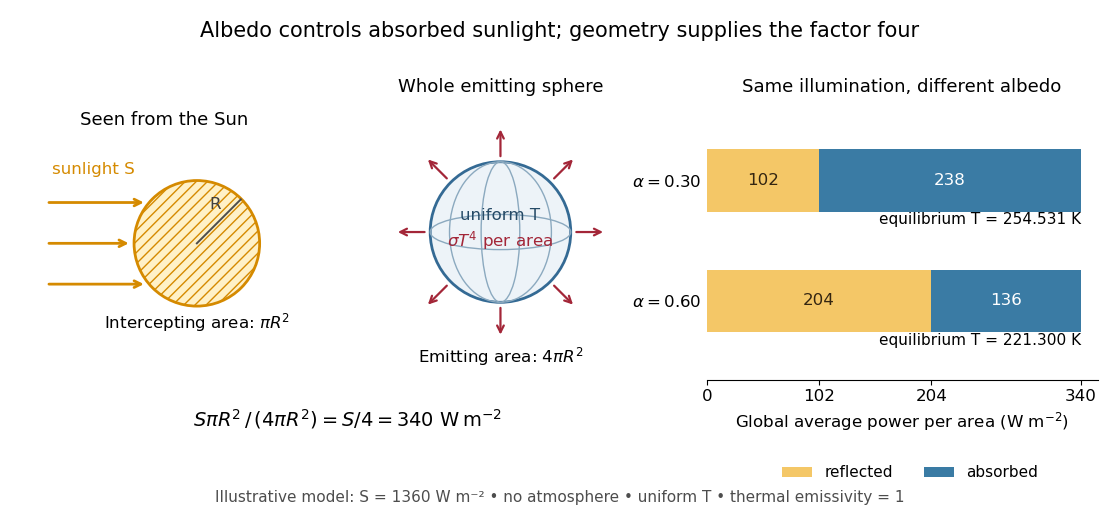

Each fixed-albedo equilibrium is a stable equilibrium: for , the derivative is . A small temperature increase produces net cooling, and a small decrease produces net heating. This is the simplest expression of the stabilizing Planck feedback. Allowing albedo to fall with temperature adds a competing term, as in ice-ocean albedo feedback.
A loss of the approximately attached-flow relation between angle of attack and lift coefficient, associated with substantial flow separation. A stalled airfoil can still produce lift; its behavior must be measured or modeled beyond thin airfoil theory.
A small-disturbance, two-dimensional potential flow model for a thin airfoil, using surface tangency and smooth flow departure at its trailing edge to determine circulation. Its lift coefficient slope is per radian, with camber shifting the zero-lift angle of attack. See airfoil for assumptions, examples and the aerodynamic stall limit.
There are unlisted articles, also show them or only show them.