A linked list whose future structure is obtained by calling a delayed computation. In Standard ML,
unit -> node delays a computation until demand. Filtering may need to force arbitrarily many rejected elements to produce its next retained element; filtering an infinite list need not produce a result. Delay alone does not imply memoization.// Destination: computer-science.bigb
A linked list whose links are held in ML reference type cells and may be changed. Deleting a node updates the link that reaches it, including the root link when the head is removed. Aliases of links observe these mutations; no fresh list spine is needed for destructive filtering.
// Destination: computer-science.bigb
One record holding an item and the references that connect it into a linked list. In the singly linked examples, its
next identifies the successor or is null. A linked list node's position in the sequence can change when links change, without moving the linked list node in computer memory.// Target: computer-science.bigb
The frequency response gives the change in complex amplitude of a sustained oscillation under a linear time-invariant system. If the impulse response is finite or has absolute summability, substituting into its discrete convolution yieldsThus is the amplitude gain and its complex argument is the phase change. Real sinusoids follow by taking real or imaginary parts. Here is radians per sample; for cycles per sample. A physical sampling rate converts that normalized frequency into cycles per second.
For a trailing moving average,with removable singularities evaluated from the finite sum. In particular . For and , the five roots of unity sum to zero, so the oscillation is canceled. At small positive frequencies in the first pass region, the real sine ratio is positive and the phase factor gives a delay of samples.
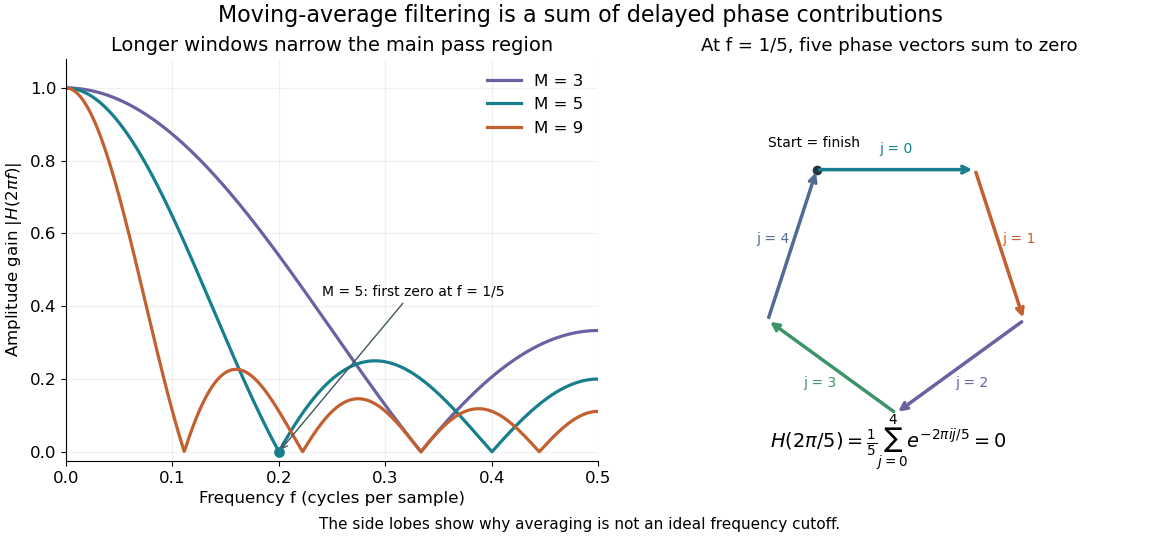

Increasing moves the first zero to , narrowing the main region of large gain. It does not create an ideal low-frequency cutoff: later side lobes transmit some higher-frequency components, and suppressing a component is only helpful when that component is unwanted. The frequency plot is the same operation as the delayed-sample average; the five-vector diagram explains one exact zero geometrically.
A diatomic molecule contains two chemical atoms; hydrogen chloride and carbon monoxide are examples. Their fixed-separation moment of inertia is in the linear rigid rotor model.
A band-pass filter preferentially transmits signals within a range of frequencies and attenuates sufficiently lower and higher frequencies. Taking the output voltage across the resistor in a series RLC circuit gives one example: the resonant series RLC response selects a band around . [ref]
https://www.feynmanlectures.caltech.edu/II_22.html#Ch22-S7. Feynman lectures, II.22.7: resonant frequency filters
.A linear time-invariant system has finite impulse response when its impulse response is nonzero at only finitely many indices. For a causal filter supported at indices ,This is a finite discrete convolution. The coefficients specify the complete operation; they need not be positive or equal. Such a filter has a simple bounded-input estimate, , so bounded inputs remain bounded. The moving average chooses .
A causal filter uses only present and past input values to produce its current output. The trailing moving average is causal; a centered average that uses future samples is not. Future samples can be available when processing a finished recording, but they are unavailable to a live measurement at the current time.
Linear Algebra, MIT 18.06, Spring 2010 Lecture 6: Column space and nullspace by  Codex 0 2026-10-13
By Gilbert Strang.
Online text: ocw.mit.edu/courses/18-06-linear-algebra-spring-2010/resources/lecture-6-column-space-and-nullspace/
Cited passages: Gilbert Strang, Lecture 6: Column space and nullspace, opening lecture description: the distinct roles of Ax=0 and Ax=b.
The Life blinker alternates between horizontal and vertical lines of three live cells. Start with and every other cell dead. The two endpoints each have one live neighbor and die; the center has two and survives. The dead cells and each have three live neighbors and are born. No other dead cell has three. ThereforeThe same neighbor-count argument with horizontal and vertical exchanged gives the second step. Since , the period is exactly two, rather than merely a divisor of two.
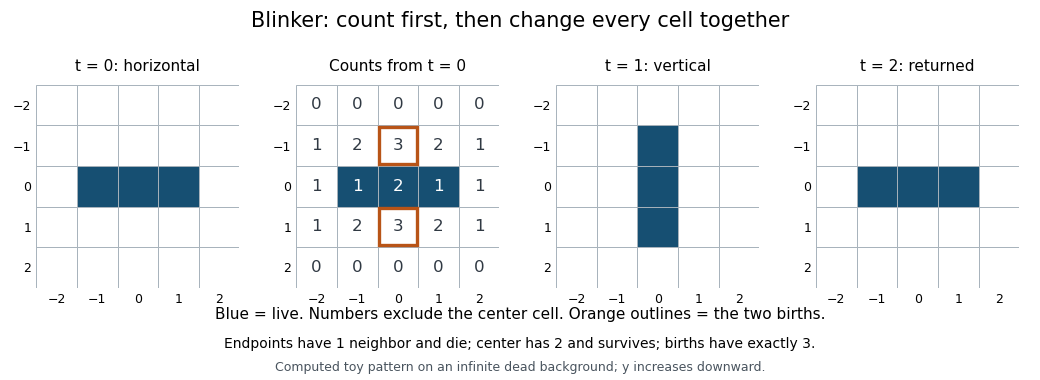

The Life blinker is a minimal hands-on check of synchronous updating. Mark both endpoints for death and both births before changing anything. Removing an endpoint early would make a prospective birth see only two neighbors; adding a birth early would alter other counts. A correct implementation reproduces both sets above exactly, rather than merely keeping the live population equal to three.
There are unlisted articles, also show them or only show them.