
Allows a running kernel execution to be involuntarily suspended for another schedulable context. Interrupt delivery and voluntary blocking are separate mechanisms.
// Target: computer-science.bigb
An operating-system kernel design retaining essential protected mechanisms while moving services into user-space services. Address spaces, software threads and IPC form a useful small foundation: the operating-system kernel protects private state and controls communication, while a file system service interprets requests about files. This separation of mechanism and policy permits different service implementations to use the same protected interface. [ref]
On micro-kernel construction by Jochen Liedtke. Liedtke, On micro-kernel construction, section 2, pp. 238–240: minimality criterion, address spaces, threads and IPC; section 3, pp. 240–241: user-level services
The useful question is which authority a service needs. A device driver may require access to a device while having no permission to overwrite an unrelated application's computer memory. A microkernel makes such protection domains possible; their actual boundaries depend on the chosen memory protection and security capabilities.
A kernel design in which major operating-system services execute within one privileged address space and can call one another directly. Avoiding cross-domain communication can improve performance, while increasing the trusted code base and the reach of a faulty service.
// Destination: computer-science.bigb
A concrete operating-system kernel whose documented file system interface distinguishes a name-associated
dentry, an object-associated inode, and a file object created for an open instance. An inode can have several name-associated objects. This illustrates the distinction among directory entries, inodes and open file descriptions; it does not imply identical structures in every operating system. [ref]https://docs.kernel.org/filesystems/vfs.html. Linux kernel documentation, Overview of the Linux Virtual File System: directory entries, inode objects and file objects
// Target: computer-science.bigb
A request from a program for an operating-system kernel service. In the Unix examples here, opening, reading, linking and unlinking files request controlled changes or access to operating system resources. The operating-system kernel checks the request and performs the permitted operation; an interface specified by POSIX does not by itself dictate every internal implementation detail.
For an isolated two-body problem in Newtonian gravity, the relative elliptic orbit's orbital period obeysHere is the relative semi-major axis, and is the sum of the two masses. The separation varies during an elliptic orbit, so replacing by works only for a circular orbit, where . Likewise, either body's individual semi-major axis about the centre of mass must first be converted to the relative one. When is negligible compared with , the denominator can be approximated by .
For fixed gravitational parameter, the orbital period depends on the semi-major axis and is independent of orbital eccentricity. Our , example gives both for and for a circular orbit with . The eccentric body's rapidly changing speed compensates for its different path. A compact way to see the cancellation uses Kepler's second law: divide the ellipse's area by its areal velocity . With and specific angular momentum , the result is .
Compare two separate Kepler orbits with the same gravitational parameter, and :With , their orbital periods are and ; measured in units of , these are and . Quadrupling the size therefore takes eight times as long to complete a circuit. This power law makes comparisons possible without first choosing physical units.
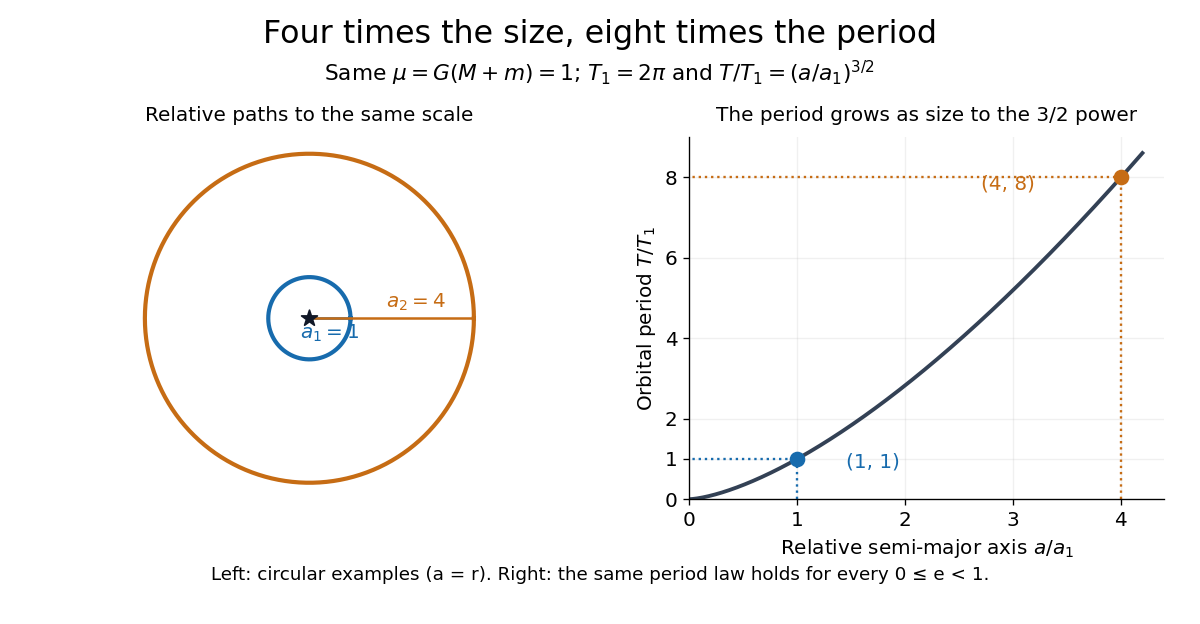

The same relation can be inverted to weigh a system: . An observed relative semi-major axis and orbital period determine the total mass, while additional information is needed to separate the two masses. This is useful for binary stars, as discussed in NASA, Orbits and Kepler's Laws: measuring masses. Geometry and a clock together become a weighing instrument.
The bound relative Kepler orbit is an ellipse with the attracting centre at one focus of a conic. In polar coordinates, its separation is the displayed function of true anomaly , the angle measured from periapsis. For and , it becomes , giving at and at . Setting orbital eccentricity to zero gives a circular orbit. This specifies the path; Kepler's second law specifies how it is traversed.
There are unlisted articles, also show them or only show them.