
A dyon carries both electric and magnetic charge. In an appropriate extended supersymmetry theory, a BPS state with these charges has mass fixed by their complex combination in the central charge in supersymmetry. Not every electrically and magnetically charged state must saturate that bound.
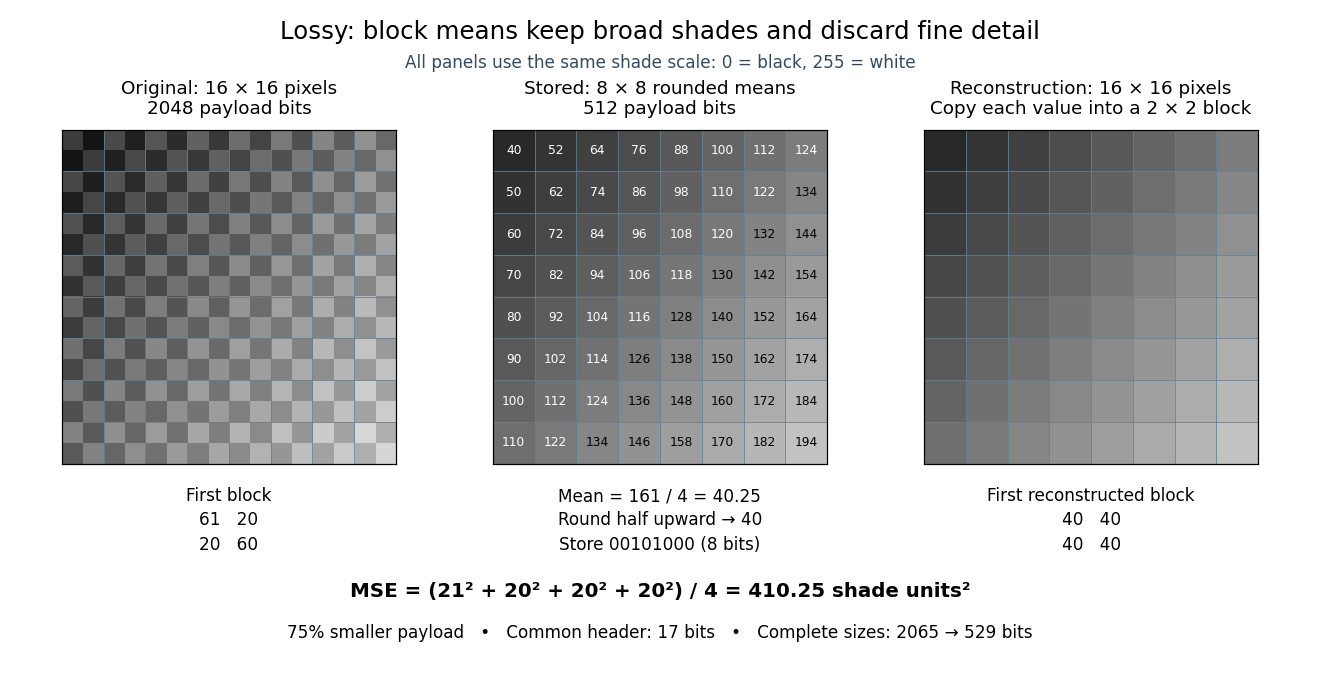
This toy image compression method stores one rounded arithmetic mean for each disjoint block of grayscale pixels. The quantization rule is round to the nearest integer, with exact halves rounded upward. Each stored value is an unsigned eight-bit integer. Reconstruction fills the original block with that value, a form of nearest-neighbor interpolation. Averaging already discards information; rounding can discard more.
Here is an exact source array. Index rows and columns by and defineThe floor function makes constant within each block; the indicator function adds 1 only to its upper-left pixel. All values are integers from 20 to 215. Each block therefore has the exact formFor example, the upper-left block has arithmetic mean and is stored as 40. The block immediately to its right is stored as 52. The complete stored array is specified by for . Its first row is ; its last is .
This toy file format again has eight-bit width and height fields followed by a one-bit mode: 0 means raw eight-bit grayscale pixels, 1 means the rounded block arithmetic means. This profile accepts only width and height 16. The decoder knows the block size and reconstruction rule from the format, reads the 64 stored values in row order, and repeats each across its corresponding block. The original 256 pixels cost payload bits; the 64 stored values cost payload bits. The reduction is . These payload counts exclude the common 17-bit file header; complete sizes are 2065 and 529 bits, or 2072 and 536 bits after final zero padding to eight-bit units. There is no stored codebook or additional prediction rule.
The empirical mean squared error averages squared differences over the 256 original pixel positions:Every block has the same four errors, so this value is exact in squared stored shade units. If the unrounded arithmetic mean could be reconstructed, the error would instead be ; eight-bit quantization adds . That hypothetical comparison does not count fractional means as free eight-bit values.
The broad shade pattern survives, while the alternating bright and dark pixels vanish. Indeed, a second source with every block constant at produces the identical stored array : exact decoding of both sources is impossible. This makes the storage benefit and the lost detail visible at once. Block averaging is useful for a coarse preview when the individual pixels are dispensable; choosing an acceptable mean squared error or visual result is part of the application, not a guarantee supplied by the encoder.

A hepatocyte is the major functional epithelial cell of the liver. Its polarized organization supports exchange with sinusoidal blood and secretion into bile canaliculi. Metabolic processing and directional secretion therefore occur at different surfaces of the same cell.
Phospholipids are lipids containing a phosphate group as part of their structure linked by covalent bonds. The familiar membrane-forming phospholipids are amphiphilic: a hydrophilic head region with chemical polarity coexists with a hydrophobic, largely nonpolar hydrocarbon region. These descriptions refer to different parts of the same molecule, not to two separate substances. See IUPAC Gold Book: phospholipids and IUPAC Gold Book: amphiphilic.
A typical two-chain glycerophospholipid provides a useful example: a glycerol scaffold carries two fatty acid-derived acyl groups through ester linkages, plus a phosphate-containing head region. Phosphatidylcholine is one example. This scaffold describes an important subclass, rather than all phospholipids: sphingomyelin has a different backbone, and even glycerophospholipids need not all have two acyl groups. See IUPAC–IUB, Nomenclature of Lipids (1976), Lip-1.5 and Lip-2.1–2.6.
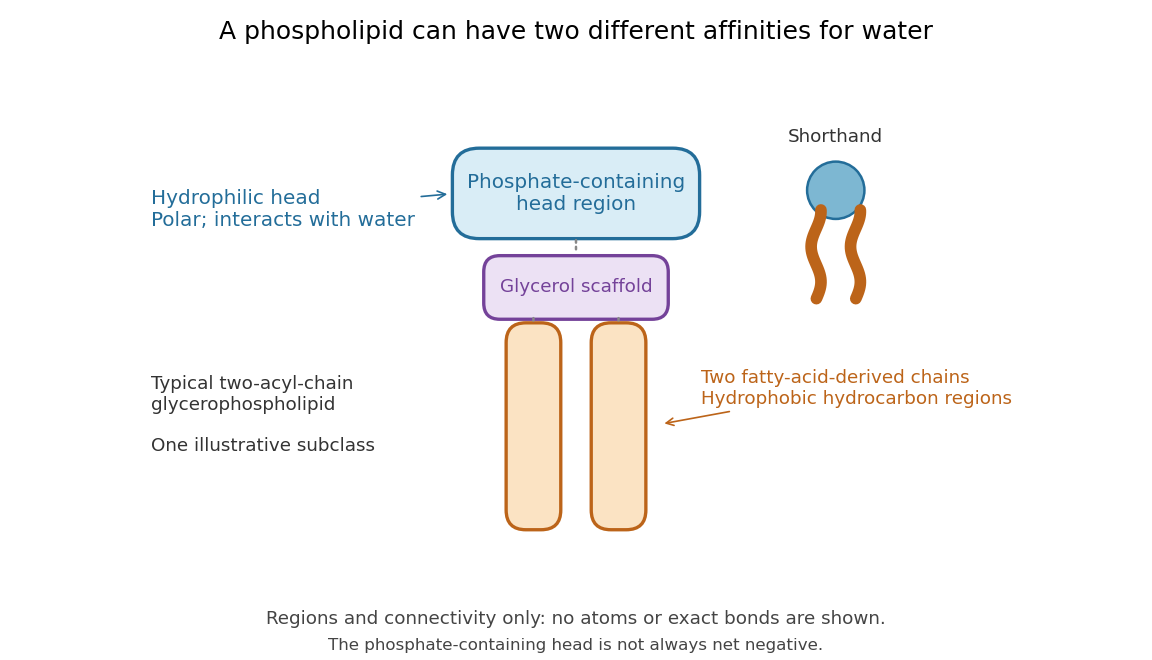

Polar does not mean negatively charged overall. At near-neutral pH, phosphatidylcholine is zwitterionic: its phosphate region carries negative electric charge and its choline region positive electric charge, with zero net electric charge for the molecule. Counting those opposite charges gives ; it does not remove their local interactions with water. See Lodish et al., Molecular Cell Biology: membrane lipids.
In a lipid bilayer, two membrane leaflets orient their hydrophilic heads toward the water on either side and their hydrophobic chains toward the shared interior. The hydrophobic effect helps explain this organization through the free energy of the water and lipids together. It is not a special repulsive chemical bond between chains and water. Which organization is favored also depends on molecular geometry, temperature, concentration, and the surrounding chemical solution; a phospholipid label alone does not guarantee a lipid bilayer. See Alberts et al., Molecular Biology of the Cell: the lipid bilayer.
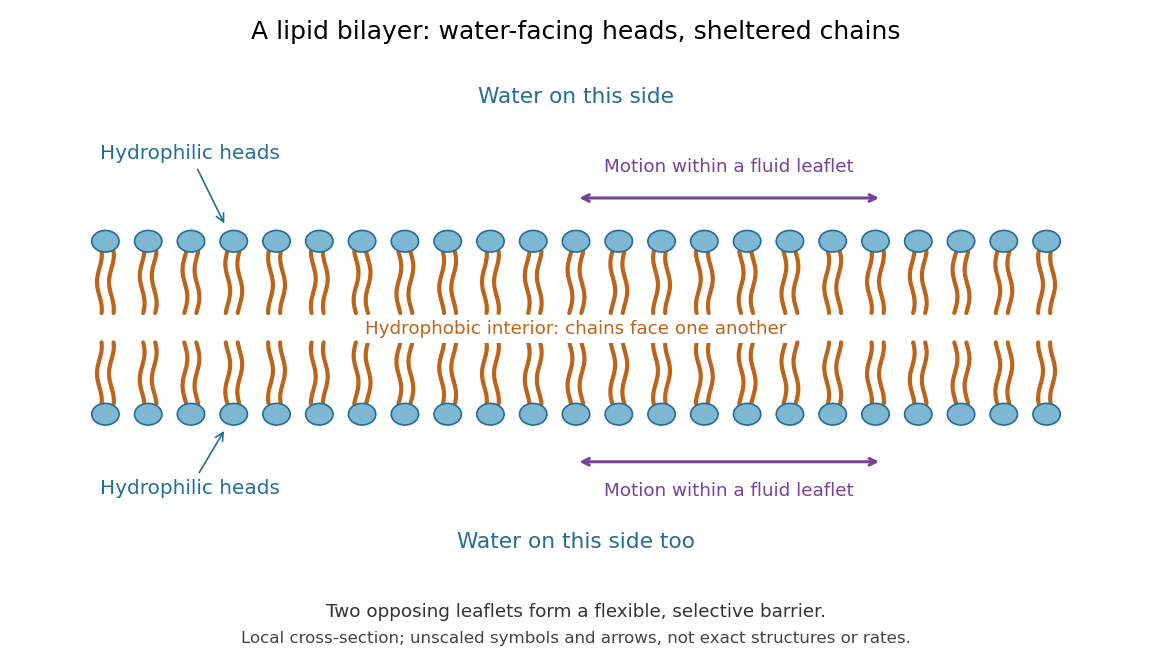

This organization supplies a flexible barrier for compartments. A fluid lipid bilayer allows lipids to undergo diffusion within each membrane leaflet; barrier function therefore coexists with motion of molecules, as in the fluid mosaic model. It is not completely impermeable: small nonpolar molecules such as molecular oxygen and carbon dioxide cross much more readily than ions. In a cell membrane, ion channels and other membrane transport proteins provide selective routes; the existing membrane transport article explains their driving forces. See Alberts et al.: principles of membrane transport.
In 1925, E. Gorter and F. Grendel extracted lipids from red blood cells and compared the surface area of a one-molecule-thick film on water with the estimated total surface area of the red blood cells. Their table gave ratios near two, supporting a two-layer covering; they also proposed heads facing the aqueous surroundings on both sides. The inference depends on recovering the relevant lipids, estimating the red blood cell surface area correctly, and comparing compatible packing in the film and the cell membrane. It was indirect evidence, not an image of the lipid bilayer. The paper itself notes possible losses during evaporation. See Gorter and Grendel, On Bimolecular Layers of Lipoids on the Chromocytes of the Blood, Journal of Experimental Medicine 41 (1925), 439–443.
Cholesterol is a lipid with four fused rings and a small hydrophilic region. It helps regulate the fluidity of animal cell membranes; it is structurally distinct from a phospholipid. See Biology 2e: cholesterol.
A triglyceride contains glycerol joined to three fatty acid-derived acyl groups through ester linkages. Compare the three chains with the two-chain, phosphate-headed glycerophospholipid illustrated below. See Biology 2e: fats and oils.
There are unlisted articles, also show them or only show them.