
Optimization with no additional optimization constraints on the chosen variable domain. At an interior local extremum of a differentiable function, the first-order optimality condition is .
A nonlinear programming problem minimizes an objective over finitely many real variables subject to constraints, with at least one objective or constraint nonlinear. Parametrizing the pulse amplitudes in quantum optimal control produces such a problem. Gradient descent and related local methods exploit differentiability, but a local stationary point need not be a global optimum without additional convexity or other structure.
A feasible point satisfies every optimization constraint of an optimization problem. For the budget constraint example, the feasible set is exactlyIt is the line segment from to , a compact set and a convex set. The point is feasible, with product ; has a larger product but violates the budget constraint. Feasibility answers whether a decision is allowed; optimality asks whether any allowed decision is better. The extreme value theorem guarantees that this continuous objective function attains its maximum on this nonempty compact set.
Eliminating gives a one-variable objective function:By completing the square, , with equality exactly at . Alternatively its derivative is , which vanishes at ; the endpoint values are both zero. Completing the square proves global optimality directly, whereas the first-order optimality condition only identifies a candidate. It also quantifies the cost of imbalance: moving to with loses exactly units of product. The arithmetic-geometric mean inequality gives another short certificate: , with equality exactly when .
For a transportation problem with capacity inequalities, feasibility requires nonnegative shipments, row totals no greater than factory capacities and column totals equal to shop demands. Feasibility alone does not prove minimal cost: a matching transportation dual certificate with capacity inequalities provides an optimality proof. The feasible set can be empty, and a finite infimum need not be attained even when the set is nonempty.
Heuristic optimization seeks useful feasible solutions without necessarily providing a universal approximation ratio or a polynomial worst-case guarantee. Examples are local search, simulated annealing and tabu search. A claimed approximation algorithm needs a separate proved performance guarantee.
For positive constants , a Cobb–Douglas production function describes output in terms of capital and labour . It is homogeneous of degree . Under with , its unique nonnegative-input optimum is and , obtained by maximizing the strictly concave logarithm along the budget line. The optimized output has derivative , equal to its budget Lagrange multiplier. When , the unconstrained Lagrangian supremum over the positive orthant is infinite for every finite multiplier, despite the finite constrained optimum; the global dual representation must not be presumed in this case.
Maxima and minima are extrema of a real-valued function. A global maximum of on its domain is a point with for every ; a global minimum reverses the inequality. A local extremum requires the inequality only in a neighbourhood of the point within . In constrained optimization, is the feasible set, so an extremum is tested relative to the constraints rather than in every ambient direction. Thus a constrained local maximum or local minimum can occur at a boundary point without being an interior critical point.
Project scheduling asks how quickly a collection of dependent activities can finish. Adding their durations usually overestimates the answer, because independent activities can run together; taking only the longest single activity usually underestimates it, because some activities must wait. The critical path method identifies the chain of dependencies that determines the finish time. Its simplest model assumes known, fixed durations, unlimited parallel processing, and precedence requirements saying that each predecessor must finish before its successor starts. These are the assumptions of the basic model in Hendrickson, Project Management for Construction, §10.2.
Represent each activity by a vertex of a finite directed acyclic graph; an edge means that activity waits for activity . Activity runs without interruption for duration , starting at . The optimization constraints and project finish time areThe objective function is to minimize . All durations and start times use the same time unit, and the project starts at time zero. The directed acyclic graph assumption allows a topological order in which every predecessor is processed first.
Consider this small, abstract project:
Activities A and E may start together. After A finishes, B and C may run together, but D must wait for both. F must similarly wait for both D and E: a merge means all incoming requirements must hold. This activity-as-vertex convention keeps durations on the activities and uses arrows only to express precedence.
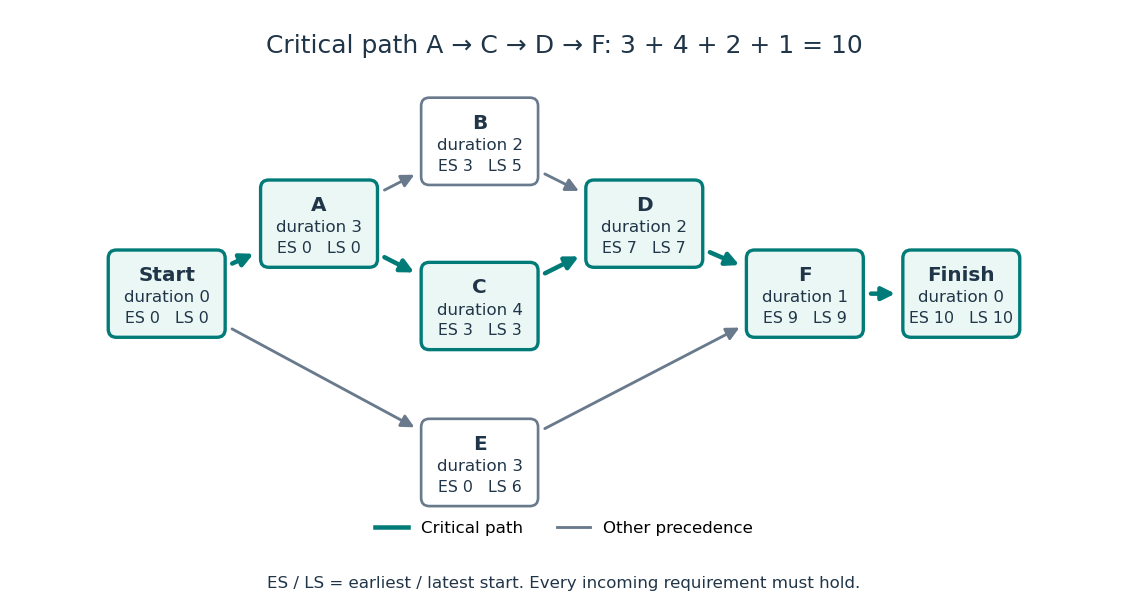
Unlimited parallel processing is essential to the equality between the longest graph path duration and the optimal finish time. For example, two independent chains, each containing two activities of duration 3, have longest graph path duration 6. Two processors can finish both chains in 6, but one processor needs 12 because all four activities must run sequentially. Thus with limited resources the longest graph path still gives a lower bound, but it need not be achievable. Such resource requirements belong to the broader subject of scheduling.
// Target: mathematical-optimization.bigb
An objective function is a real-valued function assigning a score to each decision under consideration. An optimization problem seeks a feasible solution maximizing or minimizing this score. The optimizing decision and its score are different objects: in the budget constraint example, the decision is and the optimal value is .
Choosing an objective function expresses what matters. With and , maximizing makes every feasible point equally good; maximizing selects ; maximizing rewards balance. If are side lengths, is a rectangle's area, and the budget constraint fixes its perimeter at . The same mathematics then says that a square encloses the largest area among these rectangles.
For the product objective function, the positive level sets are hyperbolas. Each collects decisions with identical scores. The highest attainable level set touches the feasible set at ; higher ones miss it entirely.
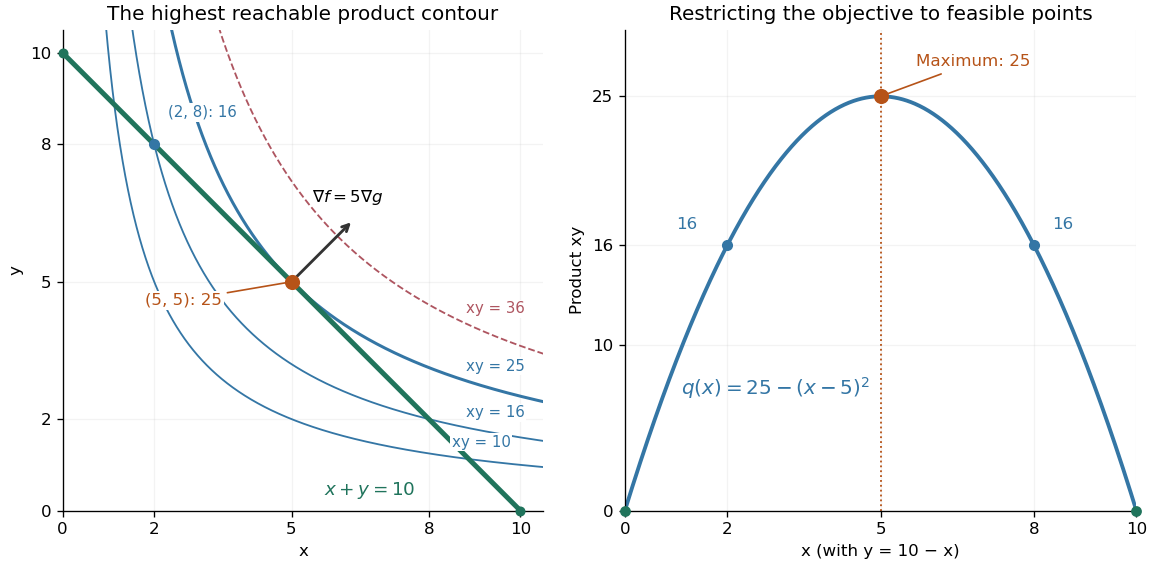


The product is neither a convex function nor a concave function on the positive quadrant: along it is , while along it is . Yet its restriction to this feasible set is a strictly concave function. Thus the geometry of the allowed decisions can make an otherwise nonconcave maximization problem tractable. Replacing by always converts a maximization problem into an equivalent minimization problem.
// Target: mathematical-optimization.bigb
Scheduling assigns jobs to processing resources and orders their execution subject to resource and precedence requirements. Objectives include completion time, lateness and throughput. In single-machine sequencing with all jobs mandatory, the total processing time is constant, but order-dependent setups can still change completion time. With parallel machines, machine allocation and sequencing jointly determine the parallel-machine makespan with sequence-dependent setups.
Compartmental models divide a biological population into states and specify transfers between them. A compartment might contain susceptible individuals, infective individuals or recovered individuals. The model must state what a compartment represents and whether its variable is a count or a fraction.
For a closed, homogeneously mixed SIR model, let and use force of infection and recovery rate . ThenEvery transfer leaves one compartment and enters another, so summing the equations gives . This conservation of population follows from the specified closed model; demographic gains, deaths or external arrivals can change the total. An SEIR model adds an exposed state to distinguish infection from the ability to transmit.
A deterministic ordinary differential equation describes continuous compartment sizes. A stochastic epidemic model instead treats infection and recovery as random events between integer states. The latter can exhibit epidemic extinction even when the corresponding deterministic trajectory initially grows.
Roots of unity among the linearization multipliers give periodic linearized perturbations but do not by themselves prove a branch of nonlinear periodic solutions. For the normalized delayed recurrence , the multipliers at are . Nevertheless, with , its sixth iterate has leading displacement , where and . The identity obstructs cancellation for small nonzero . Indeed any putative local six-cycle requires by the norm equation, and then its determinant equation would read , impossible. This is a concrete caution against promoting a linear resonance to a nonlinear bifurcation assertion.
There are unlisted articles, also show them or only show them.