
A request whose successful completion, under the device's stated contract, makes preceding covered writes survive loss of volatile memory cache contents. The diagrams wait for completion at each persistence boundary. Storage flush and atomic storage write are different properties: persistence of completed writes does not make a multi-record update indivisible.
A data structure using a bit per allocation unit to mark whether it is available. Its agreement with ownership references is a file-system crash consistency requirement; changing just this structure does not install the owner's update.
File-system journaling makes a group of related file system updates recoverable after a crash by recording them in a journal before changing their final storage locations. The useful promise is file-system crash consistency: after journal replay, a protected file-system transaction has taken effect completely or has not taken effect. File-system transaction durability adds a different promise: an acknowledged update survives the crash. The protected group can contain only file metadata, or both file metadata and file data blocks, depending on the file-system journaling mode.
Consider a tiny file containing
ABCD in four-byte file data block 7. Its inode records size 4 and a reference to block 7. Appending EFGH in previously free block 9 requires three new stored records: , the inode with size 8 and references to blocks 7 and 9; , the block allocation bitmap marking block 9 allocated; and , file data block 9 containing EFGH. An inode reference to a block still marked free lets a later allocation overwrite live contents; allocating a block without recording its owner can leak space. Even mutually consistent file metadata can expose stale contents if has not reached storage. Chapter 42 of Crash Consistency: FSCK and Journaling (section 42.1, pp. 2–4) develops this three-record append problem; the names, block numbers and tiny contents here are original teaching choices.The first diagram protects all three records with write-ahead logging. Each journal payload record identifies a final destination and its complete new contents. A storage flush makes the complete journal payload durable before a separate journal commit record is written and made durable. Only then may a journal checkpoint copy the records to their final locations. The journal remains available until those copies have themselves passed a storage flush; it can then be retired and its space reused. Journal replay repairs an interrupted journal checkpoint using the retained new contents.[ref]
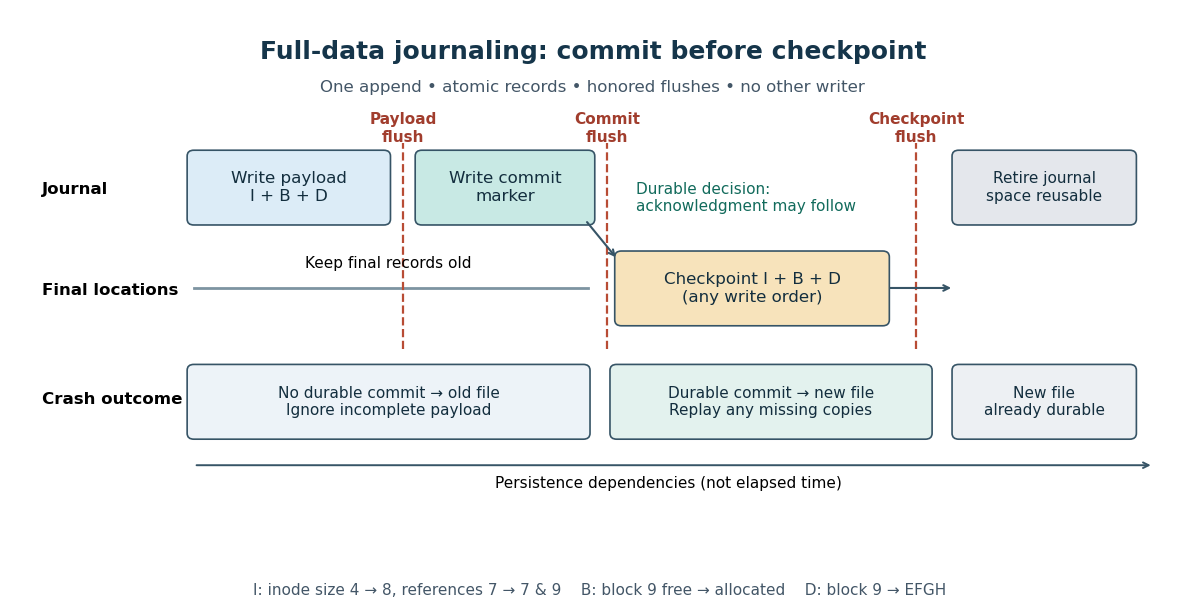
Write-ahead logging separates durable journal commit records from journal checkpoints and safe journal reuse
. Details. 
These are persistence dependencies, not a claim that issuing writes in this order is sufficient. A device can report completion while its volatile memory cache still holds the only copy. The Linux kernel documents both flushing earlier completed requests and making completion of a particular request depend on persistence. The timeline uses separate storage flushes to make the dependencies explicit; an implementation can use equivalent device-supported operations. A commit write can persist before its storage flush returns: recovery uses the actual durable marker, while acknowledgment waits for successful completion.[ref]
The appeal is that recovery knows exactly which updates to finish. It does not have to infer a user's intended contents from contradictory inodes and block allocation bitmaps. The cost includes writing the journal payload as well as its final copies and waiting for persistence boundaries. The journal records a recent transition, not a historical collection of recoverable files; file-system journaling is not a file-system backup.
A memory cache of device blocks indexed by device identity and block number. A hit avoids slow device access; a miss obtains a buffer and reads the block. Dirty buffers carry modified data that must be written before reuse, and pinned buffers cannot be evicted while an operation uses them. Deferred writes improve throughput but need explicit durability handling.
A buffer cache can hold both file data blocks and storage containing file metadata, such as inodes and block allocation bitmaps. Reusing a buffered device block saves repeated input-output; retaining several modifications before buffer cache writeback can combine them into one transfer. Section 40.7 of Operating Systems: Three Easy Pieces by Remzi H. Arpaci-Dusseau and others explains these benefits for file systems.[ref]
File System Implementation. pp. 14–16: caching and buffering
The central distinction is that a dirty buffer needs a write, whereas a pinned buffer must retain its identity. A clean buffer can still be pinned, and a dirty buffer can have no client references. Neither releasing a reference nor obtaining a cache hit establishes file-system transaction durability.
The organization of names and the rules for resolving them to files. A path such as
/notes/a selects successive directory entries starting from the root file-system directory. Its spelling describes a route, not an immutable identity: replacing the final directory entry can make the same path reach a different inode.A file containing directory entries. Each entry supplies a name in that file-system directory; two entries in the same file-system directory cannot have the same name. In an inode-based file system, a file-system directory has its own inode, and its contents describe names of other objects. [ref]
https://pubs.opengroup.org/onlinepubs/9799919799/basedefs/V1_chap03.html#tag_03_103. The Open Group, POSIX.1-2024, sections 3.103–3.104: directory and directory entry
An object whose contents and attributes can be accessed through operating system interfaces. Here an ordinary file means a byte sequence with file metadata, distinct from a file-system directory or a symbolic link. Its contents need not disappear when the creating operating-system process ends.
Represent the abstract sequence by
front @ rev rear. Keep the front nonempty unless both lists are empty. Prepending to the rear enqueues; when the front is exhausted, reverse the rear once. Along a single sequence of uses, each element crosses between lists at most once, giving constant amortized analysis cost per operation. Reusing an old persistent version can repeat a reversal and needs a separate analysis.// Destination: computer-science.bigb
Alcoholic fermentation produces ethanol and carbon dioxide from sugars through an enzyme-catalyzed pathway. See Saccharomyces cerevisiae for its ideal glucose balance and yeast for the distinction between living cells and active extracts.
For positive and light speed , the Fermat principle uses the time integrand . The Beltrami identity sets constant. Solving this first integral gives the displayed symmetric ray between when . Its travel time is . The ray's central height diverges as , while its travel time tends to .
For light speed , the travel-time integrand is . The Beltrami identity gives , so nonvertical rays are semicircles centred on . Boundary endpoints at have infinite travel time: along any rectifiable path entering positive height, and the integral diverges. These semicircles are therefore ideal-endpoint hyperbolic geodesics, not finite-time optical minimizers joining zero-speed endpoints.
In Standard ML,
exn is an extensible datatype of exception packets. Fresh declarations introduce constructors, optionally with payloads; rebinding can alias an existing constructor; raise propagates a packet and handle performs dynamic pattern-based recovery.// Target: computer-science.bigb
There are unlisted articles, also show them or only show them.