
Faraday's laws of electrolysis state that the mass of material formed or consumed by a specified electrode reaction is proportional to the transported electric charge, and that equal electric charge produces masses proportional to for different reactions. Here is the product's mass per mole, and is the positive number of electrons transferred per product entity. For complete use of the electric charge in that reaction,The first relation uses the Faraday constant; the second uses half-reaction stoichiometry; the third converts amount of substance to mass. For equal transported electric charge in two ideal cells,The number belongs to the balanced half-reaction, rather than to the metal's name alone: copper deposited from needs . These modern forms of both laws are given in KIT's practical.[ref]
If other same-direction electrode reactions share the measured electric current, define an integrated current efficiency . Provided the product is neither subsequently consumed nor lost, the retained mass isHere follows from the specified same-direction partition of electric current. It is not a universal bound on every signed partial-current convention: IUPAC notes that simultaneous oxidation and reduction at one electrode can produce a current-efficiency ratio above one.[ref] When efficiency varies during a run, use the charge-weighted ratio above, rather than an unweighted average over time. If deposition removes material from a multicomponent chemical solution, specify which chemical species is being counted and balance its half-reaction before choosing .
Michael Faraday's accessible 1834 paper, Experimental Researches in Electricity, Seventh Series, §783 states proportionality between chemical action and the quantity of electricity passed. In §§789–791 he describes connecting a molten tin-chloride cell in series with a water-decomposition charge indicator, weighing the receiving electrode before and after, and comparing the deposited metal with the indicator's gas readout. The common series electric current makes these two readouts comparable. This was a quantitative test of chemical equivalents, rather than merely an observation that a deposit appeared. It is historical evidence, not a suggested classroom procedure; the modern electron-counting derivation above uses concepts unavailable to Faraday.[ref]
Experimental Researches in Electricity, Seventh Series by Michael Faraday. §783; §§789–791; pp. 101–103
The cathode is the electrode at which the net electrode chemical reaction is reduction: the reacting chemical species gains electrons. This definition is independent of terminal sign. During Daniell cell discharge, cations accept electrons arriving at the copper cathode and become neutral copper. The cathode is then the positive terminal. In an externally driven electrolytic cell, the source's negative terminal supplies electrons to the negative cathode. See Pingarrón et al., §3.4: cathode and Daniell cell.
An ion carrying electric current need not undergo reduction at the cathode. For example, in the ideal Daniell cell charge-balance picture, potassium cations arriving from a salt bridge remain dissolved while cations are consumed. Follow the half-reaction to identify the reacting species; follow electric charge conservation to account for the other moving ions.
The anode is the electrode at which the net electrode chemical reaction is oxidation: the reacting chemical species loses electrons. This definition is independent of terminal sign. See IUPAC Gold Book: anode.
During Daniell cell discharge, a zinc chemical atom becomes a cation, leaving two electrons in the electrode; those electrons leave through the external electrical circuit. The zinc anode is the negative terminal. In an externally driven electrolytic cell, electrons instead leave the anode through the lead to the source's positive terminal. Conventional current in that lead points toward the anode, opposite to electron motion. The anode can therefore be positive while still being the site of oxidation. See Daniell cell for the balanced half-reaction and electrode for the operating-mode sign conventions.
Cited passages: EC-2: Electric Fields, General methodology steps 3–4: electrode drop, zero, contact resistance and leakage; EC-2: Electric Fields, Introduction: small current in uniform high-resistivity planar material.
For a central gravitational potential and nonzero specific angular momentum , the positive contribution to the radial effective potential can prevent the orbit reaching the centre at finite energy. It dominates the attractive term at small in a Kepler orbit. A more singular attractive term may overcome it: for , the net inverse-square coefficient is , so a central barrier exists only when that coefficient is positive.
Zooplankton are drifting aquatic consumers, including small animals. In the illustrative food web, the chosen zooplankton feed on algae and serve as prey for small fish; this assumed diet is not a claim about every kind of zooplankton.
Energy flow tracks energy entering an ecosystem, passing through organisms and leaving its boundary. To see its quantitative effect, assume net production at one trophic level is and assume a transfer efficiency at each of two successive steps. Here measures the energy incorporated into new living material per unit area per day, after that level's own cellular respiration; it is not a count of organisms or a standing stock. The joule supplies the energy unit, with .
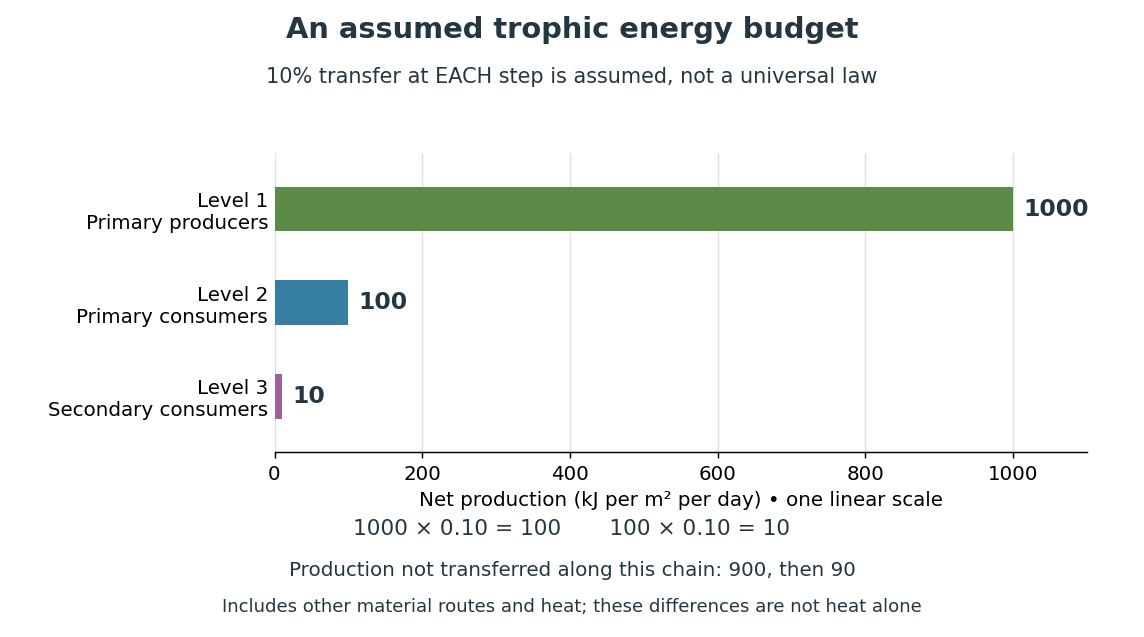

Only , or one percent, of the initial production reaches level 3 in this toy food chain. The first step leaves and the second outside the next level's new production. These differences can include uneaten material, wastes, and energy released as heat during cellular respiration; their separate amounts have not been assigned. Detritus can still carry energy to decomposers. The 10 percent efficiency is an assumption, not a universal law: transfer efficiencies vary with the organisms, food and conditions. The production ratio also differs from the fraction of an individual meal converted into growth. See Clark, Douglas and Choi, Biology 2e, 46.2: production and transfer efficiency.
The shrinking budget explains why supporting another trophic level requires enough production below it. It does not prove an exact maximum length for every food chain, particularly when a food web imports resources or has branching diets. Lindeman's 1942 paper grouped feeding relationships into trophic levels, compared transfers and cellular respiration, and emphasized the ecosystem as a unit connecting living and nonliving components. That viewpoint made different organisms comparable through a common energy budget. See Lindeman, The Trophic-Dynamic Aspect of Ecology (1942).
Material recycling and energy flow describe different bookkeeping. Carbon, nitrogen and phosphorus can be reused through chemical reactions and transfers between organisms and their surroundings. Energy transferred as heat is conserved, but is no longer the same store of chemical energy available to a consumer; photosynthetic primary producers need continuing light input. A decomposer helps recycle material and also releases heat through metabolism. Thus loss from one feeding budget means transfer into other forms or routes, never destruction of energy. See Clark, Douglas and Choi, Biology 2e, 46.3: material cycles. Conservation of energy applies to the whole accounting.
A trophic level describes feeding position relative to primary producers. Assign primary producers level 1; in the illustrated food chain, zooplankton occupy level 2, small fish level 3, and large fish level 4. Following a single feeding path adds one level at each step. The labels make dependence on the initial resource visible, but a branching food web can give an organism several feeding paths. See Clark, Douglas and Choi, Biology 2e, 46.1: feeding positions and branching food webs.
An omnivore can obtain food from more than one trophic level. As an explicitly assumed diet-weighted example, suppose an omnivore gets half its assimilated food energy from level-1 primary producers and half from level-2 consumers. Define its trophic level as one plus the weighted mean level of its food: . This computed position depends on the specified diet and weighting convention; it is not an immutable property of the species. A different life stage or diet can change it.
Detritus is nonliving organic material, including dead remains and organic wastes. It is a resource for decomposers, not itself an organism or a predator. In the illustrative food web, the dashed arrow from algae to detritus denotes a material transfer; the solid arrow from detritus to decomposers denotes resource use.
A primary producer builds organic chemical compounds from inorganic sources. Photosynthetic algae, plants and cyanobacteria use light energy for this role through photosynthesis and carbon fixation. The role supplies new living material to a food web; it does not mean that the organism creates energy.
There are unlisted articles, also show them or only show them.