
An integral Cartier divisor on a projective scheme is ample if and only if for every positive-dimensional integral closed subvariety . Testing only curves is sufficient in dimension one, but not in higher dimensions.
For a projective scheme, a divisor class is in the ample cone exactly when it is strictly positive on every nonzero element of the closed cone of curves. Equivalently, the ample cone is the interior of the nef cone. The projectivity assumption matters: the same characterization is not asserted here for arbitrary proper schemes.
A Cartier divisor on a projective scheme is ample exactly when for every positive-dimensional integral closed subvariety , including irreducible components. For the converse induct on dimension: restrictions to hyperplane sections are ample, so higher cohomology vanishing from an ample hyperplane restriction gives . A nonzero section vanishing at a chosen point then exists. The vanishing-section ampleness criterion finishes. Divergence alone does not imply a positive top-degree coefficient.
A Cartier divisor is ample if for every positive-dimensional integral closed subvariety some positive multiple restricts to a bundle with a nonzero section having a nonempty zero locus. Inductively the divisor is ample on all lower-dimensional subschemes. On an integral component the chosen section cuts out a nonempty effective Cartier divisor whose restriction bundle is ample. The restriction ampleness implies semiampleness for an effective divisor lemma makes the original divisor semiample. On a curve the vanishing section forces positive degree, so the semiample and curve-positive ampleness criterion proves ampleness.
For a non-Abelian simple gauge factor with , pure Yang-Mills theory contributes . Adding adjoint Dirac spinors changes this to . Vanishing would require , which is not a nonnegative integer. This excludes cancellation by these fermions alone, apart from the trivial value ; other matter representations or fields change the coefficient.
The adic completion is the inverse limit of the quotient modules . An element is a compatible family of residue classes at every order. For and , this gives the formal power series module . The canonical map from need not be injective in general: its kernel is . It is injective for this polynomial example because a nonzero polynomial has finite degree. Successive changes of coordinates in formal rigidity from vanishing second Hochschild cohomology converge in this completion because the order- change is the identity modulo .
Heating a gas reservoir reduces its Bondi accretion rate because . At fixed density, increasing the sound speed by ten reduces the rate by about a thousand and the gravitational capture radius by a hundred. Expansion and density loss can strengthen this negative feedback. Neither the density nor the cold pre-heating accretion rate is determined by the temperature change alone.
The normal acoustic impedance of a progressive acoustic wave at a planar boundary is the pressure amplitude divided by the normal-velocity amplitude. For propagation angle from the normal,The distinction from the acoustic impedance matters at oblique incidence: interface reflection depends on the ratio of normal impedances. For an evanescent outgoing wave is imaginary and the normal impedance is reactive, giving no mean normal acoustic energy flux.
Achromatic doublet power balance chooses two signed optical powers to meet two goals: obtain the required focal length and cancel the primary F–C colour difference. Model two thin lens elements in contact in air, using the paraxial approximation. Let label the crown glass and flint glass elements, and let denote each element's optical power at the reference d line. The Abbe number for each material isThe subscripts label standard spectral lines: blue F near , red C near , and reference d near . These are three specified wavelengths, not colour bands. A larger Abbe number means less relative optical dispersion between F and C. [ref].
For a fixed thin lens shape in air, write the lensmaker's equation as , with signed shape factor . Subtracting its C value from its F value gives the primary optical power differenceThe negative element has negative : its blue optical power is more negative, not less negative. The contact rule for optical power therefore givesThis zero is equality of the total F and C optical powers, hence equality of their focal lengths when the total optical power is nonzero. The relation follows directly from the lensmaker's equation and the Abbe number; it is exact within the fixed-shape contact thin lens model. [ref]
https://phys.libretexts.org/Bookshelves/Optics/Geometric_Optics_(Tatum)/02:_Lens_and_Mirror_Calculations/2.10:_Designing_an_Achromatic_Doublet. Jeremy Tatum, University of Victoria, Geometric Optics §2.10, equations 2.10.8–2.10.11, authored text hosted by LibreTexts
. Tatum uses a yellow D-line reference; here the Abbe number convention uses the d line consistently.For a toy design, choose , , and . ThenThe positive element contributes to the F–C difference and the negative element contributes . This retains the same reference focal length as the single , thin lens in chromatic aberration, while cancelling its primary colour split. The values are illustrative design parameters, not a catalogue optical glass pair.
Use the same synthetic colour coordinate and toy optical dispersion as in chromatic aberration. The two element optical powers and their sum becomeAt the red endpoint, the element optical powers are and ; at the blue endpoint, they are and . Both sums are . In this first-order toy model alone, the sum is constant for every and the focal length remains throughout. Real material optical dispersion is not captured by these two straight slopes, so the flat line is not a claim that a real achromatic doublet focuses all colours perfectly.
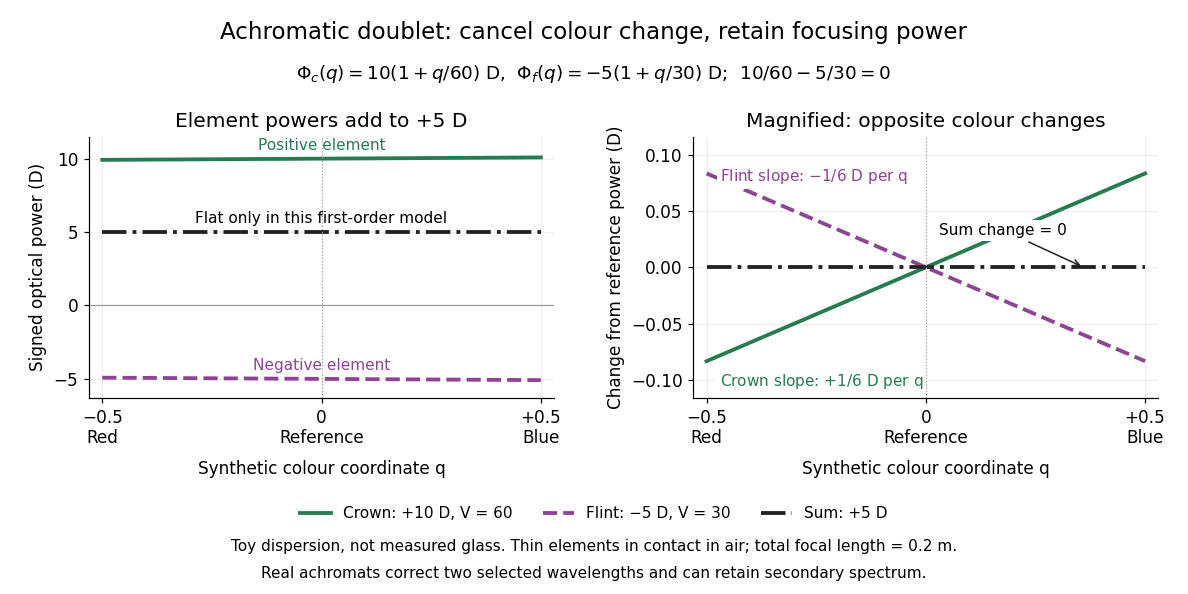

For specified nonzero reference optical power and distinct Abbe numbers, solving the two balance equations givesThus and require positive crown glass optical power and negative flint glass optical power. If the two finite Abbe numbers were equal, cancellation would force zero total optical power. If they are close, the required element optical powers become large compared with the total: cancelling primary colour can demand much stronger individual elements.
The contact assumption matters. For two thin lens elements separated by distance in air, the equivalent optical power is , evaluated at each wavelength; its colour change need not satisfy the contact balance. Finite thickness, departures from the paraxial approximation, and the secondary spectrum also limit the simple prediction.[ref]
Lecture Notes on Geometrical Optics. §J: Composite lenses
For a continuous function on , let be its dyadic slope martingale. Then is an absolutely continuous function if and only ifThis is exactly uniform integrability. The uniformly integrable martingale convergence theorem gives convergence in L1 , while their integrated linear interpolations converge uniformly to . Hence . Conversely, if has density , its slopes are , and the uniform integrability of conditional expectations proves the criterion. The dyadic tail integral is also the sum of the absolute endpoint increments in cells whose slope is at least in magnitude.
With structural-zero probability , size and count mean , the model assigns to zero and to positive counts. Its expectation is and its variance is , by the law of total variance. A logarithmic link function can relate the count-component mean to predictors.
If a discrete-time martingale deflator obeys for an affine process , unit zero-coupon bonds have exponential-affine prices. For one-step coefficients , the recursion is , , .
The unnormalized rotationally symmetric mode is . It describes balanced primary spherical aberration. The lower-degree terms make it orthogonal to constant piston and quadratic defocus under the disk area measure: direct integration gives and .
An adjoint scalar has adjoint covariant derivative . A symmetric invariant bilinear form on a Lie algebra contracts the gauge field strength and scalar kinetic terms to give gauge invariance. On a compact real form the positive internal metric is , because the Killing form itself is negative definite; complex scalar components require the associated Hermitian pairing. The Killing form is degenerate on Abelian factors, where another invariant metric is needed for a nondegenerate kinetic term.
For a real compact semisimple algebra, is a positive internal metric. With signature and connection , the healthy Lagrangian is . Gauge invariance follows from Killing-form invariance and . The physical Hamiltonian density is after imposing the Gauss law constraint in gauge theory and treating the spatial boundary flux appropriately. An Abelian factor needs a separate positive invariant metric because its Killing form vanishes.
Changing a finite generating set of a group changes individual distances, but it cannot introduce arbitrarily large relative distortion. For two finite symmetric generating sets of a group of the same group, setEach -letter can be replaced by at most -letters, and conversely each -letter by at most -letters. Applying these substitutions to shortest representatives of givesThus the identity map is a bilipschitz equivalence between the two word metrics, and hence a quasi-isometry. The constants depend on the chosen generating sets of a group.[ref]
In the Cayley graphs of the integers example, and give and : a unit move costs one in either alphabet, and a move of size two costs two unit moves. This recovers . The diamond and square in word metric balls in the integer lattice obey the same comparison, because .
Finiteness cannot simply be dropped from this universal statement. For the additive integers, take the infinite symmetric generating set of a group . Every nonzero displacement is a single allowed move, so whenever , whereas for . There is no finite with : choosing an integer violates it. This is a counterexample to unrestricted equivalence, not a claim that every infinite generating set of a group fails; two such sets with uniformly bounded generator lengths can still satisfy the same substitution bounds.[ref]
https://webusers.imj-prg.fr/~kathryn.mann/classes/GGRminicourse.pdf. Mann, remark after Proposition 1.2: bounded metric from allowing all elements
For a word metric from a finite generating set, the stable word length isSubadditivity and the Fekete lemma give the limit. Conjugating changes its length by at most a constant, so stable word length is conjugacy invariant. It satisfies . Finite-order elements have zero stable word length; in a hyperbolic group, every infinite-order element has positive stable word length.
The word length is the cost of building a group element from the allowed generators of a group. For a symmetric generating set of a group of a group , defineThe empty word over an alphabet represents the identity element and has length zero. A representative with this least number of letters labels a shortest graph path from to in the Cayley graph. Thus word length minimizes over all representatives, rather than counting the letters in whichever expression we happened to write down.[ref]
For the additive integers with , the expression has three letters but represents , whose word length is one. With , the integer has word length three, realized by . The Cayley graphs of the integers visualize why these are minimal. A freely reduced word is always shortest in a free group with its free generators and their inverses; free reduction alone need not give a shortest representative in a general group.
Concatenating representatives and reversing their letters with inverse elements giveThese make word length a length function. A finite gives finite word metric balls, since only finitely many words over an alphabet have length at most a fixed radius. The definition itself also works for infinite symmetric generating sets of a group; the bounded-metric example in equivalence of finite word metrics shows what finiteness adds.
A tidally enhanced stellar wind is a model in which a companion increases a giant's wind mass loss as the giant approaches its Roche lobe. Removing envelope mass before contact can reduce or reverse the mass ratio and make subsequent Roche-lobe overflow more stable. This is one proposed route to wide systems with Algol-like reversed evolutionary ordering. Van der Sluys's compact-binary study, section 5.7.1 discusses the enhanced-wind scenario and its effect on mass-transfer stability.
A cold nonrelativistic white dwarf supported by electron degeneracy pressure has a polytropic equation of state , so its polytropic index is . The Lane-Emden mass formula and polytropic mass-radius relation give at fixed composition. As density rises, relativistic corrections soften the exponent toward and lead toward the Chandrasekhar mass regime.
There are unlisted articles, also show them or only show them.