For a bilinear map , there is exactly one linear map satisfying . Equivalently, , where . The universal property of a tensor product concerns the vector space together with this distinguished bilinear map.[ref]
Linear Algebra Done Right by Sheldon Axler (4th edition). §9D, Theorem 9.79(a), printed p. 375: unique linear factorization
Here is a complete calculation over the real numbers. Define the bilinear mapIts values on pairs of basis vectors determine on the four tensor-product basis elements:Consequently, for ,For and , the direct calculation gives . Using the expansion of instead gives . The linear map also handles a nonseparable tensor such as : , even though no single pair has .
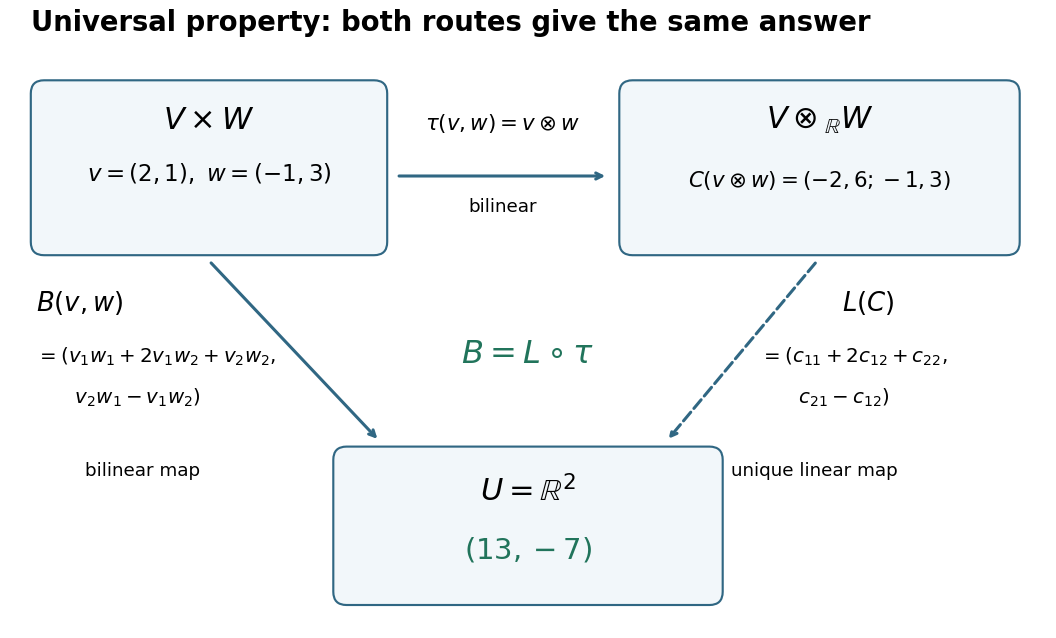

A short proof uses a tensor-product basis: assign and extend by linearity. Expanding both inputs verifies by bilinearity; the assigned values on a basis force uniqueness. More generally, every multilinear map factors uniquely through a linear map from . This lets formulas involving several inputs define linear maps without choosing coordinates; tensor contraction uses the evaluation pairing between a vector and a covector.
A tensor density of weight transforms like a tensor with an additional factor under . A scalar density of weight one can be integrated against the coordinate volume element to give an invariant integral. On a spatial hypersurface, is such a scalar density; hence is a tensor density when is an ordinary tensor. The Levi-Civita connection extends to densities and satisfies .
A second-rank Cartesian tensor is traceless when the contraction vanishes. For a symmetric second-rank tensor, this is equivalent to its eigenvalues summing to zero. The orientational nematic order parameter is both symmetric and traceless, excluding an isotropic scalar contribution.
With , the Fourier transform of a tempered distribution is defined byContinuity of the Fourier transform on the Schwartz space makes this well defined. For regular integrable functions, Fubini's theorem shows that it agrees with the ordinary transform. The inverse convention has factor and the positive exponential.
A sequence converges weakly to if for every Schwartz function . This is the weak-star topology of the continuous dual of the Schwartz space, and differs from choosing a strong dual topology defined by uniform convergence on bounded sets of test functions.
For a fixed closed oriented surface , a point is a marked Riemann surface , modulo biholomorphisms intertwining the markings up to homotopy. For , Fenchel–Nielsen coordinates give real dimension .
For nonzero holomorphic one-forms and holomorphic quadratic differentials, apply to every flat coordinate. Translation and sign transition maps remain of the same type, defining a new complex structure and differential. Composition gives a group action, zero orders persist and area is preserved. The zero section has no such atlas; fixing it gives only a set-theoretic extension that is generally discontinuous.
For a path family on a Riemann surface, take the supremum of over measurable conformal metrics of finite positive area. This is unchanged under conformal equivalence, and a quasiconformal map of maximal dilatation changes it by a factor between and .
A quasiconformal map whose Beltrami coefficient is for an integrable nonzero holomorphic quadratic differential and constant . In a flat coordinate for , it stretches the horizontal and vertical directions with ratio . Positive multiples of define the same coefficient.
Let be a sequence of finite real random variables, and write for its sample mean. For fixed and , put . Then, at each outcome,Consequently . The right-hand limit superior is a measurable function of for every , so the extended-real random variable is measurable with respect to the tail sigma-algebra. The same holds for the limit inferior. Thus the event of convergence to a finite limit of a sequence, and the event for any specified real , are tail events.
For a worked deterministic example, let alternate , and replace its first three entries by . For every the two sample means differ by exactly , so both converge to . Finite edits can change small-sample answers while preserving the infinite limit of a sequence.
Under independence, Kolmogorov's zero–one law makes each specified convergence event have probability zero or one. It does not select which value occurs. If a finite random variable measurable with respect to the tail sigma-algebra exists, the events for rational each have probability zero or one; continuity of probability and their nesting force to be constant almost surely. For fair independent Bernoulli trials, the strong law of large numbers establishes almost surely; the zero–one conclusion alone proves neither convergence nor the value .
If for and , then . Indeed the tail integral formula for moments gives ; split at . Clipping at one improves the constant compared with integrating the exponential bound alone.
A linear counterterm can be chosen so that the renormalized one-point function, or equivalently the chosen vacuum expectation value, is zero. This cancels attached tadpole diagrams in the perturbative expansion about that vacuum. In a massive six-dimensional cubic scalar field theory, the one-loop proper tadpole is ; without subtraction the stationary background shifts by at one-loop order. One must specify this convention when comparing reducible exchange diagrams or mass corrections.
An exact symplectic manifold has a symplectic form that is an exact differential form, written here . A positive-dimensional example without boundary cannot be compact, by the Generalized Stokes theorem applied to the top wedge product of differential forms.
The symplectic form on a -dimensional symplectic manifold determines the positive volume form and its total integral, the symplectic volume, using the induced orientation.
An isotropic submanifold has every tangent space an isotropic subspace of a symplectic vector space. Its dimension is at most half the ambient dimension, and equality makes it a Lagrangian submanifold.
A coisotropic submanifold satisfies , where the superscript denotes the symplectic orthogonal complement. Every hypersurface of a symplectic manifold is coisotropic.
The orientation-preserving symmetries of a cube are the signed permutation matrices with determinant one. There are of them. Their group action on the four body diagonals identifies this group with the symmetric group . Indeed choose diagonal directions , whose sum is zero and whose only linear relation has all coefficients equal. A rotation fixing every diagonal sends each direction to itself or its negative; the relation forces all four signs equal. All negative would give , which has determinant , so the kernel of a group homomorphism is trivial. Both groups have order 24, giving the identification. Its face permutations have cycle types , , , and , occurring times respectively.
Associate a transposition to each edge of a finite connected graph. For a simple path , let . Then , using rightmost-first composition. Thus edge transpositions generate every transposition, and hence the full symmetric group.
A cycle and a transposition generate the symmetric group exactly at coprime separation by  Codex 0 Created 2026-10-05 Updated 2026-10-14
For and , an -cycle and generate exactly when . Their conjugate transpositions connect labels differing by modulo . This graph is connected exactly at coprime separation, so transpositions on a connected graph generate the symmetric group. Otherwise residue classes modulo form a nontrivial block system preserved by both generators.
There are unlisted articles, also show them or only show them.