
Consider steady isentropic flow toward a Newtonian gravitational potential through a tube of cross-sectional area . Write for the inward speed and use a polytropic equation of state with specific-heat ratio . Mass conservation and the Euler equations for an inviscid fluid givewhere is the adiabatic sound speed. A regular sonic point therefore has and . The Bernoulli equation, matched to a nearly stationary reservoir with sound speed , givesFor , a finite positive sonic point requires . Differentiating the flow equation at that point, with , givesIts discriminant is , so the same bound permits real regular slopes. The branch on which the Mach number rises inward selects the negative sign inFor a spherical tube , this recovers the threshold of Bondi accretion; for a dipolar flux-tube area, gives . The tube approximation must remain valid between the reservoir matching region and the accretor.
Cut equal straight slits in two translation surfaces of genus one and cross-glue their banks by translation. The connected sum of oriented manifolds has genus two and two cone points of angle , hence two simple zeros of its holomorphic one-form. Choosing one torus of side and a slit of length creates a flat-small handle without forcing its generator to have small extremal length.
A transitive subgroup for prime that contains a transposition is . Form a graph on the letters with edges given by all conjugates in of that transposition. The transitive action permutes connected components, so their common size divides . An edge rules out size one, hence the graph is connected. Its edge transpositions generate : successive swaps along a path generate the swap of its endpoint with any chosen start. All these edge transpositions belong to .
An order automorphism of a total order is a bijection such that if and only if . Composition and inverses are again order automorphisms. Transporting the indices of an order-indiscernible sequence by such a map preserves every first-order formula on increasing finite tuples.
A solid torus is the product of a circle with a closed disk. Its boundary is the torus . It deformation retracts onto its central circle, so its degree-one de Rham cohomology is one dimensional and injects into that of its boundary.
On the torus , an integer matrix defines an endomorphism. The coordinate circles give a basis of the first homology group, and the induced map on that group is . The Künneth theorem identifies higher integral homology with the exterior powers of , so the degree- map is . In top degree it is multiplication by . The map is a homeomorphism precisely when is a unimodular matrix; a merely nonsingular integer matrix need not have an integer inverse.
For a two-sided ideal of a ring , the powers form a neighborhood base at zero for the adic topology. For an -module , use on the left or on the right. Convergence means that for every the differences eventually belong to the corresponding submodule. The formal power series ring and formal power series module are complete for ; convergence fixes each finite list of coefficients eventually. This is formal convergence, without an analytic condition on the size of coefficients.
A depth discontinuity between two constant-depth rotating layers supports an exponentially trapped Rossby wave. Continuity of surface height and cross-step volume flux gives , where and positive roots give decay. For with , the low-frequency branch has . In the Northern Hemisphere it propagates with the shallow side on its right.
This range condition puts the exact solution in the operator range of the adjoint operator. It controls the small-singular value components of the solution and supplies convergence rates for spectral regularization methods. It is the quadratic-penalty case of a source condition in variational regularization.
Synchronous rotation means one prograde turn about the body's own axis per orbital period, measured against fixed directions in an inertial frame. This spin-orbit resonance approximately describes the Moon's synchronous rotation toward Earth. [ref].
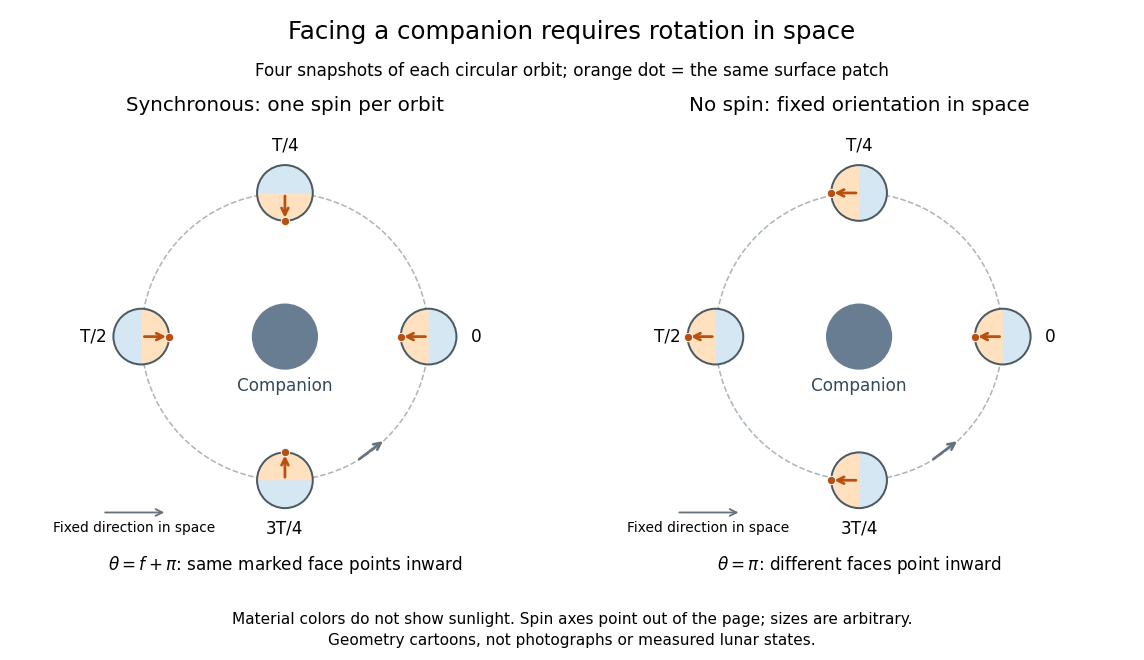

The striking geometric idea is that one turn in space can keep one face toward the companion: a fixed orientation in the frame turning with the orbit is a changing orientation in an inertial frame. This distinction helps us predict illumination: a synchronously rotating exoplanet orbiting its illuminating star can have persistent day and night hemispheres, whereas the Moon, synchronized to Earth, receives changing illumination from a different body, the Sun.
A genus- handlebody is a three-ball with one-handles attached. Its boundary is a closed orientable topological surface of genus .
A Heegaard splitting divides a closed three-manifold into two handlebodies with common boundary. For a three-manifold with boundary, one uses compression bodies, which can retain negative boundary components.
An incompressible surface is a properly embedded two-sided topological surface with no compressing disk, subject to the usual exclusion of inessential spherical components. A compressing disk has boundary an essential closed curve on the topological surface and interior disjoint from it.
In a log-pressure coordinate, quasi-geostrophic potential vorticity uses density-weighted vertical stretching. For stratification and geostrophic flow , the inviscid equation is . Combining horizontal vorticity balance with the thermal equation eliminates ageostrophic flow and gives this conservation law.
Potential-vorticity inversion recovers a balanced velocity field from potential vorticity and specified boundary and global data. In two-dimensional vortex dynamics this is a Poisson equation; shallow-water quasi-geostrophic inversion and stratified quasi-geostrophic inversion use different elliptic boundary value problems. Advance the materially conserved scalar, then invert again to recover the evolving flow. Boundary buoyancy can induce flow with zero interior anomaly. The balance relation and boundary conditions are essential: unrestricted gravity waves are additional degrees of freedom. McIntyre's potential-vorticity account explains the general invertibility principle.
The lensmaker's equation connects focal length to the refractive index and shape of a thin lens. For a thin lens in air with surfaces shaped as parts of spheres, refractive index , and incident light travelling to the right,Each signed radius of curvature is positive when its centre of curvature lies to the right of that surface, and negative when it lies to the left. A symmetric biconvex thin lens with , , and therefore has , giving and optical power . This is an ideal shape example consistent with the thin lens diagrams, not a specification of their finite thickness.
In a uniform surrounding medium of refractive index on both sides, replace by . Thus the same shape reverses its focusing sign if its refractive index is lower than its surroundings: for and , the same radii give , or . Positive focal length therefore cannot be inferred from convex shape in every environment. A proof outline applies Snell's law with the small-angle approximation at each surface, adds their direction changes, and neglects the distance between them. [ref].
The Bessel lens displacement method measures a converging thin lens's focal length by moving only the optical lens between a fixed object and screen. If their separation is , two settings give sharp real images: one enlarged, the other reduced. Read their separation on an optical bench, then calculateThe two settings exchange object and image distances, so their signed transverse magnifications are reciprocals. This makes the experiment a visible test of conjugate optical planes as well as a focal length measurement.[ref]
For an original stipulated example, put the object at , the screen at , and take an ideal thin lens with . Its two settings are and , with . The transverse magnifications are and : both real images are inverted. An object tall would give signed image heights and . Conversely, stipulated readings and give . These are model calculations, not measured data or a manufacturer's calibration.
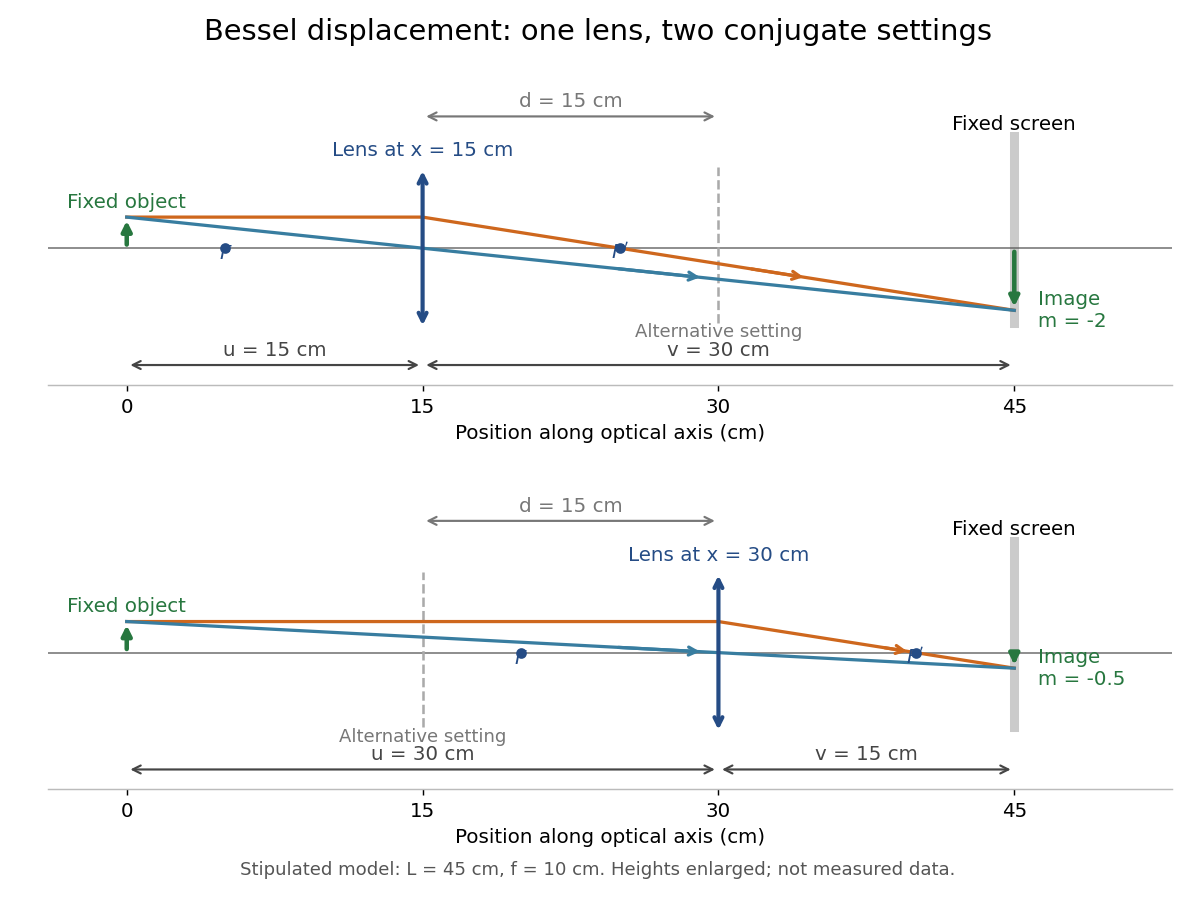

A fixed offset between a carrier's reference mark and an ideal thin lens plane cancels when subtracting the two carrier readings. That useful cancellation does not make a thick lens equivalent to one unknown optical centre: its two principal planes can be separated. The Bessel lens displacement experiment below makes this limitation explicit.
A tensor-product wavelet is a product of one-dimensional wavelets and scaling functions, with at least one wavelet factor. In two dimensions, the three simultaneous-scale types are , and . Their translates and normalized dilates form a tensor-product wavelet basis.
A finite-length smooth curve meets supports of localized two-dimensional wavelets at scale . For a bounded function, their coefficients are , so their total squared energy at that scale is . Keeping these coefficients through level uses terms and leaves squared error . Polynomial cancellation, or adequate approximation of the remaining smooth regions, therefore gives best N-term approximation squared error .
If and are bases of finite-dimensional vector spaces over , then the products form a basis of . There is one independent coordinate for every pair of indices.[ref]
Linear Algebra Done Right by Sheldon Axler (4th edition). §9D, Theorems 9.72 and 9.74, printed pp. 372–373: dimension and tensor-product basis
For a proof outline, bilinearity expands each pure tensor asso these products form a spanning set. For linear independence, take the coordinate functionals from the two dual bases. The bilinear map induces a linear functional on the tensor product, satisfying . Applying it to a proposed zero linear combination selects just , forcing every coefficient to vanish. Thus dimensions multiply, rather than add. This finite-dimensional count includes a zero factor, whose tensor product has dimension zero.
There are unlisted articles, also show them or only show them.