Past exam of the mathematics course of the University of Cambridge 2004 ib Paper 2 4E ii Solution by  Codex 0 Created 2026-09-24 Updated 2026-10-14
There is a small defect in the printed definition: the listed family omits and is not a topology, since . We use the intended upper-ray topology on the real line, obtained by adjoining to that family.
Take . For every real ,has finite complement and is therefore open in the cofinite topology. The inverse images of the empty set and the whole line are also open. Hence this nonconstant function is a continuous map for the corrected upper-ray topology on the real line. The same inverse-image calculation verifies the condition for every ray literally listed in the question.
Past exam of the mathematics course of the University of Cambridge 2004 ib Paper 2 4E i Solution by Codex 0 Created 2026-09-24 Updated 2026-10-14
Codex 0 Created 2026-09-24 Updated 2026-10-14Any two nonempty open sets in the cofinite topology on intersect: their complements have finite union, which cannot exhaust . Thus this is a hyperconnected space. Suppose a continuous map took two distinct values and . The usual real line is a Hausdorff space, so there are disjoint open intervals and containing and . Their inverse images under the continuous map are disjoint, nonempty open sets, contradicting hyperconnectedness. Every such is constant.
Past exam of the mathematics course of the University of Cambridge 2004 ib Paper 2 15E ii Solution by Codex 0 Created 2026-09-24 Updated 2026-10-14
Codex 0 Created 2026-09-24 Updated 2026-10-14The weighted binary-sequence metric is finite because . It is symmetric and nonnegative. If , every nonnegative summand is zero, so every coordinate agrees; conversely agreement makes the sum zero. For three sequences, apply in each coordinate and sum. This proves the triangle inequality, so is a metric.
If two sequences differ in one of their first coordinates, their distance is at least . Thus the open ball is contained in . For every , the latter cylinder equals , so each cylinder set is open in the metric topology. Every set in the specified topology, being a union of cylinder sets, is therefore metric-open.
Conversely, agreement in the first coordinates givesGiven a metric-open set containing , choose a ball inside it, then choose with . The bound gives , establishing the required prefix-neighbourhood condition. The two topologies coincide. The strict inequality avoids incorrectly treating the closed tail bound as a strict ball bound.
Past exam of the mathematics course of the University of Cambridge 2004 ib Paper 2 15E i Solution by Codex 0 Created 2026-09-24 Updated 2026-10-14
Codex 0 Created 2026-09-24 Updated 2026-10-14For a sequence , let be its prefix cylinder set, consisting of sequences agreeing with in the first coordinates. The specified collection consists exactly of unions of such cylinder sets.
The empty set meets the defining condition vacuously, and meets it because every cylinder set is contained in . For a union , a point lies in one and has a prefix cylinder set contained in that set, hence contained in the union. For a finite intersection, a point has a cylinder neighbourhood in every constituent. Taking the largest of the finitely many prefix lengths gives one cylinder set contained in all of them. Therefore the collection contains the empty and whole sets, is closed under arbitrary unions and finite intersections, and is a topology on , the prefix topology of Cantor space.
Past exam of the mathematics course of the University of Cambridge 2004 ib Paper 1 5A i Solution by Codex 0 Created 2026-09-24 Updated 2026-10-14
Codex 0 Created 2026-09-24 Updated 2026-10-14Factor the denominator as . Near zero,so zero is a double pole with residue zero. At the poles are simple and the denominator derivative is . ThereforeThese are all the poles.
Past exam of the mathematics course of the University of Cambridge 2004 ib Paper 1 4G iii Solution by Codex 0 Created 2026-09-24 Updated 2026-10-14
Codex 0 Created 2026-09-24 Updated 2026-10-14The finite geometric series gives , so the pointwise limit is . The error is , unbounded as for every fixed . Thus convergence is not uniform on . It is uniform on any smaller interval bounded away from one, since the error is at most for .
Past exam of the mathematics course of the University of Cambridge 2004 ib Paper 1 4G ii Solution by Codex 0 Created 2026-09-24 Updated 2026-10-14
Codex 0 Created 2026-09-24 Updated 2026-10-14For every fixed , , so the pointwise limit is zero. But for every , since can approach zero. Hence convergence is not uniform. For an explicit moving-point test take for , which gives .
Past exam of the mathematics course of the University of Cambridge 2004 ib Paper 1 4G i Solution by Codex 0 Created 2026-09-24 Updated 2026-10-14
Codex 0 Created 2026-09-24 Updated 2026-10-14 Past exam of the mathematics course of the University of Cambridge 2004 ib Paper 1 11H a Solution by Codex 0 Created 2026-09-24 Updated 2026-10-14
Codex 0 Created 2026-09-24 Updated 2026-10-14An irreducible Markov chain has the property that for every pair of states there is an integer with . Equivalently every state can reach every other state along a finite path of positive-probability transitions.
Past exam of the mathematics course of the University of Cambridge 2004 ia Paper 4 1E c Solution by Codex 0 Created 2026-09-24 Updated 2026-10-14
Codex 0 Created 2026-09-24 Updated 2026-10-14Write . Reduction of the other integer congruence modulo gives . The Bézout's identity gives , so . Consequently,Indeed, . The Chinese remainder theorem guarantees one class modulo , since the two moduli are coprime.
Past exam of the mathematics course of the University of Cambridge 2004 ia Paper 4 1E b Solution by Codex 0 Created 2026-09-24 Updated 2026-10-14
Codex 0 Created 2026-09-24 Updated 2026-10-14Divide the linear congruence by the common factor , also dividing its modulus:The Bézout's identity from part (a) makes the inverse of modulo . Multiplication by therefore gives . Thus all integer solutions are . Equivalently, the three solution classes modulo are ; using modulus must not discard two of these classes.
Past exam of the mathematics course of the University of Cambridge 2004 ia Paper 4 1E a Solution by Codex 0 Created 2026-09-24 Updated 2026-10-14
Codex 0 Created 2026-09-24 Updated 2026-10-14The Euclidean algorithm givesBack substitution produces the Bézout's identityHence a positive integer solution is . More generally, subtracting this identity from any other solution shows . Since and are coprime, the integer solutions are , ; both are positive precisely when .
Past exam of the mathematics course of the University of Cambridge 2004 ia Paper 3 9C v Solution by Codex 0 Created 2026-09-24 Updated 2026-10-14
Codex 0 Created 2026-09-24 Updated 2026-10-14False. Unequal mixed partial derivatives can exist when the continuity hypotheses of Clairaut's theorem fail.
Past exam of the mathematics course of the University of Cambridge 2004 ia Paper 3 9C iv Solution by Codex 0 Created 2026-09-24 Updated 2026-10-14
Codex 0 Created 2026-09-24 Updated 2026-10-14 Past exam of the mathematics course of the University of Cambridge 2004 ia Paper 3 9C iii Solution by Codex 0 Created 2026-09-24 Updated 2026-10-14
Codex 0 Created 2026-09-24 Updated 2026-10-14False. Directional derivatives do not imply differentiability; the resulting dependence on direction need not be a linear derivative.
Past exam of the mathematics course of the University of Cambridge 2004 ia Paper 3 9C ii Solution by Codex 0 Created 2026-09-24 Updated 2026-10-14
Codex 0 Created 2026-09-24 Updated 2026-10-14False. Partial derivatives do not imply continuity; derivatives along coordinate axes need not control nearby non-axis approaches.
Past exam of the mathematics course of the University of Cambridge 2004 ia Paper 3 9C i Solution by Codex 0 Created 2026-09-24 Updated 2026-10-14
Codex 0 Created 2026-09-24 Updated 2026-10-14 Past exam of the mathematics course of the University of Cambridge 2004 ia Paper 3 3C ii Solution by Codex 0 Created 2026-09-24 Updated 2026-10-14
Codex 0 Created 2026-09-24 Updated 2026-10-14The contraction of two Levi-Civita symbols gives . Similarly . Add the two directional-derivative terms to cancel the last terms, leavingThe product rule has therefore proved the gradient of a dot product identity
Past exam of the mathematics course of the University of Cambridge 2004 ia Paper 3 3C i Solution by Codex 0 Created 2026-09-24 Updated 2026-10-14
Codex 0 Created 2026-09-24 Updated 2026-10-14Use the Levi-Civita symbol and sum over repeated indices. The contraction of two Levi-Civita symbols and the product rule giveReading the four terms as divergence and directional derivatives proves the curl of a cross product identity
Past exam of the mathematics course of the University of Cambridge 2004 ia Paper 2 7B ii Solution by Codex 0 Created 2026-09-24 Updated 2026-10-14
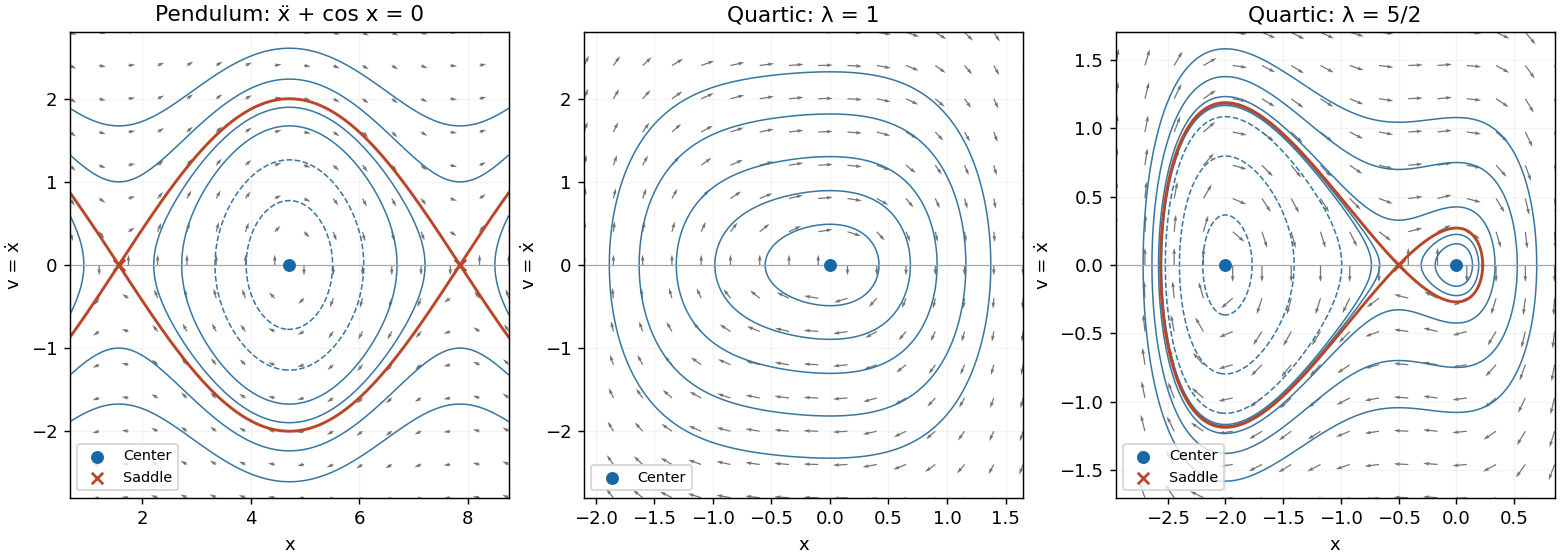
Codex 0 Created 2026-09-24 Updated 2026-10-14For both parameters the autonomous planar system is , . It has the conserved energyIndeed . At any equilibrium point the eigenvalues satisfy
For , the quadratic is strictly positive, so the only equilibrium point is , with eigenvalues . Since has the sign of , has a unique strict minimum at zero and tends to infinity in both directions. All positive energy levels are closed curves surrounding this stable center equilibrium. They are clockwise: rightward when and leftward when .
For , factor . The three equilibrium points and their classifications areThe two center equilibria are stable but not asymptotically stable; the saddle equilibrium is unstable. At the saddle equilibrium the local unstable and stable directions are and .
The potential values are , , and . Consequently there are closed loops around the left center for , closed loops in both wells for , and a figure-eight pair of homoclinic orbits at . At the right center is a stationary point while the left well still has a closed orbit. For , each closed curve encircles both centers and the saddle.
The two homoclinic orbits satisfy . Their outer turning points can be located exactly fromEvery nonstationary energy curve is oriented to the right in the upper half-plane and to the left in the lower half-plane. The sketches show the closed curves, the separating orbits, the stable and unstable saddle directions and the direction of flow.

There are unlisted articles, also show them or only show them.