Past exam of the mathematics course of the University of Cambridge 2003 ib Paper 4 15G a Solution by  Codex 0 Created 2026-09-24 Updated 2026-10-14
The zero-composition subspaces of a linear map are subspaces because the defining equations are homogeneous linear equations in : they hold for the zero map and are preserved by addition and scalar multiplication. A map with vanishes on , so it factors uniquely through the quotient vector space . Conversely every map from that quotient to gives such a . ThereforeThe condition says exactly that the image of lies in . ConsequentlyBoth dimension formulas use the fact that the space of maps between spaces of dimensions has dimension : matrix units in any chosen bases supply a basis.
Past exam of the mathematics course of the University of Cambridge 2003 ib Paper 4 13E d Solution by Codex 0 Created 2026-09-24 Updated 2026-10-14
Codex 0 Created 2026-09-24 Updated 2026-10-14Let count roots in the open unit disk. A boundary crossing can occur only at the real values found above, so the count is constant between them. Also , because the polynomial is odd. At , has one root inside and four on the circle, giving .
For small positive , the root near zero stays inside. At each boundary root , , so implicit differentiation gives . The radial crossing test for polynomial root counts isThe two roots with positive real part enter and the other two leave. Hence for .
At , the boundary roots are . Since , their radial derivative is . Both leave as increases, so the count becomes one; at itself they are excluded, also leaving one interior root. At , the remaining boundary root has radial derivative and leaves. For no interior root is possible, since in the open disk. Combining these facts and odd symmetry givesThis also gives the corresponding winding numbers of the image contour away from its crossings. Boundary roots are excluded at the crossing values; using a nearby winding number at would incorrectly count two extra roots.
Past exam of the mathematics course of the University of Cambridge 2003 ib Paper 4 13E c Solution by Codex 0 Created 2026-09-24 Updated 2026-10-14
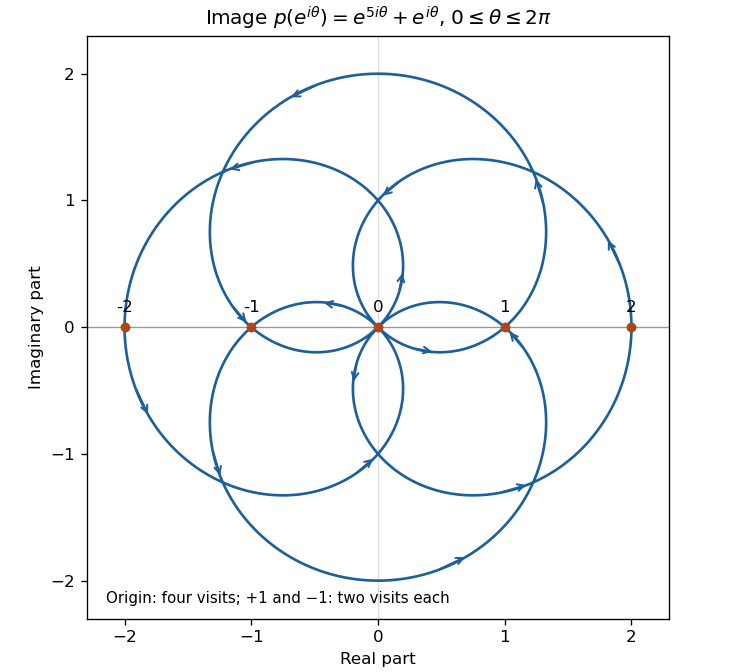
Codex 0 Created 2026-09-24 Updated 2026-10-14The image contour has polar representation . It is invariant under complex conjugation and under reflection through the origin. As runs from zero to , the successive real-axis visits areat angles . To specify the crossing direction, differentiate:Its imaginary component is at the point , at , at either visit to , and at either visit to . At a visit to zero it is , nonzero for each of the four angles. Therefore all these visits are transverse crossings of the real axis, even though different arcs share the same image point.
Past exam of the mathematics course of the University of Cambridge 2003 ib Paper 4 13E b Solution by Codex 0 Created 2026-09-24 Updated 2026-10-14
Codex 0 Created 2026-09-24 Updated 2026-10-14Write . The trigonometric sum formulas giveThus the imaginary part is zero either when , , or when , . These two lists are disjoint. At the latter four points . At the former six points the real values, in increasing angular order, areEquivalently, maps to , to , to , to , and the four roots of map to zero. These are all the unit-circle points with real image.
Past exam of the mathematics course of the University of Cambridge 2003 ib Paper 4 13E a Solution by Codex 0 Created 2026-09-24 Updated 2026-10-14
Codex 0 Created 2026-09-24 Updated 2026-10-14For a closed piecewise smooth contour in a domain, null-homologous there and avoiding the poles of a meromorphic function , the residue theorem iswhere is the winding number and the sum runs over enclosed poles with their indices. Suppose now is meromorphic and has neither zeros nor poles on . At a zero or pole , write with holomorphic and nonzero, where for a zero and for a pole. Thenso its residue is . Substituting into the residue theorem and changing variables along the image contour gives the argument principle:For a positively oriented simple boundary, this is the number of zeros minus poles inside, counted with multiplicity. The winding-number form also applies to self-intersecting image paths.
Past exam of the mathematics course of the University of Cambridge 2003 ib Paper 4 11D b Solution by Codex 0 Created 2026-09-24 Updated 2026-10-14
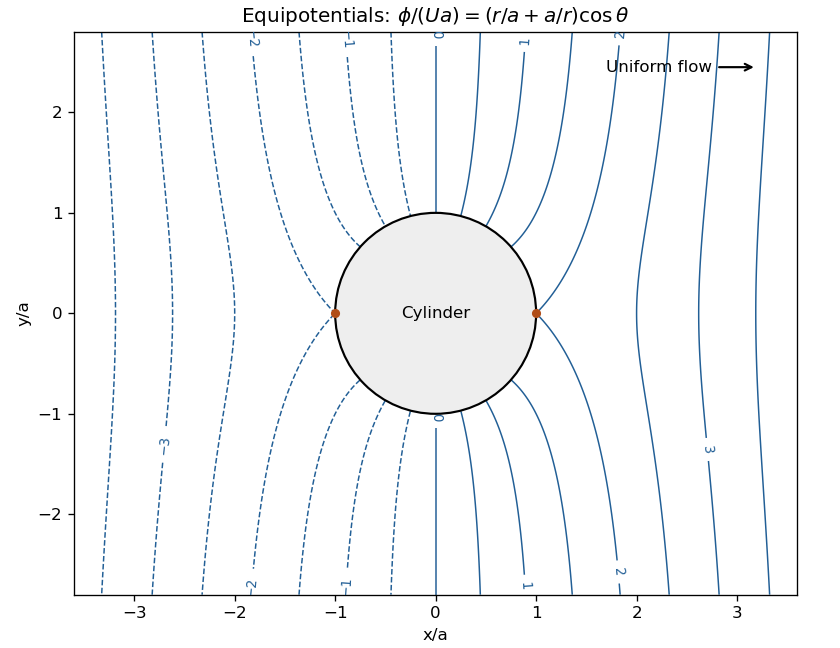
Codex 0 Created 2026-09-24 Updated 2026-10-14The far-field derivative fixes the growing cosine coefficient to and removes all other growing modes. The possible logarithmic term has derivative at the wall, so the zero wall derivative removes it. For each decaying Fourier mode, the wall condition relates its coefficient to its growing partner: the cosine partner has coefficient , and every other partner vanishes. Thus the potential flow around a circular cylinder hasIndeed, , which is zero at and tends to at infinity. The additive constant does not change the velocity. The equipotential curves satisfy . They approach vertical straight lines far away and meet the cylinder radially wherever the tangential velocity is nonzero. The two stagnation points are at .


Past exam of the mathematics course of the University of Cambridge 2003 ib Paper 4 11D a Solution by Codex 0 Created 2026-09-24 Updated 2026-10-14
Codex 0 Created 2026-09-24 Updated 2026-10-14Use separation of variables, . After multiplying the Laplace equation by , the two separated equations areSingle-valuedness requires -periodicity. Thus the nonconstant angular modes have , , and angular factors . Their radial factors are . The zero mode has constant angular factor and radial solution ; a term proportional to would be multivalued.
Finiteness at the origin removes the logarithm and negative powers. In the disk the general regular harmonic expansion isFor the exterior, regularity at every finite radius allowsCoefficients must give convergent harmonic expansions on the domain and the intended boundary regularity at . If “finite” is intended to mean bounded as , then and only the constant and decaying modes remain. Infinity is not included in the printed interval; moreover part (b)'s uniform background flow necessarily has an unbounded potential. Stating both interpretations avoids discarding that background mode.
Past exam of the mathematics course of the University of Cambridge 2003 ib Paper 3 6B b Solution by Codex 0 Created 2026-09-24 Updated 2026-10-14
Codex 0 Created 2026-09-24 Updated 2026-10-14At a simple root of a polynomial of , differentiating the product gives . Consequently the Lagrange basis polynomials can be writtenDivide the polynomial interpolation identity from part (a) by , at points outside the nodes. This gives the partial fraction decompositionEvery denominator of is simple, and the rational function is proper because , so no polynomial part is missing.
Past exam of the mathematics course of the University of Cambridge 2003 ib Paper 3 6B a Solution by Codex 0 Created 2026-09-24 Updated 2026-10-14
Codex 0 Created 2026-09-24 Updated 2026-10-14The Lagrange basis polynomials satisfy : for , the product has a zero factor, whereas for every factor is one. The polynomialhas degree of a polynomial at most and has distinct roots of a polynomial. The root bound for a polynomial implies . Hence the interpolation identity holds for every polynomial of degree at most .
Past exam of the mathematics course of the University of Cambridge 2003 ib Paper 3 3E b Solution by Codex 0 Created 2026-09-24 Updated 2026-10-14
Codex 0 Created 2026-09-24 Updated 2026-10-14The composition is an entire function, andBy Liouville's theorem, is constant. Since the exponential function never vanishes,Thus is constant. Notice that constancy of an exponential alone need not be inverted by choosing a global logarithm; differentiating supplies the conclusion directly.
Past exam of the mathematics course of the University of Cambridge 2003 ib Paper 3 3E a Solution by Codex 0 Created 2026-09-24 Updated 2026-10-14
Codex 0 Created 2026-09-24 Updated 2026-10-14Fix any . The Cauchy estimate on the circle applies for every because is an entire function. It givesTherefore . Since was arbitrary and is connected, is constant. This is the sublinear case of the polynomial growth theorem for entire functions.
Past exam of the mathematics course of the University of Cambridge 2003 ib Paper 3 19G d Solution by Codex 0 Created 2026-09-24 Updated 2026-10-14
Codex 0 Created 2026-09-24 Updated 2026-10-14Take any positive definite inner product on and define the inner product adapted to an idempotent linear mapIt is symmetric and bilinear. If its quadratic value at is zero, positive definiteness of the original inner product forces both and , hence . Thus it is positive definite.
Using and givesThe map is therefore self-adjoint for this new inner product and remains idempotent, so it is an orthogonal projection for the explicitly constructed inner product. Geometrically the construction makes its complementary kernel and image orthogonal.
Past exam of the mathematics course of the University of Cambridge 2003 ib Paper 3 19G c Solution by Codex 0 Created 2026-09-24 Updated 2026-10-14
Codex 0 Created 2026-09-24 Updated 2026-10-14The finite-dimensional inner product space has the orthogonal decomposition . Define for , . This is a linear map with image , satisfies , and is self-adjoint by taking inner products between decomposed vectors. Hence it is an orthogonal projection.
Any other orthogonal projection with image has kernel by part (a); it is identity on by idempotence and zero on its kernel. Its values are therefore forced to agree with , proving uniqueness.
Past exam of the mathematics course of the University of Cambridge 2003 ib Paper 3 19G b Solution by Codex 0 Created 2026-09-24 Updated 2026-10-14
Codex 0 Created 2026-09-24 Updated 2026-10-14For a normal operator , the adjoint operator identity and givePositive definiteness implies . Also , since orthogonality to every means for every . In finite dimension this gives .
The idempotent linear map decomposes as in part (a), now orthogonally, and acts as zero on its kernel and identity on its image. Writing and in these orthogonal summands,Thus is self-adjoint, and together with idempotence this proves is an orthogonal projection.
Past exam of the mathematics course of the University of Cambridge 2003 ib Paper 3 19G a Solution by Codex 0 Created 2026-09-24 Updated 2026-10-14
Codex 0 Created 2026-09-24 Updated 2026-10-14For any idempotent linear map , each vector decomposes asIf , write ; then . Thus the kernel of a linear map and image of a linear map give a direct sum.
For the self-adjoint map in the question, and satisfy . Hence the direct sum is an orthogonal decomposition:
Past exam of the mathematics course of the University of Cambridge 2003 ib Paper 3 16B b Solution by Codex 0 Created 2026-09-24 Updated 2026-10-14
Codex 0 Created 2026-09-24 Updated 2026-10-14Differentiating the Rodrigues representation directly gives the identityWe prove simultaneously by induction that for . It holds for , . Suppose it holds at . Differentiating the preceding identity and using the same identity at givesThe induction is complete. Substituting the derivative identity into the first formula proves the Hermite polynomial three-term recurrence relationThe initial step supplies the recurrence at without needing to define .
Past exam of the mathematics course of the University of Cambridge 2003 ib Paper 3 16B a Solution by Codex 0 Created 2026-09-24 Updated 2026-10-14
Codex 0 Created 2026-09-24 Updated 2026-10-14Repeated differentiation of the Gaussian function gives , where and . Induction shows has degree of a polynomial and leading coefficient : the differentiated term has lower degree, while multiplication by raises it by one. Thus the Hermite polynomial has degree and leading coefficient .
For , apply integration by parts times to the Rodrigues expression:All boundary terms vanish because each derivative of is a polynomial times that exponential, and such products tend to zero at either infinity. The same result for follows by symmetry of the inner product. The diagonal value is positive; indeed givesThis proves the requested orthogonality as well as its normalization.
Past exam of the mathematics course of the University of Cambridge 2003 ib Paper 3 13E e Solution by Codex 0 Created 2026-09-24 Updated 2026-10-14
Codex 0 Created 2026-09-24 Updated 2026-10-14Let have the stated zeros but not be identically zero. The origin is an isolated singularity. If it were a removable singularity, the extended holomorphic function would have zeros accumulating at an interior point. The proof in part (c) would force the extension, and then on its domain, to be identically zero.
If the origin were a pole of order , then would have a holomorphic extension with . Continuity would make nonzero on a small disc, so would have no zeros in its punctured disc, again a contradiction. The classification of isolated singularities leaves only an essential singularity at the origin. This argument applies to every function in part (d), not just the particular sine example.
Past exam of the mathematics course of the University of Cambridge 2003 ib Paper 3 13E d Solution by Codex 0 Created 2026-09-24 Updated 2026-10-14
Codex 0 Created 2026-09-24 Updated 2026-10-14Take the analytic functionIt vanishes at for every positive integer , but , so it is not identically zero. The identity theorem does not apply at the accumulation point , because that point lies outside the domain.
Past exam of the mathematics course of the University of Cambridge 2003 ib Paper 3 13E c Solution by Codex 0 Created 2026-09-24 Updated 2026-10-14
Codex 0 Created 2026-09-24 Updated 2026-10-14Put . Choose a disc about contained in the domain . Part (a) gives a convergent Taylor series there, and the accumulating zeros together with part (b) force all its coefficients to vanish. Thus near .
To propagate this to the entire domain, defineThe set is nonempty by the preceding local argument. Each derivative is continuous, so is closed relative to as the intersection of their zero sets. If , its Taylor series is zero on a disc about , and all derivatives vanish throughout that disc; hence is open relative to . Connectedness forces . Therefore throughout , proving the identity theorem for holomorphic functions rather than merely invoking it.
There are unlisted articles, also show them or only show them.