The cofinite topology on a set declares the empty set and all cofinite subsets to be open sets: a nonempty open set may exclude only a finite set of points. There is no assumed metric. On an infinite set, this gives a particularly small collection of open sets while still making every singleton a closed set. On a finite set, every subset has finite complement, so the cofinite topology is the discrete topology.[ref]
For an original example, use and chooseBoth are open sets, and their intersection is . Thus are in both. Their finite exclusions cannot separate the infinite remainder. The finite intersection of any finite collection of nonempty open sets is again a nonempty open set, since its complement is a finite union of finite sets. An arbitrary nonempty union is open because its complement is contained in the finite complement of any one nonempty member.
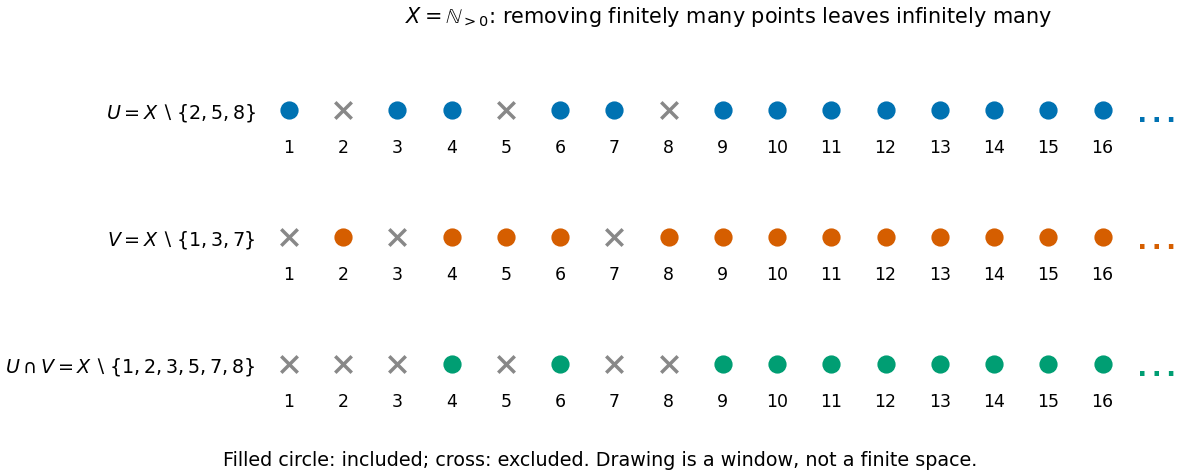
Two open sets with finite exclusions still overlap in an infinite cofinite topology
. Original sets on . Only the first sixteen labels are drawn; the dots continue indefinitely and are all included after the last excluded label. Spacing is for readability and defines no metric. Filled circles belong to the displayed set; crosses are excluded. Details.
The cofinite topology is useful for separating hypotheses that familiar metric spaces package together. An infinite cofinite topological space is a T1 space, because its singletons are closed, but is not a Hausdorff space, because two nonempty open sets cannot be disjoint sets. It is a hyperconnected space and hence a connected space. Moreover, every subset of a cofinite space is compact, and sequence convergence in the cofinite topology can have many limits. These are compatible properties, rather than contradictions: the usual uniqueness and closedness results use the Hausdorff space hypothesis.[ref]
Chapter 1: Topological spaces. Example 1.5.10 and Proposition 1.5.11: closed points, overlapping neighbourhoods, non-repeating sequences and uniqueness in Hausdorff spaces
Let be the underlying set of real numbers with the cofinite topology. The diagonal in with its subspace topology is homeomorphic to the usual real line. Indeed, is a continuous bijection: its first coordinate is continuous because usual finite sets are closed, and its second coordinate is the identity. The inverse is the second coordinate projection restricted to . Consequently is not compact, whereas is compact by the fact that every subset of a cofinite space is compact. Thus is not homeomorphic to .
For a set with its cofinite topology, a subset is a connected subset exactly when is empty, a singleton, or infinite. Indeed, its subspace topology is the cofinite topology on : the traces of open sets are precisely for finite , together with the empty set. For infinite , two nonempty open sets intersect, because their complements have finite union. Hence is a hyperconnected space and therefore a connected space. A finite has the discrete topology, which admits a separation of a topological space as soon as has at least two points.
For an infinite set with its cofinite topology, every infinite subset is connected, but has an infinite disconnected topological subspace. Choose and use . The open sets and have disjoint nonempty traces and on , covering it. Thus is a product of a discrete two-point subspace with an infinite cofinite factor. The ambient open rectangles may intersect; only their traces must be disjoint for a separation of .
By convergence of a sequence in a topological space, means that every open neighbourhood of contains all sufficiently late terms. In the cofinite topology, this is equivalent to the condition that, for every , the value occurs only finitely often. Necessity uses the open neighbourhood ; sufficiency chooses an index beyond every last occurrence of the finitely many points excluded by a given open neighbourhood.
Consequently a sequence with distinct terms converges to every point of . For the original choice on , take the two open neighbourhoodsAll terms with lie in and all terms with lie in . More generally, each finite excluded set has a last visit, so and , and in fact for every . No numerical distance is tending to zero here; the open sets specify the meaning of convergence.
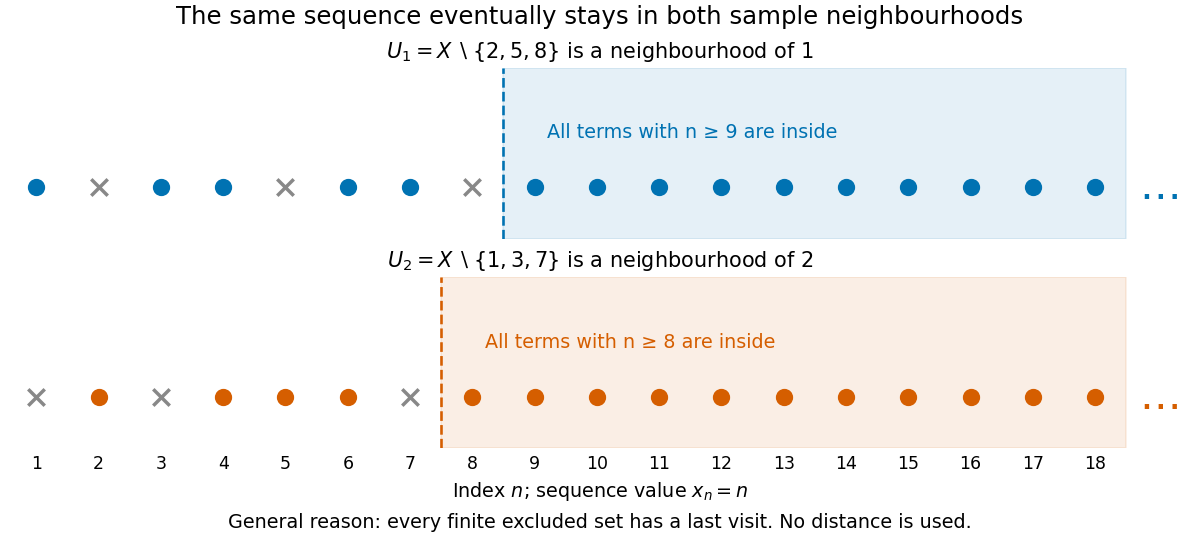
The same sequence eventually stays in neighbourhoods of two different limits
. Original sequence in the cofinite topology. Two sample neighbourhoods have different finite exclusions and different last-visit indices. Their memberships illustrate the general finite-exclusion argument; testing just these two neighbourhoods would not by itself prove convergence. Details.
Distinct terms are sufficient, not necessary. The sequence also converges to every point, since each value occurs only twice. By contrast, the constant sequence converges only to : an open neighbourhood of any can exclude . The alternating sequence converges to no point, since some value different from any proposed limit occurs infinitely often.
Every subset of a cofinite topological space is a compact subset. To see the finite reduction directly, take an open cover of a nonempty by open sets of and choose one member containing a point of . Since has finite complement, the set is finite. Choose a covering member for each of those remaining points. Those members together with are a finite subcover. The empty set is already compact.
Equivalently, the subspace topology on is itself cofinite: for finite , the trace of is . The argument applies again inside . A concrete open cover of needs only the two members and when these labels are distinct: each fills the other's single gap.
On , the subset of even integers is compact but not closed, because it is infinite and proper. A compact subset of a Hausdorff space is guaranteed to be closed, whereas compactness without the Hausdorff space assumption does not suffice. Changing the topology changes compactness: the same infinite set with its discrete topology has the singleton open cover, which has no finite subcover. The finite-exception argument is special to finite complements; in the cocountable topology, compact subsets of a cocountable space must instead be finite.
If is an infinite set with its cofinite topology and is a Hausdorff space, every continuous map is a constant function. Otherwise two distinct image points would have disjoint open neighbourhoods. Their inverse images would be nonempty disjoint open sets of , contradicting its hyperconnected space property.
For example, from with its cofinite topology into the real line with its usual Euclidean metric is not continuous: the inverse image of the open interval is , which is not open in the infinite domain. A continuous real-valued readout on that domain can only report one value. Finite cofinite domains are different: their discrete topology allows arbitrary functions into any topological space.
Let be a nonempty infinite set with the cofinite topology, let be any topological space, and let be Hausdorff. For a continuous map , every slice is constant. Thus , where for any fixed . The map is continuous, since is continuous into the product topology. It is unique because the coordinate projection is a surjection. If is a surjection, so is .
For and homeomorphic to the circle, a surjective cannot be injective: otherwise the compact-to-Hausdorff continuous bijection theorem would contradict the fact that the circle and interval are not homeomorphic. Hence distinct satisfy simultaneously for all .
A continuous map from a nonempty finite product space of infinite sets with their cofinite topologies to a Hausdorff space is a constant function. Fixing all but one coordinate gives a continuous map from an infinite cofinite topology, so changing that coordinate does not change the value. Any two points in a finite Cartesian product can be joined by finitely many one-coordinate changes. This proves the assertion. In particular every real-valued continuous function on is constant when is the real line equipped with the cofinite topology.
Articles by others on the same topic
There are currently no matching articles.