Past exam of the mathematics course of the University of Cambridge 2003 ia Paper 1 10F i Solution by  Codex 0 Created 2026-09-24 Updated 2026-10-14
On , is positive, continuous and decreasing, since its denominator has positive derivative . Substituting givesThe integral test for convergence therefore shows that the series is divergent.
Past exam of the mathematics course of the University of Cambridge 2002 ib Paper 4 4G b Solution by Codex 0 Created 2026-09-24 Updated 2026-10-14
Codex 0 Created 2026-09-24 Updated 2026-10-14Let , and suppose were a separation into disjoint nonempty relatively open sets. Each connected subset lies wholly in or wholly in , by the argument just proved. Since , consecutive subsets must lie on the same side. Induction puts every on the side containing . The other side is then empty, a contradiction. Hence is connected. This is the connected chain of overlapping subsets argument; it does not require all the subsets to share one common point.
Past exam of the mathematics course of the University of Cambridge 2002 ib Paper 4 4G a Solution by Codex 0 Created 2026-09-24 Updated 2026-10-14
Codex 0 Created 2026-09-24 Updated 2026-10-14The sets and are relatively open in the subspace topology on . They are disjoint and their union is . If both were nonempty, they would be a separation of , contradicting its connectedness. Therefore at least one is empty, and lies entirely in or entirely in . The assertion also holds for empty .
Past exam of the mathematics course of the University of Cambridge 2002 ib Paper 4 1E b Solution by Codex 0 Created 2026-09-24 Updated 2026-10-14
Codex 0 Created 2026-09-24 Updated 2026-10-14Both assertions hold for a normed vector space. The norm is continuous, so is open and is closed. If , then lies outside and converges to . Hence no such boundary point belongs to the interior of , giving . Conversely, converges to every unit vector , so . Closedness gives the reverse inclusion, and . Points already in cause no difficulty. In the zero-dimensional space , so the conclusions still hold. This is the interior and closure of norm balls; radial scaling supplies what a general metric space lacks.
Past exam of the mathematics course of the University of Cambridge 2002 ib Paper 4 1E a Solution by Codex 0 Created 2026-09-24 Updated 2026-10-14
Codex 0 Created 2026-09-24 Updated 2026-10-14Neither assertion holds for a general metric space. Take with and center . This is a discrete topology: both singleton sets are open and closed. The open ball is , whereas the closed ball is . Thus the interior of is , strictly larger than , and the closure of is , strictly smaller than . In general and , but the inclusions need not be equalities.
Past exam of the mathematics course of the University of Cambridge 2002 ib Paper 4 18D d Solution by Codex 0 Created 2026-09-24 Updated 2026-10-14
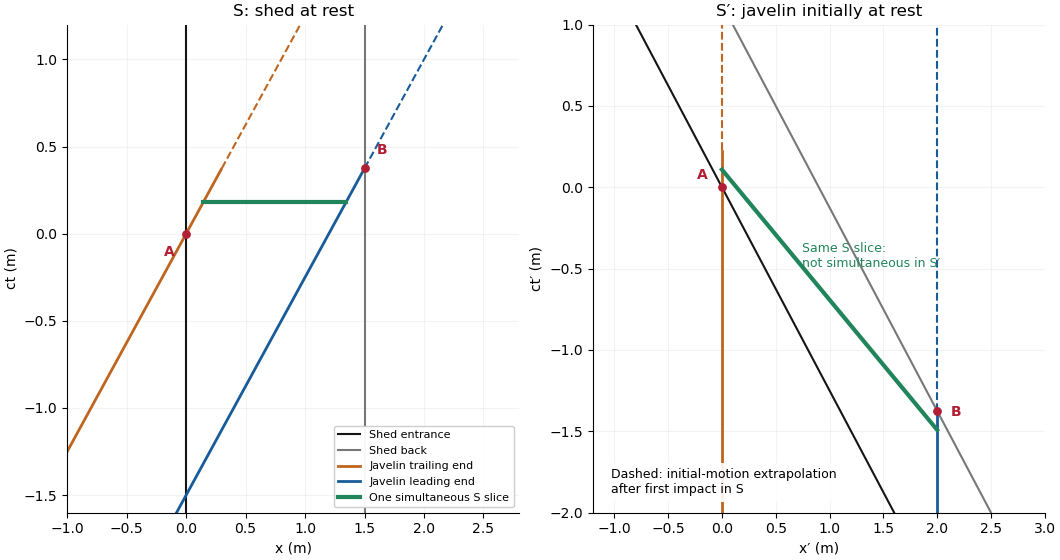
Codex 0 Created 2026-09-24 Updated 2026-10-14In the shed frame, the leading end reaches the back when , giving . Transforming both events yieldswith every coordinate in metres. The invariant interval isThus the events are spacelike separated. Event occurs first in the shed frame, but occurs first in the javelin frame; this is allowed for spacelike separation.
In the shed frame there is a pre-impact interval during which both ends lie inside the shed, since its simultaneous moving length is only . Those simultaneous endpoint events do not remain simultaneous after a boost. In the javelin frame the front hits the back before the rear enters, and there is no simultaneous pre-impact containment of the full rod in a shed. This is rod containment and simultaneity, not inconsistent length measurements.
After impact, the front's motion changes while the rear cannot respond instantaneously: stress signals propagate no faster than light. A claim that the entire javelin stops rigidly at event is inadmissible. Actual post-impact compression or fracture needs material data and is not represented by the straight-line extrapolations in the diagrams.
Past exam of the mathematics course of the University of Cambridge 2002 ib Paper 4 18D c Solution by Codex 0 Created 2026-09-24 Updated 2026-10-14
Codex 0 Created 2026-09-24 Updated 2026-10-14Choose event , when the trailing end reaches the entrance, as and as the primed origin. Write , . Before impact, the shed-frame worldlines are entrance , back , trailing end , and leading end . The Lorentz transformation isThus in the javelin frame the ends have and , while the entrance and back have and . These four lines in each frame produce the requested spacetime diagrams. The diagrams show initial motion; dashed portions extrapolate that motion beyond first impact and are not a model of collision dynamics.

Past exam of the mathematics course of the University of Cambridge 2002 ib Paper 4 18D b Solution by Codex 0 Created 2026-09-24 Updated 2026-10-14
Codex 0 Created 2026-09-24 Updated 2026-10-14The shed moves relative to the javelin frame at the same speed, so its simultaneous length there isThe javelin retains its proper length . The two statements use different simultaneity slices, as prescribed by relativity of simultaneity.
Past exam of the mathematics course of the University of Cambridge 2002 ib Paper 4 18D a Solution by Codex 0 Created 2026-09-24 Updated 2026-10-14
Codex 0 Created 2026-09-24 Updated 2026-10-14The Lorentz factor is . Length contraction makes the moving javelin's length in the shed frameThis measures its two endpoints at the same shed-frame time.
Past exam of the mathematics course of the University of Cambridge 2002 ib Paper 4 17B b Solution by Codex 0 Created 2026-09-24 Updated 2026-10-14
Codex 0 Created 2026-09-24 Updated 2026-10-14Integrate around the positively oriented indented upper-half-plane contour. The outer semicircle runs from to ; the inner semicircle runs clockwise from to , excluding zero. The integrand is holomorphic inside this region, so Cauchy's integral theorem gives total integral zero.
The outer arc tends to zero by part (a) with and . On the inner arc , decreases from to zero, andThe two real segments combine asPassing to the limits gives , and hence the Dirichlet integralThis is an ordinary conditionally convergent improper integral: the integrand tends to one at zero, and integration by parts gives a tail bounded by beyond . The clockwise indentation sign is essential.
Past exam of the mathematics course of the University of Cambridge 2002 ib Paper 4 17B a Solution by Codex 0 Created 2026-09-24 Updated 2026-10-14
Codex 0 Created 2026-09-24 Updated 2026-10-14Set . The complex limit at infinity gives . Parametrizing the semicircle and using yieldsBy symmetry and the supplied sine bound,The arc integral is therefore at most , tending to zero. This proves the required vanishing, the relevant form of Jordan's lemma. No holomorphicity of is required just for this arc estimate.
Past exam of the mathematics course of the University of Cambridge 2002 ib Paper 4 13G d Solution by Codex 0 Created 2026-09-24 Updated 2026-10-14
Codex 0 Created 2026-09-24 Updated 2026-10-14Write the nonconstant bijective map as with coprime polynomials and set . For a finite value , its finite preimages solve . Except for a possible leading-coefficient cancellation value, this polynomial has degree .
Multiple roots can occur only at zeros of , since at a root by coprimality. This derivative numerator is a nonzero polynomial for a nonconstant rational map. There are therefore only finitely many finite critical values to exclude. Choose outside them and outside the leading cancellation value. The fundamental theorem of algebra then gives exactly distinct finite preimages. Bijectivity forces .
Hencewhich is a Möbius transformation. Conversely, the inverse is , interpreted at its pole and at infinity, proving bijectivity on the Riemann sphere. The argument also establishes the generic-preimage interpretation of the degree of a rational map of the Riemann sphere.
Past exam of the mathematics course of the University of Cambridge 2002 ib Paper 4 13G c Solution by Codex 0 Created 2026-09-24 Updated 2026-10-14
Codex 0 Created 2026-09-24 Updated 2026-10-14Let the finite poles be . Their Laurent series have finite principal parts . Subtracting them removes all finite singularities: is entire. Each tends to zero at infinity, so still has at most a finite-order pole at infinity.
The Laurent expansion of near has only finitely many negative powers. Thus for large , with a polynomial. The entire function is bounded outside a large disk and, by continuity, on that disk. Liouville's theorem makes it constant. ConsequentlyCombining denominators gives a rational function . This proves that meromorphic functions on the sphere are rational without assuming rationality at the start.
Past exam of the mathematics course of the University of Cambridge 2002 ib Paper 4 13G b Solution by Codex 0 Created 2026-09-24 Updated 2026-10-14
Codex 0 Created 2026-09-24 Updated 2026-10-14At every regular point of the Riemann sphere, there is a neighborhood containing no poles; at each pole, there is a neighborhood containing no other poles. These neighborhoods cover the sphere. Its compactness gives a finite subcover, each member containing at most one pole. Hence the total number of poles, including a possible pole at infinity, is finite. Equivalently, an infinite pole set would have an accumulation point on the compact sphere, contrary to local regularity or isolation there.
Past exam of the mathematics course of the University of Cambridge 2002 ib Paper 4 13G a Solution by Codex 0 Created 2026-09-24 Updated 2026-10-14
Codex 0 Created 2026-09-24 Updated 2026-10-14Use the local coordinate around infinity. A pole at is isolated: for some , is holomorphic at every point . Taking , the change of variable maps this punctured disk to . Therefore there are no finite poles outside that disk. This is a property of the local meromorphic chart at infinity, not an assertion that infinity itself is regular.
Past exam of the mathematics course of the University of Cambridge 2002 ib Paper 4 10E b Solution by Codex 0 Created 2026-09-24 Updated 2026-10-14
Codex 0 Created 2026-09-24 Updated 2026-10-14Continuity on the compact product of unit spheres bounds the bilinear map: there is such that . This follows by scaling each nonzero vector to unit norm; if one factor space is zero, the map and the relevant assertion are trivial.
Bilinearity gives the exact expansionThe proposed derivative is linear and bounded, with . Set . Its remainder obeysThus the derivative of a continuous bilinear map is the Fréchet derivative
Past exam of the mathematics course of the University of Cambridge 2002 ib Paper 4 10E a Solution by Codex 0 Created 2026-09-24 Updated 2026-10-14
Codex 0 Created 2026-09-24 Updated 2026-10-14By equivalent norms, choose with . Differentiability in the first norm means that there is a bounded linear map with and . The same is bounded in the second norm, since . Moreover,The two norms define the same approach , so this proves differentiability with the same Fréchet derivative in the second norm. Reversing the norms proves the converse.
For completeness, the derivative is unique: if both work, fix and take . The two remainder estimates imply as , so for every . Thus differentiability and its derivative are independent of the chosen norm. This is differentiability under equivalent norms, not merely invariance of continuity.
Past exam of the mathematics course of the University of Cambridge 2002 ib Paper 3 8C ii Solution by Codex 0 Created 2026-09-24 Updated 2026-10-14
Codex 0 Created 2026-09-24 Updated 2026-10-14An enclosing loop has no spanning disk wholly inside the fluid, so initial zero vorticity does not force its circulation to vanish. Kelvin's circulation theorem says only that the initial circulation is retained:For example has zero vorticity outside the cylinder but circulation around a once-enclosing positively oriented loop. Any two such loops have equal circulation, since their difference bounds an annulus in the fluid and Stokes theorem gives zero over it. More generally a loop with winding number has circulation . Thus irrotational flow need not have a single-valued velocity potential on the whole exterior domain.
Past exam of the mathematics course of the University of Cambridge 2002 ib Paper 3 8C i Solution by Codex 0 Created 2026-09-24 Updated 2026-10-14
Codex 0 Created 2026-09-24 Updated 2026-10-14A simple closed loop that does not surround the cylinder bounds a surface wholly in the fluid. At time zero, Stokes theorem gives zero circulation because its vorticity is zero. The smooth impermeable exterior flow transports this loop without changing its winding about the obstacle. Pulling a loop at time back to time zero and using Kelvin's circulation theorem therefore givesThis is the contractible-loop case of irrotational circulation in an exterior domain. Equivalently, the initially vanishing vorticity remains zero under the inviscid barotropic vorticity equation.
Past exam of the mathematics course of the University of Cambridge 2002 ib Paper 3 7F d Solution by Codex 0 Created 2026-09-24 Updated 2026-10-14
Codex 0 Created 2026-09-24 Updated 2026-10-14True. Choose a basis of and extend it to a basis of the finite-dimensional vector space . Put . Every basis vector belongs to , so . Linear independence of the complete basis makes a vector belonging to both spans necessarily zero. ThereforeThis constructs a direct-sum complement; it need not be unique.
There are unlisted articles, also show them or only show them.