An -module is flat when tensoring with it preserves injections, equivalently when is an exact functor.
The tensor product of an -module and an -module is an -module generated by pure tensors , subject to additivity in both variables and the balancing relation
Laplace integral method for a differential equation by  Codex 0 Created 2026-09-24 Updated 2026-10-03
Codex 0 Created 2026-09-24 Updated 2026-10-03Laplace's integral method seeks . Substitution into the differential equation and integration by parts transfer multiplication by into differentiation with respect to , producing a first-order equation for and endpoint conditions for .
Möbius inversion recovers an arithmetic function from its divisor sum. For arithmetic functions , the following statements are equivalent, with each equality required for every positive integer :Here ranges over positive integer divisors of and is the Möbius function. No multiplicativity assumption is needed, and both sums are finite. The right side can also be written by exchanging complementary integer divisors. [ref]
https://darijgrinberg.gitlab.io/floor.pdf. Darij Grinberg, MIT 18.781 lecture notes, Theorem 2.5.1 and Proposition 2.5.2
The divisor sum bundles together with values at smaller integer divisors. Möbius inversion subtracts aggregates indexed by one distinct prime factor, adds those indexed by two, and continues with the alternating signs of inclusion-exclusion. A divisor containing a squared prime factor receives weight zero. The Möbius divisor-sum identity ensures that every unwanted contribution cancels exactly.
In Dirichlet convolution notation, and , where is the constant-one arithmetic function and is the Identity for Dirichlet convolution. Associativity and commutativity give the short proof:Convolving with proves the reverse implication. At , the formula reduces to because .
For a worked example, take , Euler's totient function. The totient divisor-sum identity says that , the identity arithmetic function:This identity comes from classifying the integers by their greatest common divisor with : the group with has members, since and are coprime integers. Summing the group sizes gives , as detailed under totient divisor-sum identity.
Now undo this aggregation with the Möbius function:The nonzero terms use ; vanish because they contain the square of the prime number . The four surviving integers coprime to are .
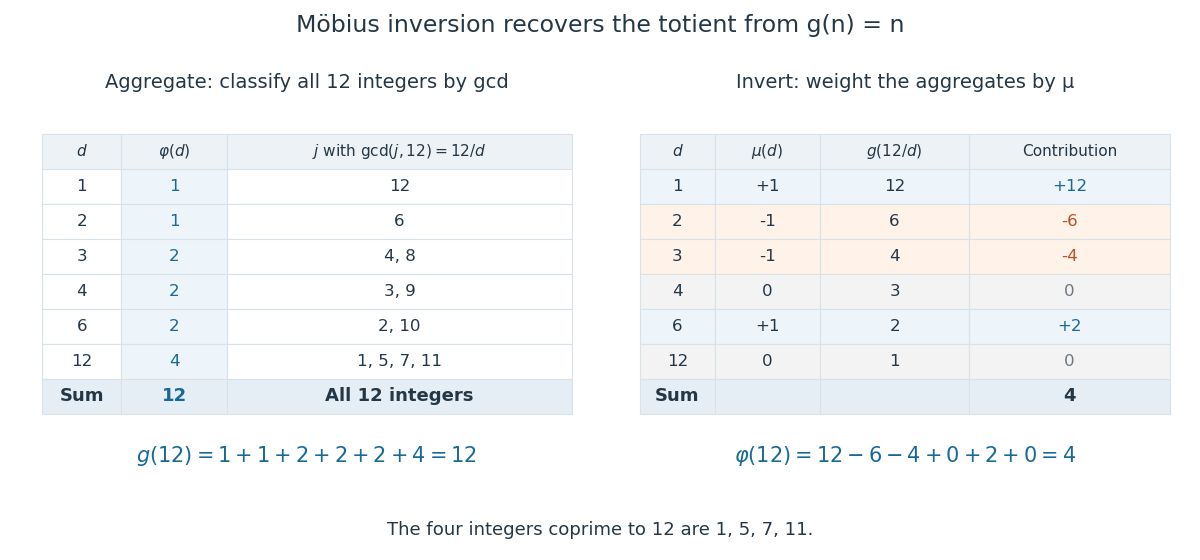
A divisor sum aggregates Euler's totient function values to 12, while Möbius inversion recovers the four integers coprime to 12
. Details. This example also reveals why Möbius inversion is useful: it turns an easy count of all objects into a count satisfying a coprimality restriction. Expanding over subsets of distinct prime factors givesThe product is inclusion-exclusion over multiples of the prime factors. For , it gives . More generally, whenever a counting problem produces a divisor sum, Möbius inversion lets that aggregate be reversed without solving a new system of equations.
The light cone of a spacetime event consists of together with the spacetime events having null separation from it. In the coordinates of an inertial frame centered on , it obeysFor it traces an expanding spherical flash of light, with radius at time ; for it describes possible incoming light rays. A spacetime diagram with one spatial coordinate shows the two lines . The apparent angle uses equal scales for and and is not a separate physical angle.
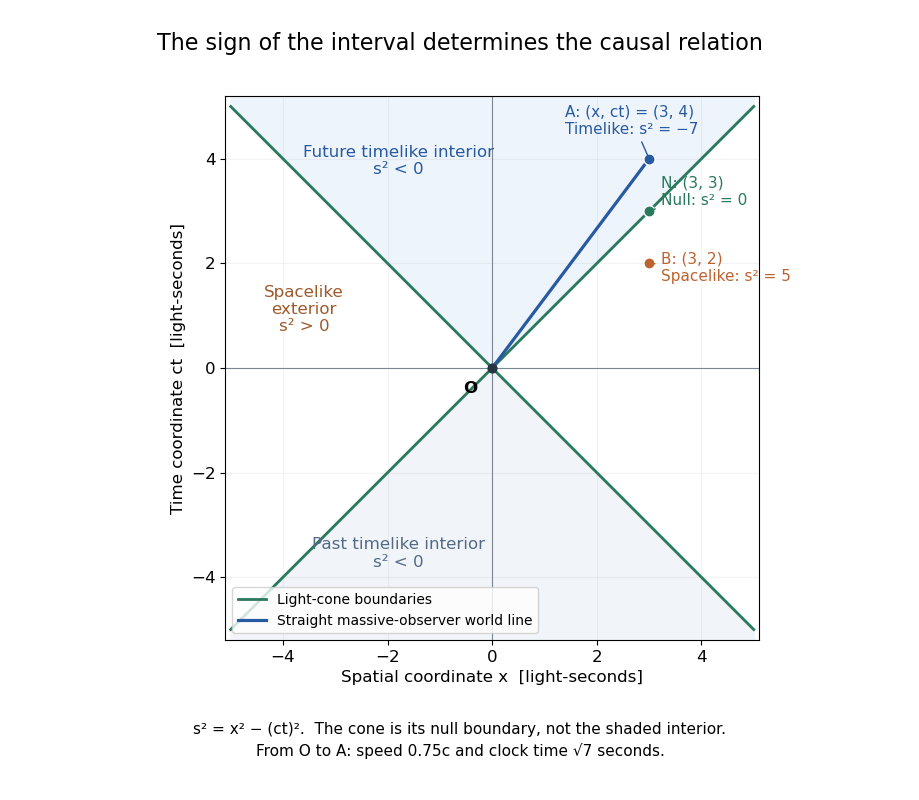
Light-cone boundaries separate timelike, null and spacelike events relative to the origin
. Details. The light cone is the boundary, while its interior has timelike separation from . An outgoing light ray follows the boundary; a future-directed massive observer's world line remains inside it. The exterior has spacelike separation: no signal travelling at or below the speed of light can connect its spacetime events directly to . This separates possible causal influence from merely being assigned a later coordinate time.
In the diagram, is inside the future boundary, is on it, and is outside. Their squared Minkowski intervals are respectively in . Thus occurs later than in the displayed inertial frame while still being unable to receive a light-speed-or-slower signal sent from .
The usefulness is immediate for an experiment: a detector's reading can depend on a source event only if a causal influence can reach it. A Lorentz boost changes coordinates but preserves this classification. For a boost with and Lorentz factor , applying the Lorentz transformation gives, in light-second length units,The corresponding squared Minkowski intervals remain . In particular is now earlier than , which is allowed for spacelike separation; remains later.
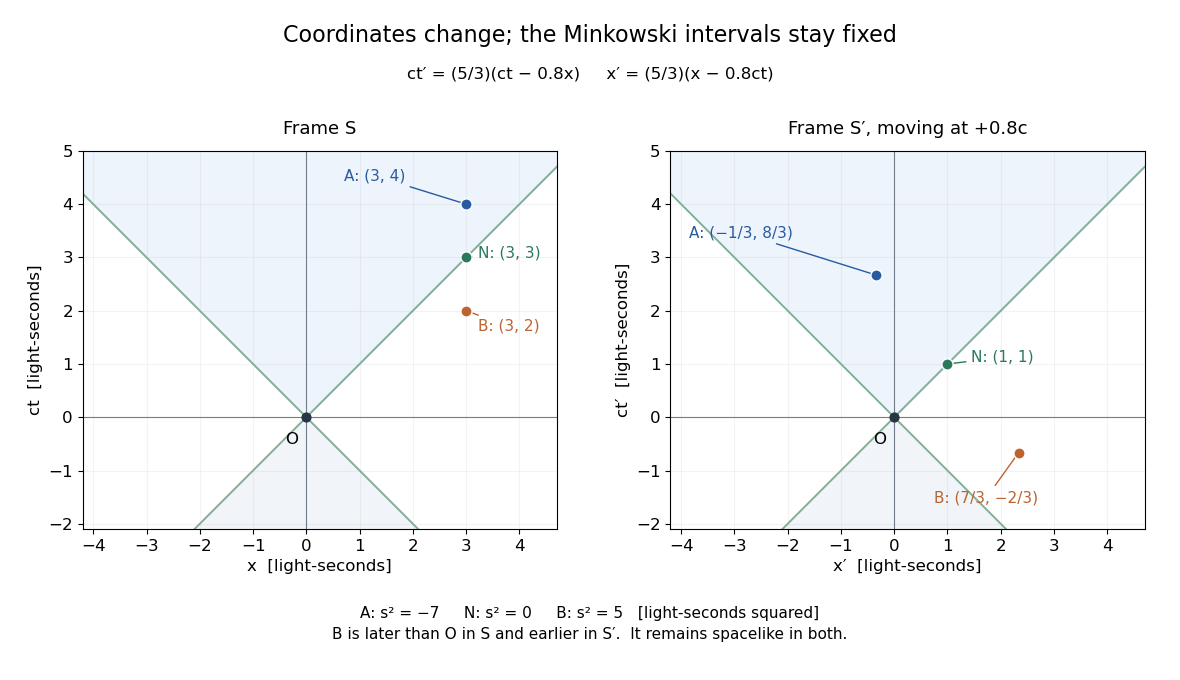


This quadratic form belongs to the geometry of Minkowski spacetime; the spacetime itself is a broader concept than this squared norm.
For a real quadratic field with embeddings , the imageis a lattice in of covolume , and the product of the two coordinates is the field norm.
Likelihood-ratio criterion for minimal sufficiency by Codex 0 Created 2026-09-24 Updated 2026-10-06
Codex 0 Created 2026-09-24 Updated 2026-10-06The Galactic bar is the elongated central stellar structure of the Milky Way. Extinction-corrected near-infrared standard candles and gas position--velocity maps constrain its distance, orientation, and three-dimensional shape.
Galactic multiwavelength astronomy combines spectral bands that respond differently to stars, gas, dust, magnetic fields, temperature, and energetic particles.
The interstellar medium is the gas, dust, magnetic field, and energetic-particle population between stars in a galaxy.
The Zweifach--Fung effect, or plasma skimming, is the disproportionate entry of red blood cells into the higher-flow daughter at an asymmetric microvascular bifurcation.
The Fahraeus--Lindqvist effect is the reduction of blood's apparent viscosity as a small vessel narrows over much of the microvascular range. Red blood cells migrate toward the centre and leave a relatively low-viscosity cell-free plasma layer near the wall.
Murray's law balances viscous pumping power against the metabolic cost of maintaining blood volume. For cylindrical vessels it gives and hence at an ideal bifurcation.
There are unlisted articles, also show them or only show them.