The Leray-Helmholtz projection is the orthogonal projection of square-integrable vector fields onto divergence-free vector fields. Applying it to an incompressible momentum equation removes the pressure gradient.
Free-endpoint normal mode of a coupled variational functional by  Codex 0 Created 2026-09-24 Updated 2026-10-06
Codex 0 Created 2026-09-24 Updated 2026-10-06Forwith free terminal values, the Euler-Lagrange equations and natural conditions give a nonzero stationary family exactly when . It is
For a language , defineThis is a right congruence, and its equivalence classes are the states of the minimal deterministic finite automaton for .
Incremental information in a twofold binary repetition code by Codex 0 Created 2026-09-24 Updated 2026-10-14
Codex 0 Created 2026-09-24 Updated 2026-10-14Send a uniform bit twice through independent binary symmetric channels of crossover probability . The first received bit supplies bits. Since the received bits disagree with probability , the additional information in the second bit is
For finite discrete random variables, the mutual information supplied by two observations equals the information supplied by the first plus the additional conditional mutual information supplied by the second:The order changes the individual contributions but leaves the total unchanged.[ref]
https://web.stanford.edu/class/ee376a/files/lecture_3.pdf. Stanford EE376A/STATS376A, Lecture 3, Definition 7 and equations (48)–(51)
To prove the first identity, add and subtract the intermediate conditional entropy:With base-two logarithms, all contributions are in bits. Repeatedly inserting intermediate conditional entropies makes them cancel, as in a telescoping series, and gives the rule for any finite list of observations:where the term is . The same calculation with already known gives .For the fair-bit exclusive or example in conditional mutual information, observing alone tells nothing about , but observing after tells everything:Here by independence and because . In the reverse order, , so and : the two observations are individually uninformative but jointly reveal one bit. Simply adding their separate mutual informations would miss all of it.
The chain rule is useful for measuring the value of each new observation without double counting information already supplied. It also guarantees by nonnegativity of conditional mutual information. Keeping and adding can help, even though discarding and retaining only a processed is constrained by the data processing inequality. Equating the two observation orders gives the precise identitywhich explains why there is no general rule that conditioning decreases mutual information.
For finite discrete random variables, conditional mutual information measures the average reduction in uncertainty about from observing , when is already known. With base-two logarithms, it is measured in bits:The second expression follows from the chain rule for conditional entropy and makes the symmetry in visible. Equivalently, compute the mutual information separately in each conditional probability distribution and then average:Here is the Kullback-Leibler divergence, also computed with base-two logarithms; zero-probability terms contribute zero. The Gibbs inequality gives , with equality exactly when and have conditional independence given : the conditional joint probability mass function factors for every of positive probability.[ref]
For a fully computed example, take independent random variables that are fair bits, and let , where is exclusive or. The complete joint probability distribution has only these four positive entries:
Table 1. .
Every pair has probability , so . But . Given , the pairs each have conditional probability , while both conditional marginals are fair. ThusGiven , the pairs give the same calculation. ThereforeThe conditional entropy calculation tells the same story: because either value of leaves fair, whereas because . Learning the exclusive or does not reveal either bit alone; it reveals whether they agree, so learning one then determines the other.
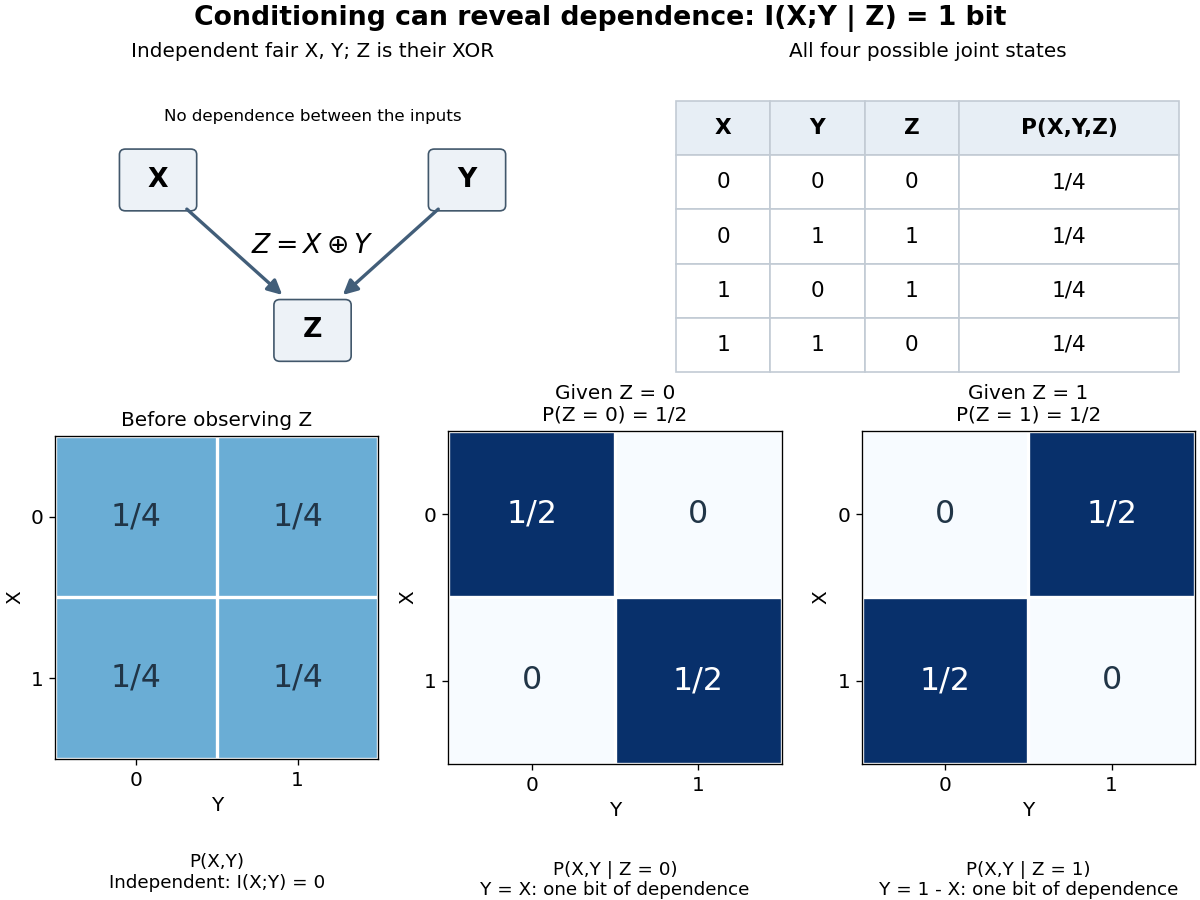
This example distinguishes conditional independence from ordinary independence. It also disproves the claim that conditioning always reduces mutual information, despite conditioning reduces entropy. There is no general ordering between and : the example above increases it from zero to one, while taking and for a fair bit decreases it from one to zero. The chain rule for mutual information explains why both are possible.[ref]
Conditional mutual information is useful for asking whether an additional observation tells us anything after information already available has been accounted for. Its zero case expresses conditional independence exactly; in a Markov chain, this is the step that turns the chain rule for mutual information into the data processing inequality.
For discrete random variables ,The difference between the left- and right-hand sides is the nonnegative conditional mutual information .
A consistent linear multistep method is convergent exactly when it is zero-stable.
Zero-stability requires the roots of the first characteristic polynomial to lie in the closed unit disc, with unit-modulus roots simple.
Index-two square-class argument for three related residues by Codex 0 Created 2026-09-24 Updated 2026-09-24
Codex 0 Created 2026-09-24 Updated 2026-09-24In a finite field with elements, the equation has exactly solutions. Indeed, after choosing a generator of the multiplicative group, is a solution exactly when .
Finite multiplicative subgroup of a field is cyclic by Codex 0 Created 2026-09-24 Updated 2026-09-24
Codex 0 Created 2026-09-24 Updated 2026-09-24Every finite subgroup of the multiplicative group of a field is cyclic. If is the exponent of , commutativity lets one combine elements whose orders realize the prime-power factors of , producing an element of order . Every element of is a root of , so the Lagrange root bound over a field gives . Since , equality holds and that element generates .
For multiplicative functions bounded by one, the pretentious distance up to is defined byIt measures how similarly and behave on primes.
The divisor sum of an arithmetic function assigns to each positive integer the sumOnly positive integer divisors are included, so . The weights can count the integer divisors, measure their sizes, or record other arithmetic information: the constant-one arithmetic function gives the divisor function, whereas the identity arithmetic function gives the sum-of-divisors function.
Equivalently, , where is Dirichlet convolution and is the constant-one arithmetic function. If is a multiplicative function, then is a multiplicative function by Multiplicativity of Dirichlet convolution. [ref]
https://darijgrinberg.gitlab.io/floor.pdf. Darij Grinberg, MIT 18.781 notes on floor and arithmetic functions, Proposition 2.4.2 and Theorem 2.6.1
Here is the mechanism. For positive coprime integers , every positive integer divisor of has a unique form with and ; moreover, are coprime integers. Thus a multiplicative function satisfiesAt a prime power, the divisor sum becomes . This turns a calculation over many integer divisors into short local calculations at prime powers.
An arithmetic function is a completely multiplicative function when and for every pair of positive integers . In particular for every prime number and every nonnegative exponent . Both the constant-one arithmetic function and the identity arithmetic function are completely multiplicative functions: and . The divisor function fails this stronger condition at .
For two particles, the exchange operator sends to . It has eigenvalues on symmetric states and on antisymmetric states.
The determinant assigns a scalar to a square matrix. For a linear map on the real plane, it measures signed area scaling: its absolute value tells how much area grows, and its sign records whether the orientation of a vector space is preserved or reversed. In three dimensions, the same idea measures signed volume. Over a field, a square matrix is an invertible matrix exactly when its determinant is nonzero. These are two views of one phenomenon: losing an independent direction collapses full-dimensional volume and makes the original input impossible to recover uniquely.[ref]
https://www.math.ucla.edu/~rse/algebra_book.pdf#page=716. Elman, Lectures on Abstract Algebra, section 121: determinant and inverse
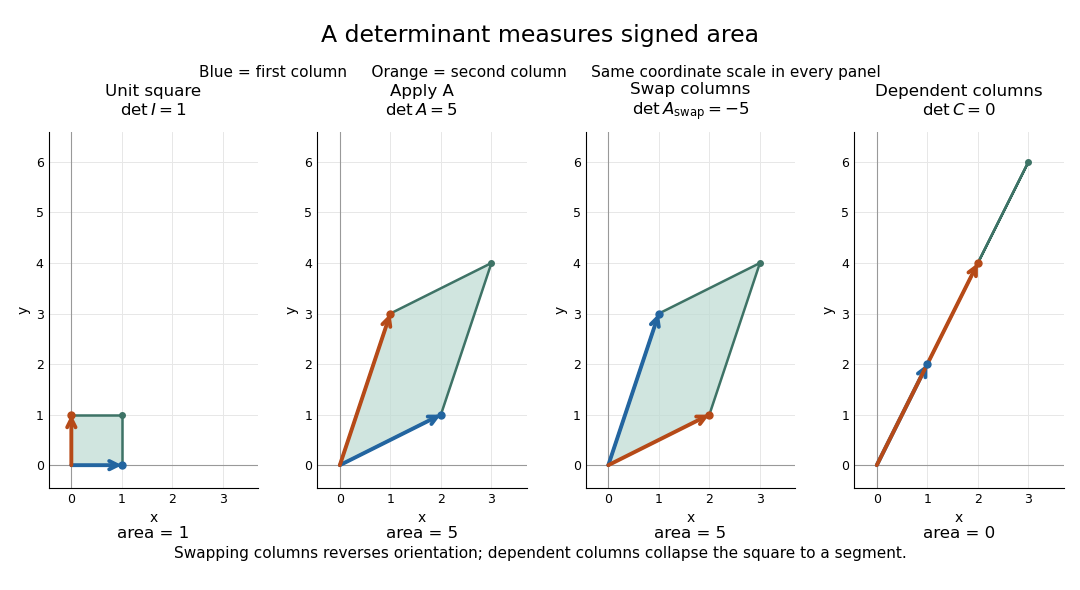
Start with an explicit matrix and its action on a vector:The columns are the images of the standard basis vectors: and . Consequently the unit square with corners becomes the parallelogram with corners . Its area is five. Every small patch of this square undergoes the same linear map, so the factor describes the whole deformation, rather than just one specially chosen boundary. The matrix mixes horizontal and vertical components, but its determinant compresses that combined effect into one area factor.[ref]
https://ocw.mit.edu/ans7870/18/18.013a/textbook/HTML/chapter04/section01.html. MIT calculus notes, section 4.1: determinants and area
Now exchange the columns:The parallelogram occupies exactly the same region, but its generating vectors arrive in the opposite order. Moving from the first column to the second now turns clockwise rather than counterclockwise. Ordinary area remains five; the oriented volume in two dimensions changes sign. A negative determinant therefore signals reversed orientation of a vector space, not a negative amount of material. Keeping the sign makes successive reversals calculable: two reversals restore the original orientation of a vector space.
Compare a singular matrix:Its columns are linearly dependent: the second is twice the first. The unit square collapses onto the segment from to , which has zero area despite nonzero length. Since , the kernel of a linear map contains a nonzero vector; inputs differing by that vector have identical outputs. The collapsed picture explains why an inverse matrix cannot exist.


For , recovery is possible, and the complete matrix multiplication check isHere is the identity matrix. The inverse matrix restores the original square, shrinking its area by . Generally, the adjugate identity gives whenever the determinant is nonzero over a field; this is why the denominator matters.[ref]
https://ocw.mit.edu/ans7870/18/18.013a/textbook/HTML/chapter04/section04.html. MIT calculus notes, section 4.4: determinant and inverse
The multiplicativity of the determinant describes two successive deformations. Matrix multiplication means that applies first, then . TakeThe first linear map doubles area; the second multiplies the resulting area by five. Thus the unit square passes through areas , with the last parallelogram bounded by . Direct calculation agrees:This explains physically why area factors multiply instead of adding. The general identity holds for square matrices of the same size, including singular matrices. If either stage loses a direction, later processing cannot recover the discarded information.[ref]
https://ocw.mit.edu/ans7870/18/18.013a/textbook/HTML/chapter32/section04.html. MIT calculus notes, section 32.4: determinant products
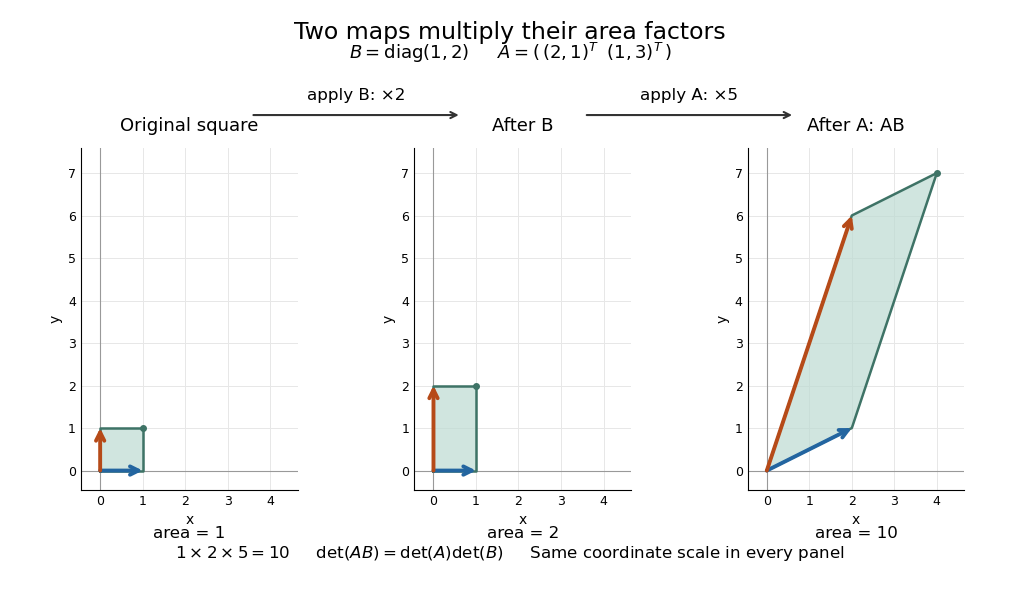
Successive linear maps multiply area factors: one becomes two, then ten
. Details. 
The same interpretation works in three dimensions without drawing a new picture. The diagonal matrixsends the unit cube to a rectangular box with side lengths two, three, and one. Its ordinary volume is six. The minus sign comes from reversing the third direction, so the oriented volume is minus six. Replacing the last diagonal entry by zero flattens the cube into a planar region: its area may be positive, but its three-dimensional volume is zero. This distinction matters whenever a linear map changes shape: the determinant measures size in the full input dimension, rather than the size of whichever lower-dimensional object remains.
The determinant measures neither trace nor perimeter. For , the trace happens also to be five, but the identity matrix in two dimensions has trace two and determinant one. The first parallelogram above has perimeter , compared with four for the unit square; boundary length follows a different rule. Nor does determinant one require every length to stay fixed: the diagonal matrix preserves area while stretching one direction and compressing the other.
These properties make the determinant useful when coordinates obscure what a deformation does. A nonzero determinant certifies that linearly independent input directions remain distinguishable; its magnitude counts the area or volume represented by a transformed cell. That second role reappears in the change of variables formula, where the Jacobian determinant corrects the sizes of small cells. Signed volume also separates a deformation that reverses the orientation of a vector space from one that merely stretches it, even when both give identical ordinary volume factors.[ref]
https://ocw.mit.edu/ans7870/18/18.013a/textbook/HTML/chapter24/section02.html. MIT calculus notes, section 24.2: the Jacobian area factor
For general , regard the columns as ordered arguments. The determinant is the unique alternating multilinear map to the scalar field normalized by . The multilinearity of the determinant means linearity in each column separately, with all others held fixed:Alternation means equal columns give zero; exchanging columns negates the result. Normalization sets the oriented volume of the standard basis to one. These properties also hold in rows. For real three-dimensional columns, their determinant is the scalar triple product, and its absolute value is the enclosed volume. Over other fields, the algebraic definition still works even without a geometric notion of positive volume.[ref]
https://web.mit.edu/18.06/www/Spring16/lecture22.pdf. Barwick, MIT 18.06 Lecture 22: the determinant axioms
Separate linearity does not mean the determinant is a linear map on the whole matrix. Scaling every column of an -by- matrix by gives . For our two-dimensional example, : doubling both directions quadruples area. The power records how many independent directions are being scaled together.
The properties suggest practical computations. Adding a multiple of one column to another preserves the determinant: the extra term has repeated columns and vanishes. This is the algebra behind an area-preserving shear mapping. Alternatively, expansion along a row uses cofactors, each a matrix minor multiplied by a sign:where deletes row and column . The Leibniz formula for determinants supplies the general entry formula. Both calculations encode the same geometric invariant; the defining properties explain their structure without requiring memorization of a separate recipe for every size.[ref]
https://ocw.mit.edu/ans7870/18/18.013a/textbook/HTML/chapter04/section03.html. MIT calculus notes, section 4.3: cofactor expansion
For a basis with scalar triple product , the reciprocal vectors are cyclic cross products divided by and satisfy . This construction is used for the basis of a reciprocal lattice.
There are unlisted articles, also show them or only show them.