A rank- tensor on a vector space is a multilinear map of vector or covector arguments, equivalently an element of an -fold tensor product. Its components transform by one copy of the change-of-basis matrix for each index.
Two integration paths with the same endpoints differ by a closed-path period determined by the residues and winding numbers of their concatenation.
The Eilenberg-Moore category consists of algebras for a monad and their structure-preserving morphisms.
Moment of inertia of a solid cone about its vertex by  Codex 0 Created 2026-09-24 Updated 2026-09-24
Codex 0 Created 2026-09-24 Updated 2026-09-24For a planar lamina in the -plane, the moments about three mutually perpendicular axes through one point satisfyThis follows pointwise from in the defining mass integrals.
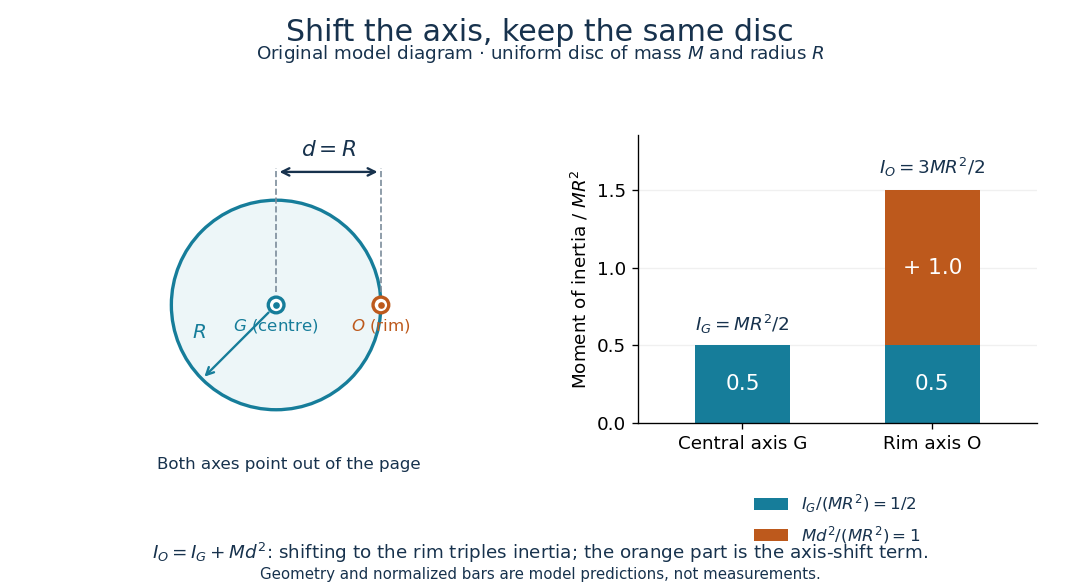
The parallel axis theorem transfers a moment of inertia from an axis through the centre of mass to a parallel axis through :Here is the total mass and is the shortest perpendicular distance between the two axes. Both moments of inertia concern the same mass distribution and the same axis direction. The axis for must pass through the centre of mass; may refer to an axis outside the body. No uniform-density or planar-shape assumption is needed. Within any family of parallel axes, the centre of mass axis minimizes the moment of inertia.[ref]
A short proof isolates why the centre of mass matters. Choose parallel axes perpendicular to an plane, put at the origin, and place at . Thenbecause in centre of mass coordinates. Individual mass elements can move closer to the new axis, but their weighted cross terms cancel. For arbitrary parallel axes and , use , where each distance is measured from the parallel centre of mass axis; adding times the squared separation of and is generally incorrect. A displacement along the axis has . Changing the axis direction instead requires the inertia tensor or, in its applicable planar setting, the perpendicular axis theorem.
For a uniform disc, mass and radius , the central perpendicular moment of inertia is . Shifting that axis to the rim gives and , three times . In the computed , example, , and . At angular speed the rim-pivoted disc has rotational kinetic energy . Its centre of mass now moves, so already includes that translation; adding a separate centre of mass translation term to it would count that contribution twice.

The physical pendulum measurement described under moment of inertia provides a practical check: infer at several pivot positions, then subtract to obtain . Keep all pivot axes parallel and measure to the centre of mass of the entire moving assembly. The same assembly should yield the same within measurement precision. If a smartphone is attached, its mass and its own moment of inertia belong in both the geometric prediction and the centre of mass calculation. The published bar-and-phone study explicitly adds both contributions using the parallel axis theorem.[ref]
For a careful replication, release small swings without a push, repeat timings at several small amplitudes, and check that the extrapolated oscillation period is stable as amplitude decreases. Time many complete oscillations and repeat the run; two crossings of a photogate per cycle must not be mistaken for two cycles. Inspect decay of amplitude and compare early and late timings to detect significant pivot friction or air drag. Mark the bar and phone mount to detect relative slip, tighten the attachment, and check that the pivot support does not rock or migrate between holes. Repeat with an independent photogate or video readout to check the phone's timing. These are proposed controls for the replication, not additional results reported by the authors. The ideal model excludes appreciable damping, large swings and flexing; subtraction of also magnifies relative errors when is much smaller than .
The oscillation period need not increase monotonically with pivot distance: the shift raises the moment of inertia but also increases the gravitational restoring torque. For a computed slender uniform bar model of length , andThis expression has its minimum at . With , and stipulated , the prediction is ; it is not a recorded timing or a prediction for the bar with a phone attached. The competing terms explain why a timing experiment can reveal a mass distribution rather than merely its weight.
The inertia tensor packages the moments of inertia about every axis through a specified point into one symmetric matrix. An axis still needs a direction: if is a unit vector, its scalar moment of inertia is . The same mass layout can therefore be easy to spin about one direction and harder about another. The inertia tensor also determines rotational kinetic energy and relates angular velocity to angular momentum in the appropriate rigid body model.
Take position vectors relative to , expressed in an orthonormal basis. For point masses , or a continuous distribution with mass density and ,Here is the Kronecker delta. Equivalently, using the identity matrix and an outer product,Every entry has SI units . The diagonal entries are axial moments of inertia; the off-diagonal entries carry a minus sign in this convention. Some texts instead define the integrals without the prefixed minus sign , , as their named off-diagonal quantities and put the minus signs into the displayed matrix. Check that convention before combining formulas. [ref] [ref]
The symmetric matrix is positive semidefinite, because its quadratic form isThe dot product and cross product identify this as a sum of squared distances when is a unit vector. A zero moment of inertia occurs precisely when all the mass lies on that axis, up to sets of zero mass. A genuine three-dimensional body with positive mass density in a volume has strictly positive axial moments of inertia. Do not confuse this inertia tensor with the mass second-moment tensor : they obey , where denotes the matrix trace.
If is fixed in an inertial frame and each velocity is , summing the individual kinetic energies and angular momenta givesThese formulas also describe angular momentum and rotational kinetic energy relative to the centre of mass of a translating rigid body. In that case the total kinetic energy in the inertial frame is . For a general moving point , the body's actual velocities include , so alone need not be its angular momentum about . [ref] [ref]
Changing the orthonormal basis changes components, rather than the physical distribution: if the columns of an orthogonal matrix are the new basis vectors expressed in the old basis, then . Changing the reference point is a different operation, governed by the tensor parallel-axis theorem. Both principal axes and principal moments of inertia must therefore be quoted with their reference point.
Structure theorem for finitely generated modules over a principal ideal domain by Codex 0 Created 2026-09-24 Updated 2026-10-14
Codex 0 Created 2026-09-24 Updated 2026-10-14Every finitely generated module over a PID is a direct sum of a free module and cyclic prime-power torsion modules.
An irreducible, or simple, module is nonzero and has no submodules other than zero and itself.
A module is cyclic if one element generates it: every element is for some scalar . The generating element need not give unique coefficients. The module homomorphism , , is surjective. Over a commutative ring, its kernel is the annihilator , givingThus cyclic modules are exactly the quotient modules for ideals in . For a left module over a noncommutative ring, use a left ideal and interpret the quotient as a module, with no claim that it is a quotient ring. See John A. Beachy's Abstract Algebra Online, section 10.1.
The module is generated by , and also by , whose successive multiples are . The element generates only , a submodule with three elements. A cyclic module can be infinite and free, as shows, or finite and torsion, as shows. One generator counts directions of generation, not the number of elements and not freedom from relations.
A module over an integral domain is torsion-free when with implies , equivalently when its torsion submodule is zero. Every free module over an integral domain is torsion-free, as one can check in each coefficient. Every vector space is torsion-free over its scalar field.
The converse requires hypotheses. A finitely generated module over a principal ideal domain is free if it is torsion-free, but the module over is torsion-free and not free. Any two nonzero rational numbers have a nontrivial integer relation, so a possible basis of a module could have at most one element; no single generates all rational numbers, since for . The finite-generation hypothesis cannot be dropped. See Keith Conrad's Modules over a PID, Corollary 2.6.
A free module is a module with a basis of a module : every element has exactly one expression with and only finitely many nonzero. Equivalently, the coefficient map is a module isomorphism. Existence means generation; uniqueness means linear independence in a module. For finite of size , this says , a finite free module. See Neil Strickland's Rings, Modules and Linear Algebra, section 11.
The integer lattice in the opening diagram is a free module over with basis of a module , . For example, , and comparing the two coordinates makes the coefficients unique. A different basis of a module is , , because ; in particular .
By contrast, and are linearly independent in a module, but generate only the submodule . They miss because has no integer solution. They would form a basis over the rational numbers. Even generation need not let one extract a basis of a module: the elements generate , since , but neither singleton generates it, and is a nontrivial linear relation between them. These are concrete failures of the usual vector space argument that divides by any nonzero coefficient.
The cyclic module has no basis of a module over : every element has the nontrivial relation , so no nonempty subset is linearly independent in a module, while the empty subset cannot generate this nonzero module. Specifying the scalar ring is essential: over , the same additive object is a free module with the one-element basis of a module , since each coefficient is itself a unique class in .
Primary decomposition theorem for finitely generated modules over a principal ideal domain by Codex 0 Created 2026-09-24 Updated 2026-10-03
Codex 0 Created 2026-09-24 Updated 2026-10-03A finitely generated module over a principal ideal domain decomposes aswith finitely many irreducibles . The free rank and primary cyclic factors are unique up to associates and ordering.
The length of a module is the number of simple factors in a composition series. It is additive across short exact sequences.
There are unlisted articles, also show them or only show them.