
Boyer-Lindquist coordinates adapt the Kerr metric to its stationary and axial symmetries. The horizon radii are the roots of .
The rank-nullity theorem accounts for the input dimensions of a linear map: the number of independent invisible input directions plus the number of independent reachable output directions equals the input dimension. For over a field, with finite-dimensional domain of a function ,Here is the nullity, and is the rank of a linear map. The kernel lives in the input vector space, while the image of a linear map lives in the output vector space. For an -by- matrix of matrix rank , the formula is : the number of columns counts input coordinates. [ref]
Linear Algebra Done Right by Sheldon Axler (4th edition). Sheldon Axler, Linear Algebra Done Right, fourth edition, §3B: fundamental theorem of linear maps
For a computed example over the real numbers, takeThe kernel is and the image of a linear map is . Each has dimension one, so the two input dimensions split as . The vector can be writtenThe second summand is undetectable: . The picture uses the standard dot product to choose a visible direction perpendicular to the kernel; this is a convenient geometric choice, not an extra hypothesis of the rank-nullity theorem.
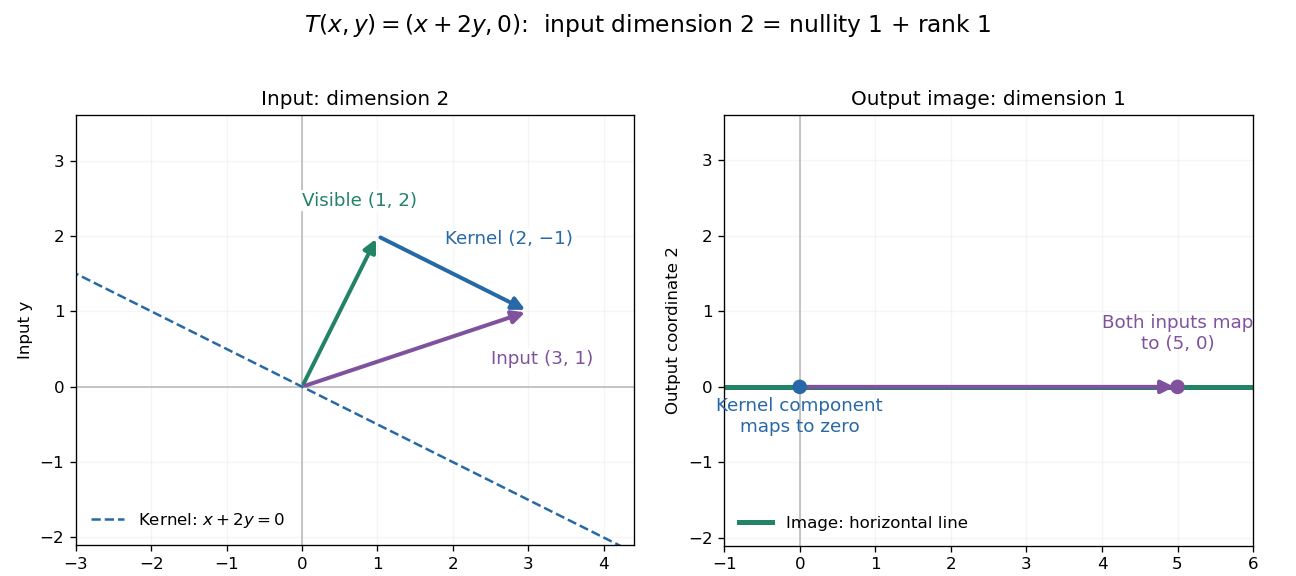
Two input dimensions split into one visible direction and one kernel direction
. For , the input splits into and . Both and map to , while the kernel component maps to zero. The horizontal output line is the entire image of a linear map. Details.
This explains a practical tradeoff in a linear system. If , every other input with output is for . The nullity therefore counts independent freedom in an existing solution; the rank counts independent reachable output directions. In the example, has all solutions , while has none. The cokernel records this failure of reachability.
For an -by- matrix, injectivity requires matrix rank , and surjectivity requires matrix rank . When , these conditions differ. For example, with has rank one and nullity two, because . The input accounting is , although only one of two output directions is reached.
Proof outline: extend a basis of the kernel to a basis of . Every output is a linear combination of because the vanish under . If a linear combination of the is zero, the corresponding combination of the lies in the kernel; linear independence of the full basis forces all its coefficients to vanish. Thus the added basis vectors give a basis of the image of a linear map. Counting them proves the formula.
The specific angular momentum is angular momentum per unit mass, . For a planar Kepler orbit its magnitude is .
The specific orbital energy is the mechanical energy per unit mass,Its sign distinguishes bound elliptic, marginal parabolic, and unbound hyperbolic Kepler orbits.
An orbital element is one of a set of parameters specifying an orbit at a chosen epoch. For a Kepler orbit, the semi-major axis and eccentricity determine its size and shape, while angular elements determine its orientation and the body's position.
Orbital eccentricity distinguishes circular, elliptic, parabolic, and hyperbolic conics.
Binet’s equation rewrites a central-force orbit using . If is angular momentum and the potential is , then
For a rapidly decreasing KdV potential and a normalized bound-state eigenfunction, integration of the Wronskian identity over the real line gives . Thus every discrete eigenvalue is constant.
Jeans instability is the gravitational growth of density perturbations whose self-gravity overcomes pressure support. For physical sound speed , the comoving threshold isModes with grow gravitationally, whereas modes with undergo pressure-supported acoustic oscillations.
For observations , the unbiased sample variance isFor independent identically distributed observations with finite variance , it converges in probability to .
For real periodic KdV data, translation by one period acts on a conjugate basis of scattering solutions byLax compatibility gives for the matrix of on the eigenspace. Hence is conserved.
Ifthen every positive power has constant trace:The final equality is the cyclic property of the matrix trace.
A singularity is non-isolated when every punctured neighbourhood contains another singularity. An accumulation point of poles or essential singularities cannot itself be classified as a removable singularity, pole, or isolated essential singularity.
An isolated singularity is removable, a pole, or essential according as its Laurent principal part has zero, finitely many nonzero, or infinitely many nonzero terms.
There are unlisted articles, also show them or only show them.