
Every finite graph of maximum degree at most has an independent set of size at least . Greedily choose a vertex and delete its closed neighbourhood.
A unipotent operator has every eigenvalue equal to one and may create a nonsplit Jordan-block extension.
A nonsplit extension contains an invariant subrepresentation with no invariant complementary subspace.
For an unnormalized target density, self-normalized importance sampling uses weights and estimates expectations by . Resampling a point with probability proportional to produces the associated weighted empirical distribution.
Coordinates on an immersed surface are isothermal when the first fundamental form is for a positive function .
A smooth embedding is an injective immersion that is a homeomorphism onto its image with the subspace topology.
This is the differentiable specialization of an embedding, with an injective differential in addition to its topological embedding property.
Bosonic Matsubara frequencies are . They are the Fourier modes on the periodic imaginary-time circle.
The Kubo--Martin--Schwinger condition uses cyclicity of the thermal trace to relate correlation functions separated by imaginary time .
For a fixed amount of substance and composition of classical ideal gas, internal energy depends only on temperature: , with no independent volume dependence. This does not require constant heat capacity at constant volume. Between equilibrium endpoints,Here is total heat capacity at constant volume, is molar heat capacity, and for sample mass is specific internal energy, whose change is . These endpoint relations apply even when the intervening process is not at fixed volume; they do not say that transferred heat always equals . With constant , the safe statement is . Writing additionally chooses the reference energy; it does not prove that a physical gas remains classical and ideal down to zero temperature. [ref]
https://www.feynmanlectures.caltech.edu/I_45.html#Ch45-S1. Richard Feynman, Robert Leighton and Matthew Sands, §45-1: internal-energy derivatives and heat capacity
A thermodynamic proof outline uses the first law of thermodynamics in equilibrium form, , and the Maxwell relation :The last step uses the ideal gas law and the molar gas constant , with fixed composition and amount of substance. Microscopically, separated ideal gas particles store no intermolecular interaction energy; their translational kinetic energy and any internal molecular energy are determined by temperature. Negligible intermolecular interactions still allow a molecule to have internal vibrational potential energy.
An original analytical model makes the distinction between an ideal gas and constant heat capacity concrete. Assume classical translation, two fully active rotational terms, and one independent quantum harmonic oscillator per diatomic molecule, with fixed angular frequency . Define the vibrational temperature scale , using the reduced Planck constant and Boltzmann constant . Summing its thermal occupations givesThe constant includes the chosen reference and zero-point energy, whose temperature derivative vanishes. When the vibrational contribution to heat capacity is exponentially small; when it tends to per mole. This model assumes rotations remain active throughout the interval and excludes dissociation, electronic excitation and real gas corrections. Its low- edge is not a model of rotational freezing or of an actual substance at absolute zero.[ref]
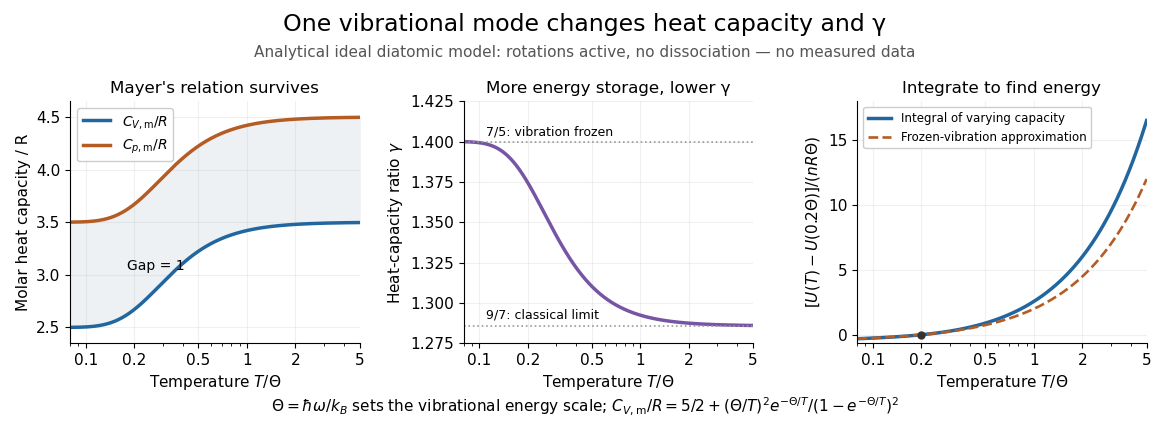
Temperature-dependent internal energy of an ideal gas, molar heat capacities and heat capacity ratio in a vibrational model
. Analytical illustration with active rotations and one quantum harmonic oscillator per molecule. Left: Mayer's relation keeps the capacity difference equal to . Middle: heat capacity ratio falls from toward . Right: the internal energy change from is an integral of varying heat capacity at constant volume; the dashed line suppresses the vibrational contribution. No measured gas curve or material-specific vibrational frequency is implied. Details.
For this stipulated model, heating from to gives . Holding the frozen-vibration value throughout would give , underestimating the required internal energy increase by about of the model's full value. The integral measures all thermal storage activated along the interval. At fixed volume with only heat input, this is also the supplied heat; at fixed pressure, expansion work must be added through Mayer's relation.
Joule's free-expansion experiment tests the independence from volume in a different way: an insulated rigid vessel allows gas into an evacuated compartment, so no external work is delivered and ideally no heat is exchanged. The first law of thermodynamics gives ; positive then predicts equal initial and final equilibrium temperatures for the ideal gas. The apparatus, thermal-capacity controls and limitations of this inference are described in Joule's free-expansion experiment and temperature sensitivity of a free-expansion experiment. This endpoint test differs from the reversible adiabatic expansion of a loaded piston, which delivers work and lowers internal energy.
A gas is nondegenerate when its occupation numbers are low enough that quantum statistics reduce to the Maxwell-Boltzmann distribution. A common criterion is , where is the thermal de Broglie wavelength.
For an ideal gas, this is the classical statistical regime; nondegeneracy alone does not assert the absence of interactions.
Every element of a finite ideal class group has finite order. Therefore every nonzero ideal has a positive power that is principal.
Bounded-norm representatives prove class-group finiteness because only finitely many integral ideals have norm at most a fixed constant.
If every integral ideal contains nonzero with , then is an integral representative of with norm at most .
Basal sliding is motion of glacier ice relative to its bed. A sliding law relates the basal velocity to basal shear stress, effective pressure, roughness, or other bed properties.
The shallow-ice approximation uses the small ratio of ice thickness to horizontal extent to make pressure hydrostatic and balance its horizontal gradient primarily by vertical shear stress.
There are unlisted articles, also show them or only show them.