A Bézout domain is an integral domain in which every finitely generated ideal is principal. Equivalently, every pair has a greatest common divisor satisfying a Bézout identity . A Noetherian Bézout domain is a principal ideal domain because all its ideals are finitely generated.
A greatest-common-divisor domain is an integral domain in which every two nonzero elements have a greatest common divisor, defined up to multiplication by a unit.
A nonzero nonunit in an integral domain is irreducible when every factorization has at least one unit factor.
The field discriminant is the discriminant of any integral basis and controls the index of every suborder.
For a one-degree-of-freedom closed orbit, action-angle coordinates make the Hamiltonian a function and give , .
The Gram-Schmidt process turns a finite ordered family of linearly independent vectors in an inner product space over the real numbers into an orthonormal basis of their linear span. It keeps every successive linear span, so the first new vectors describe exactly the same directions as the first inputs. Its idea is geometric: remove the orthogonal projection onto directions already found, then divide the remaining vector by its norm. This makes a complicated basis easier to use without changing the vector subspace it describes.[ref]
Start with and . At step , use the previously obtained orthonormal set to defineThe sum is the orthogonal projection onto a finite-dimensional subspace , and is the orthogonal projection residual. Linear independence ensures : otherwise would already be a linear combination of earlier inputs. If the input family is linearly dependent, use only the retained orthonormal vectors in the sum and omit an input whenever its remainder is the zero vector; do not divide by zero. The retained outputs still form an orthonormal basis of the original linear span, but their number can be smaller than .
For a short verification, orthonormality makes every earlier inner product vanish:Also is minus a linear combination of earlier vectors, while is plus that same linear combination. These two inclusions, followed by division by a nonzero norm, giveThe argument also works in an inner product space over the complex numbers with the existing inner product convention, linear in the first argument: the coefficients remain . With the convention linear in the second argument, write instead.
For a first picture, take and in with the ordinary dot product. ThenSubtracting the diagonal component leaves an orthogonal direction; dividing by its norm makes its length one. If the second input were instead, its orthogonal projection would be the entire input and , revealing linear dependence.
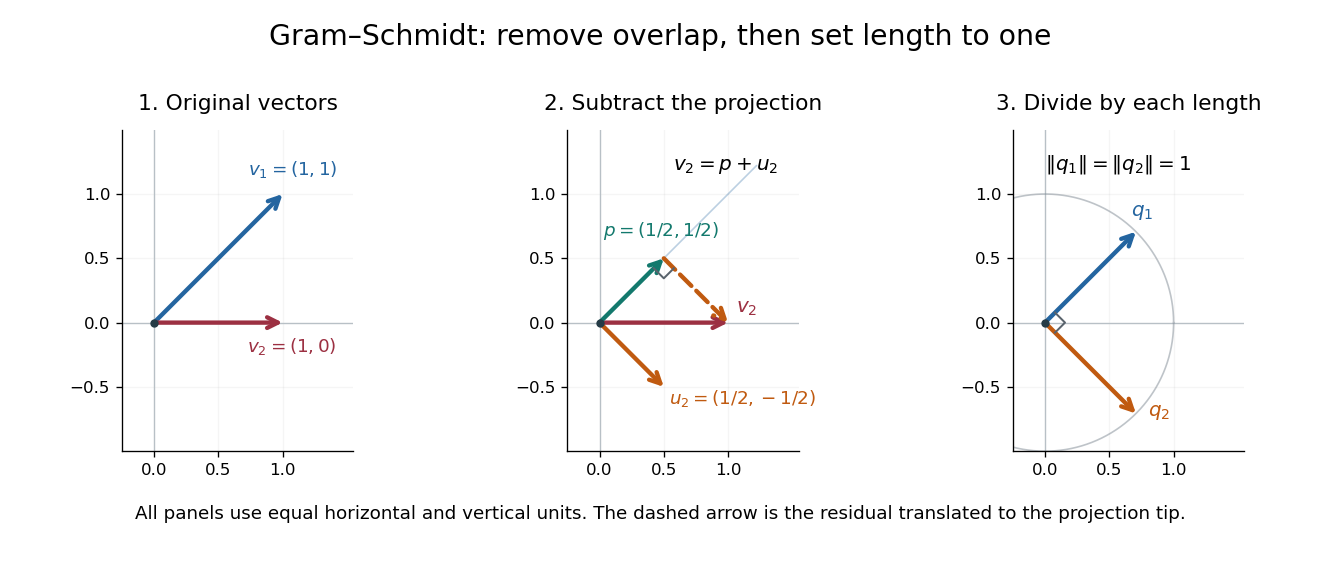
Gram-Schmidt orthogonalization in : input vectors, subtraction of an orthogonal projection, and an orthonormal basis
. Details. 
For a full three-dimensional calculation, use the ordinary dot product and the input vectorsThe first two steps giveAt the third step, the inner products are and . ConsequentlyThe three numerator vectors have pairwise dot products and squared Euclidean norms . Thus the displayed outputs are indeed an orthonormal basis, and the three nonzero remainders also confirm linear independence of the inputs. Keeping the removed coefficients produces the QR decomposition below.
An immediate reward is a reusable orthogonal projection: once an orthonormal basis of a vector subspace is known, any vector hasFor the linear span of just the first two inputs in the three-dimensional example, gives . Its orthogonal projection residual is , visibly in the missing orthogonal direction. This is the geometry behind the linear least-squares problem.
The formulas above describe exact arithmetic. With floating-point arithmetic, subtracting an orthogonal projection nearly equal to the input can leave a small remainder; dividing by its small norm can magnify existing roundoff error. The Classical Gram-Schmidt and Modified Gram-Schmidt arrangements agree in exact arithmetic but can give different rounded results. Exact linear dependence and a small computed remainder therefore require different judgments in a numerical implementation.[ref]
https://nhigham.com/wp-content/uploads/2023/10/high95m.pdf. Higham, The Test Matrix Toolbox for Matlab, §8, p. 22
Two vectors are nonorthogonal when their inner product is nonzero. In the power method, the starting vector must be nonorthogonal to a dominant eigenvector.
Two vectors are orthogonal when their inner product is zero.
For real Euclidean vectors, the inner product is the dot product, so and are orthogonal: . For nonzero Euclidean vectors, this means their angle is . The zero vector is orthogonal to every vector, although it has no direction or defined angle.[ref]
https://ocw.mit.edu/courses/18-06-linear-algebra-spring-2010/resources/lecture-14-orthogonal-vectors-and-subspaces/. Strang, MIT 18.06, Lecture 14: orthogonal vectors and subspaces
In an abstract inner product space, orthogonality always refers to its chosen inner product. For example, the weighted inner product makes and orthogonal, since . Their ordinary dot product is , so their arrows are not perpendicular in the usual Cartesian coordinate system. The algebraic definition also applies to functions, where arrows need not be available.
Orthogonal projection onto a finite-dimensional subspace by  Codex 0 Created 2026-09-24 Updated 2026-10-14
Codex 0 Created 2026-09-24 Updated 2026-10-14A finite-dimensional linear subspace of an inner product space has a unique closest vector to any given vector . This is its orthogonal projection . If is an orthogonal basis of , compute it one direction at a time:The inner product convention here is linear in its first argument, including over the complex numbers. For an orthonormal basis, each denominator is one. When consists only of the zero vector, the empty sum gives . The finite-dimensional formula is described in Francis Narcowich, Inner Products and Norms: minimization problems.
Take and , using the dot product. With ,The orthogonal projection residual has . To verify the best approximation directly, every candidate in the line is , andThe smallest squared Euclidean norm error is therefore , attained only at . The diagram connects the perpendicular residual to this one-variable quadratic polynomial.
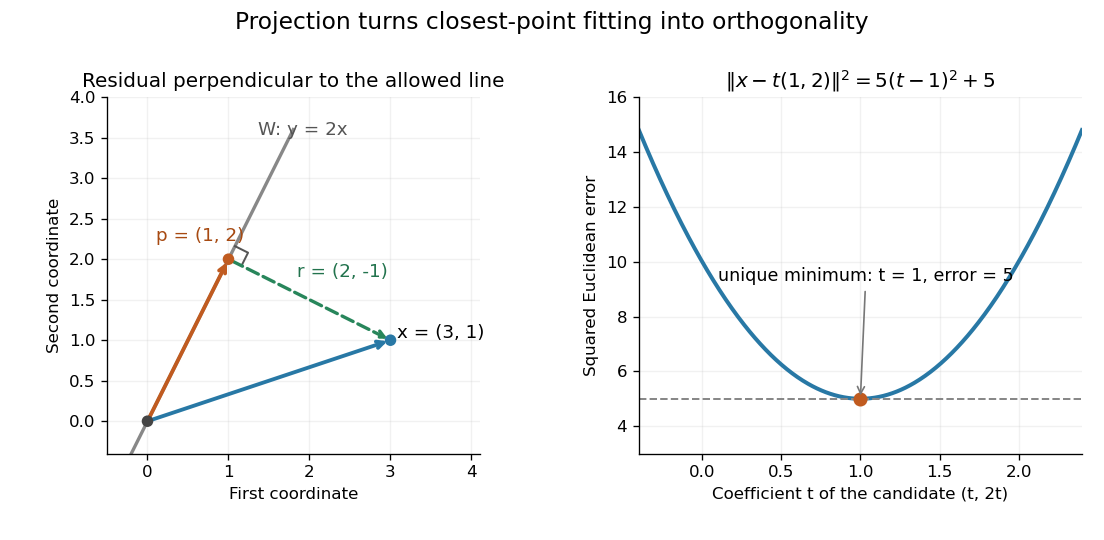
The perpendicular residual identifies the closest point on a line and the unique minimum of the squared error
. Details. 
The general mechanism is the Pythagorean theorem in an inner-product space. For any , the vectors and are orthogonal, soMoving away from inside adds a nonnegative squared norm, which is zero only when . This proves both optimality and uniqueness.
The useful feature is separation of preparation from evaluation. Construct an orthonormal basis once with the Gram-Schmidt process, then obtain each new best approximation using inner products instead of a fresh optimization problem. When is the column space of a matrix, this gives linear least squares; when is spanned by orthogonal polynomials, it gives a least-squares polynomial in an orthogonal-polynomial basis. The ambient inner product space need not be a Hilbert space for this finite-dimensional construction. In an infinite-dimensional target linear subspace, existence requires additional hypotheses, supplied by orthogonal decomposition by a closed subspace.
For vectors , the Gram matrix isTwo finite vector families with the same Gram matrix are related by an isometry between their spans; in finite dimensions that isometry can be extended to a unitary map after completing orthonormal bases.
The injective hull of a module is a minimal injective extension of in which is an essential submodule.
Over an integral domain, a module is divisible when for every nonzero . A divisible group is precisely a divisible -module, and over a principal ideal domain divisibility is equivalent to injectivity.
This criterion characterizes an injective module using extension from ideals. A left -module is injective exactly when every homomorphism from a left ideal of extends to a homomorphism from .
For a source and fixed positive integer , form the block source . Whenever the original information rate exists, the blocked source has information rate , because
There are unlisted articles, also show them or only show them.