For nonnegative , with and , the log-sum inequality isIt proves both Gibbs inequality and the data processing inequality for relative entropy.
This is the data processing inequality for f-divergences specialized to relative entropy. Passing two probability distributions through the same Markov kernel cannot increase their relative entropy. For a kernel ,
For probability distributions and on a product space, the Kullback-Leibler divergence decomposes into the divergence of a marginal and the expected divergence of the corresponding conditional distributions. Iteration gives
For probability distributions and on the same finite set,with equality exactly when on the support of .
For a Noetherian local ring , the Krull dimension of , the Krull dimension of the associated graded ring , and the order of the pole at of its Hilbert series are equal.
Scattering-amplitude equations for one-dimensional band edges by  Codex 0 Created 2026-09-24 Updated 2026-10-03
Codex 0 Created 2026-09-24 Updated 2026-10-03If one symmetric cell has reflection and transmission amplitudes , thenAt a periodic or antiperiodic band edge, with and , setting gives
Floquet discriminant of the delta-comb Kronig-Penney model by Codex 0 Created 2026-09-24 Updated 2026-09-24
Codex 0 Created 2026-09-24 Updated 2026-09-24A knot is doubly slice when it is the equatorial cross-section of an unknotted smooth two-sphere in .
A Seifert surface for an oriented knot is a compact connected oriented surface with oriented boundary .
A satellite knot is obtained by embedding a patterned solid torus into a tubular neighborhood of a companion knot .
For nonzero coprime integers , the torus knot lies on a standard unknotted torus in the three-sphere and winds times meridionally and times longitudinally. Here a meridian of a solid torus goes around the small cross-section of the doughnut, while the longitudinal direction goes around its central hole. The integers count signed turns, so changing one sign gives the mirror of a link of the torus knot. In this article is always the meridional count and the longitudinal count.
An explicit parametric curve in three-dimensional Euclidean space iswhere . Its cylindrical radius satisfies , the equation of the supporting torus. Its meridional angle is and its longitudinal angle is : this checks the convention directly rather than relying on the picture. Its squared speed isIf two parameter values give the same point, their difference satisfies . Bézout's identity for the coprime integers then gives . Thus the loop closes and is an injective function on the parameter circle, with nonzero derivative; it is a smooth embedding.
For example, , , , produces a trefoil knot. During one circuit the meridional angle changes by and the longitudinal angle by . The supporting torus is a guide for construction, not a constraint on later ambient isotopies: the knot may move off it. This family makes arithmetic visible as geometry: the coprime integers determine whether a single traversal visits the whole loop without repetition.
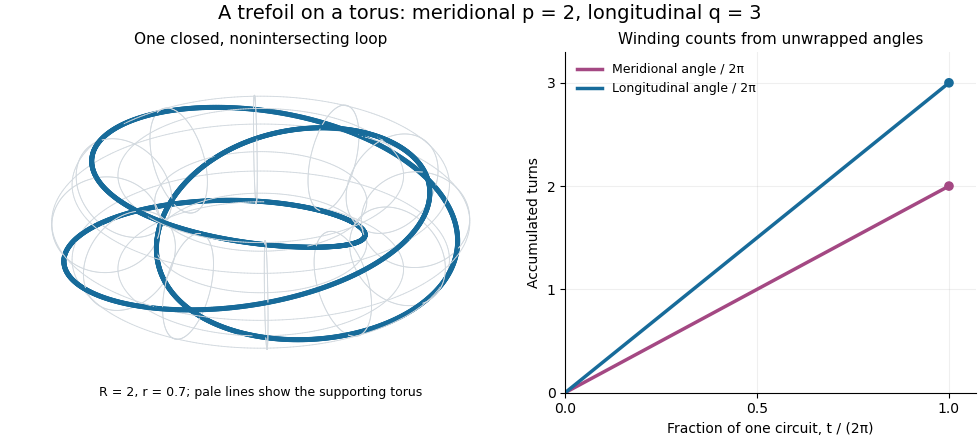

The coprime integers hypothesis matters. If the greatest common divisor is , the same parametric curve retraces a single component times; it does not automatically draw different components. The corresponding torus link is instead the full set of points on the torus whose angles satisfy , with meridional angle and longitudinal angle . It has disjoint components, each with winding counts . For instance, the torus link consists of two parallel loops and is a Hopf link, whereas substituting into simply traces one of those loops twice.
The connected sum removes a short unknotted arc from each of two oriented knots and joins the four endpoints by an orientation-compatible pair of arcs.
The unknot is the knot type represented by the planar circleEquivalently, an unknot is a knot that bounds a smoothly embedded disk in the three-sphere. The disk must itself be embedded; merely filling a loop with a map that is allowed to intersect itself does not establish that the knot is an unknot. Flattening a neighborhood of an embedded spanning disk explains why this criterion recovers the planar circle.
A complicated drawing can still represent an unknot. Starting with a crossing-free knot diagram of , insert a small kink by a type I Reidemeister move. The resulting knot diagram has one crossing, but removing the kink exhibits the same unknot. Repeating in separate small regions gives knot diagrams of the unknot with arbitrarily many crossings, although the crossing number of a knot is . A drawing's apparent complexity is therefore not a certificate of knotting.
The normalized Alexander polynomial of a knot and Jones polynomial of the unknot are both , and its knot group is the infinite cyclic group , because the knot exterior is a solid torus. These are useful comparison values. In particular, a nonconstant Alexander polynomial of a knot certifies that a knot is not an unknot, but the converse fails: nontrivial untwisted Whitehead doubles also have Alexander polynomial of a knot .
Dissipation estimate for high-Reynolds-number bubble drag by Codex 0 Created 2026-09-24 Updated 2026-09-24
Codex 0 Created 2026-09-24 Updated 2026-09-24For a clean bubble of size and speed at large Reynolds number, the outer potential flow violates the stress-free condition by a strain of order . A boundary layer of thickness needs a velocity correction only of order , so its dissipation is smaller than the outer-flow dissipation by order . The leading drag power is therefore obtained from
Rotational kinetic energy is the kinetic energy of a rigid body's rotation. For pure rotation about an axis fixed in an inertial frame,Here is the perpendicular distance of a mass element from that axis, is the moment of inertia about that same axis, and is the common angular speed, measured in radians per second. The rigid body assumption fixes the relative positions of the mass elements; they share angular velocity but have different speeds . Summing their kinetic energies gives the formula. This is a nonrelativistic model; deformation or internal motion can contribute additional kinetic energy.[ref]
For a computed example, take a uniform disc and an ideal thin ring, each of mass and radius , rotating about its central perpendicular axis at angular speed . The moment of inertia of a uniform disc is , while the ring has moment of inertia . Their rotational kinetic energies are therefore and . The ring stores twice the energy at the same angular speed, because more mass lies farther from the axis. At the same nonzero rotational kinetic energy, its angular speed would instead be times the disc's. This makes radial placement useful for storing energy in a rotating wheel, although a real design must also withstand the stresses of rotation.
For fixed-axis rotation with constant moment of inertia, write the signed rotation rate as , with angle in radians. The axial component of net external torque obeys , so the work-energy theorem becomesAn opposing torque removes rotational kinetic energy; bearing friction must be included in the net torque. The signed matters when the direction reverses. Rotation about a fixed axis need not be about a principal axis: the scalar energy formula still holds, but transverse bearing torques can be needed to maintain that axis.
For general rigid body motion, use the inertia tensor about the centre of mass :This is the kinetic-energy decomposition about the centre of mass. In a principal body frame, the rotational term is , using the principal moments of inertia. Away from a principal axis, angular momentum and angular velocity need not be parallel. A freely rotating asymmetric rigid body can change the direction of angular velocity relative to the body even while rotational kinetic energy remains constant; Euler equations for a torque-free rigid body govern that motion. One constant axial moment of inertia is then insufficient.[ref]
The Kerr ergoregion is the region where the asymptotically timelike stationary Killing field becomes spacelike. Its outer boundary is .
The Kerr realization of an ergosphere lies outside the outer horizon where the stationary Killing vector is spacelike; its outer boundary is .
There are unlisted articles, also show them or only show them.