The sign function records whether a real number is positive or negative, with a convention chosen separately at zero.
This indefinite bilinear form supplies the metric of Minkowski spacetime. On the Minkowski inner product with mostly-positive convention is
For opposite side , .
An ideal vertex is a vertex at infinity of an ideal triangle or another ideal hyperbolic polygon. An ideal vertex lies on the boundary at infinity and has internal angle zero.
A noncentral finite-order orientation-preserving hyperbolic isometry fixes an interior point and is elliptic.
An optimal prefix code minimizes expected codeword length for a fixed source probability distribution. Here the source alphabet is finite, has symbols, and has for every symbol; each source symbol receives one codeword over the binary output alphabet . Its code tree puts the symbols at leaves. Reading the edges along the graph path from the root of a tree to a leaf produces its codeword, so the leaf depth in a code tree is exactly its codeword length. ThusFor unnormalized positive weights, minimize instead; the corresponding expected codeword length is . This connects the abstract optimization to storage or transmission: counts the bits charged when symbol occurs. Huffman coding attains this minimum; the Huffman sibling property and Huffman sibling contraction explain why. [ref]
For , a balanced code tree charges every symbol two bits, giving . The codeword lengths charge the most frequent symbol only one bit, giving . The choice concerns weighted cost, not just the greatest codeword length: increasing that maximum from two to three can improve the average.
The search over prefix codes looks infinite, but positivity reduces it to finitely many full binary trees with leaves. A vertex with one child can be suppressed to improve cost, and a full binary tree with leaves has internal vertices. There are consequently finitely many such shapes and symbol assignments, so the minimum exists. For four leaves, the only possible sorted codeword lengths in a full binary tree are and . Probability monotonicity of optimal prefix-code lengths assigns larger probabilities to shallower leaves, giving respective minimum costs and in this example. This is an independent small-instance check of the Huffman code.
These hypotheses matter. With zero weights, suppressing a subtree carrying only zero weight need not strictly improve cost, so an optimal prefix code need not have a full binary tree. A one-symbol source raises the convention of whether an empty codeword is allowed. Both cases are outside the original statement here. Encoding groups of symbols changes the source alphabet and the optimization problem; the minimum here concerns one source symbol per codeword.
For a finite source alphabet of symbols with positive weights , choose any two least weights, breaking ties arbitrarily. There exists an optimal prefix code over the binary output alphabet whose chosen symbols occupy sibling leaves in a code tree at maximum leaf depth in a code tree. Weights may be counts or probabilities: dividing every weight by gives the same minimizers. The existence statement is what makes the first merge of Huffman coding safe. It does not say that every optimal prefix code already has the chosen pair together.[ref]
A Method for the Construction of Minimum-Redundancy Codes by David A. Huffman. p. 1099: Derived Coding Requirements and Optimum Binary Code
An exchange makes the idea tangible. Take probabilities . The prefix code , , , has expected codeword length bits. Exchange only the symbols at their existing leaves: the available codewords and code tree shape stay fixed, but the codeword lengths in symbol order become . The new expected codeword length is bits, and the two least probabilities, those of , now occupy deepest sibling leaves in a code tree. The saving is bit per source symbol.
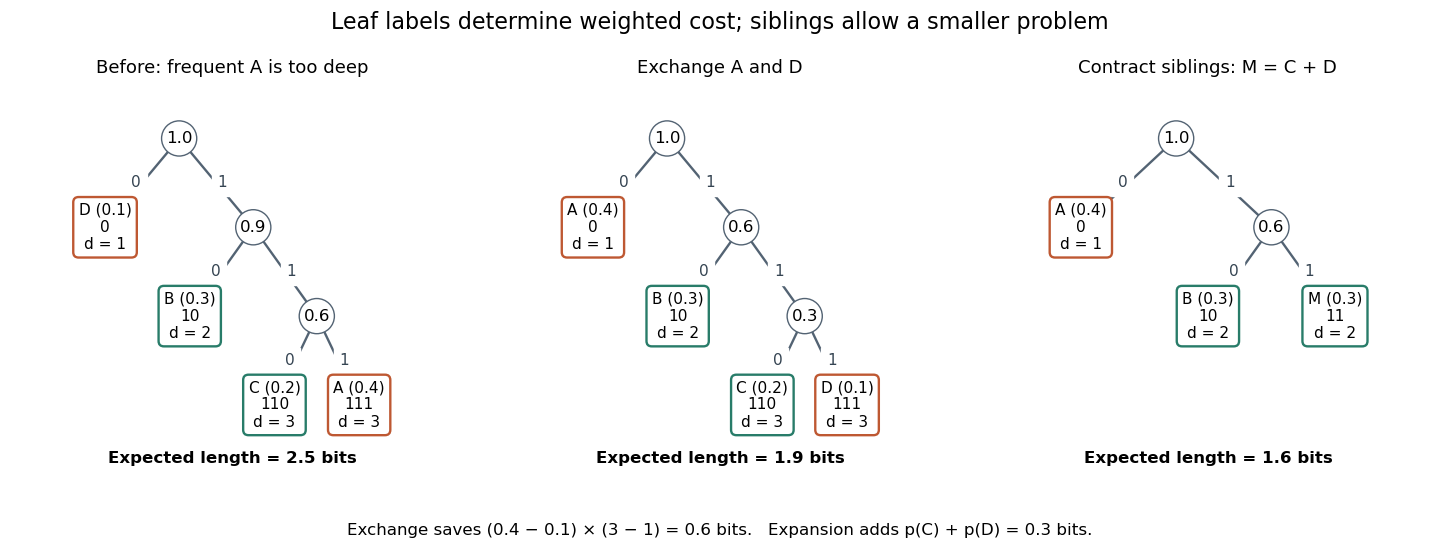
Exchanging two leaf labels reduces expected length from 2.5 to 1.9 bits; contracting the least-probability siblings leaves cost 1.6
. Details. 
Here is the short proof outline. An optimal prefix code with positive weights has a full binary tree as its code tree: suppressing a vertex with only one child shortens every codeword in that subtree and strictly reduces cost. A deepest leaf therefore has a leaf as its sibling, giving the deepest sibling property of an optimal prefix code. Put the two chosen least weights at these positions by successive exchanges of leaf labels. Moving a weight from leaf depth in a code tree to a deepest position , occupied by , changes the weighted sum byFix one chosen weight there, then move the other into the neighbouring deepest position; if it is already there, no exchange is needed. The prefix code condition survives because the set of codewords is unchanged. Starting from an optimal prefix code, the cost cannot decrease below the minimum, so these exchanges preserve optimality. Strictly unequal weights at unequal depths would give a strict decrease, explaining probability monotonicity of optimal prefix-code lengths. Equal weights or equal depths allow cost-neutral exchanges. [ref]
The velocity-distance relation is Hubble's law; a peculiar velocity is a departure from this homogeneous flow.
If a directed covering graph of an interval map has two distinct closed walks of the same length , based at the same interval and with different first edges, successive use of the interval covering relation produces two subintervals with disjoint interiors that maps across the base interval. Hence has a horseshoe for an interval map.
In a subcritical Hopf bifurcation, the small periodic orbit repels within the critical centre manifold and lies on the side where the equilibrium point attracts within that manifold. With the critical eigenvalue real part increasing through zero, the positive cubic sign gives the exact radial Hopf normal formFor , the nonzero radius is . Radii below shrink to zero, whereas radii above it grow. The radial derivative at the cycle is , proving that the periodic orbit repels. For example, gives an unstable circle of radius : a radius of decays while one of grows. The unstable circle shrinks into zero as ; at , already drives every small positive radius outward.
For there is no nonzero constant radius in this cubic model, and zero repels. In a general dynamical system, this says only that the nearby orbits leave the local neighbourhood. It does not guarantee a distant attracting limit cycle, a jump to a particular amplitude, or hysteresis. Additional nonlinear or global information is needed; the quintic radial Hopf equation illustrates one possible stabilizing extension. Reversing the parameter orientation reverses which numerical side contains the branch, so the defining distinction between supercritical Hopf bifurcation and subcritical Hopf bifurcation is their reduced stability and their relation to the equilibrium point, rather than the bare sign of an arbitrarily named parameter.
Winding-number proof of the no-retraction theorem by  Codex 0 Created 2026-09-24 Updated 2026-09-24
Codex 0 Created 2026-09-24 Updated 2026-09-24If a continuous retraction from a closed disc to its boundary existed, applying it to a contraction of the boundary circle inside the disc would give a homotopy in from a loop of winding number one to a constant loop of winding number zero. Homotopy invariance of winding number rules this out.
Winding-number proof of the fundamental theorem of algebra by Codex 0 Created 2026-09-24 Updated 2026-09-24
Codex 0 Created 2026-09-24 Updated 2026-09-24For a polynomial of positive degree, on a sufficiently large circle its leading term dominates the remaining terms. The dominated-perturbation lemma therefore gives winding number to the loop . If had no zero, radial contraction of the input circle would map under to a homotopy with a constant loop in , which has winding number zero. This contradiction proves the Fundamental theorem of algebra.
If closed continuous paths satisfy for every , then never vanishes. It is therefore a homotopy through closed paths in , and
The Steenrod squares are natural operationsFor a degree-one class , , and agrees with the mod-two Bockstein.
For a fibration with suitable connectivity, the cohomological Serre spectral sequence haswith differential .
There are unlisted articles, also show them or only show them.