The loop space is the space of based loops in . It is the homotopy fiber of the inclusion of the base point into .
A homotopy pullback is the derived form of a pullback. A strict pullback square of fibrant objects computes a homotopy pullback whenever one of the two maps into the lower-right object is a fibration.
A homotopy fiber sequence identifies , up to homotopy, with the homotopy fiber of . It induces a long exact sequence of homotopy groups.
The th homotopy group consists of based homotopy classes of maps . It is a group for and an abelian group for .
The local homology at is . It is preserved by homeomorphisms and, in a simplicial complex, is computed from the reduced homology of the local link.
Simplicial homology computes homology from the boundary maps between free abelian groups generated by oriented simplices.
For an abelian coefficient group , there is a split short exact sequenceFor , the Tor term vanishes.
This is the homology case of the universal coefficient theorem; its cohomology case uses Hom and Ext rather than tensor product and Tor.
A chain complex is a sequence of abelian groups or modules and homomorphisms satisfying . Its homology is .
Excision identifies relative homology after removing a subspace whose closure lies in the interior of the subspace being quotiented. It makes local homology computable in an arbitrarily small neighborhood.
A closed map sends closed subsets of its domain to closed subsets of its codomain. A bijection is a homeomorphism exactly when it is continuous and closed.
Analytic function with image in an affine real line by  Codex 0 Created 2026-09-24 Updated 2026-09-24
Codex 0 Created 2026-09-24 Updated 2026-09-24If is a holomorphic function on a connected domain andthen the Cauchy-Riemann equations force both components of to vanish. Hence is constant.
An entire function is a holomorphic function whose domain of a function is the whole complex plane. Its derivative exists at every . Every polynomial, the complex exponential function , the product , and the complex sine function are entire functions. The Taylor series of an entire function about any finite centre converges throughout the complex plane.
The complex exponential function is a particularly revealing entire function. Writing , Euler's formula givesThus the complex exponential function never takes the value zero. Conversely, for any , choose an argument of . All its preimages under the complex exponential function areHere is the real natural logarithm, and ranges over the integers. Substitution gives ; equality of moduli and arguments shows these are all the solutions. The complex exponential function therefore has image exactly , with infinitely many preimages for each nonzero value.
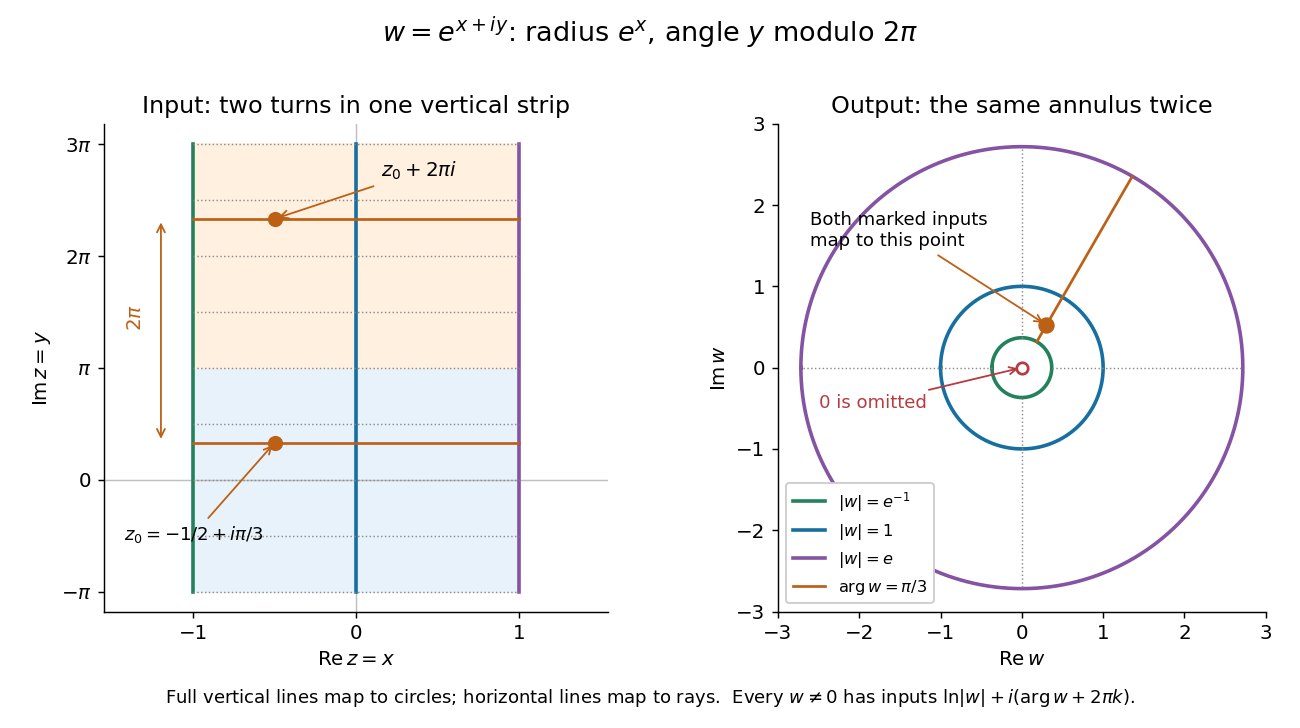
Under the complex exponential, vertical lines become circles, horizontal lines become rays, and inputs separated by 2 pi i have the same image
. Details. 
In the pictured vertical strip , the real part sets the modulus between and , while the imaginary part sets the argument modulo . The two drawn bands each make one full turn around the same annulus; their corresponding points differ by and have identical images. Allowing all real gives every positive modulus, so the whole complex plane covers every nonzero output.
An entire function has exceptionally strong global constraints. The Liouville theorem says that a bounded function which is also an entire function must be a constant function. Accordingly, the nonconstant entire functions above are unbounded somewhere in the complex plane, even when their restrictions to the real axis are bounded: the complex sine function satisfies , growing through the hyperbolic sine. The Little Picard theorem adds a different constraint: an unbounded nonconstant entire function still cannot leave two distinct complex values out of its image. These results make entire functions useful when global bounds or restrictions on the image can establish rigidity without solving for the function explicitly.
In the opening of his 1880 memoir, Émile Picard credits Karl Weierstrass with the terminology of entire functions and describes them by everywhere-convergent power series. [ref]
https://numdam.org/articles/10.24033/asens.187/. Picard, Mémoire sur les fonctions entières (1880), p. 145
An analytic continuation extends a holomorphic function beyond its original domain without changing its existing values. Formally, if are domains and is holomorphic on , a holomorphic function on with is an analytic continuation. More locally, holomorphic functions on overlapping open sets continue one another when they agree on the overlap, allowing a chain of patches along a path. The identity theorem for holomorphic functions forces agreement throughout a connected overlap once they agree on a nonempty open set in it. It also makes an extension to a fixed connected domain unique. [ref]
https://ocw.mit.edu/courses/18-04-complex-variables-with-applications-spring-2018/af8c9c78c3915aaf3fd1695f8d32a3b3_MIT18_04S18_topic13.pdf. Orloff, MIT 18.04 Topic 13, section 13.2 and Theorem 13.2
The geometric series illustrates why a formula can reach farther than the power series that first represents it. For , its partial sum isWhen , , so the series converges to . The rational function is holomorphic on and agrees there with the sum on the unit disc. It therefore continues to every point except its simple pole at . In particular,Thus analytic continuation gives a value at without making the original geometric series converge there. Its radius of convergence remains : on the terms do not even tend to zero.
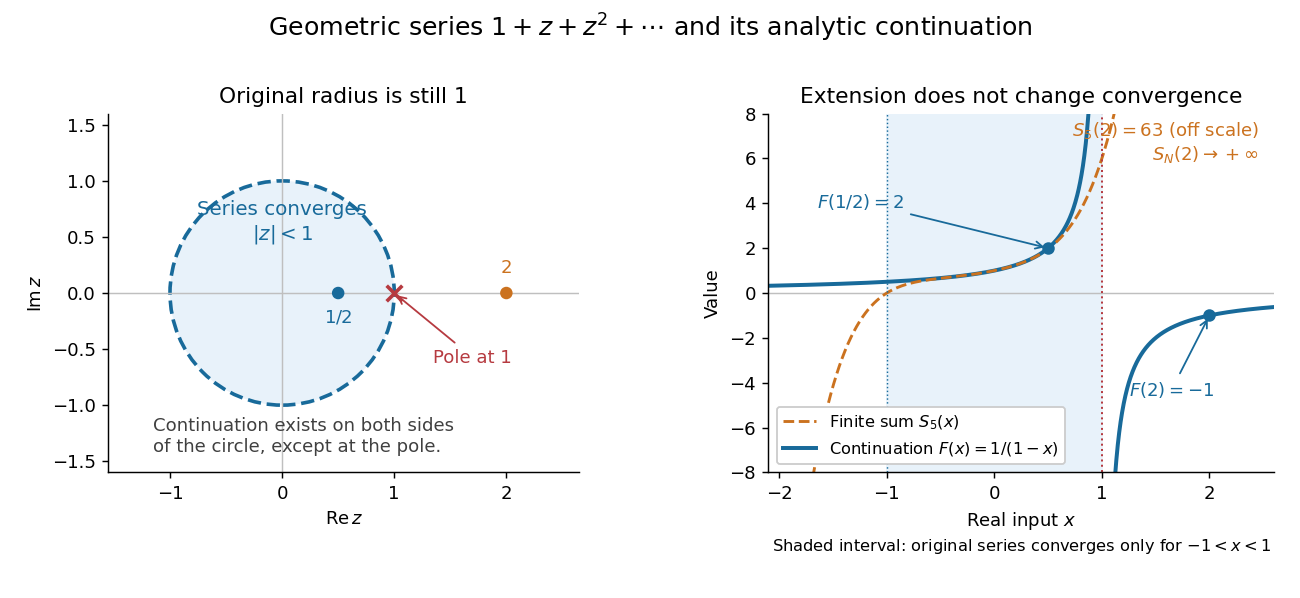
The original geometric series converges only inside the unit circle, while its rational continuation exists everywhere except the pole at 1
. Details. 
The pole at limits the original Taylor series, although most points of its convergence circle are regular for . Recentring at gives another genuinely convergent power series,At this yields , even though the original powers of grow. This is the useful idea: overlapping local descriptions can represent one holomorphic function on a larger region.
Uniqueness on a connected overlap does not imply that every path leads to the same terminal germ of a holomorphic function. Continuing a complex logarithm around changes its value by , giving monodromy; the return patch can carry a different branch of a multivalued function. If two patches have a disconnected overlap, agreement on one component imposes no agreement on the others. [ref]
https://ocw.mit.edu/courses/18-04-complex-variables-with-applications-spring-2018/af8c9c78c3915aaf3fd1695f8d32a3b3_MIT18_04S18_topic13.pdf. Orloff, section 13.2.1, Example 13.4
Continuation using the rational function is single-valued: any path avoiding gives the same terminal germ of a holomorphic function, even if it winds around the pole. There are unlisted articles, also show them or only show them.